
Most businesses say they're customer-first. Very few actually build their growth strategy around customers.
Customer-centric growth isn't about adding a support chat or sending feedback forms. It's about designing products, marketing, operations, and decisions around real customer needs and letting growth follow naturally.
This guide explains what a customer-centric growth strategy really means, why it works, and how businesses use it to grow sustainably, especially in experience-driven sectors like eCommerce and logistics supported by platforms such as iCarry.in.
What Is a Customer-Centric Growth Strategy?
A customer-centric growth strategy puts customer value before short-term revenue.
Instead of asking:
"How do we sell more?"
Customer-centric businesses ask:
"How do we solve customer problems better?"
Companies known for long-term success often credit growth to customer obsession, not aggressive sales tactics. In commerce and logistics, this obsession shows up in faster deliveries, clearer communication, and smoother post-purchase experiences enabled by delivery management features.
Why Customer-Centric Businesses Grow Faster (and Stronger)
Customer-centric companies benefit from:
- Higher retention
- Better word-of-mouth
- Lower acquisition costs
- Stronger brand trust
Business research consistently shows that retaining existing customers costs far less than acquiring new ones, making customer focus a growth multiplier.
For eCommerce brands, retention is deeply tied to fulfillment reliability and delivery success. Brands that invest in seamless delivery experiences consistently outperform those focused only on ads.
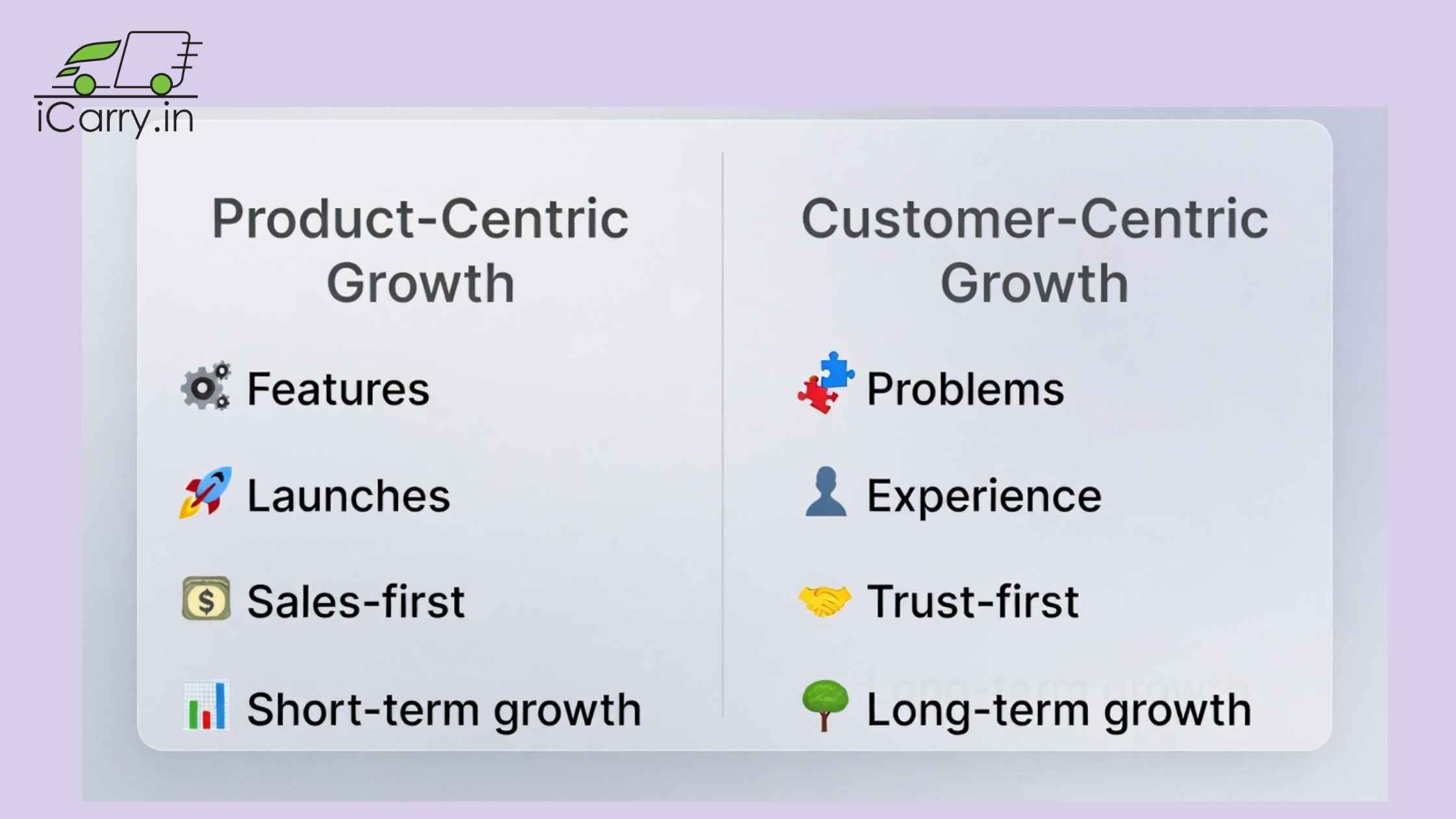
Customer-Centric vs Product-Centric Growth
Product-centric growth focuses on features, launches, and internal roadmaps.
Customer-centric growth focuses on outcomes, feedback, and experience.
Product-centric thinking says:
"We built this feature, now let's market it."
Customer-centric thinking says:
"Customers are struggling here, let's fix that."
The difference shows up clearly in long-term loyalty, especially when brands fix friction points like slow shipping, unclear tracking, and high return rates using eCommerce shipping optimization.

Core Pillars of a Customer-Centric Growth Strategy
1. Deep Customer Understanding
Customer-centric companies actively listen through:
- Support conversations
- Reviews and complaints
- Usage patterns
- Feedback surveys
Customer insights gathered from real interactions are far more valuable than assumptions made in boardrooms.
In logistics-driven businesses, feedback around delivery delays, COD issues, and failed attempts often reveals hidden growth leaks such as inefficient shipping costs.
2. Designing for Customer Experience (Not Just Conversion)
Growth isn't just about first purchase. It's about the entire journey:
- Discovery
- Buying
- Delivery
- Support
- Repeat usage
Brands that invest in smooth post-purchase experiences often outperform those focused only on acquisition.
This includes proactive delivery updates, accurate tracking, and reduced returns powered by centralized courier management.
3. Personalization Over Mass Marketing
Customers respond better when they feel understood.
Personalized communication based on behavior, preferences, and history increases engagement without increasing noise.
In commerce, relevance also means showing accurate delivery timelines, COD eligibility, and location-specific serviceability, reducing future disputes and improving RTO reduction outcomes.
4. Feedback-Led Product and Process Improvements
Customer-centric growth treats feedback as strategy, not criticism.
Businesses that close feedback loops:
- Improve faster
- Reduce churn
- Build trust
When customers see their feedback reflected in improvements like better packaging, faster shipping, or simpler returns, loyalty deepens. Many of these improvements directly reduce losses from weight discrepancies and delivery failures.
How Customer-Centricity Drives Sustainable Growth
Higher Retention = Predictable Revenue
Retained customers buy more often and cost less to serve.
Subscription models, loyalty programs, and repeat purchases thrive on customer-centric thinking.
In logistics-heavy businesses, predictable revenue improves when delivery success rates increase and COD failures fall, supported by delivery performance tools.
Organic Growth Through Advocacy
Satisfied customers become marketers.
Reviews, referrals, and social mentions reduce dependency on paid ads and improve credibility.
Brands that eliminate shipping friction and returns build stronger advocacy through shipping cost optimization.
Stronger Brand Differentiation
In crowded markets, features can be copied. Experiences can't.
Customer experience becomes the moat.
For eCommerce brands, experience includes transparent shipping, real-time tracking, and consistent delivery reliability backed by shipping API integrations.
Common Mistakes Businesses Make
- Saying "customer-first" but prioritizing short-term metrics
- Collecting feedback but never acting on it
- Over-automating support and losing the human touch
- Treating customers as transactions, not relationships
Customer-centricity fails when it's only a slogan.
How to Build a Customer-Centric Culture
Customer-centric growth isn't just a strategy. It's a mindset.
Strong customer-centric companies:
- Empower support teams
- Share customer insights across departments
- Align KPIs with customer outcomes
- Reward long-term value, not quick wins
Culture determines consistency.
Customer-Centric Growth in Action
You'll often see customer-centric brands:
- Simplifying processes instead of adding complexity
- Proactively solving issues before customers complain
- Educating customers instead of hard-selling
These actions compound into trust and growth over time, especially when supported by strong logistics infrastructure like iCarry.in.
Final Thoughts
Customer-centric growth isn't the fastest path to revenue. It's the most reliable path to sustainable success.
When customers feel heard, respected, and valued, growth stops being a struggle and starts becoming a byproduct.
In the long run, the best growth strategy is simply caring deeply about customers and proving it through action, supported by reliable delivery, transparent logistics, and operational clarity using platforms like iCarry.in.
Customer-centric growth puts customer value before short-term revenue—when customers feel heard, respected, and valued, sustainable growth becomes a natural byproduct, not a struggle.