Laundry is a daily need, not a trend. That's why laundry delivery businesses work when executed well.
From busy professionals to students and families, customers pay for convenience, reliability, and consistency. But running a profitable laundry delivery service isn't just about washing clothes, it's about operations, logistics, and trust.
This guide covers how to start, run, and scale a laundry delivery business step by step, with a strong focus on delivery management, workflow control, and service quality.
Why Laundry Delivery Is a Strong Business
Laundry delivery works because demand is recurring, customers value time over price, subscriptions are natural, and local density improves margins.
When pickup routes, delivery scheduling, and daily operations are optimized, margins improve month over month. This is why modern laundry brands invest early in structured logistics systems, order tracking, and centralized delivery management similar to courier aggregators used in ecommerce.
Business Models in Laundry Delivery
Aggregator Model
You partner with local laundries and handle customer acquisition, pickup and delivery, payments, and customer support.
Pros: Low setup cost
Cons: Less control over quality
This model depends heavily on delivery reliability and partner coordination.
Own Facility Model
You operate your own laundry unit.
Pros: Full quality control and higher margins
Cons: Higher upfront investment
Here, success depends on standardized workflows, strong pickup and delivery operations, and consistent turnaround times.
Hybrid Model
A combination of owned facilities and partner laundries.
Pros: Scalable with quality control
Cons: Operational complexity
Hybrid models benefit the most from centralized order management and delivery aggregation systems.
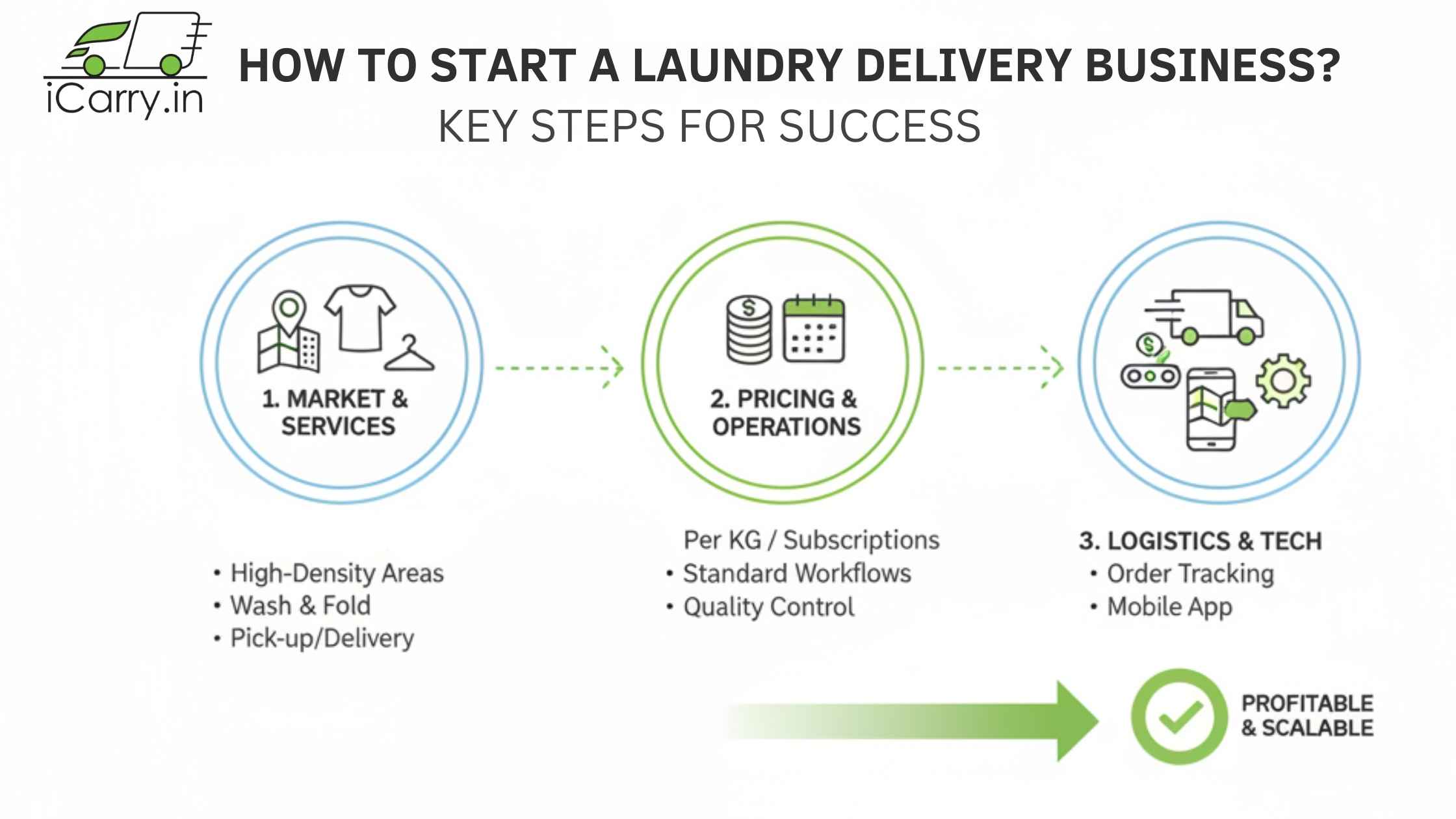
Step 1: Market and Location Analysis
Before starting, evaluate residential density, student hostels and PG clusters, office hubs, competitor coverage, pricing models, and delivery accessibility.
Laundry businesses work best in high-density urban zones where route optimization reduces delivery cost per order and improves rider productivity.
Step 2: Services You Should Offer
Start simple with wash and fold, wash and iron, and steam ironing.
Later, add dry cleaning, express delivery, and shoe, carpet, or blanket cleaning.
More services increase average order value, but they also increase operational and logistics complexity, so expansion should be gradual and controlled.
Step 3: Pricing Strategy
Common pricing methods include per kg pricing, per item pricing for dry cleaning, and subscription plans.
Subscriptions increase predictability, improve delivery planning, and strengthen retention. Pricing must include processing costs, packaging, manpower, and delivery expenses to protect margins.
Step 4: Operations and Workflow
A smooth laundry workflow looks like this: order placement, pickup scheduling, sorting and garment tagging, washing and drying, ironing and packaging, quality check, out-for-delivery, and final delivery confirmation.
Every step must be standardized to avoid losses, mix-ups, and customer dissatisfaction. Clear operating procedures are the foundation of scale.
Step 5: Logistics and Delivery Optimization
Delivery efficiency decides profitability.
Best practices include fixed pickup and delivery slots, route batching, area-wise scheduling, clear service timelines, and real-time order tracking - all proven components of last mile delivery optimization strategies.
As order volumes grow, managing pickups and deliveries manually becomes inefficient and error-prone. Many successful laundry brands adopt delivery aggregation platforms to centralize their logistics operations.
Platforms like iCarry.in allow businesses to manage multiple delivery partners, zones, and daily order volumes from a single dashboard. With transparent rate visibility, accurate billing reconciliation, and real-time delivery tracking, laundry businesses gain better control over delivery costs and service quality.
By optimizing routes, reducing missed pickups, and eliminating billing discrepancies, delivery aggregation helps laundry brands scale without increasing operational complexity or leakage. This approach is especially valuable for subscription-based laundry services where consistency and reliability directly impact customer retention.
Step 6: Technology Stack
At minimum, you need an ordering system through an app, website, or WhatsApp, order and delivery tracking, a customer database or CRM, a digital payment gateway, and a pickup and delivery management system.
Automation reduces human errors, improves delivery reliability, and makes it possible to scale without increasing operational chaos - a trend supported by broader technology trends in delivery and logistics observed across industries.
Step 7: Quality Control and Trust
Laundry is personal. Customers are trusting you with their belongings.
Build trust with garment tagging and digital order records, damage and stain documentation, a clear compensation policy, consistent wash quality, and delivery confirmation systems.
Trust creates repeat customers, referrals, and long-term brand value.
Step 8: Customer Experience and Retention
Retention matters more than acquisition.
Focus on on-time pickup and delivery, clean and sealed packaging, transparent pricing, easy communication, and responsive support.
Loyal customers order weekly. This is where real profitability is built.
Revenue and Cost Breakdown
Revenue usually comes from per-order charges, monthly subscriptions, and add-on services like express delivery and premium cleaning.
Major costs include labor, detergents, water and electricity, rent and equipment, delivery and fuel, and technology tools.
Scale improves margins through efficiency, route density, and automation.
Common Mistakes to Avoid
Underpricing to gain customers, expanding too fast, ignoring quality complaints, poor route planning, and operating without standard processes.
Laundry success is built on discipline, not discounts.
How to Scale a Laundry Delivery Business
Increase route density before adding new zones. Push subscriptions and weekly plans. Add corporate, hostel, and co-living clients. Expand area by area instead of going city-wide instantly. Invest in automation and delivery management systems.
Scale operations, not chaos.
Final Thoughts
A laundry delivery business is not glamorous, but it is reliable and scalable.
The winners focus on operational excellence, delivery and logistics control, trust and consistency, local density, and repeat customers.
If you master logistics, workflow discipline, and quality control, growth follows naturally.
Frequently Asked Questions (FAQs)
1. Is a laundry delivery business profitable?
Yes, a laundry delivery business can be profitable when operations and delivery logistics are optimized. Profitability improves with route density, subscription plans, repeat customers, and efficient pickup and delivery management.
2. What is the biggest challenge in running a laundry delivery business?
The biggest challenge is managing timely pickups and deliveries while controlling costs. Poor route planning, missed deliveries, and manual coordination often lead to customer complaints and margin leakage.
3. How important is delivery logistics in a laundry business?
Delivery logistics is critical. Laundry is a recurring service, and customers expect consistent pickup and drop timelines. Efficient last-mile delivery directly impacts customer retention and business scalability.
4. Should laundry businesses use third-party delivery partners?
Yes, many laundry businesses use third-party delivery partners to reduce fixed costs. Using a centralized delivery management or aggregation platform helps coordinate multiple riders and partners more efficiently.
5. How can laundry businesses reduce delivery costs?
Delivery costs can be reduced through route batching, fixed delivery slots, subscription-based orders, area-wise scheduling, and using delivery aggregation platforms that provide transparent pricing and performance visibility.
6. What technology is needed for a laundry delivery startup?
At minimum, a laundry delivery startup needs an order management system, customer database, digital payments, pickup and delivery tracking, and a delivery management solution to handle daily logistics efficiently.
7. Can laundry delivery businesses scale across multiple locations?
Yes, but scaling requires standardized workflows, centralized order and delivery management, and strong quality control. Businesses that scale logistics before expanding geographically grow more sustainably.
8. How do subscriptions help laundry delivery businesses?
Subscriptions create predictable demand, improve delivery planning, reduce customer acquisition costs, and increase lifetime value. They also allow better route optimization and delivery cost control.
9. What mistakes should new laundry delivery businesses avoid?
Common mistakes include underpricing services, ignoring delivery costs, expanding too quickly, inconsistent quality control, and operating without structured logistics and tracking systems.
10. Is delivery aggregation useful for local service businesses like laundry?
Yes. Delivery aggregation helps local service businesses manage multiple delivery partners, reduce operational complexity, improve delivery reliability, and maintain accurate billing and reconciliation as order volumes grow.
Laundry delivery success is built on operational excellence, delivery control, and trust—master logistics, workflow discipline, and quality control, and growth follows naturally.