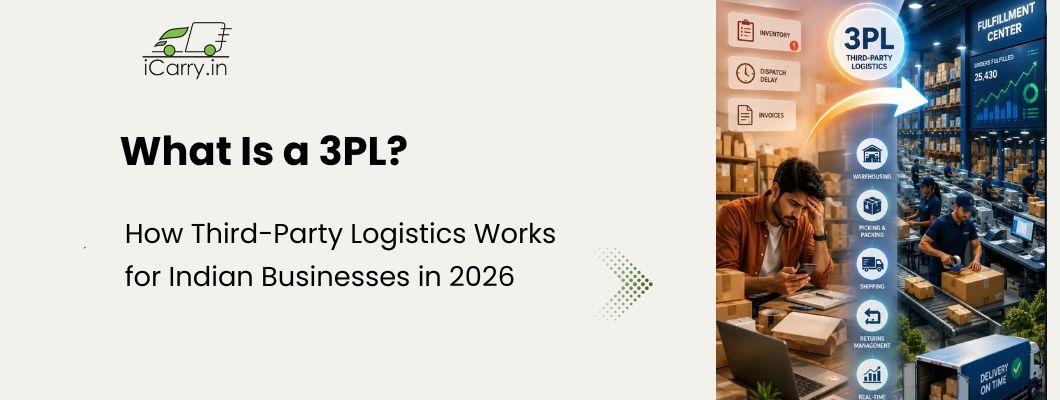
You started shipping from your home. Then a small warehouse. Now you are processing 300 orders a day, managing two warehouse staff, spending half your time on logistics instead of building your business, and wondering whether there is a better way.
For many Indian businesses reaching this inflection point, the answer is a 3PL - third-party logistics provider. A 3PL takes on some or all of your logistics operations: warehousing, picking, packing, shipping, and sometimes returns management. You focus on your product and customers. They handle the physical movement of goods.
India's 3PL market is worth USD 24.9 billion and is projected to reach USD 78.5 billion by 2034 (IMARC Group), one of the fastest-growing rates in Asia, driven by the expansion of commerce across geographies and business types that were previously underserved by modern logistics infrastructure. Understanding what a 3PL actually does - and whether it is the right choice for your business at your current stage - is increasingly important for Indian businesses across sectors.
This guide explains what a 3PL is, how it differs from other logistics models, what services are included, when it makes sense for Indian businesses, and how courier aggregators fit into the 3PL picture.
What Is a 3PL? The Definition
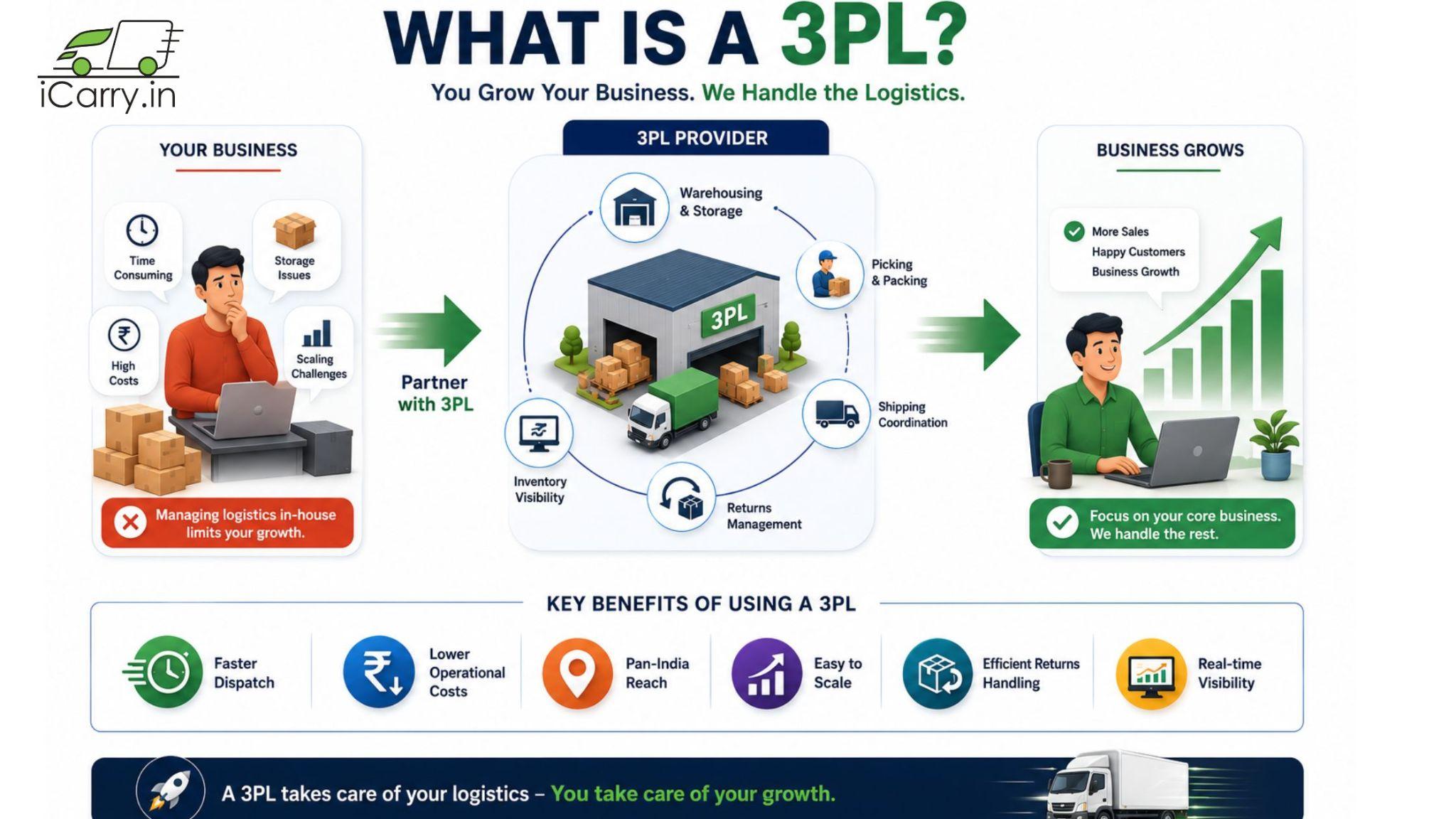
3PL (Third-Party Logistics) refers to a company that provides outsourced logistics services to businesses. A 3PL typically handles some combination of warehousing, inventory management, order picking, packing, shipping coordination, and returns processing - on behalf of the business that owns the goods.
The 3PL model exists on a spectrum. At the simplest end, a 3PL provides warehouse space and basic fulfilment. At the most complex end, a 3PL manages the entire supply chain from inbound goods receipt to customer delivery and returns - with technology integration, real-time inventory visibility, and multi-channel fulfilment capability.
The key characteristic: the goods belong to the business, not the 3PL. The 3PL provides labour, space, technology, and shipping relationships. The business retains ownership of inventory and control of the customer relationship.
How to Tell If You're Ready to Evaluate a 3PL?
- Is logistics management consuming more than 30% of your operational time?
- Are you processing more than 200 orders per day consistently?
- Is your storage capacity at its limit with current demand?
- Do you want to expand to regional fulfillment without setting up your own satellite warehouses?
- Are you losing customers because of inconsistent dispatch SLA or delivery quality?
- Is your return processing and restocking taking more than 48 hours?
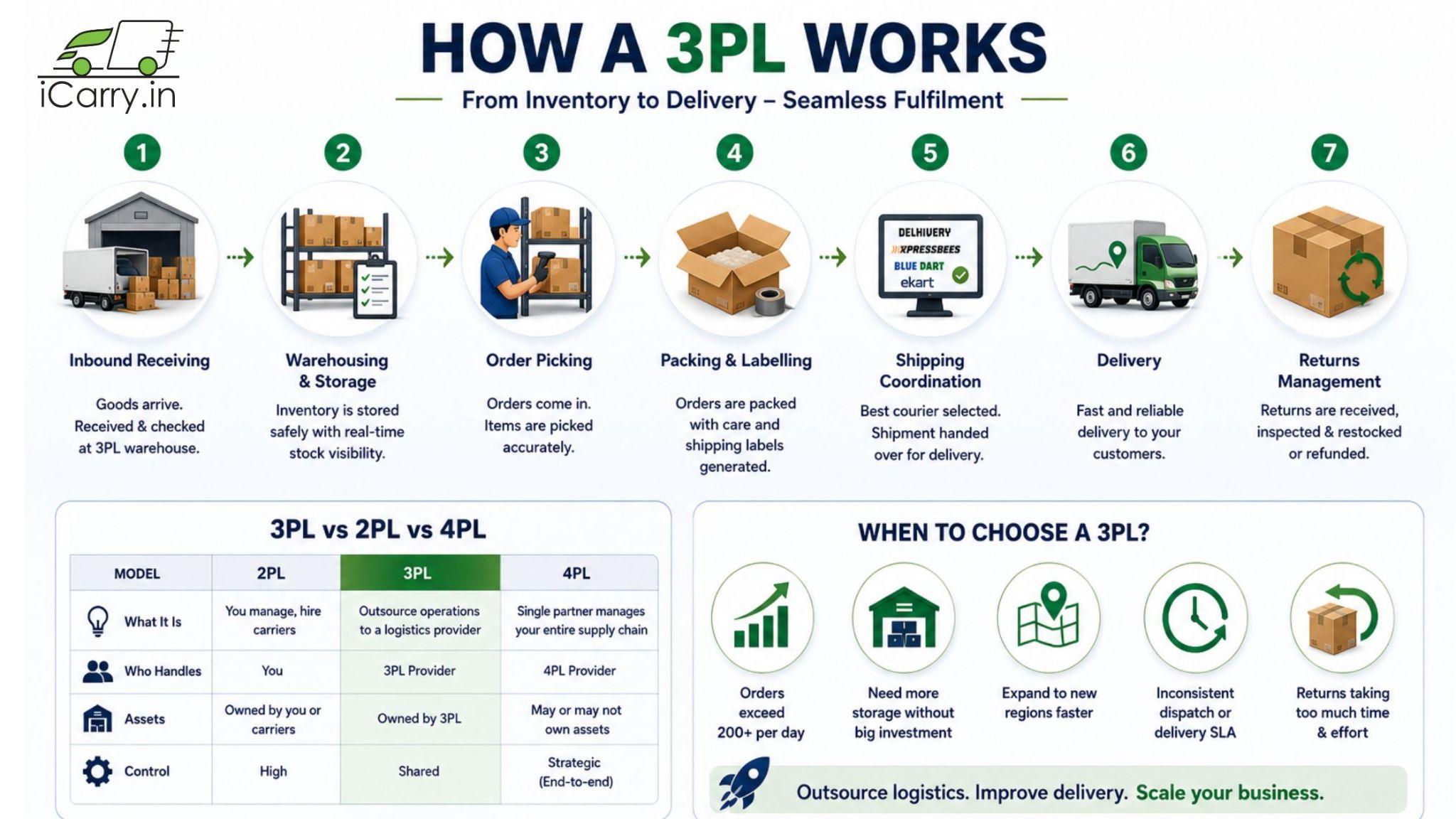
1PL, 2PL, 3PL, 4PL - What Is the Difference?

Most growing Indian businesses operate somewhere between 1PL (managing everything themselves) and 3PL (outsourcing fulfillment). The move from 1PL to 3PL is the most common logistics transition for businesses scaling from self-managed operations to structured fulfillment.
What Services Does a 3PL Provide?
Inbound and Inventory Receiving
When goods arrive at the 3PL's facility from a manufacturer or supplier, the 3PL receives, counts, inspects, and catalogues the inventory. Each unit is logged into the 3PL's warehouse management system (WMS) against your SKU list. From this point, you have real-time visibility of your stock at the 3PL's facility.
Warehousing and Storage
The 3PL allocates physical space for your inventory. Storage is typically charged per pallet, per square foot, or per cubic metre per month. The 3PL is responsible for maintaining the storage environment, inventory security, and stock accuracy.
Order Picking
When an order arrives from your platform (Shopify, WooCommerce, marketplace, or ERP), the 3PL receives it through API integration or file transfer. A picker retrieves the ordered items from storage, following the 3PL's pick path and verification process.
Packing and Labelling
The 3PL packs the order according to your specifications - branded packaging, inserts, gift wrapping, or standard box - and generates the shipping label. Some 3PLs offer value-added packing services like kitting (assembling product sets), customisation, and branded packaging for an additional fee.
Shipping and Carrier Coordination
The 3PL books the shipment with a courier and hands it over to the carrier at their facility. For businesses using a courier aggregator, the 3PL can connect through the aggregator's API to book across multiple couriers and compare rates per order.
Returns Processing
When a returned consignment arrives at the 3PL, they receive, inspect, grade, and either restock, quarantine, or dispose of the item according to your returns policy. Returns processing SLA - how quickly items are returned to available inventory - is a key differentiator between 3PL providers.
3PL vs Self-Fulfilment - When to Make the Switch
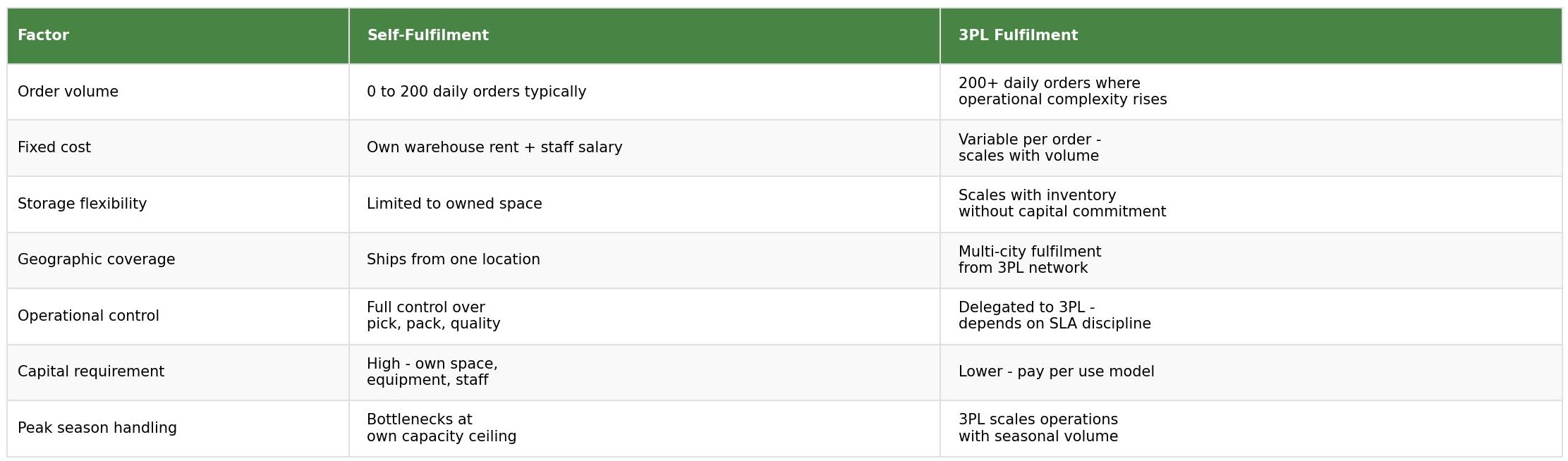
The decision is not purely about order volume. Businesses with high SKU complexity, significant return volumes, or ambitious geographic expansion often benefit from 3PL earlier than pure volume suggests. Equally, businesses with simple operations, consistent packaging, and manageable volumes may find self-fulfilment more cost-effective longer than typical benchmarks suggest.
Types of 3PL Providers in India
Fulfilment-Only 3PLs
Provide warehousing, pick-pack, and handover to courier. The business manages courier selection and booking separately. Best for businesses that want warehousing and labour outsourced but want to retain shipping control through their own courier aggregator account.
Full-Service 3PLs
Handle everything from inbound receiving through shipping coordination, tracking, and returns. Often have preferred courier relationships and book through their own accounts. The business gets end-to-end outsourcing but loses direct courier relationship and rate visibility.
Marketplace Fulfilment Programs
Platforms like Amazon (FBA) and Flipkart (FBF) operate their own fulfillment networks that function as 3PLs for their marketplace sellers. Inventory stored at the marketplace's fulfilment centres is picked, packed, and shipped by the marketplace. High cost per order but fast delivery badges and increased platform visibility.
Regional 3PLs
Smaller fulfillment operations focused on specific geographies - a Bengaluru's regional 3PL market 3PL for South India coverage, a Delhi NCR 3PL for North India. Better pincode depth in their geography, lower minimum volumes, but limited to their region. India's 3PL market has seen particularly strong momentum in these regional hubs, with investor interest concentrated around routes from NCR to Bengaluru as the market has expanded rapidly.
How Courier Aggregators Work Alongside 3PLs
A courier aggregator and a 3PL serve different functions - but they work best together. The 3PL handles the physical fulfillment: receiving, storage, pick, pack. The courier aggregator handles the shipping leg: multi-courier rate comparison, booking, label generation, tracking, COD management, and delivery follow-through.
This separation matters because:
3PLs that use their own courier contracts may not give visibility into the rates being applied
Businesses lose the ability to compare courier rates and choose the optimal courier per consignment
COD remittance consolidation across multiple couriers is harder through a 3PL's embedded logistics
Delivery management tools - Delivery Boost, two-way WhatsApp communication, address quality scoring - are only available when shipping through a platform that offers them
The recommended model for Indian businesses using a 3PL: retain direct control of the shipping leg through your own courier aggregator account. The 3PL generates the packed consignment and hands it to your designated courier agent. Shipping is booked through your aggregator. You retain rate visibility, courier choice, COD management, and delivery management tools.
Watch Overview of My Account > My Shipments to see how multi-pickup-address management works in iCarry® - enabling businesses to manage 3PL locations alongside self-managed warehouse locations from one account.
What to Evaluate When Choosing a 3PL in India
Location and Geographic Coverage
A 3PL's location determines the zone classification for your customer orders. A 3PL in Bengaluru serves South India at Zone A or B rates. North India customers become Zone D. Evaluate whether the 3PL has multiple facilities or network partners that can provide regional coverage, and what the freight implications are for your order geography.
Technology Integration
The 3PL must integrate with your order management system. Evaluate whether they support API connection with your Shopify, WooCommerce, marketplace, or ERP platform. Manual file transfers are acceptable at low volumes but create bottlenecks and errors above 200 daily orders.
Inventory Accuracy and Reporting
You are entrusting your stock to a third party. Evaluate their inventory accuracy rate (target: above 99.5%), cycle count frequency, shrinkage policy, and the reporting tools available for real-time stock visibility. A 3PL that cannot provide daily inventory snapshots per SKU is not suitable for a business with active demand planning.
Returns Processing SLA
Returns that sit at a 3PL facility for 5 to 10 days before being inspected and restocked directly reduce your available inventory and can cause stockouts on fast-moving SKUs. Evaluate their returns SLA: time from received to inspected, time from approved to restocked, and how damaged or non-resalable returns are handled.
Minimum Volume and Contract Terms
Most 3PLs in India have minimum monthly order thresholds. Below-minimum months often attract a fixed fee. Evaluate whether the minimum aligns with your current and projected volume. Avoid long-term contracts without volume-tested SLA performance data - pilot for 3 months before committing to a 12-month agreement.
Pricing Structure
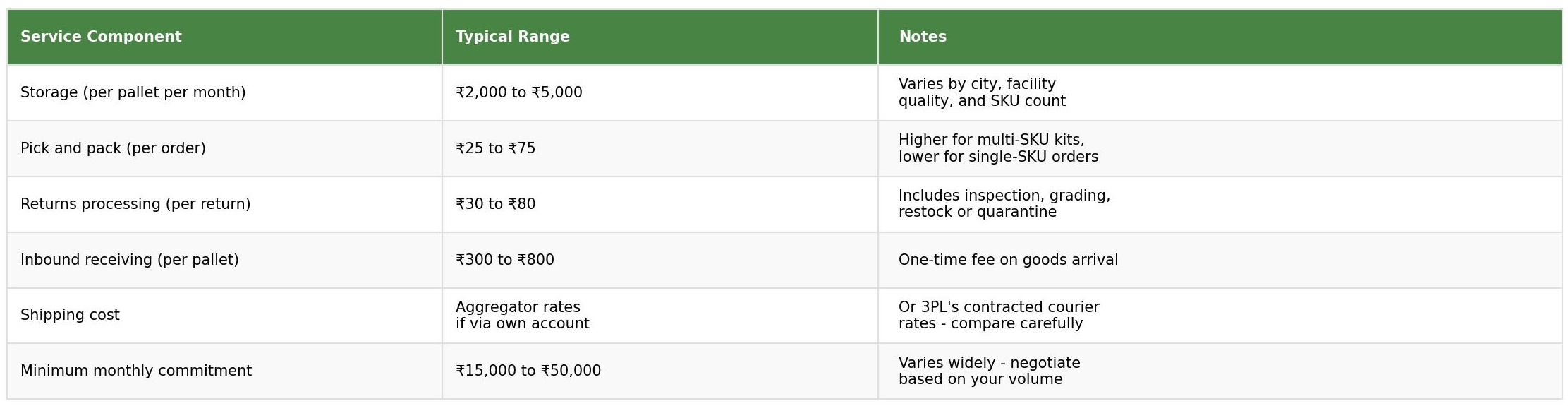
3PL pricing typically includes: monthly storage fee (per pallet or per cubic metre), per-order handling fee (pick, pack, label), shipping cost (if using their courier contracts), and returns handling fee. Model your total 3PL cost per delivered order against your current self-fulfilment cost before committing.
3PL Cost Benchmarks for Indian Businesses
Common Mistakes When Moving to a 3PL in India
Not piloting before committing: Run a 3-month pilot with a portion of your inventory before switching fully. This reveals inventory accuracy issues, SLA gaps, and integration problems before they affect all orders
Giving up courier control: Using the 3PL's embedded courier contracts removes your ability to compare rates, manage COD consolidation, and use delivery management tools. Retain direct courier aggregator access
Underestimating returns complexity: 3PLs often have stronger pick-pack SLAs than returns SLAs. Agree on returns processing timelines explicitly in the contract before signing
Not modelling total cost: Storage + handling + shipping + returns + minimum fees. The total 3PL cost per delivered order sometimes exceeds self-fulfilment cost at moderate volumes. Check carefully before assuming 3PL is cheaper
Wrong 3PL location for your order geography: A Bengaluru 3PL for a business with 60% North India customers creates Zone D freight on most orders. Match 3PL location to your demand geography
As India's 3PL sector increasingly looks toward vertical and quick commerce for its next phase of growth, according to Economic Times Supply Chain, these fundamentals of careful evaluation matter even more as more specialised 3PL models enter the market.
How iCarry® Supports Businesses Using 3PLs
iCarry® works with both self-managed and 3PL-managed businesses. For businesses using a 3PL for fulfilment, iCarry® handles the shipping leg:
Multiple pickup addresses: Register your 3PL facility's address as a pickup point. Bookings made from this location route pickup collection to the 3PL facility
API integration: iCarry®'s full REST API allows your OMS or 3PL system to trigger bookings, generate labels, and receive tracking updates programmatically
Rate comparison per consignment: Even when shipping from a 3PL location, every booking is compared across multiple couriers for the best available rate. Compare rates before booking at every 3PL dispatch point
Delivery Boost: Available regardless of whether the consignment was packed by you or your 3PL. Agents coordinate delivery in the consignee's regional language
Two-way WhatsApp communication: Consignees can reply to reschedule, update an address detail, or confirm delivery timing. iCarry®'s team coordinates on the sender's behalf with full conversation visibility
COD remittance: Daily automatic COD settlement across all couriers, whether shipping from your own facility or a 3PL location. Early COD remittance options from T+0 to T+4 are also available at a nominal cost for businesses that need faster access to working capital.
iCarry® serves all Indian businesses - at every scale and every logistics model. Register free at iCarry® - no monthly fee, no minimum volume.
Final Thoughts
A 3PL is not the right choice for every Indian business at every stage. At low volumes, the fixed cost and minimum commitments make self-fulfilment more cost-effective. At high volumes with complex operations, the right 3PL partnership frees up capital, management time, and warehouse constraints that would otherwise limit growth.
The transition decision should be made on data: current cost per order, current time investment in operations, current storage constraints, and the modelled cost of 3PL alternatives. The businesses that make this transition well pilot carefully, retain shipping control, agree on returns SLAs explicitly, and match the 3PL's geographic location to their actual order geography.
The shipping journey begins after your 3PL has fulfilled the order. Once your shipment is packed and ready for dispatch, iCarry® helps route it through the most suitable courier partner while providing the tools and visibility needed to manage deliveries more effectively. Register for free on iCarry® and start shipping today.
Frequently Asked Questions (FAQs)
What is a 3PL in logistics?
A 3PL (Third-Party Logistics provider) is a company that manages logistics services on behalf of a business - typically warehousing, order picking, packing, shipping coordination, and returns processing. The goods belong to the business; the 3PL provides the operational infrastructure, labour, and technology to fulfil orders.
What is the difference between 2PL and 3PL?
A 2PL (Second-Party Logistics) is an asset-based carrier - a truck company, airline, or courier - that moves goods but does not provide warehousing or fulfillment. A 3PL provides the full operational layer: storage, pick-pack, shipping coordination, and returns - using either their own assets or contracted carriers.
When should an Indian business use a 3PL?
When logistics management consumes more than 30% of operational time, when daily order volume consistently exceeds 200, when storage is at capacity, when geographic expansion requires multi-city fulfilment, or when return processing volume exceeds the team's capacity to manage alongside daily dispatch.
How much does a 3PL cost in India?
Typical 3PL costs in India include storage (₹2,000 to ₹5,000 per pallet per month), pick and pack (₹25 to ₹75 per order), returns handling (₹30 to ₹80 per return), and minimum monthly commitments (₹15,000 to ₹50,000). Total cost per delivered order must be modelled against self-fulfilment cost before committing.
Can I use my own courier aggregator with a 3PL?
Yes - and it is recommended. Retaining direct courier aggregator access ensures you can compare rates per consignment, maintain COD remittance consolidation, and use delivery management tools like Delivery Boost and two-way WhatsApp communication. Register your 3PL facility as a pickup address in your courier aggregator account.
Is a courier aggregator the same as a 3PL?
No. A courier aggregator provides multi-carrier shipping access, rate comparison, tracking, COD management, and delivery tools - but does not provide warehousing, picking, or packing. A 3PL provides the fulfillment operations. The two are complementary: a 3PL handles physical fulfilment; a courier aggregator handles the shipping leg from dispatch to delivery.
A 3PL is not the right choice for every Indian business at every stage. At low volumes, the fixed cost and minimum commitments make self-fulfilment more cost-effective. At high volumes with complex operations, the right 3PL partnership frees up capital, management time, and warehouse constraints that would otherwise limit growth. The businesses that make this transition well pilot carefully, retain shipping control, agree on returns SLAs explicitly, and match the 3PL's geographic location to their actual order geography.