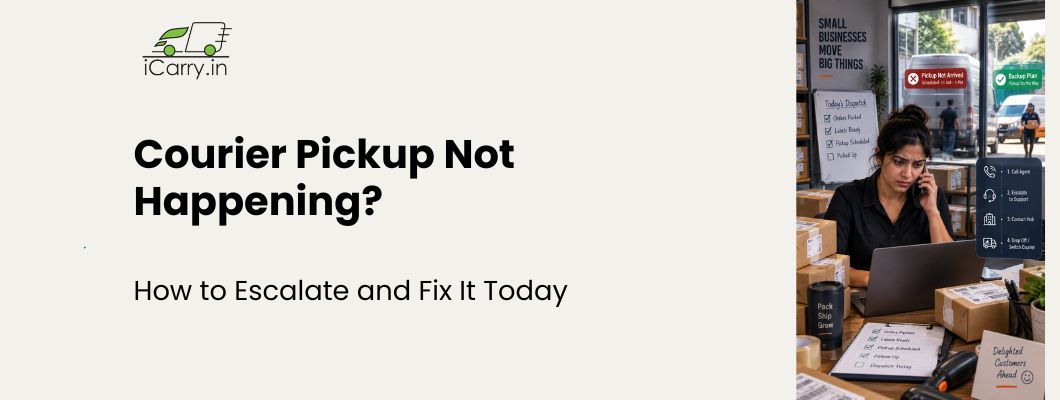
It is 3 PM. Pickup was scheduled for 11 AM to 1 PM. 80 orders are packed, labelled, and ready. The courier agent has not arrived. The phone rings to voicemail. Your dispatch window closes at 4 PM. Customers who ordered prepaid this morning are expecting a same-day dispatch notification.
A missed pickup is not just a logistics inconvenience. For marketplace sellers, it is a dispatch SLA breach that triggers account penalties. For D2C brands, it is delayed orders and the customer service queries that follow. For time-sensitive shipments - festival gifts, perishables, event materials - it can mean the order misses its purpose entirely.
Missed courier pickups are one of the most frustrating operational problems Indian businesses face - and one of the most consistently mishandled. As India's logistics network scales, pickup SLA adherence varies significantly between couriers, cities, and even individual pickup routes. Understanding the escalation process - who to call, in what order, with what information - is the difference between a 2-hour resolution and a full-day loss.
This guide covers why pickups get missed, how to escalate effectively for same-day resolution, and how to prevent recurring missed pickups.
What Counts as a Missed Pickup?
A missed pickup is when a courier agent does not arrive within the committed pickup window, with no advance notice. It becomes an operational problem the moment it risks a marketplace dispatch SLA or a same-day delivery promise - which is usually within the first hour of the window closing.
How to Respond When a Pickup Has Not Arrived: Quick Checklist
- Is it past the committed pickup window? (First confirm the window before escalating)
- Have you already called the pickup agent's direct number?
- Have you raised a ticket with your courier aggregator's support team?
- Do you have a backup courier option enabled for emergency drop-off?
- Have you notified your dispatch team to hold parcels - do not cancel bookings yet?
- For marketplace orders: have you checked the SLA breach trigger time and planned accordingly?
Why Courier Pickups Get Missed in India
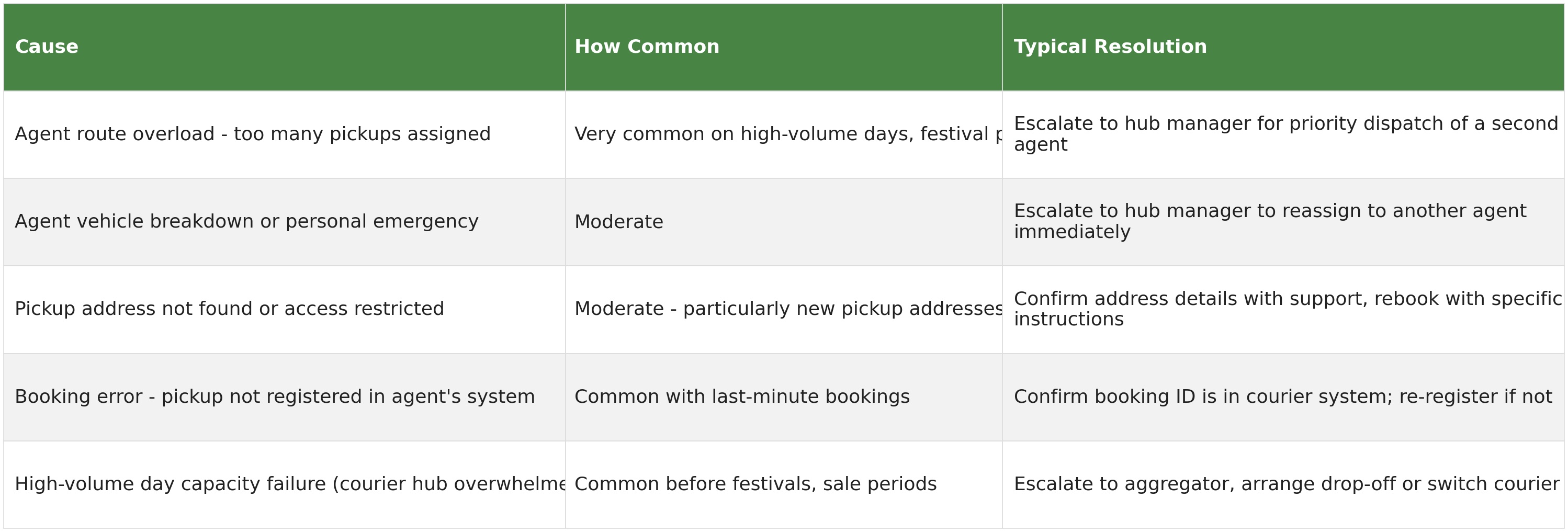
Understanding the cause determines the right escalation path. Missed pickups in India fall into five categories:
The Escalation Sequence - Who to Contact and When
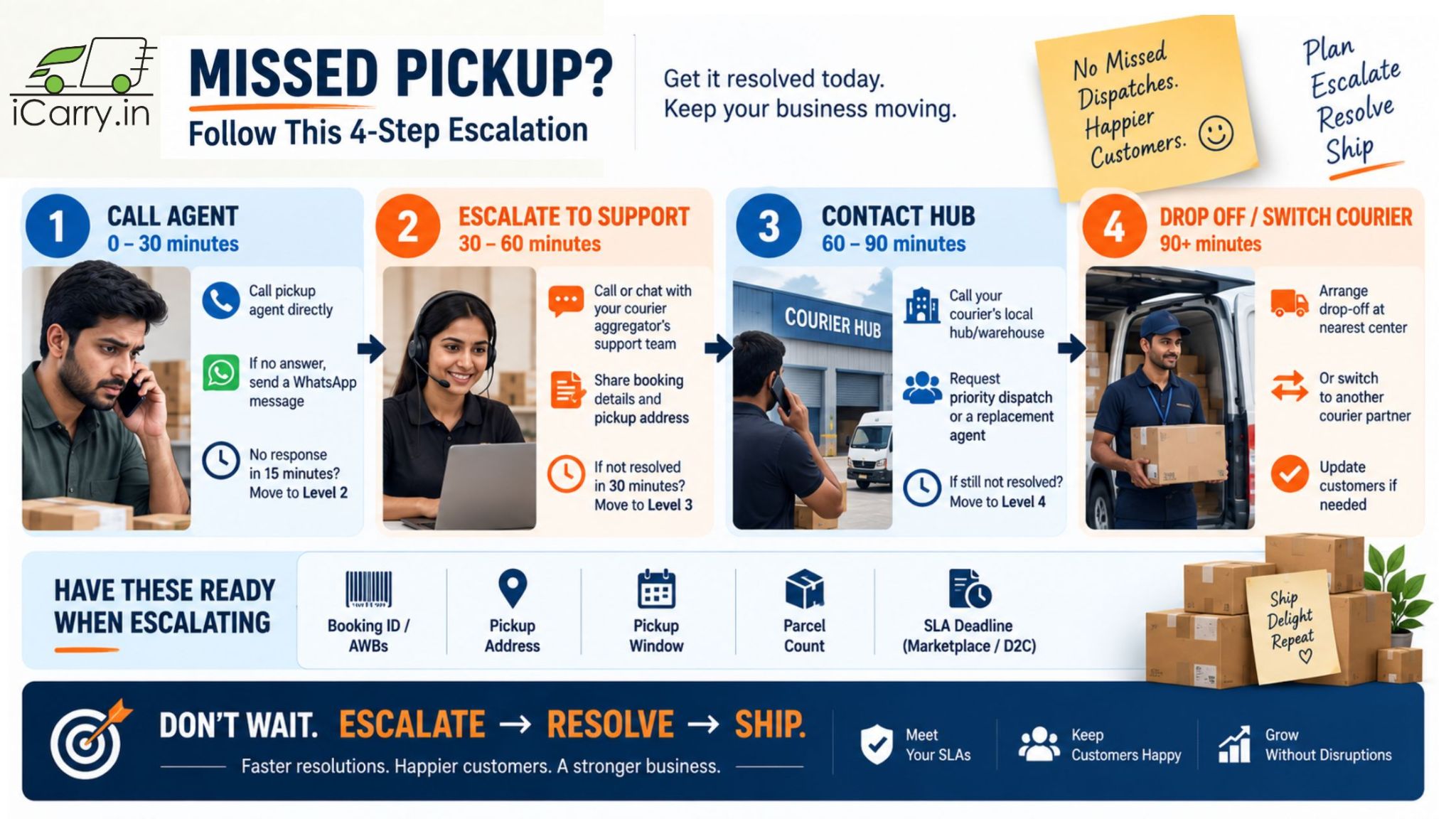
A missed pickup requires a structured escalation sequence. Each level has a response window. If the current level does not resolve within that window, move to the next.
Level 1: Direct Contact with the Pickup Agent (0 to 30 minutes past window)
- Call the pickup agent's direct mobile number. This number should be in your contact list from previous pickups
- If no answer after 2 attempts, send a WhatsApp message: 'Hi, pickup from [Your address] for [AWB count] parcels was scheduled for [time]. Please confirm ETA.'
- If the agent responds with a delay beyond 1 hour, proceed to Level 2 immediately - do not wait
- If no response within 15 minutes of first contact attempt, proceed to Level 2
Level 2: Courier or Aggregator Support (30 to 60 minutes past window)
- Call or chat with your courier or aggregator's support team. This is your primary escalation channel - aggregators have direct hub-level contacts
- Provide: booking ID or AWBs, pickup address, scheduled pickup window, current time, and agent contact attempts made
- Ask specifically: 'Can you contact the pickup hub and get an agent dispatched within the next 30 minutes?'
- Request a ticket number for the escalation - this creates a logged record of the missed pickup
- Ask for an ETA confirmation - not just 'we will look into it'
Level 3: Direct Courier Hub Contact (60 to 90 minutes past window)
- Ask your aggregator support for the pickup hub's direct number or contact the courier's customer care for the hub incharge contact
- Speak to the hub manager or area supervisor - not the general customer care line, which has no authority to dispatch an agent
- State clearly: pickup was scheduled for [time], it is now [time], [X] parcels are ready, marketplace SLA breach risk in [Y hours]
- For marketplace sellers, mention the SLA breach explicitly - courier hubs are aware that marketplace penalties create accountability and tend to prioritise accordingly
Level 4: Alternative Resolution - Drop-Off or Switch Courier (90+ minutes past window)
If escalation has not produced a confirmed agent ETA within 90 minutes of the missed window, the most reliable resolution is to arrange an alternative:
- Drop at nearest courier facility: Most couriers accept walk-in drops at their hub or service centre. Pack the manifest, load the parcels, and drop directly. This is faster than waiting for an agent who may not arrive
- Switch to an alternate courier for the day's volume: If you use a courier aggregator, cancel the unconfirmed bookings and rebook with an alternate courier that has confirmed pickup availability for the same day. Most aggregator platforms allow same-day rebooking with alternate couriers
- Hyperlocal courier for city orders: For same-city orders, a hyperlocal courier (Borzo or similar) can pick up and deliver within hours - bypassing the problem entirely for the local portion of your dispatch
The "switch courier for the day" option is only as fast as your access to alternate couriers - a courier aggregator account like iCarry® means that rebooking is a few clicks, not a new sign-up.
Marketplace SLA Management During a Missed Pickup
Marketplace sellers face a specific pressure during missed pickups: dispatch SLA. Most marketplaces require orders to be dispatched within 24 to 48 hours of placement. Breach triggers account health metrics, financial penalties, and in repeated cases, account suspension.
- Know your SLA breach window: Identify which orders in today's batch are closest to their SLA deadline. Prioritise these for any alternate courier or drop-off resolution
- Document the missed pickup: Keep a record of your escalation attempts with timestamps. Some marketplaces accept courier-side evidence of pickup failure as grounds for SLA breach forgiveness
- Contact marketplace seller support: For repeated missed pickups causing SLA breaches, contact the marketplace directly with documentation. Most have an appeals process for courier-caused SLA failures
- Do not cancel and rebook orders: Cancelling marketplace orders to avoid a dispatch SLA breach triggers a different metric penalty. Dispatch SLA breach is generally less severe than order cancellation at the seller's initiative
How to Prevent Recurring Missed Pickups
1. Establish a Direct Relationship with Your Hub Incharge
The hub incharge at your local courier facility is the person who dispatches pickup agents. A direct relationship with this person - even just having their mobile number - gives you a resolution path that bypasses general customer care entirely.
Most hub incharges are accessible through your courier's area sales manager. Ask for the contact when setting up a new courier account and maintain it.
2. Give 24-Hour Advance Notice for High-Volume Days
Courier pickup agents are assigned routes with a fixed capacity. An unexpected 3x volume spike creates an overload that the agent cannot handle in the committed window. Informing your courier agent or hub of a high-volume day 24 hours in advance allows them to allocate additional capacity.
Before any sale, campaign, or festival dispatch, message your pickup agent: 'Tomorrow's pickup will be approximately [X] parcels, approximately [Y] kg. Please confirm you can handle this or I need to arrange additional coverage.'
3. Set an Earlier Pickup Window
A pickup window of 11 AM to 1 PM leaves no buffer for the rest of your dispatch day. A window of 9 AM to 11 AM gives you time to escalate, arrange an alternative, or drive to the hub for drop-off if the pickup does not materialise - all before marketplace SLA deadlines close.
Book pickups as early in the day as your dispatch process allows. The earlier the pickup, the more options you have if it fails.
4. Always Have a Backup Drop-Off Plan
Know the address, operating hours, and contact of the nearest hub or service centre for every courier you use. If a pickup fails, the 10-minute drive to drop parcels directly is always faster than waiting another hour for a pickup agent who may not come.
Keep a printed list of courier drop-off points at your dispatch station. When the pickup fails, your team knows where to go without needing to search.
5. Track Pickup Success Rate by Courier
Log every missed pickup with date, courier, reason (if known), and resolution method. A courier that misses pickup more than twice per month on your route has a systematic problem that a conversation with the hub incharge will not permanently fix.
Use this data to make courier allocation decisions. A courier with consistent pickup failures should receive reduced volume - not because the shipping rate is wrong, but because the operational reliability is wrong.
When to Switch Couriers Permanently
A missed pickup once is a logistics event. Missed pickups twice a month is a courier reliability problem. Consider switching primary courier when:
- Two or more missed pickups in a 30-day period from the same courier on the same route
- Hub incharge escalation produces promises but no sustained improvement
- Marketplace SLA penalties attributable to courier pickup failure are occurring regularly
- Agent contact details change frequently - indicating high staff turnover at the hub which correlates with lower pickup reliability
How iCarry® Supports Pickup Management
iCarry® is a courier aggregator that gives Indian businesses multiple courier options from one account - so a missed pickup from one courier is resolved by switching to another, not by waiting indefinitely:
- Multiple courier partners: If Courier A misses pickup, rebook the same shipments with Courier B from the same iCarry® account. No new account setup, no separate negotiation - same platform, different courier.
- Support ticket escalation: Raise a missed pickup ticket through iCarry®'s support system. iCarry®'s support team can coordinate with courier partners and escalate pickup issues through the appropriate channels for faster resolution.
- Pickup confirmation: For large volume days, inform iCarry® support 24 hours in advance. The team can coordinate with courier hubs to ensure additional pickup capacity is allocated
- Manifest preparation: Always have your manifest printed and ready. How to Print Shipment Label and Manifest shows the process in iCarry® - having the manifest ready speeds up both agent pickup and hub drop-off resolution
- Pickup reliability data: Track your pickup success rate by courier across your iCarry® shipment history. Use this data to allocate volume away from consistently unreliable couriers on specific routes
- Free Bronze plan, no minimum volume.
Final Thoughts
A missed pickup is a solvable problem - if you act in the right sequence, at the right pace, with the right information. Waiting passively for the agent to arrive while your dispatch window closes is the wrong response. Immediate escalation through the correct channels - aggregator support, hub incharge, alternate courier - resolves most missed pickups within 90 minutes.
Prevention is more valuable than resolution. Direct hub incharge relationships, advance volume notification, early pickup windows, and documented pickup performance data are the four habits that reduce missed pickup frequency to near-zero for most Indian businesses.
And when a specific courier has a persistent problem - not once, but repeatedly - the right decision is to reduce their volume, not to hope for improvement. Multi-courier access through a courier aggregator makes this decision operationally straightforward.
Frequently Asked Questions (FAQs)
What should I do first when a courier pickup is missed?
Call the pickup agent directly. If no answer within 15 minutes or if the agent confirms a delay beyond 1 hour, immediately escalate to your courier aggregator's support team with the booking ID, scheduled pickup window, and current time. Request that they contact the pickup hub and get a confirmed agent ETA within 30 minutes.
How do I escalate a missed pickup to the courier hub?
Ask your courier aggregator for the pickup hub's direct number or hub incharge contact. Speak to the hub manager directly - not general customer care, which has no authority to dispatch an agent. State the booking ID, the missed window, the parcel count, and any marketplace SLA deadline pressure. Hub incharges can prioritise emergency pickups when the business case is clearly stated.
Can I switch couriers if my regular pickup is missed?
Yes, through a courier aggregator with multiple courier access. If the missed pickup cannot be resolved within 90 minutes of the committed window, cancel the unconfirmed bookings and rebook with an alternate courier that has confirmed same-day pickup availability. Most aggregator platforms support this without additional setup.
How do I handle marketplace SLA during a missed pickup?
Identify which orders are closest to their SLA deadline and prioritise those for alternate courier or drop-off resolution. Document all escalation attempts with timestamps. If SLA breach occurs despite documented courier failure, contact the marketplace seller support with evidence - most have an appeals process for courier-caused delays. Do not cancel orders to avoid SLA breach; cancellation typically triggers a more severe penalty than late dispatch.
How do I prevent recurring missed pickups?
Get the hub incharge's direct contact and use it for escalations rather than general customer care. Notify your courier 24 hours before high-volume days. Set pickup windows early in the day (9 to 11 AM) to allow time for alternatives if pickup fails. Know your nearest courier drop-off point for every courier you use. Track missed pickup frequency by courier and reduce volume to any courier with more than two missed pickups per month.
Does iCarry® help with missed pickup escalations?
Yes. iCarry®'s support team has direct contacts with courier partners and can escalate missed pickup situations faster than most businesses can independently. Multi-courier access means same-day rebooking with an alternate courier is possible without setting up a new account. Raise a missed pickup ticket in iCarry®'s support system with the booking ID and the escalation begins immediately.
A missed pickup is a solvable problem if you act in the right sequence, at the right pace, with the right information - immediate escalation through the correct channels resolves most missed pickups within 90 minutes. Prevention is more valuable than resolution: direct hub incharge relationships, advance volume notification, early pickup windows, and documented pickup performance data are the four habits that reduce missed pickup frequency to near-zero for most Indian businesses.