India's Cross-Border eCommerce Opportunity
India is one of the world's largest producers of textiles, handicrafts, spices, Ayurvedic products, and software - and global demand for Indian goods is growing. India's merchandise exports were $437 billion in FY2023-24, with eCommerce and direct-to-consumer exports representing an increasingly significant share.
For Indian sellers, cross-border eCommerce means selling directly to international buyers on platforms like Amazon Global Selling, Etsy, eBay, or a brand's own international website - and shipping via express courier (FedEx, Aramex) rather than ocean freight. It is the entry point into global commerce for Indian businesses that are not yet large enough for traditional B2B export contracts.
What Is Cross-Border eCommerce from India?
Cross-border eCommerce from India means selling directly to buyers in other countries through marketplaces like Amazon Global Selling and Etsy, or through your own website, and shipping individual orders by international courier rather than ocean freight. It involves requirements such as an Import Export Code (IEC), a commercial invoice for each shipment, and an understanding of the destination country's import duties and VAT. Incomplete documentation or unexpected import charges can lead to customs delays, refused deliveries, or abandoned orders.
Top Export Markets for Indian Cross-Border Sellers
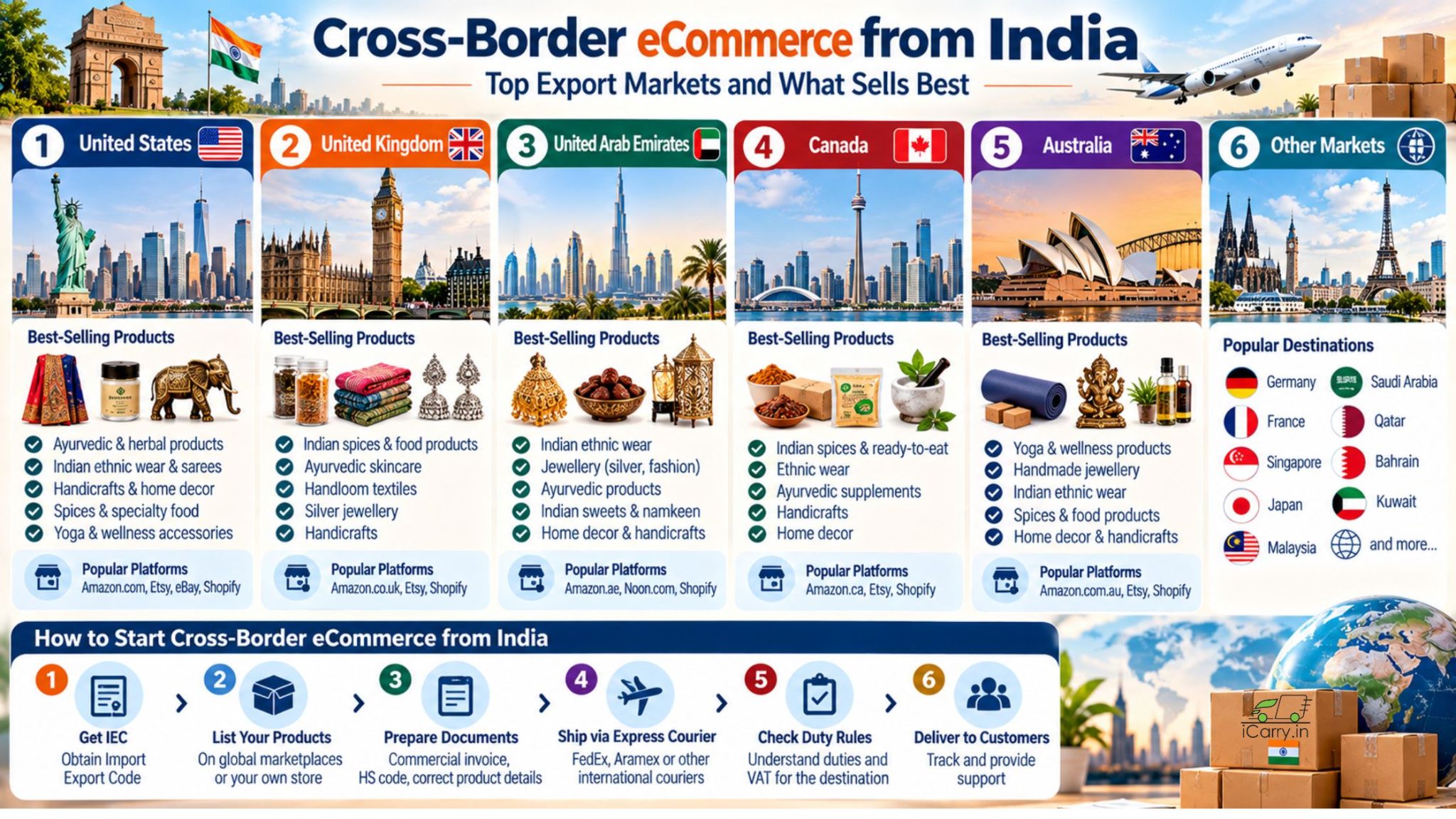
United States
The largest single market for Indian cross-border eCommerce, with a large Indian-American community and strong mainstream demand for Indian-origin products.
- Best-selling categories: Ayurvedic and herbal products, Indian ethnic wear and sarees, handmade jewellery, home decor and handicrafts, spices and specialty food, yoga and wellness accessories
- Key platforms: Amazon.com (via Amazon Global Selling), Etsy, eBay, brand's own Shopify website
- De minimis: The US$800 duty-free threshold is suspended for every country: first by executive order on August 29, 2025, then by CBP regulation from June 24, 2026 (July 24, 2026 for mail), with a permanent repeal on July 1, 2027. Duty and a customs entry now apply to every US-bound parcel, so build duty into your pricing or offer duties-paid checkout so buyers are not surprised at delivery
United Kingdom
Strong Indian community market plus growing mainstream interest in Indian wellness, food, and fashion.
- Best-selling categories: Indian spices and food products, Ayurvedic skincare, handloom textiles, silver jewellery, handicrafts
- Key platforms: Amazon.co.uk, Etsy, brand's own website
- Post-Brexit note: Import duty applies on goods above £135. VAT applies from the first pound. UK buyers expect clear customs cost communication at checkout. The UK has announced it will remove the £135 duty relief by October 2028 at the latest
United Arab Emirates
One of the world's largest Indian diaspora communities plus high-spending local consumers with strong appreciation for Indian goods.
- Best-selling categories: Indian ethnic wear, gold and silver jewellery, Ayurvedic products, Indian sweets and namkeen (halal certified), home decor
- Key platforms: Amazon.ae, Noon.com, brand's own website
- Logistics advantage: 3 to 4 day express courier transit from India. Aramex has strong UAE infrastructure
Canada
Large Indian diaspora, strong demand for Indian ethnic products and food.
- Best-selling categories: Indian spices and ready-to-eat products, ethnic wear, Ayurvedic supplements, handicrafts
- Key platforms: Amazon.ca, Etsy, brand's own website
- De minimis: CAD$20 - very low threshold means import duty applies on most shipments. Build this into pricing
Australia
Growing Indian community (700,000+) and mainstream consumer interest in natural and artisan Indian products.
- Best-selling categories: Yoga accessories, Ayurvedic wellness, handmade jewellery, Indian ethnic wear, spices
- Key platforms: Amazon.com.au, Etsy, brand's own website
- De minimis: AUD$1,000 - generous threshold. Most small parcel Indian exports clear without import duty
Germany and Western Europe
Growing mainstream market for artisan, natural, and sustainable Indian products beyond the diaspora segment.
- Best-selling categories: Organic and natural products, handicrafts and home decor, yoga products, handloom textiles
- Key platforms: Amazon.de, Etsy, brand's own website
- EU customs note: VAT applies from €0 since 2021. Non-EU sellers must register for EU VAT or use IOSS (Import One Stop Shop) to collect VAT at checkout. Since July 1, 2026 the EU also charges a temporary €3 customs duty per item type on parcels up to €150, replacing the old €150 duty exemption
Product Categories That Sell Best Internationally
- Ethnic wear and textiles: Sarees, kurtas, dupattas, handloom fabric - consistent demand from diaspora and growing mainstream Western interest in Indian fashion
- Ayurvedic and herbal products: Ashwagandha, turmeric supplements, Ayurvedic skincare - high global demand, strong India-origin premium
- Handicrafts and home decor: Brass items, block print products, handmade ceramics, jute products - India's artisan identity is a commercial asset internationally
- Spices and specialty food: Indian spices (cardamom, saffron, turmeric) command premium prices internationally. Diaspora food products also ship well
- Handmade jewellery: Silver, beaded, and artisan jewellery from Rajasthan, Gujarat, and Andhra Pradesh sell consistently on Etsy and Amazon internationally
- Yoga and wellness accessories: Yoga mats, meditation tools, aromatherapy products - India's wellness association drives global demand
Getting Started With Cross-Border Shipping
- Step 1 - IEC: Register at dgft.gov.in. Takes 2 to 3 days, costs ₹500. Mandatory for all international commercial shipments
- Step 2 - Platform: List on Amazon Global Selling, Etsy, or build your own Shopify international store. Most platforms handle the buyer-facing international experience
- Step 3 - Pricing: Price in the buyer's currency. Include a realistic estimate of import duty in your checkout flow or in your product description. Unexpected customs charges are the most common reason for international buyer complaints
- Step 4 - Courier: FedEx and Aramex for most markets. Compare rates at your product weight before committing to a single courier
- Step 5 - Documents: Commercial invoice, packing list, Certificate of Origin for FTA duty benefits. Keep these templates ready before the first order ships
How iCarry® Supports Cross-Border eCommerce
iCarry® is a courier aggregator with FedEx and Aramex access for international shipments from India to all major markets.
- Rate comparison before every booking: Compare FedEx and Aramex rates to the US, UK, UAE, Australia, and Europe before confirming each international order
- No minimum volume: Whether you ship 5 international orders a month or 500, iCarry®'s Bronze plan has no minimum commitment
- Domestic courier for pre-export: Move goods from your warehouse to freight forwarders or customs brokers using iCarry®'s domestic courier network
- Free Bronze plan, no minimum volume.
Frequently Asked Questions (FAQs)
Which country should an Indian seller target first for cross-border eCommerce?
The UAE is the most practical first market: transit is 3 to 4 days via Aramex, it has a large Indian diaspora, and it is unaffected by the recent US and EU low-value parcel duty changes. The US is still the largest market by demand, but its US$800 duty-free threshold has been suspended since August 29, 2025, so every US-bound parcel now attracts duty and a customs entry. Treat the US as a second step, once your pricing includes duty.
What products from India sell best internationally?
Ethnic wear and textiles, Ayurvedic and herbal products, handicrafts and artisan home decor, Indian spices and specialty food, handmade jewellery, and yoga and wellness accessories consistently perform well across international markets. Products with a clear India-origin story command premiums that generic products cannot.
Do I need to collect VAT for international sales?
It depends on the destination country and the platform. Amazon Global Selling and Etsy handle VAT collection for many markets automatically. For your own website selling to EU buyers, you may need to register for EU VAT or use IOSS. For UK buyers, VAT on consignments up to £135 is accounted for at the point of sale, so overseas sellers generally need to register for UK VAT from their first sale - the UK's turnover-based threshold applies only to UK-established businesses, and IOSS covers the EU only. Always verify the current VAT requirements for each market you sell in.
What is the minimum I need to start shipping internationally from India?
An IEC (Import Export Code) from DGFT - ₹500 and 2 to 3 days to register. A courier account with FedEx or Aramex (available through iCarry® with no minimum volume). A commercial invoice template in English. A listing on an international platform or your own website in English. That is genuinely everything you need to ship your first international order.
To sell from India to the world, start with an IEC, list on a platform such as Amazon Global Selling or Etsy, price in the buyer's currency with import duty in mind, and compare FedEx and Aramex rates at your product weight. The UAE is the most practical first market, and the US is a strong second step once your pricing includes duty.