A textile manufacturer in Surat ships fabric to a buyer in Bangladesh. The bank returns the shipping documents: the exporter's IEC (Import Export Code) is not mentioned on the commercial invoice. The shipment is held at customs. The buyer is waiting. The bank cannot process the letter of credit.
The IEC is a DGFT-issued registration. Without it, no commercial export from India can proceed. And yet, many first-time exporters learn about DGFT only when a shipment is blocked or a compliance notice arrives.
The Directorate General of Foreign Trade (DGFT) is the government authority that regulates India's import and export trade policy. Every business that exports commercially from India operates under DGFT's framework - whether they know it or not. DGFT administers India's Foreign Trade Policy, which determines what can be exported, under what conditions, and with what benefits.
This guide explains what DGFT is, what it does, how the IEC registration works, what licences and schemes it administers, and what Indian exporters need to know to stay compliant and claim the benefits available to them.
What Is DGFT?
DGFT (Directorate General of Foreign Trade) is a government body under India's Ministry of Commerce and Industry. It is responsible for formulating and implementing India's Foreign Trade Policy (FTP) - the comprehensive framework that governs all imports and exports from India.
DGFT's primary functions:
- Issuing IEC (Import Export Code) registrations - the mandatory identifier for all commercial exporters and importers
- Administering export promotion schemes and incentives
- Issuing import and export licences for restricted goods
- Maintaining and updating the export and import classification system (ITC HS codes)
- Managing special trade regimes including Advance Authorisation, EPCG, and DFIA schemes
- Formulating trade policy to support India's export growth objectives
DGFT operates through a network of Regional Authorities across major cities. Most DGFT interactions for exporters - IEC registration, licence applications, scheme claims - are now processed online through the DGFT portal.
How to Check DGFT Compliance for Indian Exporters
- Do you have an IEC (Import Export Code) registered with DGFT?
- Is your IEC linked to your current PAN and active bank account?
- Do you know whether your product falls under free, restricted, or prohibited export categories under the current FTP?
- Have you checked whether your exports are eligible for RoDTEP or RODTEP benefits?
- Is your IEC number mentioned on your commercial invoices and shipping bills?
- If you import inputs for export production, have you explored the Advance Authorisation scheme?
What Is an IEC (Import Export Code)?
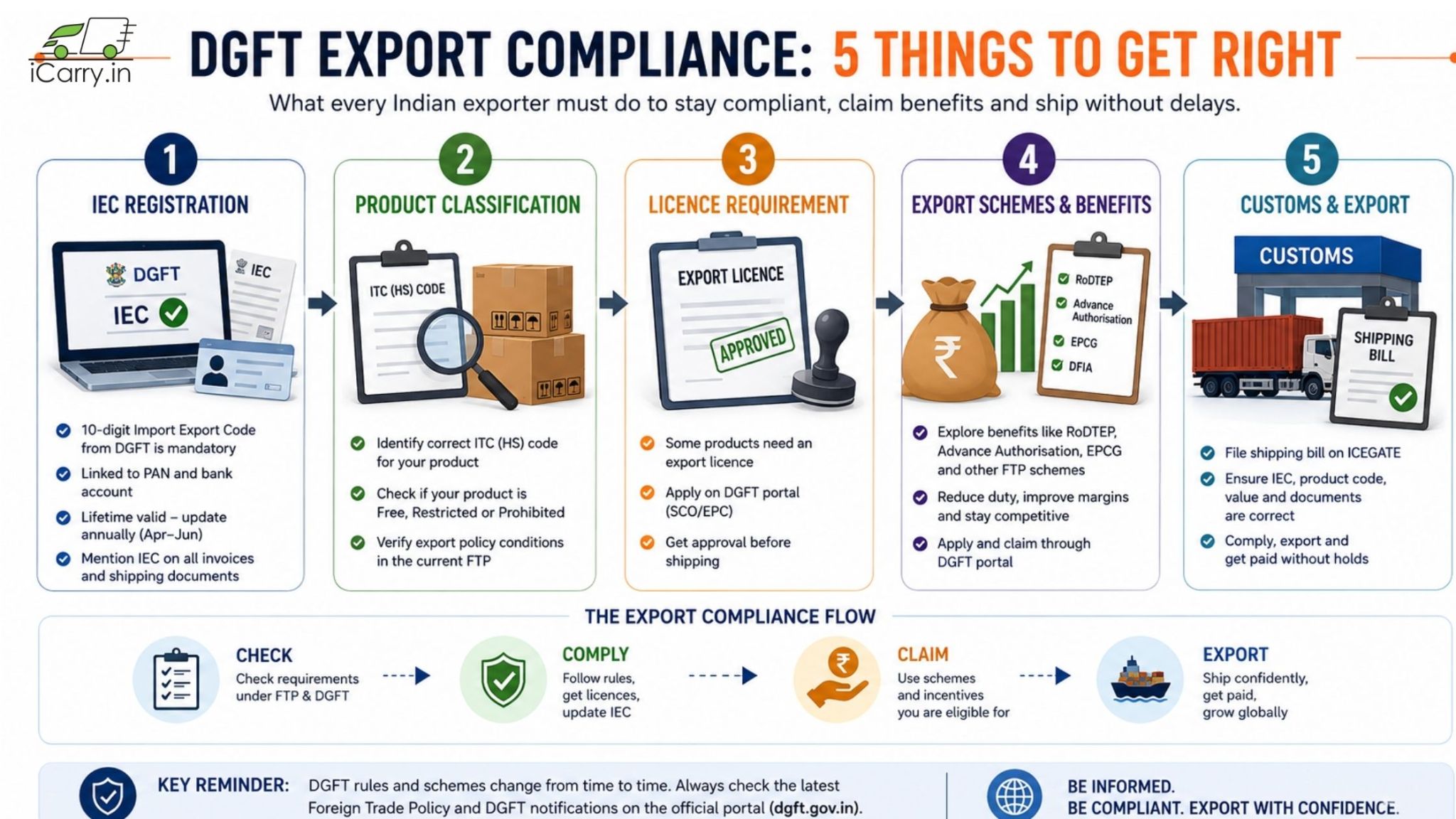
IEC (Import Export Code) is a 10-digit registration number issued by DGFT that is mandatory for any entity engaged in commercial import or export from India. It is sometimes called the 'passport for international trade.'
Key facts about IEC:
- Mandatory for all commercial exports: No shipping bill can be filed with Indian customs without a valid IEC. Banks cannot process export remittances without it
- Linked to PAN: The IEC is now aligned with the entity's PAN number. For proprietorships, the IEC is the owner's PAN. For companies and LLPs, it is the entity's PAN
- Lifetime validity: Once registered, an IEC does not expire. However, it must be updated annually on the DGFT portal to confirm that details are current
- No minimum turnover or export volume: Any individual, proprietorship, partnership, LLP, or company can register for an IEC regardless of size or export volume
- Single IEC per PAN: One IEC per PAN. A business cannot hold multiple IECs
How to Register for IEC
- Step 1: Log in to dgft.gov.in using your PAN-linked credentials
- Step 2: Navigate to Services > IEC Profile Management > Apply for IEC
- Step 3: Fill in business details - entity type, PAN, address, bank account details (for export remittance)
- Step 4: Upload required documents - PAN card, address proof, cancelled cheque or bank certificate, digital signature
- Step 5: Pay the registration fee (₹500) via online payment
- Step 6: Submit. IEC is typically issued within 2 to 3 working days if documents are in order
Annual update requirement: Even if no export activity occurred, the IEC must be confirmed/updated on the DGFT portal between April and June every year. Failure to update renders the IEC inactive - which blocks exports until reactivated.
DGFT's Foreign Trade Policy (FTP) - What Exporters Must Know
India's Foreign Trade Policy is announced periodically (currently FTP 2023) and outlines the rules, restrictions, incentives, and procedures for all international trade. Every exporter is directly affected by it.
Export Categorisation Under FTP
Every product that can be exported from India is classified into one of three categories:
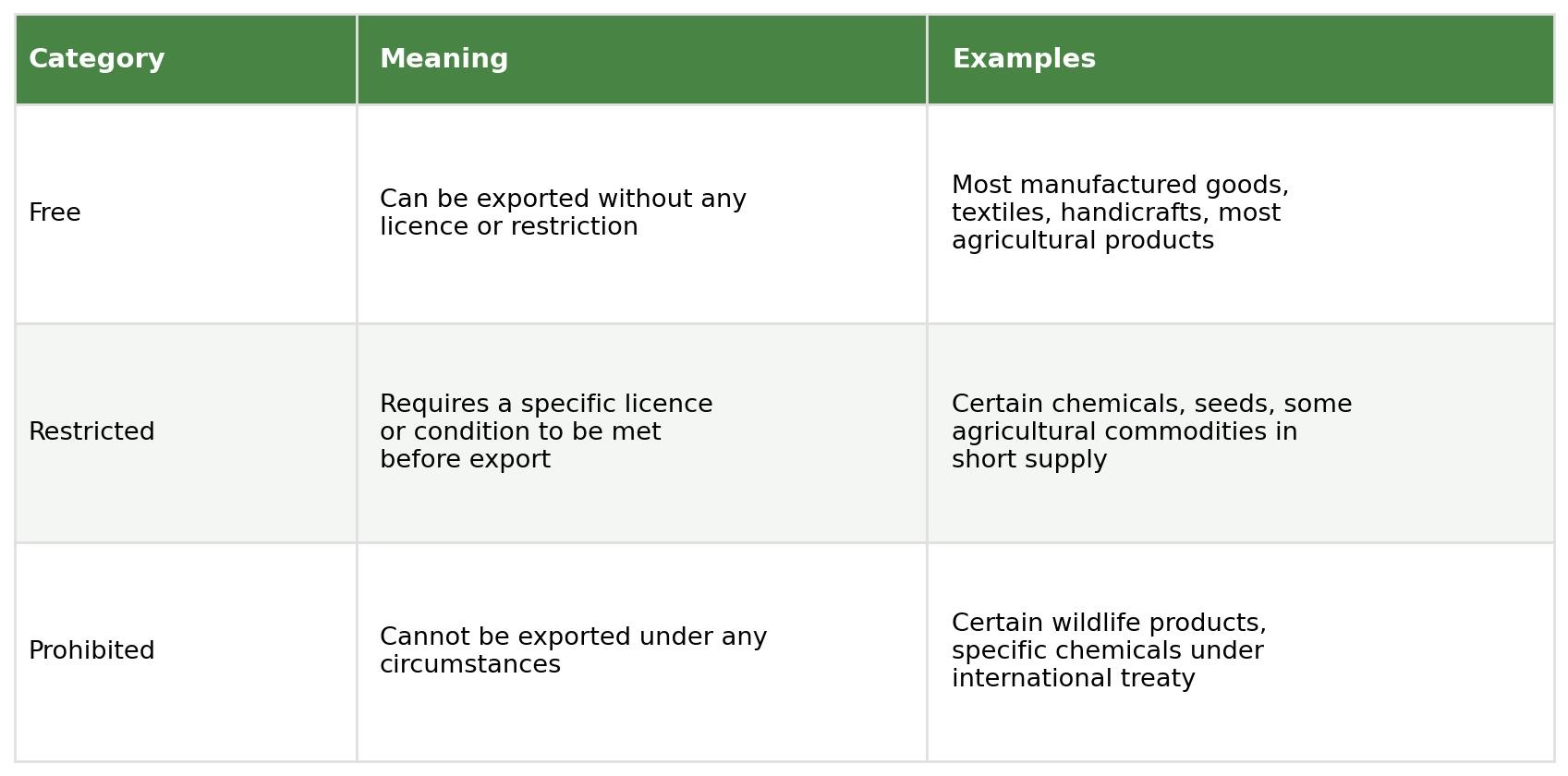
Check your product's export category using the ITC HS code search on the DGFT portal before attempting first export. Exporting a restricted product without the required licence is a serious violation. Verify your product's export classification at DGFT.
Key DGFT Export Promotion Schemes
RoDTEP (Remission of Duties and Taxes on Exported Products)
RoDTEP replaced the older MEIS scheme. It reimburses duties, taxes, and levies paid on inputs used in export production that are not refunded through other mechanisms. The reimbursement is provided as transferable duty credit scrips.
- Who qualifies: Most manufactured goods exporters. The scheme covers items on the RoDTEP schedule, which lists eligible product categories and rates
- How to claim: RoDTEP benefit is claimed while filing the shipping bill. The benefit rate is a percentage of FOB value - the percentage varies by product category
- How it is received: As an electronic duty credit (scrip) in your ICEGATE account, usable to pay customs duty on imports
Advance Authorisation
Allows exporters to import inputs duty-free for use in manufacturing export products. Available for standard input-output norms (SION) defined by DGFT or on the basis of self-declaration for custom inputs.
- Who it benefits: Manufacturers who import raw materials or components and export finished goods
- Condition: Export obligation must be fulfilled within 18 months of the authorisation date. Failure to export the committed value results in duty payment on all imported inputs plus interest
- How to apply: Apply on DGFT portal under Schemes > Advance Authorisation
EPCG (Export Promotion Capital Goods)
Allows import of capital goods (machinery, equipment, technology) at zero or reduced customs duty, subject to an export obligation of 6 times the duty saved within 6 years.
- Who it benefits: Manufacturers investing in production technology for export-oriented businesses
- When to use: When importing new machinery for a new or upgraded export production line where the capital goods duty saving is significant
Deemed Exports
Certain domestic supply transactions are treated as 'deemed exports' under DGFT - even though goods do not physically leave India. These include supplies to EOUs (Export Oriented Units), SEZ units, and government projects. Deemed exporters can claim advance authorisation and refund of terminal excise duty on deemed export supplies.
DGFT Portal - What Exporters Can Do Online
Most DGFT functions are now digital. The dgft.gov.in portal allows exporters to:
- Register and manage IEC
- Apply for Advance Authorisation, EPCG, and other licences
- File and track licence applications
- Check ITC HS code classifications and export-import policy for specific products
- Update IEC profile and bank account details
- Apply for online grievance redressal through DGFT's trade facilitation portal
- Access trade statistics and foreign trade policy documents
Important: DGFT portal access requires a digital signature for most licence applications. A Class 2 or Class 3 DSC (Digital Signature Certificate) linked to the authorised signatory's PAN is required for key transactions.
DGFT and Customs - How They Work Together
DGFT and Indian customs (administered by CBIC) are separate authorities but deeply interconnected in the export process. CBIC's ICEGATE system processes shipping bills (export customs declarations) and cross-references DGFT data for:
- IEC validation - every shipping bill must carry a valid IEC
- Licence verification - if an export licence is required, customs verifies it against the DGFT database before issuing Let Export Order
- RoDTEP and other incentive claims are processed at customs based on DGFT scheme eligibility
- Export obligation fulfilment under Advance Authorisation is tracked through ICEGATE shipment data
Common DGFT Compliance Mistakes Indian Exporters Make
- Not updating IEC annually: IEC becomes inactive if not updated April to June every year. An inactive IEC blocks all exports until reactivated. Calendar this every year without exception
- Exporting restricted goods without checking: Many exporters assume 'free export' applies to all products. Always verify the export classification of any new product category before first shipment
- Not claiming RoDTEP at shipping bill stage: RoDTEP can only be claimed at the time of shipping bill filing. It cannot be claimed retroactively on past shipments. Ensure your customs broker knows to claim RoDTEP on every eligible shipping bill
- Wrong IEC on invoice: The IEC on the commercial invoice and shipping bill must match exactly. A typo or outdated IEC number causes customs clearance to fail
- Not tracking Advance Authorisation export obligations: Exporters who take duty-free imports under Advance Authorisation must meet the export commitment within 18 months. Missing the deadline triggers full duty payment plus interest
How iCarry® Supports Indian Exporters
iCarry® is a courier aggregator that handles the courier and parcel logistics leg of Indian exports - not DGFT compliance, which remains the exporter's direct responsibility. What iCarry® provides for export-active businesses:
- International courier access: FedEx and Aramex for parcel-level international shipments - D2C orders, samples, and small B2B exports.
- International rate comparison: Compare courier rates by weight and destination before every international booking. Estimate international shipping cost across FedEx and Aramex to optimise the logistics cost on each export order
- Domestic pre-export logistics: Move goods from manufacturing locations to freight forwarders, customs brokers, or port facilities using iCarry®'s domestic courier network
- Declared value and coverage: Enable declared value coverage on export courier shipments to protect against loss or damage between dispatch and international delivery
For DGFT registration, licence applications, and export scheme claims, work with a licensed customs broker or trade consultant. For the courier leg of your international exports, iCarry® provides transparent rates and multi-courier access from one account. Register free at iCarry® today.
Final Thoughts
DGFT is the regulatory backbone of Indian export trade. The IEC is not optional - it is the starting point for every commercial export. The FTP schemes DGFT administers - RoDTEP, Advance Authorisation, EPCG - represent significant financial benefits that many exporters leave unclaimed simply because they do not know they exist or how to access them.
Understanding DGFT does not require becoming a trade policy expert. It requires knowing three things: your IEC is current and linked to your active PAN and bank account, your product's export classification is verified before shipping, and the schemes applicable to your export business are claimed at every eligible shipment.
These habits - maintained consistently - keep your export operations compliant and ensure you capture every financial benefit the Indian government provides to exporters.
Frequently Asked Questions (FAQs)
What is DGFT and what does it do?
DGFT (Directorate General of Foreign Trade) is India's government authority for foreign trade policy. It issues IEC registrations, administers export promotion schemes like RoDTEP and Advance Authorisation, issues licences for restricted exports and imports, and maintains India's trade classification system. Every Indian exporter and importer operates under DGFT's framework.
Is IEC mandatory for all exports from India?
Yes. An IEC (Import Export Code) is mandatory for all commercial exports from India. No shipping bill can be filed without a valid IEC, banks cannot process export remittances without it, and it must appear on commercial invoices for international transactions. The only exception is for certain personal shipments and government-to-government exports.
How do I register for an IEC online?
Register at dgft.gov.in using PAN-linked credentials. Navigate to Services > IEC Profile Management > Apply for IEC. Provide entity details, upload PAN, address proof, and bank account documentation. Pay ₹500 registration fee online. IEC is issued within 2 to 3 working days if documents are complete. The IEC must be updated annually on the DGFT portal between April and June to remain active.
What is RoDTEP and how do Indian exporters claim it?
RoDTEP (Remission of Duties and Taxes on Exported Products) is a scheme that reimburses duties, taxes, and levies on export production inputs that are not covered by other refund mechanisms. The benefit is provided as transferable duty credit scrips. It is claimed at the time of shipping bill filing - not retroactively. Ensure your customs broker claims RoDTEP on every eligible shipping bill by specifying the applicable product's scheme rate.
What happens if I export a restricted product without a DGFT licence?
Exporting a restricted product without the required DGFT licence is a serious violation of India's Foreign Trade (Development and Regulation) Act. Consequences include shipment seizure, financial penalties, suspension of IEC, and in serious cases criminal proceedings. Always verify your product's export classification on the DGFT portal before first shipment.
DGFT is the regulatory backbone of Indian export trade, and the IEC is where compliance begins - not an optional formality but the document every shipping bill and bank remittance depends on. Beyond the IEC, DGFT's schemes - RoDTEP, Advance Authorisation, EPCG - represent real financial benefit that goes unclaimed when exporters do not know they exist. Keep the IEC current, verify product classification before shipping, and claim every scheme you are eligible for at the shipping bill stage.