An Indian textile exporter quotes a buyer in Germany: FOB Mumbai ₹45 per unit. The buyer's freight forwarder books a vessel. The shipment is loaded at Mumbai port. Three weeks later the buyer calls: the shipment was damaged at sea and they expect the Indian seller to compensate.
The seller's response: 'Risk transferred to you at loading in Mumbai. Our FOB obligation ended when the goods were loaded on the vessel. The marine insurance claim is yours.'
This is FOB working exactly as it should. The seller delivered to the agreed point. The buyer accepted risk from that point. Neither party is wrong - but if either had misunderstood what FOB means, the dispute would be unresolvable.
FOB is one of the most widely used Incoterms in global trade - and one of the most misunderstood. Indian exporters use FOB across virtually every major export category, from textiles and handicrafts to engineering goods and pharmaceuticals. Understanding exactly what it means - what the seller is responsible for, where responsibility ends, and what documentation it requires - is foundational to exporting correctly.
What Does FOB Mean?
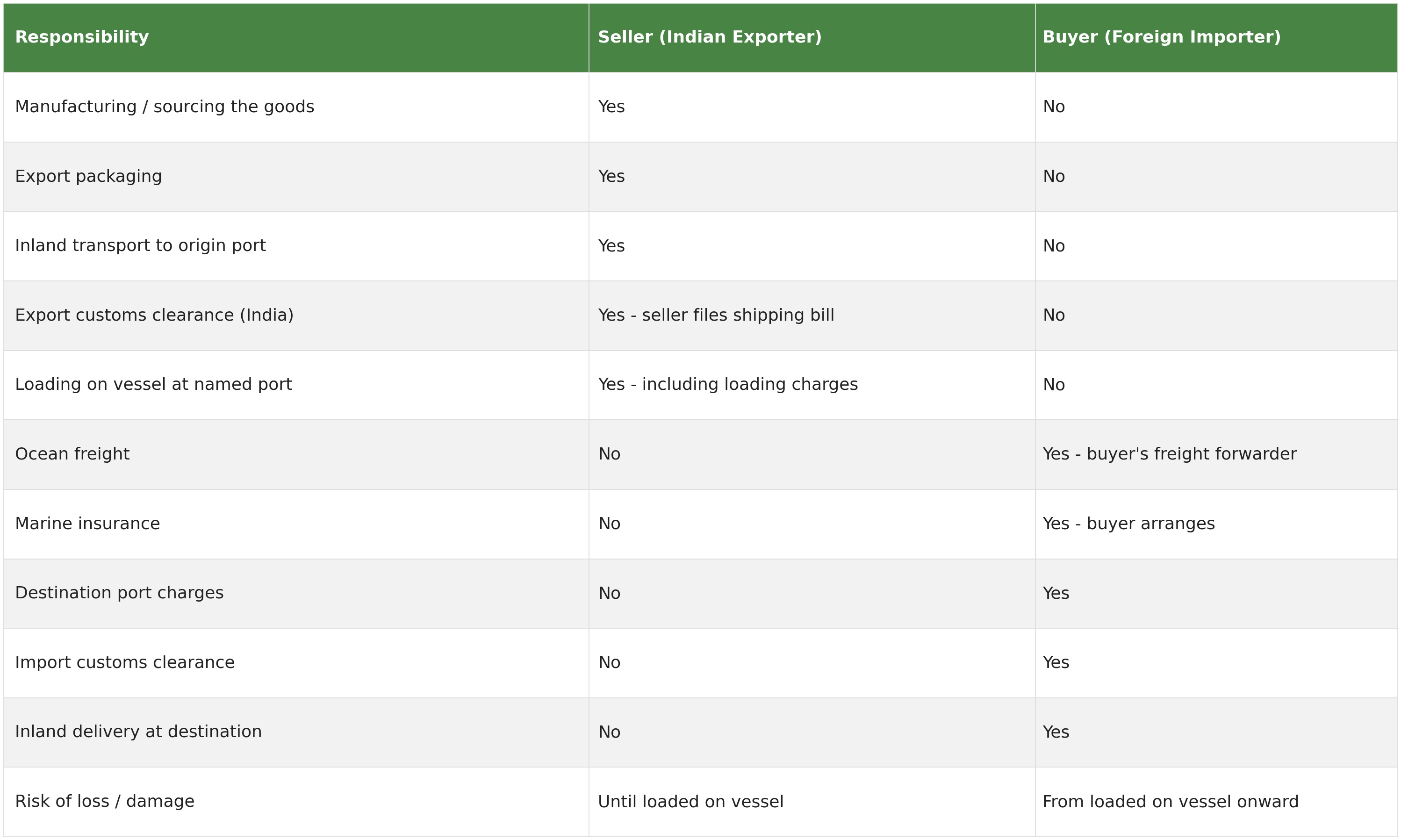
FOB (Free on Board) is an international commercial term (Incoterm) that defines the point at which responsibility for goods transfers from the seller to the buyer in a transaction. Under FOB:
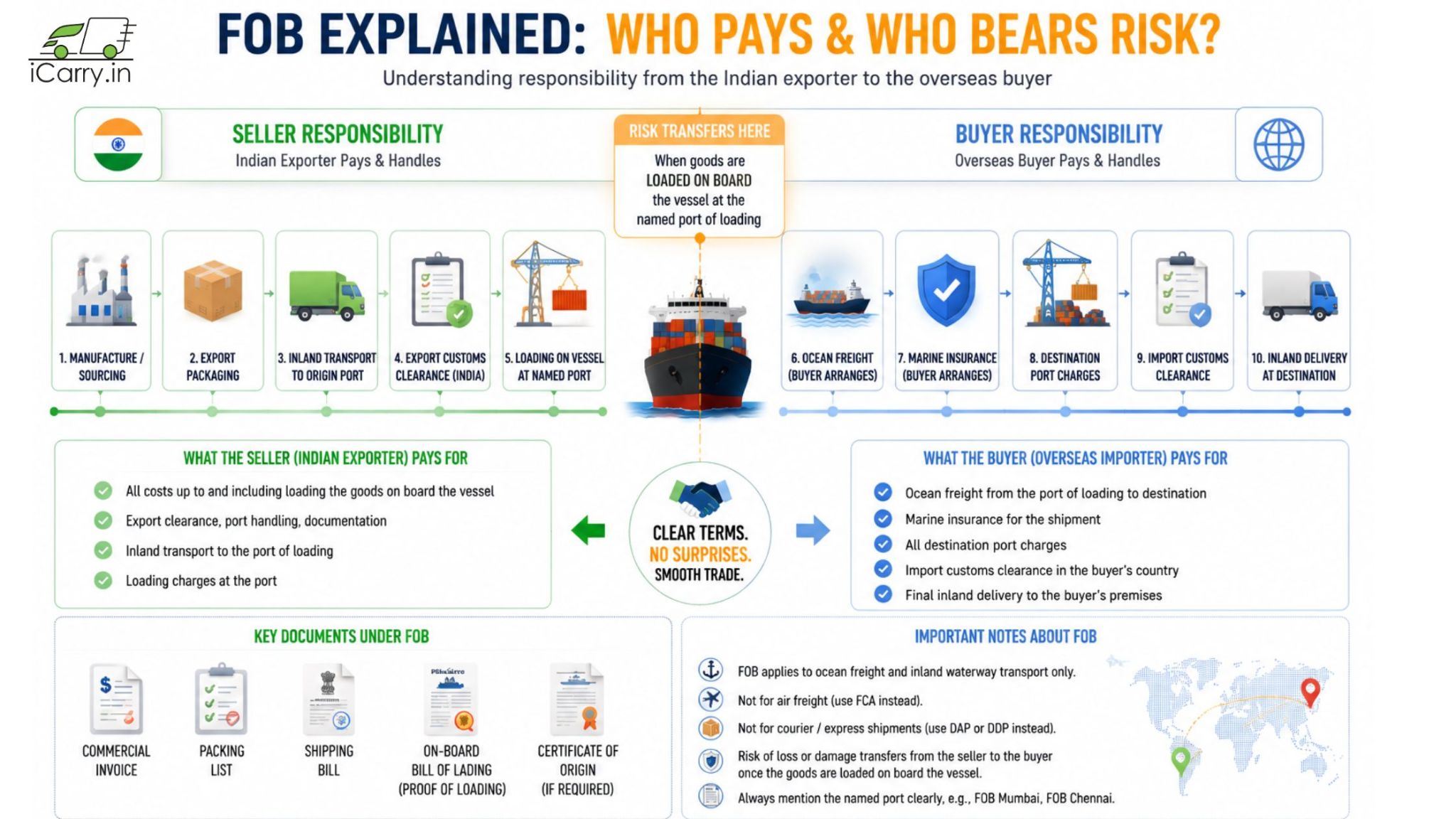
- The seller is responsible for: all costs and risks until the goods are loaded on board the vessel at the named port of shipment
- The buyer is responsible for: the costs and risks once the goods are loaded on board the vessel at the named port, including ocean freight, marine insurance, destination port charges, import customs clearance, and inland delivery at the destination.
The full term is always written with the named port: FOB Mumbai, FOB Chennai, FOB Nhava Sheva, FOB Mundra. The named port is the precise point where responsibility transfers.
FOB applies to ocean freight and inland waterway transport only. It is not used for air freight (use FCA instead) and not used for courier/express shipments (use DAP or DDP instead).
How to Check the FOB Transaction Essentials
- Is the named port of loading (e.g. FOB Mumbai) the correct port for your shipment?
- Have you completed Indian export customs clearance before the goods are loaded?
- Has the buyer arranged their own freight forwarder and vessel booking?
- Does your commercial invoice state 'FOB [Port Name]' as the Incoterm?
- Have you obtained the on-board bill of lading as proof that goods were loaded?
- Is marine insurance the buyer's responsibility under this FOB arrangement?
The FOB Risk and Cost Division - In Detail
FOB vs Other Common Incoterms
FOB (Free on Board) is one of the internationally recognized Incoterms 2020 rules that defines the responsibilities, costs, and risk transfer point between buyers and sellers in global trade. Understanding how it compares to the most common alternatives helps Indian exporters choose the right term for each transaction.
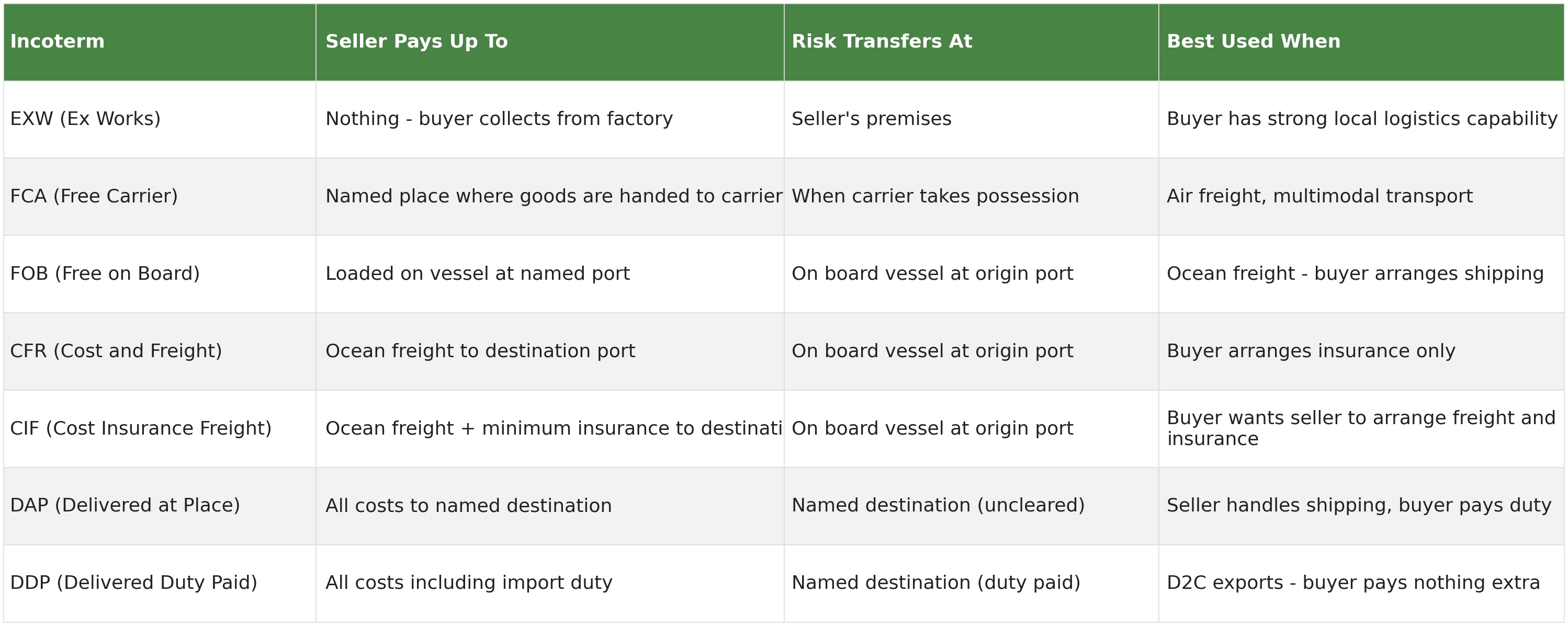
Key distinction between FOB and CIF: Under FOB, the buyer arranges and pays for both ocean freight and marine insurance. Under CIF, the seller arranges and pays for both - though risk still transfers at loading. Many buyers prefer FOB because it gives them control over freight carrier selection and insurance terms.
Why Indian Exporters Commonly Use FOB
FOB is the preferred Incoterm for many Indian export categories because:
- It is familiar: FOB is deeply established in Indian export trade documentation, banking, and customs practice. Most freight forwarders, banks, and customs brokers in India work with FOB routinely
- Indian export incentives are FOB-based: Many Indian export promotion schemes, duty drawback calculations, and MEIS/RoDTEP benefits are calculated as a percentage of FOB value. The FOB value on the shipping bill is the figure the Indian government uses for export statistics and incentive calculations
- It protects the exporter's cash flow: Under FOB, the seller's cost and risk exposure ends at the Indian port. The seller does not need to arrange international freight or insurance - simplifying the transaction and reducing the seller's upfront cost commitment
- Letters of credit are commonly written on FOB terms: Many L/C transactions are structured on FOB terms, with the buyer's bank paying against shipping documents that confirm loading at the named port
How FOB Export Works in India - Step by Step
- Step 1 - Price negotiation: Seller quotes FOB price per unit or per consignment including all costs to loaded on vessel at named Indian port. Buyer understands they pay freight and insurance from this point.
- Step 2 - Buyer arranges freight: Buyer nominates their freight forwarder and provides shipping instructions - which vessel, which service, sailing date. Seller coordinates with the buyer's freight forwarder for booking confirmation.
- Step 3 - Pre-shipment: Seller prepares the goods, export packaging, and all pre-shipment documents: commercial invoice (stating FOB [port]), packing list, and any product-specific certificates.
- Step 4 - Export customs clearance: Seller's customs broker files the shipping bill with Indian customs through ICEGATE. This is the seller's responsibility under FOB. Customs examines and issues Let Export Order (LEO).
- Step 5 - Loading: Goods moved to the port and loaded on the nominated vessel. Loading charges are the seller's responsibility under FOB. Risk transfers at the point of loading.
- Step 6 - On-board bill of lading: The shipping line issues an on-board bill of lading (BOL) confirming the goods are loaded. This is the key FOB document - it proves the seller's obligation is complete.
- Step 7 - Document presentation: Seller presents the shipping documents (commercial invoice, packing list, on-board BOL, certificate of origin if required) to the buyer or buyer's bank for payment.
- Step 8 - Ocean transit: Buyer's responsibility entirely. Any damage, delay, or loss during ocean transit is the buyer's risk. The seller's FOB obligation is complete after loading.
FOB Documentation Requirements
A complete FOB export from India requires the following documents:
- Commercial invoice: Must state 'FOB [named port]' as the Incoterm. Include unit price, quantity, total FOB value, currency, HS code, and country of origin
- Packing list: Itemised list of all packages, weights, and dimensions. Must match the commercial invoice exactly
- Shipping bill: Filed electronically with Indian customs via ICEGATE. References the commercial invoice and declares the FOB value for export statistics and incentive calculations
- On-board bill of lading: Issued by the shipping line confirming goods are loaded on the named vessel. The key document proving FOB obligation is met
- Certificate of origin: Required for buyers claiming FTA benefits at destination. Indian exporters use certificates from Export Inspection Council, FIEO, or Chamber of Commerce depending on destination country requirements
- Pre-shipment inspection certificate: Required for specific product categories or specific destination countries
FOB Value and Indian Export Incentives
The FOB value declared on the shipping bill is the basis for several Indian export incentive calculations. India's export promotion framework including duty drawback, RoDTEP (Remission of Duties and Taxes on Exported Products), and advance licence benefits are calculated as a percentage of FOB value.
This makes accurate FOB value declaration critically important:
- Under-declaring FOB value reduces your incentive claim
- Over-declaring FOB value constitutes customs fraud with serious penalties
- FOB value is the actual transaction price of the goods at the port of export - it excludes freight, insurance, and any charges beyond the point of loading
- FOB value on the shipping bill must match the commercial invoice exactly - discrepancies trigger customs queries
When NOT to Use FOB
FOB is not appropriate for every export transaction. Do not use FOB when:
- Exporting via air freight: Use FCA (Free Carrier) instead. FOB is an ocean freight term and is not appropriate for air shipments
- D2C international parcel exports via courier: Use DAP or DDP for courier-level exports. FOB is not appropriate for small parcel courier shipments via FedEx or Aramex
- The buyer has no freight arrangement capability: If the buyer cannot arrange their own shipping from an Indian port, FOB puts them in a difficult position. Consider CIF or DDP where the seller arranges shipping
- The seller wants control of the freight: FOB hands freight control to the buyer. If the seller prefers to manage freight - for relationship reasons or because they have better freight rates - use CFR or CIF
How iCarry® Fits Into the Indian Export Picture
iCarry® is a courier aggregator that serves the parcel and express courier segment of Indian exports.. For Indian exporters, iCarry® is relevant for two parts of the export operation:
- Parcel-level international exports: D2C orders, product samples, small B2B consignments via FedEx and Aramex. These use DAP or DDP Incoterms, not FOB. Compare international rates before every booking
- Domestic pre-export logistics: Moving goods from your factory or warehouse to a freight forwarder or port facility within India. Multiple courier partners for domestic B2B shipments, including surface freight options for heavier pre-export consignments
For FOB ocean freight exports, work with a licensed freight forwarder and customs broker. For courier-level parcel exports, iCarry® provides FedEx and Aramex access with transparent rate comparison.
Final Thoughts
FOB is a precise commercial and legal term. Its precision is its value - it leaves no ambiguity about who pays for what and who bears risk at each stage of the export journey. The seller's obligation is clear: deliver the goods on board the vessel at the named port, complete Indian export customs, and provide the on-board bill of lading as proof.
Indian exporters who understand FOB correctly negotiate better, document correctly, claim incentives accurately, and avoid the post-shipment disputes that arise when either party misunderstands where their responsibility ends.
Use FOB for ocean freight exports where the buyer arranges their own shipping. Use FCA for air freight. Use DDP or DAP for parcel-level courier exports. Match the Incoterm to the shipment mode and the buyer's capability - and state it precisely on every commercial invoice.
Frequently Asked Questions (FAQs)
What does FOB mean in simple terms?
FOB (Free on Board) means the seller is responsible for all costs and risks until the goods are loaded on the ship at the agreed Indian port. From the moment of loading, all costs - ocean freight, insurance, destination charges, import duty - and all risk of loss or damage become the buyer's responsibility.
What is the difference between FOB and CIF?
Under FOB, the buyer arranges and pays for ocean freight and marine insurance from the Indian port. Under CIF, the seller arranges and pays for both freight and minimum insurance to the destination port - though risk still transfers to the buyer at loading. CIF gives the seller more control over the shipment journey but requires the seller to advance freight and insurance costs.
Why is FOB important for Indian export incentives?
Indian export incentives including duty drawback and RoDTEP are calculated as a percentage of FOB value - the declared value of goods at the port of export. The FOB value on the shipping bill filed with Indian customs is the figure used for both incentive calculations and official export statistics. Accurate FOB value declaration is mandatory. Verify current incentive rates at DGFT portal.
Can FOB be used for air freight exports?
No. FOB is an ocean freight and inland waterway term only. For air freight exports, use FCA (Free Carrier) with the named airport or freight terminal. Using FOB on an air freight shipment is technically incorrect and can create insurance and liability ambiguities.
What is the key document that proves FOB obligation is complete?
The on-board bill of lading issued by the shipping line confirming the goods are loaded on the named vessel at the named port. This document proves the seller has fulfilled their FOB obligation and is required for payment under letter of credit transactions and for the buyer to take delivery at the destination port.
FOB is a precise commercial and legal term - its precision is its value, leaving no ambiguity about who pays for what and who bears risk at each stage of the export journey. The seller's obligation is clear: deliver the goods on board the vessel at the named port, complete Indian export customs, and provide the on-board bill of lading as proof. Indian exporters who understand FOB correctly negotiate better, document correctly, claim incentives accurately, and avoid the post-shipment disputes that arise when either party misunderstands where their responsibility ends.