When businesses trade globally, taxes, customs duties, and regulations often slow things down and increase costs.
To solve this, many countries create special areas where trade becomes easier, faster, and more cost-efficient. These areas are called Free Trade Zones (FTZs).
This guide explains what Free Trade Zones are, how they work, the different types, and why businesses use them to improve global trade efficiency and logistics performance.
What Are Free Trade Zones?
A Free Trade Zone (FTZ) is a designated area within a country where goods can be imported, stored, processed, assembled, and re-exported without paying customs duties or taxes immediately.
In simple terms, FTZs allow businesses to handle goods with minimal customs restrictions. Duties are generally paid only when goods enter the domestic market, not when they are re-exported.
Why Governments Create Free Trade Zones?
Governments establish FTZs to boost international trade, attract foreign investment, promote exports, create employment, and improve logistics efficiency.
By simplifying trade procedures, FTZs make a country more competitive and attractive to global businesses.
How Free Trade Zones Work?
Goods entering a Free Trade Zone are treated as being outside the customs territory of the country.
They can be stored, processed, or assembled without immediate duty payments. Taxes are applied only when goods move into the local domestic market. If goods are re-exported, no customs duty is paid at all.
This structure supports efficient supply chain management and better cash flow control.
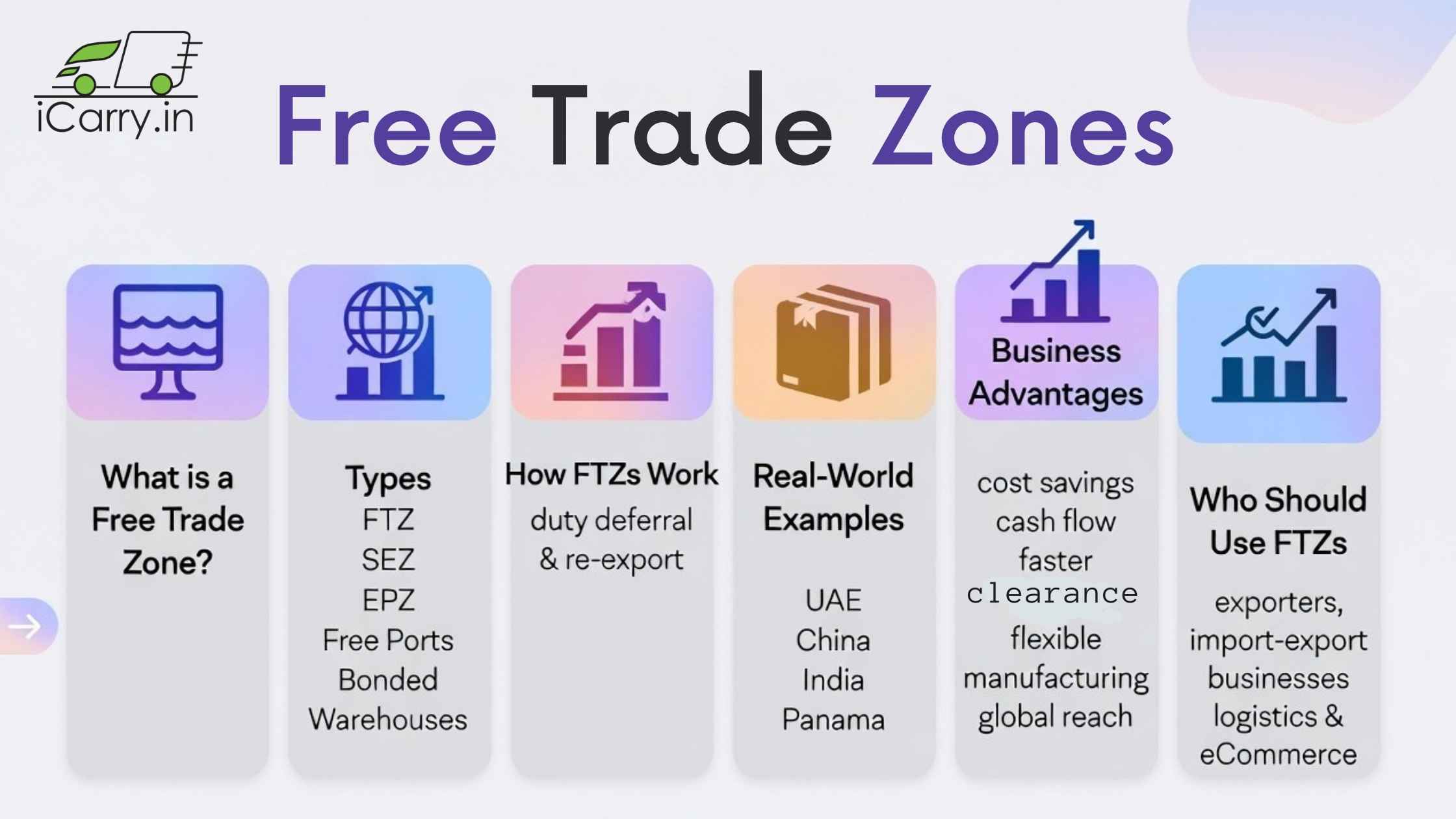
Types of Free Trade Zones
Free Trade Zones (FTZs)
These are basic zones focused on storage, distribution, and re-export. They are commonly located near ports and airports to support fast movement of goods.
Special Economic Zones (SEZs)
SEZs are larger zones that offer tax incentives, manufacturing facilities, and export-focused infrastructure. They are widely used in countries such as India and China.
Export Processing Zones (EPZs)
EPZs are designed specifically for manufacturing goods for export and often allow duty-free import of raw materials.
Free Ports
Free ports are large areas with relaxed customs controls, usually located at major global shipping hubs and trade gateways.
Bonded Warehouses
Bonded warehouses allow goods to be stored while deferring customs duties until clearance. They are commonly used for inventory management and working capital optimization.
Real-World Examples of Free Trade Zones
The Jebel Ali Free Zone in the UAE serves as a major global logistics hub.
The Shenzhen SEZ in China is a world-renowned manufacturing and export powerhouse.
The Kandla SEZ in India supports export-oriented industries.
The Panama Free Zone acts as a key trade hub for Latin America.
These zones play a critical role in global supply chains.
Business Advantages of Free Trade Zones
FTZs help businesses achieve duty and tax savings, as customs charges are reduced, deferred, or eliminated.
They improve cash flow, since duties are paid only when goods enter the local market.
FTZs enable faster customs clearance through simplified procedures, reducing delays.
They allow flexible manufacturing and assembly, including repackaging and labeling at lower costs.
FTZs also support strategic global positioning, allowing businesses to serve multiple markets from a single logistics hub.
Who Should Use Free Trade Zones?
Free Trade Zones are ideal for exporters, import-export businesses, manufacturers, logistics companies, and global eCommerce sellers.
They are especially useful for businesses handling high-volume or high-value goods.
Free Trade Zones vs Normal Trade Areas
In Free Trade Zones, customs duties are deferred or exempt, regulations are simplified, goods can be processed freely, and the focus is strongly on exports.
In normal trade areas, duties are paid immediately, regulations are standard, processing is limited, and export focus is mixed.
FTZs significantly reduce trade friction.
Challenges of Using Free Trade Zones
Using FTZs requires compliance with regulatory requirements, initial setup and licensing costs, limited access to domestic sales, and accurate record-keeping.
FTZs benefit businesses that are organized and process-driven.
Free Trade Zones in Modern Global Trade
As global trade supply chains grow more complex, FTZs are becoming critical for logistics optimization, central to re-export strategies, and increasingly important for cost control.
They are no longer optional for global businesses. They are strategic tools.
Summary
Free Trade Zones exist to make international trade easier and more efficient.
For businesses, they offer cost efficiency, speed, operational flexibility, and global reach.
When used correctly, Free Trade Zones can significantly improve profitability, competitiveness, and supply chain resilience.
Free Trade Zones are not just tax-saving tools—they are strategic assets that enable businesses to compete globally with lower costs, faster operations, and greater flexibility.