A 180 kg order is too heavy for a courier and too small to fill a truck. Book the wrong mode and you pay for it in freight, delays and damage.
What Is PTL?
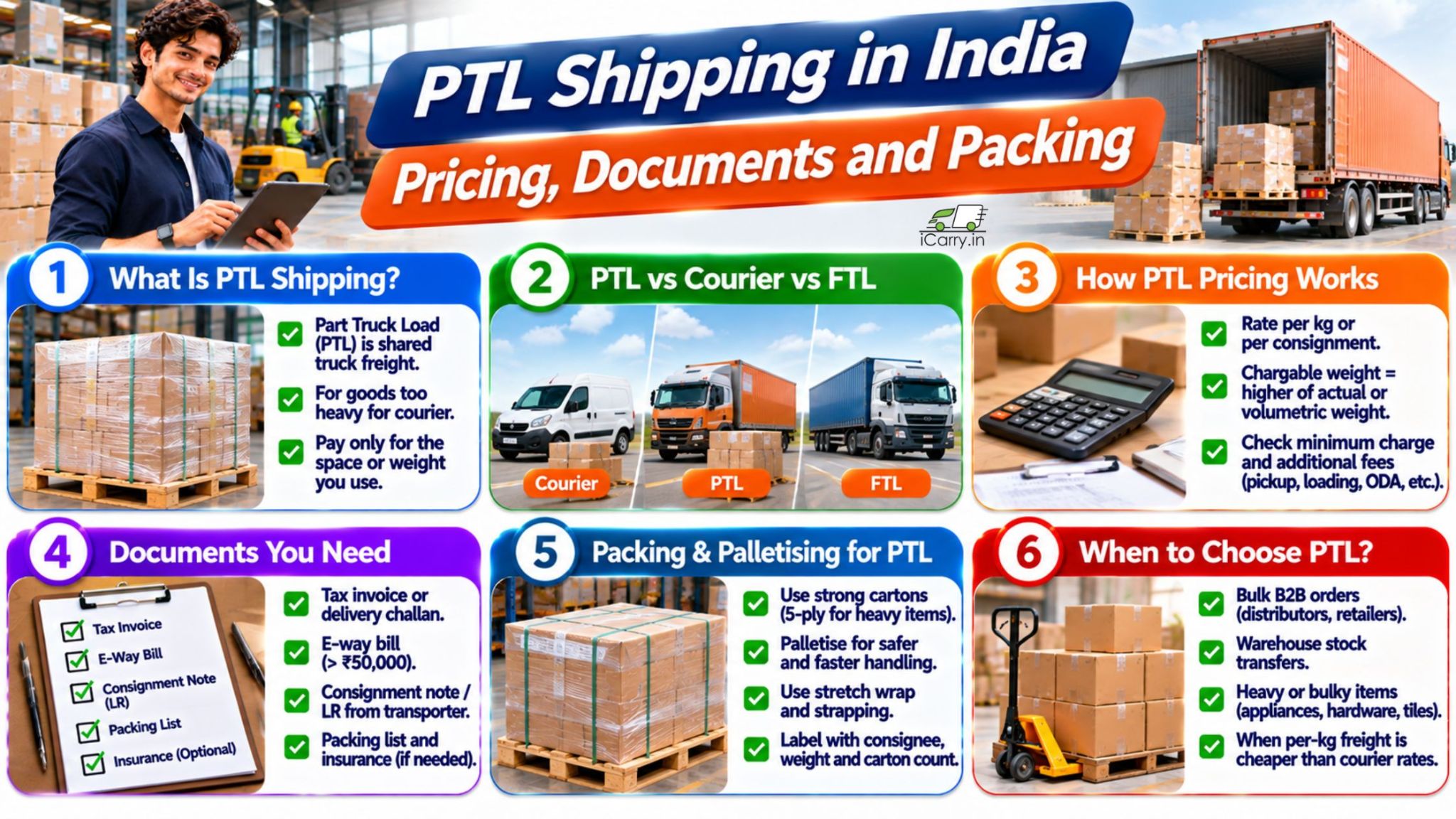
PTL (Part Truck Load) is a freight service for consignments that are too large or heavy for courier, but too small to fill a whole truck. Your goods share truck space with other shippers' goods, and you pay only for the weight or space you use.
In India, PTL is often used interchangeably with LTL (Less Than Truckload). Providers differ in how they use the terms, so confirm what a quote includes. In both cases, the goods travel through a network of transport hubs rather than on a dedicated vehicle.
PTL is widely used by manufacturers, distributors and B2B sellers, as India's logistics sector grows. It sits between a courier, which is built for parcels, and FTL, which books an entire truck.
PTL vs Courier vs FTL
- Courier: Best for single parcels and small multi-box orders, usually up to around 25 to 30 kg per piece. Door-to-door with tracking and COD options
- PTL: Best for consignments from roughly 50 to 100 kg up to several tonnes, depending on the provider. Priced per kg with a minimum chargeable weight
- FTL: Best when you fill most of a truck, or need a dedicated vehicle for speed, security or special handling
The exact switch points depend on the route and the provider. Compare quotes for the same consignment across modes before deciding.
How PTL Pricing Works
- Rate per kg or per consignment: Rates depend on the origin, destination, weight and the provider
- Chargeable Weight: The higher of actual weight and volumetric weight. PTL carriers use their own volumetric factor, which may differ from the standard courier formula. Always confirm the applicable volumetric factor with the carrier before booking
- Minimum charge: Many providers set a minimum chargeable weight per consignment
- Additional charges: Pickup, loading, unloading, fuel, ODA and handling charges may apply
- Waiting charges: Delays at loading or delivery can lead to detention or demurrage charges
- Risk terms: Freight is often offered on owner's risk, with limited carrier liability, or on carrier's risk for an extra fee. Check what is covered
Always compare all-in costs: Add freight, loading, unloading, ODA, handling and insurance to see the true price, not only the headline rate.
When PTL Makes Sense
- Orders too heavy for courier, such as cartons above courier limits
- Large B2B orders to a distributor, retailer or project site
- Stock transfers between warehouses, in pallets or bulk cartons
- Heavy, bulky products such as appliances, hardware, tiles or furniture
- Consignments where per-kg freight is cheaper than courier rates
PTL is usually not the right choice for urgent, fragile, high-value or time-critical consignments, where fewer handling points matter more than cost.
Documents You Need
- Tax invoice or delivery challan: Matched to the consignee, with correct GST details
- E-way bill: Required when the value of goods in a consignment exceeds ₹50,000. Generate it before dispatch
- Consignment note or LR (lorry receipt): Issued by the transporter. It is the main transport document and tracking reference
- Packing list: Itemised list that matches the invoice
- Insurance documents: If you buy cover for the consignment
Packing and Palletising for PTL
- Use strong cartons, 5-ply for heavy items, and reinforce seams with tape or strapping
- Palletise where possible. Pallets speed loading and reduce handling damage
- Stack cartons evenly, and avoid overhang that can be crushed
- Use stretch wrap and strapping so cartons cannot slide or fall
- Mark each carton and each pallet with the consignee, weight and carton count
- Mark FRAGILE and THIS SIDE UP, and do not stack heavy cartons on fragile ones
- Take photographs of the packed and loaded consignment before dispatch
Handling, Transit Time and Damage Risk
- Multiple handling points: PTL goods are often moved between hubs and vehicles, so they face more handling than a direct truck
- Transit time varies: It depends on the route, hub timings and the carrier network. Ask for an indicative transit time and track by LR number
- Damage risk is higher than FTL: Use better packing and consider insurance
- Check count and condition at delivery: Count cartons or pallets before signing, and note damage on the delivery receipt
Delivery Requirements at the Receiver
- Confirm whether the receiver has a loading dock, forklift or ground-floor access
- Ask whether the carrier provides tail-lift or unloading help, and at what charge
- Agree on delivery hours, a contact person and an appointment where needed
- Share the consignment details so the receiver is ready, to avoid detention charges
How to Reduce PTL Costs
- Consolidate several orders going to the same region into one consignment
- Palletise to reduce handling and damage
- Right-size cartons so volumetric weight does not inflate the bill
- Compare at least two or three providers for your lanes
- Plan pickups and deliveries to avoid waiting charges
- Track damage and delay rates per provider and shift volume to the better ones
For orders that can travel as parcels, see how to book a multi-box B2B shipment on iCarry®.
How iCarry® Fits In
iCarry® is a courier aggregator that helps businesses manage parcel-level shipping through multiple courier partners. For larger consignments that require PTL or FTL freight, sellers should use a suitable freight provider.
- Multi-Box B2B Booking: For eligible orders that can travel within courier limits, use iCarry® B2B Multi-Box Shipping to book multiple cartons as one linked shipment. Watch how to book a B2B multi-box shipment.
- Rate Comparison at Packed Weight and Dimensions: Compare available courier partners using your shipment's actual packed weight and dimensions to understand which services can accommodate your consignment.
- Support for Parcel Limits: Unsure whether your shipment qualifies for courier or B2B multi-box booking? Contact iCarry® customer support. The team can guide you through the applicable weight and dimension limits and booking process.
Start with the free Bronze plan, with no minimum shipment volume. Register at iCarry
Frequently Asked Questions (FAQs)
What does PTL mean in shipping?
PTL stands for Part Truck Load. It is a freight service for consignments that are too big for courier but too small to fill a truck. Your goods share a vehicle with other shippers' goods, and you pay for the weight or space you use.
What is the difference between PTL and FTL?
In PTL, your goods share a truck with others and travel through hubs. In FTL, you book an entire truck for your consignment. FTL is faster and has fewer handling points, but costs more unless you fill most of the truck.
How is PTL freight priced?
Usually by chargeable weight, which is the higher of actual and volumetric weight, at a rate for the route, plus any minimum charge and additional charges such as loading, unloading, fuel, ODA and handling. Ask each provider for an all-in quote and its volumetric factor.
Do I need an e-way bill for PTL shipments?
Yes, when the value of goods in the consignment exceeds ₹50,000. Generate the e-way bill before dispatch, and keep the invoice or delivery challan and the consignment note with the goods.
PTL (Part Truck Load) fits consignments too heavy for courier but too small for a full truck. Compare all-in quotes across courier, PTL and FTL, confirm each carrier's volumetric factor and minimum charge, palletise and strap your cartons, and generate the e-way bill when the consignment value exceeds ₹50,000.