You import 100 fitness products at ₹500 each and price them at ₹650, expecting a healthy margin. Then the freight, customs duty and CHA bills arrive, and your real cost is ₹818.70 per unit. You are now losing money on every sale.
What Is a Landed Cost?
Landed cost is the total cost of a product from its country of origin to your warehouse or point of sale in India. It includes every expense incurred to get the product from the supplier's location to your shelf - not just the purchase price.
Most importers make their first pricing mistake by treating the purchase price (FOB or CIF value) as the cost basis. The actual cost by the time the goods reach your warehouse can be 30 to 70% higher than the FOB price. Pricing without landed cost means selling at a margin you never actually had.
The Landed Cost Formula
Landed Cost = Purchase Price + International Freight + Insurance + Customs Duty + IGST + Port and CHA Charges + Inland Freight to Warehouse
Each Component Explained
1. Purchase Price (FOB or EXW Value)
The price paid to the overseas supplier. If quoted FOB (Free on Board), the supplier has paid freight to the port of export. If EXW (Ex Works), you pay freight from the supplier's factory. FOB is the most common Incoterm for imports into India, but customs duty is calculated on the CIF value, not FOB.
2. International Freight
The cost to ship from the origin country to an Indian port (Mumbai, Chennai, JNPT, Delhi ICD, etc.). Varies significantly by:
- Mode: air freight (expensive, fast) vs ocean freight (cheaper, slower)
- Origin country and port pair
- Volume (FCL - full container load vs LCL - less than container load)
- Season and carrier capacity
For air imports: International air freight is typically charged on volumetric weight (L x B x H in cm, divided by 6,000) or actual weight, whichever is higher. For dense goods, actual weight dominates. For lightweight bulky goods, volumetric weight dominates.
3. Insurance
Marine or air cargo insurance covering the shipment from origin to Indian port. Often around 0.5 to 1% of the shipment value. If you give customs no insurance document, it adds 1.125% of the FOB value as insurance. Optional but strongly recommended for high-value imports. If not separately insured, some carriers provide minimal per-kg liability.
4. Customs Duty
India's customs duty structure for imports has multiple components. Check the current applicable rates on the CBIC customs tariff portal:
- Basic Customs Duty (BCD): The primary import tariff. Rates vary widely by product HS code, and the median BCD rate is 10%. Many manufactured goods attract 10 to 20% BCD. Some goods also face anti-dumping or safeguard duties
- Social Welfare Surcharge (SWS): 10% of the BCD amount. Some items are exempt, so check your HS code
- IGST on imports: Applied on (Assessable Value + BCD + SWS). Rate is the same as the domestic GST rate for that product (5%, 18% or 40% since the 22 September 2025 GST rate reform). Critically, this IGST is claimable as Input Tax Credit by GST-registered importers
- Assessable value for duty calculation: CIF value (FOB + Insurance + Freight) is the base. Customs computes duty on this CIF value, not FOB
Example: FOB value ₹1,00,000. Insurance ₹1,000. Freight ₹8,000. CIF = ₹1,09,000. BCD at 20% = ₹21,800. SWS at 10% of BCD = ₹2,180. IGST at 18% on (1,09,000 + 21,800 + 2,180) = 18% on ₹1,32,980 = ₹23,936. Total duty and taxes = ₹47,916. Effective duty rate: 47.9% of FOB value.
5. Port and CHA Charges
The customs house agent (CHA) or customs broker charges for processing the import documentation and clearing the goods through customs:
- Bill of Entry filing charges: ₹2,000 to ₹7,000 typically
- Port handling charges, CFS (Container Freight Station) charges
- Container examination fee if physical inspection is ordered
- Storage charges if clearance is delayed
- CHA professional fee: typically ₹5,000 to ₹20,000 depending on shipment value and complexity
6. Inland Freight to Warehouse
The cost to move goods from the Indian port or ICD to your warehouse. For a shipment arriving at JNPT and warehoused in Delhi, this is a significant additional freight cost. For a shipment arriving at Delhi ICD with a Delhi warehouse, it is minimal.
Include last-mile delivery costs if goods are shipped directly to customers from the port without intermediate warehousing.
Selling to customers after clearance? Compare courier rates for your parcels with the iCarry® domestic rate calculator, so your price covers delivery as well as landed cost.
IGST Input Tax Credit - The Hidden Benefit
Critical: The IGST paid at import is fully claimable as Input Tax Credit (ITC) by GST-registered businesses selling the imported goods domestically. This means the IGST component of landed cost is not a real cost for any GST-registered importer, whether it sells to businesses or to consumers - it flows back through the ITC mechanism. See the CBIC GST FAQ on imports.
For landed cost pricing purposes:
- GST-registered importers (B2B or B2C sellers): exclude IGST from landed cost since it is fully recoverable as ITC
- Unregistered or composition-scheme sellers: include IGST in landed cost as it cannot be recovered
Moving cleared goods to business buyers? See how to book a multi-box B2B shipment on iCarry® once your import is in the warehouse.
Worked Landed Cost Example
Importing 100 units of a fitness product from China, FOB price ₹500 per unit (₹50,000 total):
- FOB value: ₹50,000
- International sea freight: ₹8,000
- Insurance: ₹500
- CIF value: ₹58,500
- BCD at 20%: ₹11,700
- SWS at 10% of BCD: ₹1,170
- IGST at 18% on ₹71,370: ₹12,847 (recoverable as ITC for GST-registered importer)
- CHA and port charges: ₹8,000
- Inland freight to warehouse: ₹2,500
- Total landed cost (excluding recoverable IGST): ₹81,870 for 100 units = ₹818.70 per unit vs ₹500 FOB
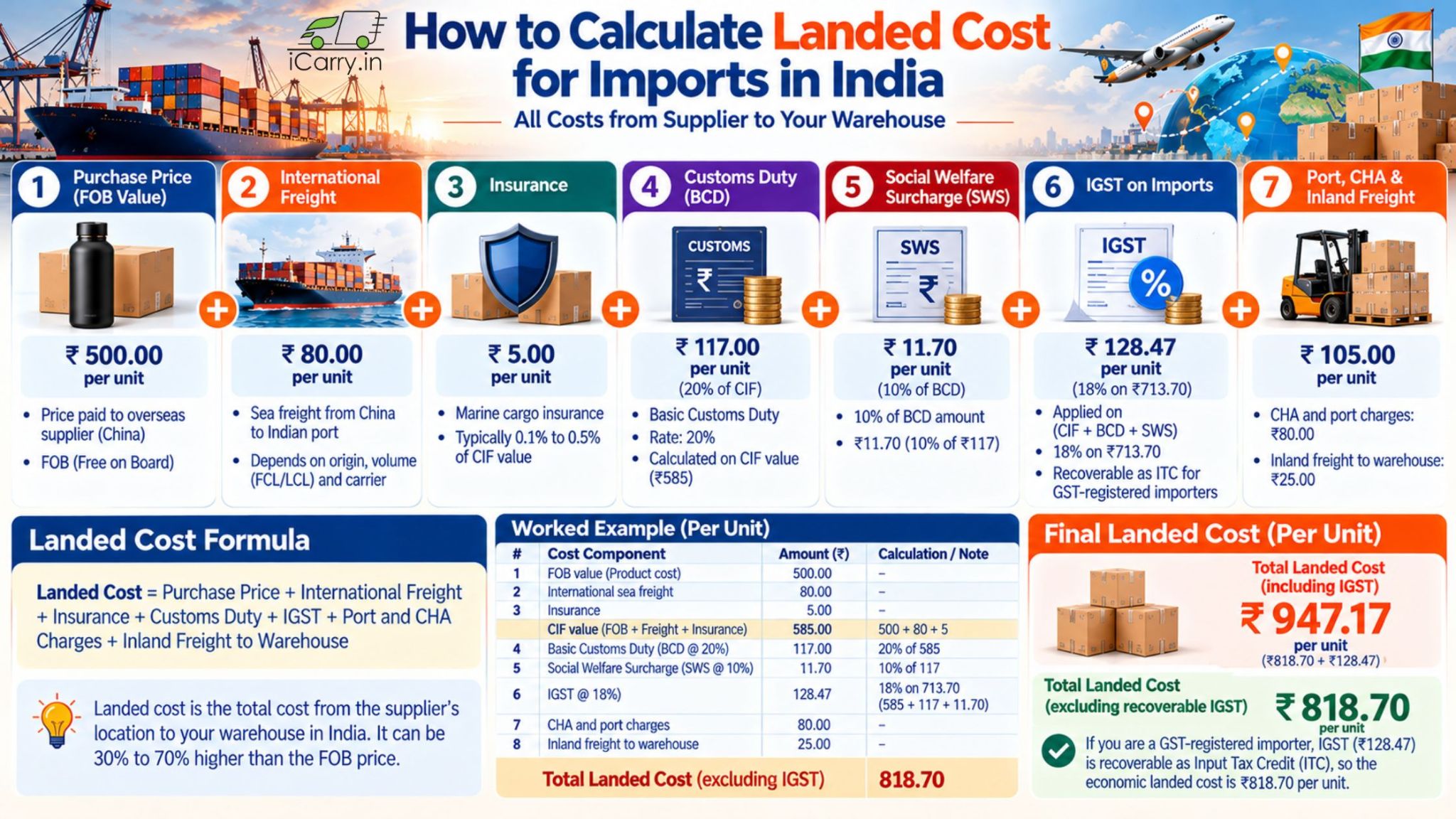
The FOB price was ₹500 per unit. The true landed cost is ₹818.70 - a 64% premium over FOB. Pricing based on FOB would have meant selling at a fraction of the actual cost basis.
How to Calculate Landed Cost in 6 Steps
- Get the FOB or EXW price: Start with the supplier's invoice, since every other cost is added on top of it
- Add freight and insurance: This gives you the CIF value, which is the base for customs duty
- Work out duties: Apply BCD on CIF, then SWS on the BCD, because each step builds on the one before
- Add IGST: Apply it on CIF + BCD + SWS, and leave it out of landed cost if you are GST registered, as you can claim it back
- Add CHA, port and inland costs: These small items add up, so get a written quote before the goods arrive
- Divide by units: This gives your landed cost per unit, the number to price against
How iCarry® Helps Manage Post-Import Shipping Costs
Calculating landed cost does not end when your imported goods clear customs. You also need to account for the cost of moving inventory from your warehouse to customers or business buyers across India. iCarry® helps businesses manage this stage through access to multiple courier partners and shipping rate comparisons.
- Domestic shipping rate comparison: Use the iCarry® domestic shipping rate calculator to estimate delivery costs and factor them into your product pricing.
- Multiple courier partners: Compare courier rates before booking and choose suitable services based on shipment weight, dimensions, destination, and serviceability.
- B2B bulk distribution: If you distribute imported inventory to retailers, dealers, or business buyers, use B2B multi-box shipping to manage multiple cartons within a linked shipment.
- Pan-India shipment management: Manage domestic shipments and track deliveries across available courier partners through one account, helping you keep post-import distribution costs visible when calculating overall profitability.
By accounting for domestic shipping alongside purchase price, freight, customs duties, and other import expenses, you can make better-informed pricing decisions and protect your margins.
Free Bronze plan with no minimum shipment volume.
Frequently Asked Questions (FAQs)
What is the difference between FOB price and landed cost?
FOB (Free on Board) price is what you pay the supplier at their port of export. Landed cost is the total cost after adding international freight, insurance, Indian customs duty (BCD + SWS + IGST), port and CHA charges, and inland freight to your warehouse. Landed cost is typically 30 to 70% higher than FOB price depending on the product's customs duty rate and freight mode.
Is IGST paid on imports recoverable?
Yes, for GST-registered businesses. The IGST paid at import is claimable as Input Tax Credit (ITC) and can be offset against your GST output liability on domestic sales. If you are GST registered, IGST at import flows through the ITC chain whether you sell to businesses or to consumers, so it is not a real cost. Only unregistered or composition-scheme sellers must treat IGST as a real cost in landed cost calculations.
How do I find the customs duty rate for a specific imported product?
Check the CBIC (Central Board of Indirect Taxes and Customs) customs tariff portal at cbic.gov.in. Enter your product's HS code to find the Basic Customs Duty rate. Add 10% Social Welfare Surcharge on BCD. Add IGST at the domestic GST rate applicable to your product. Apply them in order: SWS on the BCD, then IGST on the CIF value plus BCD plus SWS. Simply adding the three rates together understates your effective rate.
What is the assessable value for customs duty calculation?
The assessable value is the CIF (Cost Insurance Freight) value of the imported goods - the FOB price paid to the supplier plus international freight plus insurance. Customs duty is calculated on this CIF value, not the FOB value alone. This means international freight and insurance costs directly affect the customs duty amount, which is why optimising freight costs also reduces your duty liability.
Pricing imports on FOB alone loses money: landed cost adds international freight, insurance, customs duty (BCD, SWS and IGST), CHA and port charges, and inland freight. In the worked example, ₹500 FOB becomes ₹818.70 per unit - a 64% premium. GST-registered importers can claim the IGST back as ITC, so leave it out of landed cost, and add domestic shipping to your price too.