A beauty brand sells a ₹199 lip balm. The customer pays ₹199. The brand's cost of goods is ₹65. Gross margin before shipping: ₹134.
Now add the actual fulfillment cost. Courier freight to Zone B: ₹48. Fuel surcharge: ₹7. COD handling fee (COD order): ₹22. Packaging: ₹14. Total logistics cost: ₹91.
Net margin per order: ₹43. On a ₹199 sale.
Now add the RTO provision. If 25% of COD orders for this product return, the expected loss per order dispatched increases by another ₹16 (0.25 x ₹65 round-trip freight). Effective net margin: ₹27 on a ₹199 order. That is 13.5%. For Indian businesses shipping at scale, this 13.5% margin erodes further with every payment gateway fee, return handling cost, and customer service query.
Low-value orders are not inherently unprofitable. But they become unprofitable when shipped with the same logistics assumptions as high-value orders. This guide explains how to make them work.
What Makes a Low-Value Order Unprofitable?
A low-value order becomes unprofitable when fixed logistics costs - base freight, fuel surcharge, COD handling fee, packaging, and RTO provision - are modelled the same way as they are for a high-value order. These costs barely change whether an order is worth ₹199 or ₹1,999, so as a share of order value they can consume 80 to 90% of gross margin on the cheapest items versus 20 to 30% on higher-priced ones. The fix isn't avoiding low-value orders altogether - it's pricing, packaging, and payment policy that account for how disproportionate these costs are at the low end.
How to Check If Your Low-Value Orders Are Profitable
- Have you calculated net margin per order at your lowest price point after freight, surcharge, packaging, and COD fee?
- Do you know your RTO rate specifically on low-value COD orders?
- Is your packaging right-sized for your smallest products - or are you using the same box for everything?
- Have you set a free shipping threshold that excludes your lowest-value orders from free shipping?
- Have you tested a minimum order value or a product bundling strategy to increase AOV?
The Unit Economics of a Low-Value Order
Low-value orders fail the margin test because several logistics costs are fixed per order - they do not scale with order value. The COD handling fee, the packaging cost, and the base freight are roughly the same whether the order is ₹199 or ₹1,999. But as a percentage of order value, they are different.
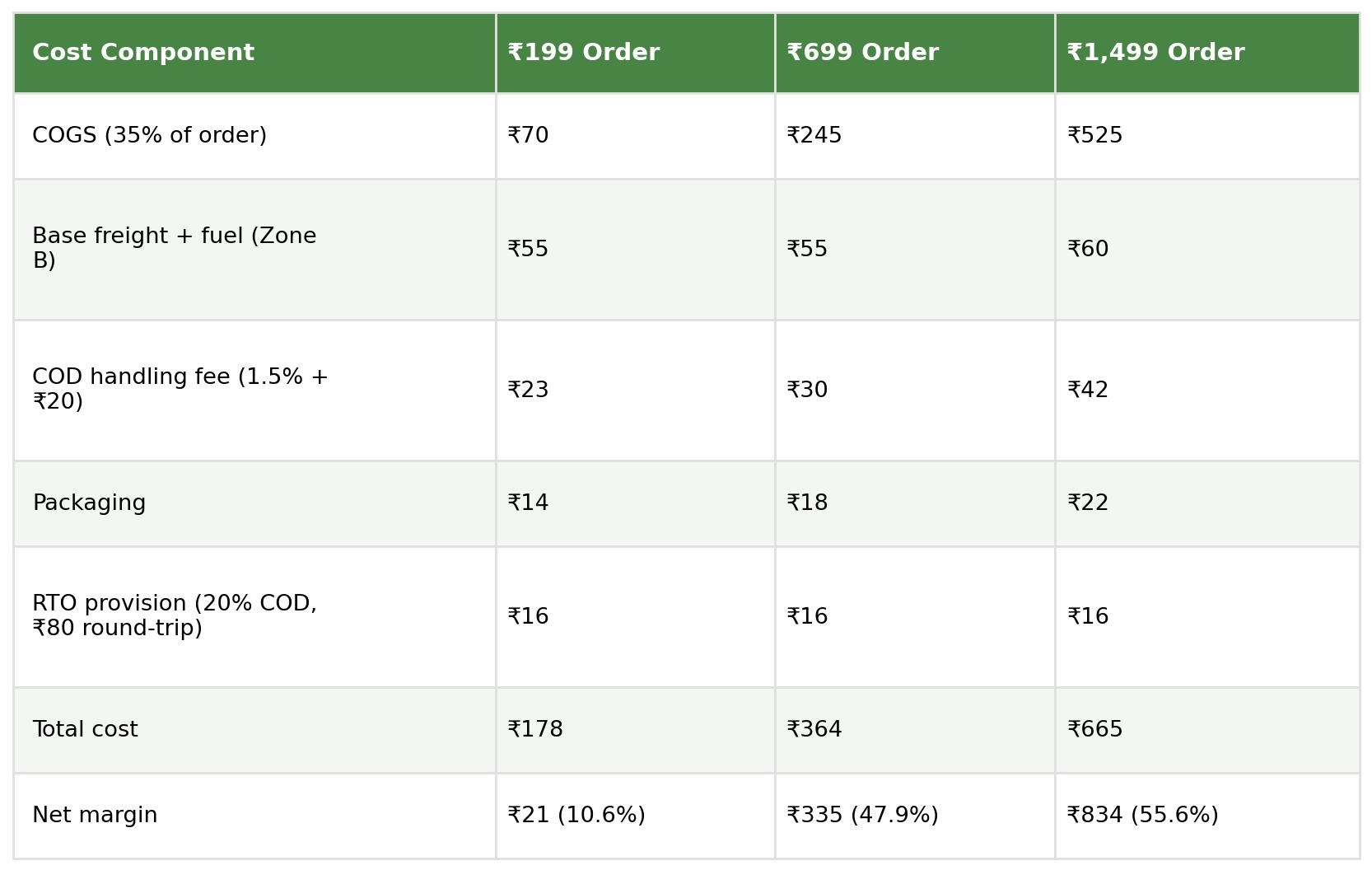
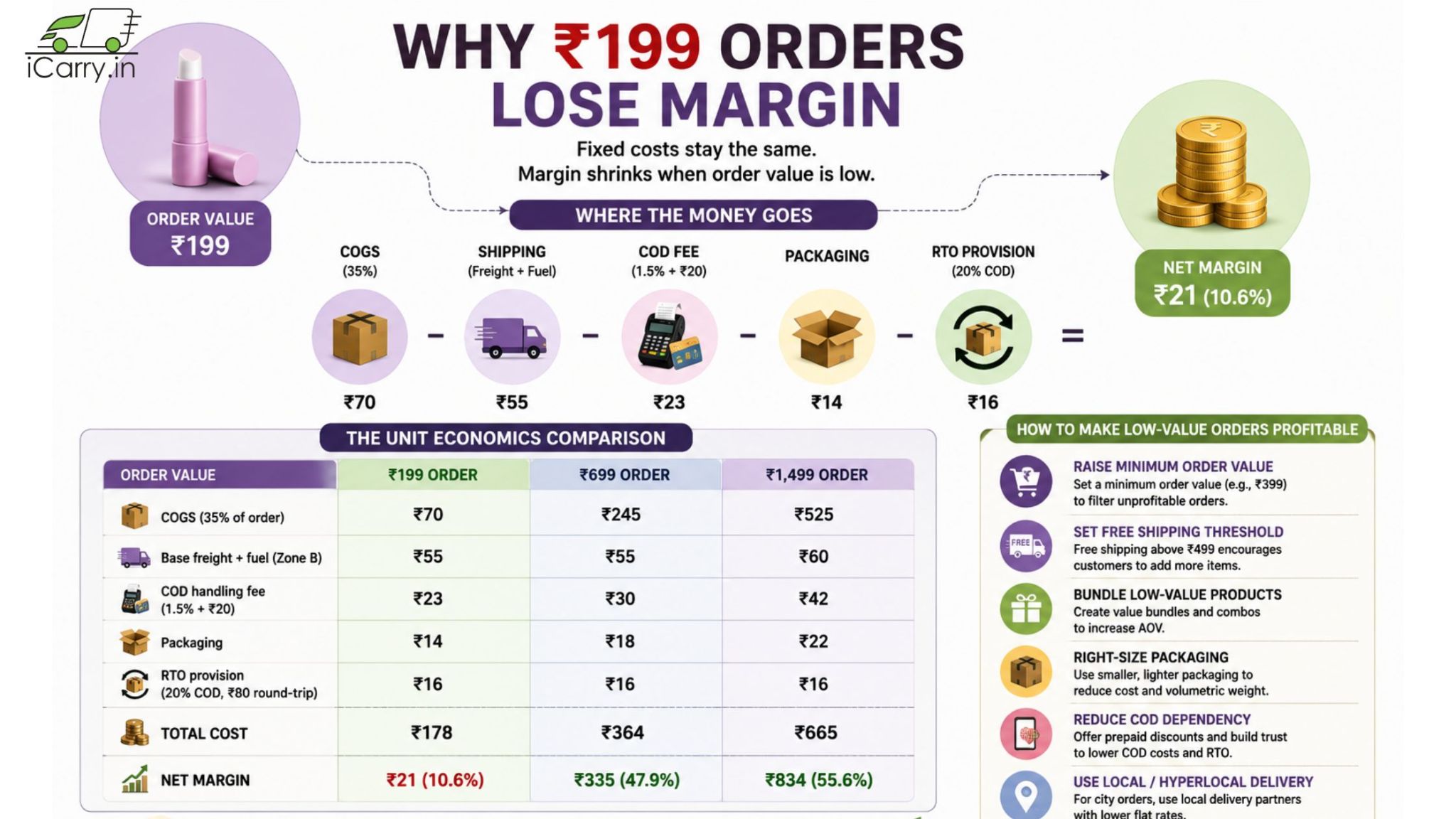
The fixed cost problem is clear. Broadly similar logistics costs - ₹108 on the ₹199 order versus ₹119 on the ₹699 order (freight + surcharge + COD fee + packaging + RTO provision) - leave 10.6% margin at the low end and 47.9% at the higher one. The only way to solve low-value order economics is to reduce the fixed costs, increase the order value, or both.
Strategy 1: Raise Minimum Order Value
The most direct solution. If orders below ₹399 are unprofitable after fulfilment, do not accept them. Set a minimum order value at checkout.
Customers who want the product for ₹199 will add another item to reach the ₹399 threshold. Some will not order at all - these are orders you were losing money on anyway. The net effect is typically positive: fewer orders, higher per-order value, better margin.
How to implement: Show the minimum order value clearly on your product pages and at checkout. 'Minimum order value ₹399 for delivery.' Most customers accept this if the product selection gives them a natural way to reach the threshold.
Strategy 2: Free Shipping Threshold That Excludes Low-Value Orders
If a minimum order value feels too restrictive, a free shipping threshold achieves a similar effect more gently.
'Free shipping above ₹499' makes every sub-₹499 order a paid-shipping order. The customer sees the shipping cost at checkout and must decide whether to pay it, add more items to reach the threshold, or not order.
For a ₹199 product with ₹55 logistics cost, show a ₹50 shipping charge below the threshold. The customer who pays it converts the order economics from 10.6% margin to approximately 35% margin. The customer who adds a second ₹199 product pushes the order to ₹398 - still below threshold but with doubled margin before shipping is factored in.
Setting the right threshold: Calculate the order value at which your blended logistics cost as a percentage of order value falls below your minimum acceptable margin. For most businesses, this is between ₹399 and ₹699.
Strategy 3: Bundle Low-Value Products
If your product catalogue has multiple items in the ₹150 to ₹299 range, bundle them.
- Two-product bundle: Two ₹199 items bundled at ₹349 (a discount) ship in one parcel, share one COD fee, one freight charge, one packaging cost. The logistics cost per rupee of revenue drops sharply
- Trial kit or starter pack: Bundle three or four smallest products into a single SKU at a combined price. One parcel, one logistics cost, higher order value
- Free gift with purchase: A low-cost item added free above a threshold increases perceived value, encourages buyers to reach the threshold, and does not add meaningful logistics cost if it fits in the same parcel
Strategy 4: Right-Size Packaging for Low-Value Products
The most consistently overlooked cost lever. Small, low-value products are frequently shipped in oversized packaging because the seller uses a standard box for all orders. Volumetric weight penalties are particularly punishing for low-value orders where there is no high product margin to absorb them.
A ₹199 lip balm in a 20 x 15 x 10 cm box has a 600g volumetric weight on a 30g product. Billed at 600g. Use a padded mailer sized for the actual product: the lip balm fits in a 10 x 8 x 3 cm mailer, 80g actual, billed at 80g. Freight drops from Zone B 600g rate (₹55) to Zone B 100g rate (₹28). A ₹27 saving on a ₹199 order is the difference between 10.6% margin and 24% margin.
Strategy 5: Shift Low-Value COD Orders to Prepaid
COD handling fee is a fixed cost that hits hardest on low-value orders. On a ₹199 order, the COD fee (₹23) is 11.5% of order value. On a ₹1,499 order, the same fee structure (₹42) is 2.8%. The impact is disproportionate at low values.
Offer a visible incentive to switch to prepaid on low-value orders:
- Prepaid discount: '₹30 off for prepaid payment on this order.' The discount costs you ₹30 but eliminates the ₹23 COD fee and significantly reduces RTO probability - likely net positive
- UPI collect before dispatch: For new customers placing low-value COD orders, send a UPI payment request via WhatsApp before dispatch. Customers who genuinely want the product will often pay. Customers who were impulse-ordering will not - saving you the logistics cost entirely
- Disable COD below a threshold: Remove COD as a payment option for orders below ₹299. Show only UPI and card. The friction of prepaid payment filters out the lowest-intent low-value COD buyers
Strategy 6: Reduce RTO Rate on Low-Value Orders
Low-value COD orders have the highest RTO rates. A buyer who spent ₹199 impulse-ordering at 11 PM has far less commitment than one who spent ₹1,499. Every RTO on a low-value order absorbs the entire thin margin of 2 to 3 successful deliveries. This matters more every year, since Tier 2 and 3 cities - where COD dependency and RTO risk both run higher - are projected to drive 66% of new D2C orders in FY26 (IBEF). Reducing RTO on low-value COD orders is as important as raising the order value.
- Order confirmation for all low-value COD orders: Send a WhatsApp confirmation before dispatch. The 10-second effort eliminates the lowest-intent orders before you spend money on packing and shipping
- Do not ship to high-RTO pincodes without confirmation: Use your historical data. If a pincode has a 40%+ RTO rate and the order is sub-₹299 COD, require confirmation or prepaid
- Limit reattempts on low-value orders: Authorise only one reattempt for low-value COD orders that fail first delivery. Two return trips on a ₹199 order is not commercially viable
Strategy 7: Use Local and Hyperlocal Couriers for City Orders
For same-city low-value orders, hyperlocal couriers can significantly reduce last-mile cost compared to express courier networks. A Zone A order that would cost ₹35 to ₹45 via a standard courier might cost ₹20 to ₹28 via a hyperlocal same-day courier within the same city.
iCarry®'s Borzo collaboration provides same-day hyperlocal delivery within cities - particularly useful for food, fresh products, and time-sensitive low-value orders where same-day delivery is a value proposition and city-only coverage is acceptable.
What Low-Value Orders Are Actually Worth
Before optimising or eliminating low-value orders entirely, consider what they are worth beyond the single transaction:
- Trial purchase: A ₹199 first order from a new customer who subsequently orders ₹1,499 and ₹2,499 is worth investing in even at thin margin on order one
- Customer acquisition: If the ₹199 order costs ₹172 in fulfilment but the customer's lifetime value is ₹8,000, the first order is not a loss - it is an acquisition cost
- Product sampling: Low-value entry products are often deliberate sampling mechanisms. The margin calculation is different when the repeat purchase rate is high
The distinction: low-value orders that convert to repeat high-value buyers are worth managing carefully. Low-value orders from customers who never return are worth eliminating through threshold and COD controls.
How iCarry® Reduces Logistics Cost on Low-Value Orders
iCarry® is a courier aggregator that helps Indian businesses reduce per-order logistics cost across all order values:
- Pre-negotiated rates: Access aggregator rates from the first shipment. On a 100g poly mailer order, the difference between rack rate and aggregator rate can be ₹10 to ₹15 - significant on a ₹199 order
- Rate comparison: Compare rates across multiple couriers before every booking. Compare rates before booking to ensure low-value orders always ship at minimum cost
- Two-way WhatsApp engagement: Reduces failed delivery probability on low-value COD orders by enabling customers to reschedule - avoiding the RTO that destroys thin margins
- COD remittance: Free automatic T+7 settlement on all plans including Bronze, with Early COD from T+0 so businesses can receive COD funds as early as the next day after delivery.
- Borzo hyperlocal: Same-city low-value orders via Borzo at lower Zone A rates than standard courier networks
Free Bronze plan, no minimum volume, no monthly fee.
Final Thoughts
Low-value orders are not inherently unprofitable. They become unprofitable when shipped with oversized packaging, COD on orders that should be prepaid, no RTO management, and no threshold to encourage higher order values.
Fix the packaging first - it is the fastest, cheapest intervention. Then set a shipping threshold that makes low-value orders paid-shipping. Then shift low-value COD to prepaid where possible. The combination of these three changes converts most losing low-value orders into profitable ones without turning away customers who genuinely want the product.
Model the numbers for your specific product. The answer is always in the data.
Frequently Asked Questions (FAQs)
Why are low-value orders often unprofitable in India?
Because logistics costs - courier freight, fuel surcharge, COD handling fee, packaging, and RTO provision - are largely fixed per order regardless of order value. On a ₹199 order these fixed costs can consume 80 to 90% of gross margin. On a ₹999 order the same fixed costs consume 20 to 30% of gross margin. The product margin is the same; the logistics burden as a percentage is vastly different.
What is the best way to increase average order value for low-value products?
Set a minimum order value or free shipping threshold that nudges customers to add more items. Create product bundles of two to four complementary low-value items into a single SKU at a combined price. Add a 'free gift with purchase above ₹X' offer. All three strategies increase order value without requiring the customer to pay more for a single item.
Should I disable COD for orders below a certain value?
For orders below ₹299, disabling COD or adding a visible COD charge (₹25 to ₹30) is worth testing. The COD handling fee on a ₹199 order is 11.5% of order value. Requiring prepaid for low-value orders filters the lowest-intent buyers, reduces RTO significantly, and eliminates the COD handling fee - improving margin substantially.
How does right-sizing packaging help low-value order economics?
Courier charges are based on the higher of actual weight and volumetric weight (L x B x H in cm / 5,000). A small product in an oversized box bills at a much higher volumetric weight than its actual weight. Right-sizing to a padded mailer or smaller corrugated box reduces billed weight - and therefore freight cost - often by ₹15 to ₹30 per order, which is transformative for thin-margin low-value orders.
What is a good free shipping threshold for low-value product sellers in India?
Calculate the order value where your blended logistics cost (freight + surcharge + COD fee + packaging + RTO provision) falls below your minimum acceptable margin percentage. For most mid-margin D2C products this is between ₹399 and ₹699. Start at ₹499, measure the percentage of orders that hit the threshold naturally, and adjust based on conversion impact.
Low-value orders are not a lost cause - they are a unit economics problem with known fixes. Right-size the packaging first, since it is the fastest and cheapest change. Add a free shipping or minimum order threshold so low-value orders stop absorbing the same fixed costs as high-value ones for free. Shift COD to prepaid where you can, and manage RTO aggressively on the orders that remain COD. None of this means turning away genuine low-value buyers - it means stopping the ones that were costing you money on every single delivery.