Why Pallets Matter for B2B Shipping
Twenty loose cartons going to a distributor can be unloaded one by one, counted one by one, and damaged one by one. The same cartons on one pallet can be lifted by a forklift in a single move. For B2B sellers shipping heavy or high-volume orders, pallets cut handling time, reduce damage and make counting simple.
Pallet shipping is common for consignments sent by part truck load, full truck load and warehouse-to-warehouse movement. As India's logistics sector grows, building pallets correctly becomes a basic skill. A badly built pallet leans, collapses or gets rejected at the dock, even if the goods inside are perfect.
What Is Pallet Shipping in India?
Pallet shipping is the movement of goods stacked, wrapped and strapped on a pallet so a forklift can load and unload them in one move. In India it is used for PTL, FTL and warehouse-to-warehouse transfers, and a common pallet size is about 1200 x 1000 mm.
Pallet Sizes and Types
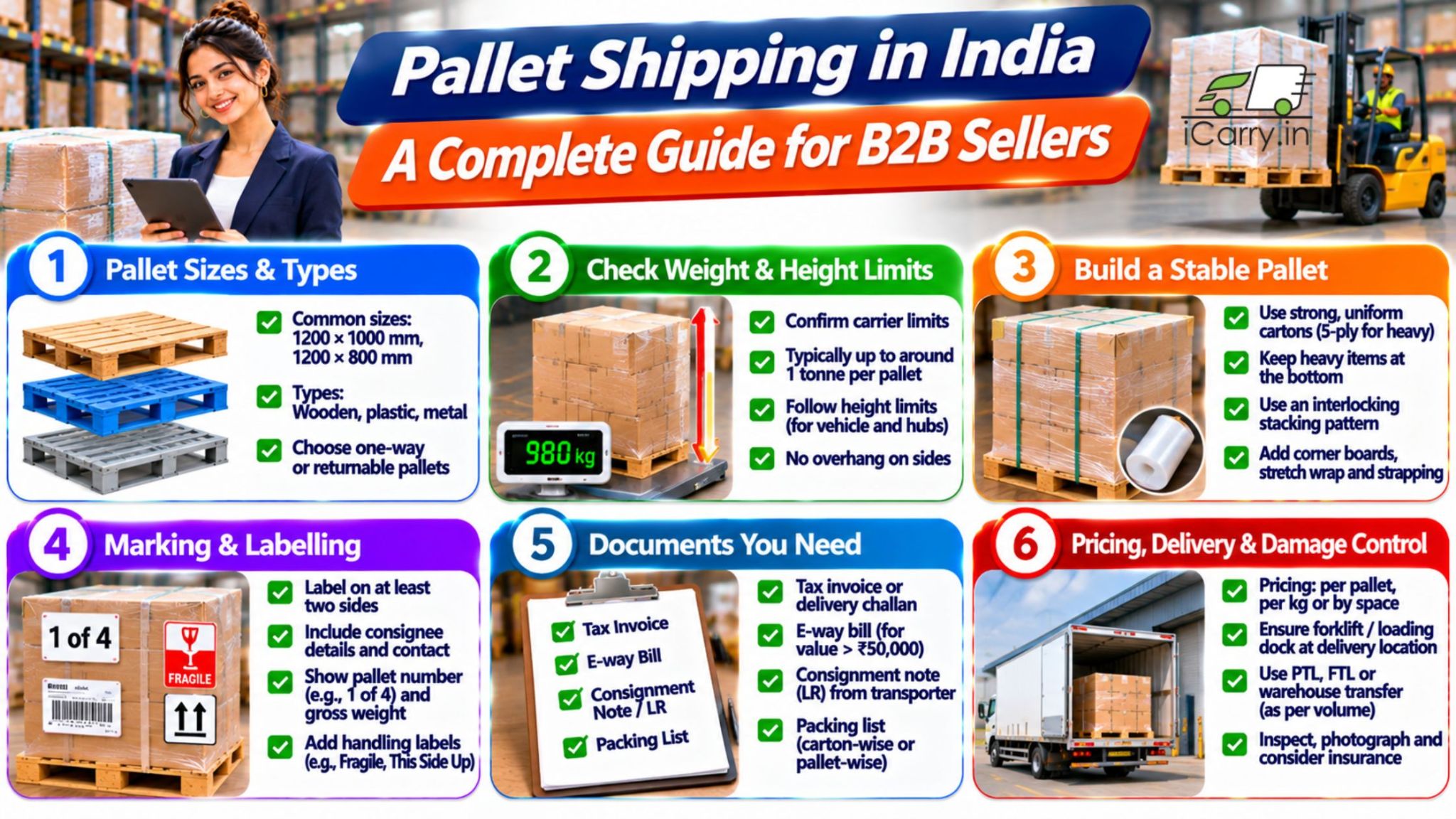
- Common sizes: Pallets of about 1200 x 1000 mm are widely used in India. Other sizes such as 1200 x 800 mm are also used. Confirm which size your carrier and receiver prefer
- Wooden pallets: The most common. Strong and low cost. Check that they are dry, clean and free of cracks or nails sticking out
- Plastic pallets: More durable, easier to clean and lighter. Higher cost. Useful for food, pharma and repeated use
- Metal pallets: For heavy-duty needs. Higher cost and less common in standard B2B shipping
- One-way vs returnable pallets: Agree who owns the pallet and whether it is returned or charged for
Check Weight and Height Limits
- Carriers set limits for pallet weight and pallet height. Confirm them before you build
- As a general guide, many carriers handle pallets of several hundred kilograms up to around a tonne. Heavier pallets may need special handling
- Height limits depend on the vehicle and hub equipment. Taller pallets can be refused or priced at a premium
- Do not exceed the pallet's rated load capacity. Overloaded pallets break under forklifts
- Keep goods inside the pallet footprint. Overhang is easily crushed and can be refused
Note: Limits differ by carrier and service. Treat the figures above as general patterns and get the actual limits from your provider.
Check whether your cartons fit courier limits before you palletise, using the iCarry® domestic rate calculator.
How to Build a Stable Pallet
- Start with a sound pallet: Check for broken boards and protruding nails
- Use uniform, strong cartons: Cartons of the same size stack better. Use 5-ply for heavy goods
- Place the heaviest cartons at the bottom: Lighter and more fragile goods go on top
- Use an interlocking pattern: Brick or column stacking, whichever suits the carton size, so layers lock together
- Keep edges aligned: Cartons should sit flush with the pallet edges without overhang
- Use corner boards and top sheets: Protect the edges and the top layer from strapping and rubbing
- Stretch wrap the whole load: Wrap the pallet from the base to the top, with several turns at the bottom to secure it to the pallet
- Add strapping for heavy loads: Straps give extra stability
- Mixed pallets: Put similar-weight cartons together, and keep products that may leak or contaminate each other apart
Marking and Labelling Pallets
- Attach a label on at least two sides, with the consignee name, address, contact number and consignment details
- Show the pallet number, such as '1 of 4', and the gross weight
- Mark FRAGILE, THIS SIDE UP or DO NOT STACK where needed
- Keep a packing list in a document pouch on the pallet
- Photograph each finished pallet before dispatch
Documents for Pallet Consignments
- Tax invoice or delivery challan: With correct GST and consignee details
- E-way bill: Required when the value of goods in the consignment exceeds ₹50,000
- Consignment note or LR: From the transporter
- Packing list: Carton-wise or pallet-wise, matching the invoice
Pricing and Charges
- Rate basis: Priced per pallet, per kg or by pallet space, depending on the provider
- Chargeable weight: The higher of actual and volumetric or space-based weight
- Pallet charges: Some providers charge for pallets, handling or exchange
- Loading and unloading: Confirm who provides forklift or labour at each end, and at what cost
- ODA, tail-lift and appointment charges: May apply for remote areas or special delivery needs
- Detention and waiting: Delays at loading or delivery can lead to extra charges
Delivery Requirements at the Receiver
- Confirm a loading dock, forklift or pallet jack at the receiving site
- Ask about ground-floor access, gate width and truck access
- Arrange a tail-lift if there is no dock
- Share delivery hours, a contact person and a delivery appointment if needed
- Tell the receiver the number of pallets and the expected weight in advance
Reducing Damage on Pallet Shipments
- Use proper cartons and stack them evenly
- Wrap and strap pallets well, and check them before loading
- Avoid stacking pallets on top of each other unless the load can bear it, and mark it clearly
- Count pallets and check wrap condition at delivery, and note damage on the receipt before signing
- Photograph loaded pallets and keep evidence for claims
- Consider insurance for high-value pallets
For orders that can travel as parcels, see how to book a multi-box B2B shipment on iCarry®.
How iCarry® Fits In
iCarry® is a courier aggregator that helps businesses manage their shipping requirements through multiple courier partners and shipping options. For B2B orders, sellers can explore available parcel and multi-box shipping options based on their shipment requirements.
- B2B Multi-Box Shipping: Manage eligible B2B orders through iCarry® B2B Multi-Box Shipping.
- Rate Comparison Before Booking: Use the Domestic Shipping Rate Calculator to compare available courier options based on shipment details and destination.
- Get Help With Your B2B Shipping Requirements: Have questions about pallet shipments, carton dimensions, weight limits or available shipping options? Contact iCarry® customer support. The team can help you understand the available options and guide you through the next steps.
For B2B orders, contact iCarry® customer support to discuss your shipment requirements and understand how iCarry® can help.
Frequently Asked Questions (FAQs)
What is the standard pallet size in India?
Pallets of about 1200 x 1000 mm are widely used in India, and 1200 x 800 mm pallets are also common. Always confirm the preferred size with your carrier and the receiver before you build the pallet.
How do I secure goods on a pallet?
Stack uniform cartons in an interlocking pattern with the heaviest at the bottom, keep edges flush with no overhang, use corner boards and a top sheet, stretch wrap the whole load from base to top, and add strapping for heavy loads.
Do I need an e-way bill for pallet shipments?
Yes, when the value of goods in the consignment exceeds ₹50,000. Generate the e-way bill before dispatch and keep the invoice or delivery challan and the consignment note with the goods.
How do I reduce damage on pallet shipments?
Use strong, uniform cartons, build stable pallets, wrap and strap them well, mark them clearly, photograph each pallet before dispatch, count and inspect at delivery, and consider insurance for high-value loads.
A pallet that arrives intact is built before it is booked: start with a sound pallet, stack uniform cartons with the heaviest at the bottom in an interlocking pattern, keep edges flush with no overhang, and stretch wrap from base to top with strapping for heavy loads. Label at least two sides with the pallet number and gross weight, carry the invoice or challan, e-way bill above ₹50,000 and consignment note, and confirm the carrier's weight and height limits and the receiver's dock or forklift access before dispatch.