
Shipping costs do not announce themselves. They accumulate quietly - in weight discrepancy charges nobody disputed, in RTO rates that crept up on one courier while nobody was watching, in ITC that was claimable but never claimed, in fuel surcharges that increased last quarter without triggering a rate review.
Most Indian businesses review their shipping setup once at launch and again only when something goes visibly wrong. By that point, months of avoidable cost have already been absorbed.
A monthly shipping audit changes this. A structured 60 to 90 minute review of 8 specific data points each month catches margin leaks before they compound, identifies which courier and pincode combinations are underperforming, and keeps the logistics operation aligned with a business that is constantly changing.
This guide covers exactly what to check, what the benchmarks are, and what action to take when the numbers are off.
What Is a Shipping Audit?
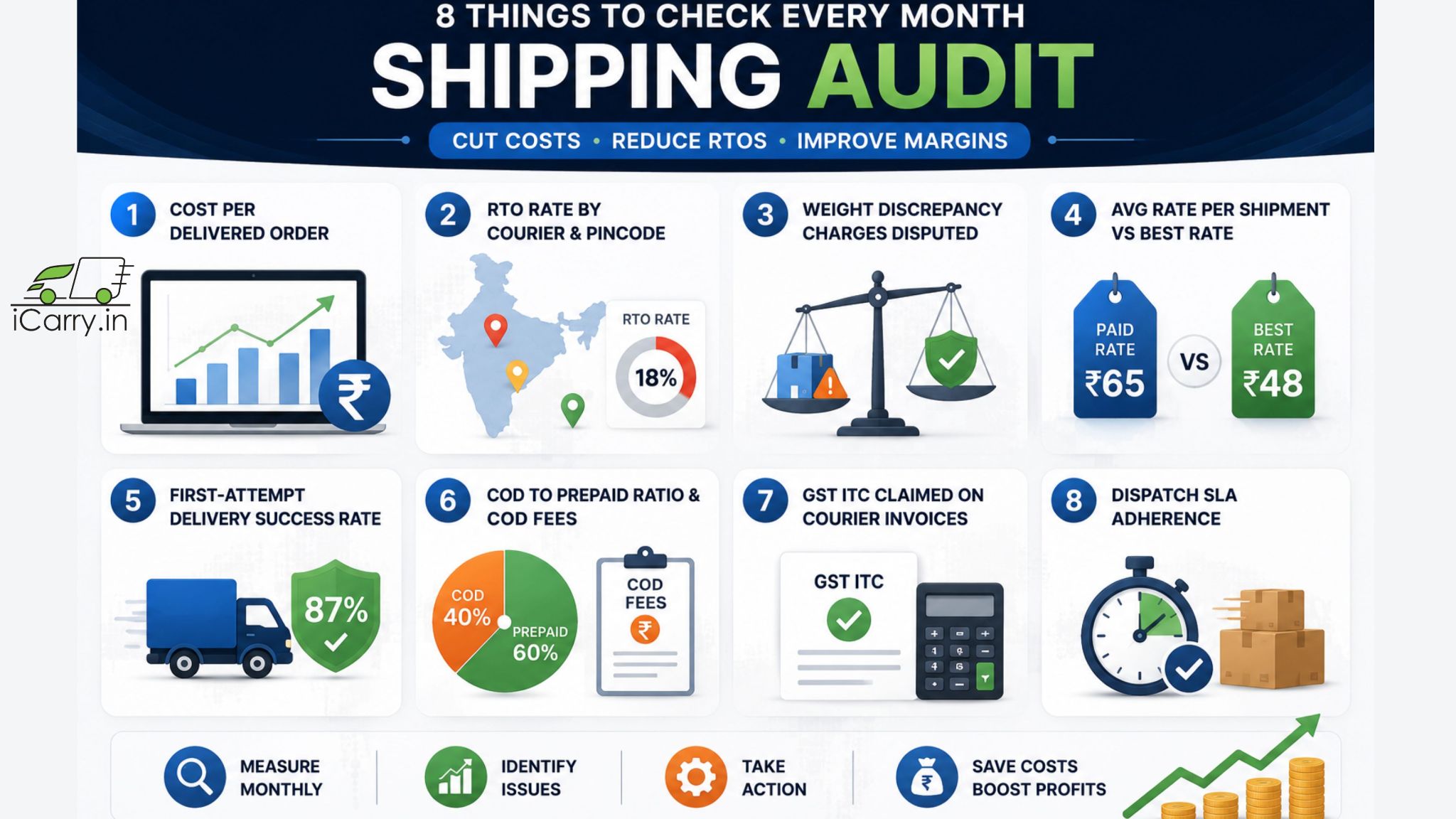
A shipping audit is a structured monthly review of 8 specific logistics data points - cost per delivered order, RTO rate by courier and pincode, weight discrepancy disputes, rate comparison, delivery success rate, COD ratio, GST ITC claimed, and dispatch SLA compliance. Instead of reacting only when something breaks, a shipping audit catches margin leaks - unclaimed tax credit, undisputed discrepancy charges, creeping RTO on one courier - while they are still small and easy to fix.
How to Run a Quick Monthly Shipping Audit
- Pull last month's cost per delivered order and compare to the month before
- Break RTO rate out by courier and by pincode cluster, not as one blended number
- Check what share of eligible weight discrepancy charges were actually disputed
- Compare your average rate paid per shipment to the best available rate for that zone
- Check first-attempt delivery success rate against the 85% (metro) / 75% (Tier 2-3) benchmark
- Confirm 100% of courier GST is being claimed as ITC in GSTR-3B
- Check dispatch SLA compliance against the 95% (marketplace) / 90% (direct) benchmark
Why Monthly Is the Right Frequency
Weekly is too frequent for most metrics to show meaningful trend changes. Quarterly is too infrequent - three months of elevated RTO or unchallenged discrepancy charges is significant absorbed cost. Monthly gives enough data volume for statistically meaningful rates, aligns with invoice reconciliation and GST filing cycles, and creates a natural operational rhythm.
Block 90 minutes on the last working day of every month. Pull the same eight data sets in the same order. Compare to the previous month. Act on the outliers.
Audit Check 1: Cost Per Delivered Order
What to measure: Total monthly logistics spend (freight + COD fees + return freight + weight discrepancy charges + platform fees) divided by total orders successfully delivered.
Benchmark: Stable or declining month-on-month. A rising cost per delivered order indicates a specific leak - rising RTO rate, more discrepancy charges, or rate increases. These leaks are not trivial at a national level either - India's logistics costs run about 14% of GDP versus 8-9% in developed economies - a gap that individual businesses can close through exactly this kind of monthly review.
Action if rising: Identify which component increased. RTO, discrepancy, or COD fee total each has a different fix. Hidden shipping charges in India cover each component in detail.
Audit Check 2: RTO Rate by Courier and Pincode
What to measure: RTO rate split by courier partner and by delivery zone or pincode cluster. Not a blended number - by courier and geography.
Benchmark: Below 15% overall for COD-heavy operations. Below 5% for prepaid-heavy. Any single courier above 25% RTO for a specific zone is a routing problem.
Action: Reroute volume away from underperforming couriers on specific pincodes. Multi-courier allocation by pincode performance is the highest-impact routing change most businesses can make.
Watch Overview of My Account > My Shipments to see how shipment filtering by courier and status works in iCarry®.
Audit Check 3: Weight Discrepancy Charges Raised vs Disputed
What to measure: Total discrepancy charges raised by couriers. Total disputed. Total recovered. Dispute success rate.
Benchmark: Every eligible discrepancy disputed within the 5-day window. A dispute rate below 80% means charges are being absorbed without challenge.
Action: Pre-upload product images in iCarry® panel for standard SKUs to enable automatic dispute triggering. The 5-day dispute window process is strict - missing it means absorbing the charge with no recourse.
Audit Check 4: Average Rate Per Shipment vs Best Available Rate
What to measure: What you actually paid per shipment on average versus what you would have paid if you had always selected the lowest available rate for that zone and weight.
Benchmark: Gap should be below ₹10 per shipment if you are comparing before every booking. Above ₹10 consistently means you are defaulting to one courier without comparing.
Action: Compare rates before every booking using iCarry®'s rate calculator. Takes 30 seconds and helps to know the gap immediately.
Audit Check 5: First-Attempt Delivery Success Rate
What to measure: Percentage of shipments delivered on the first courier attempt with no NDR event.
Benchmark: Above 85% for metro-heavy profiles. Above 75% for Tier 2 and Tier 3 heavy profiles. Below 70% indicates a systemic address quality or delivery coordination problem.
Action: Enable pre-dispatch Address Quality Scoring to catch bad addresses before shipment. Activate Delivery Boost for high-risk COD orders in problem zones. Two-way WhatsApp communication for delivery coordination reduces missed-window failures.
Audit Check 6: COD to Prepaid Ratio and COD Handling Fee Total
What to measure: Percentage of orders that are COD versus prepaid. Total COD handling fees paid in the month.
Benchmark: COD ratio stable or declining. COD handling fee total should fall proportionally as prepaid share grows.
Action: If COD ratio has increased without a geographic explanation, investigate whether your prepaid incentive at checkout is working. If COD handling fee total is above ₹10,000 per month, model early remittance - the 0.39% T+4 fee may be cheaper than the working capital cost of T+7 float.
Audit Check 7: GST ITC Claimed on Courier Invoices
What to measure: Total 18% GST charged on courier aggregator invoices for the month. Total ITC claimed in GSTR-3B for the same period. Courier services are taxed at 18% GST under SAC code 996812, confirmed on the CBIC GST rates page.
Benchmark: If GST registered, 100% of courier GST should be claimed as ITC every month.
Action: If ITC is not being claimed, consult your CA immediately. For a business paying ₹1 lakh monthly in freight, unclaimed ITC is ₹18,000 per month written off unnecessarily.
Audit Check 8: Dispatch SLA Compliance Rate
What to measure: Percentage of orders dispatched within the promised SLA window - typically 24 to 48 hours of order placement.
Benchmark: Above 95% for marketplace sellers where SLA breaches trigger metric penalties. Above 90% for direct channel sellers.
Action: Late dispatch traces to three causes: order processing not running daily, booking done one-by-one rather than in bulk, or dispatch cutoff not enforced. Use bulk booking to process all pending orders in one action before 11 AM every day.
Monthly Shipping Audit Summary Template
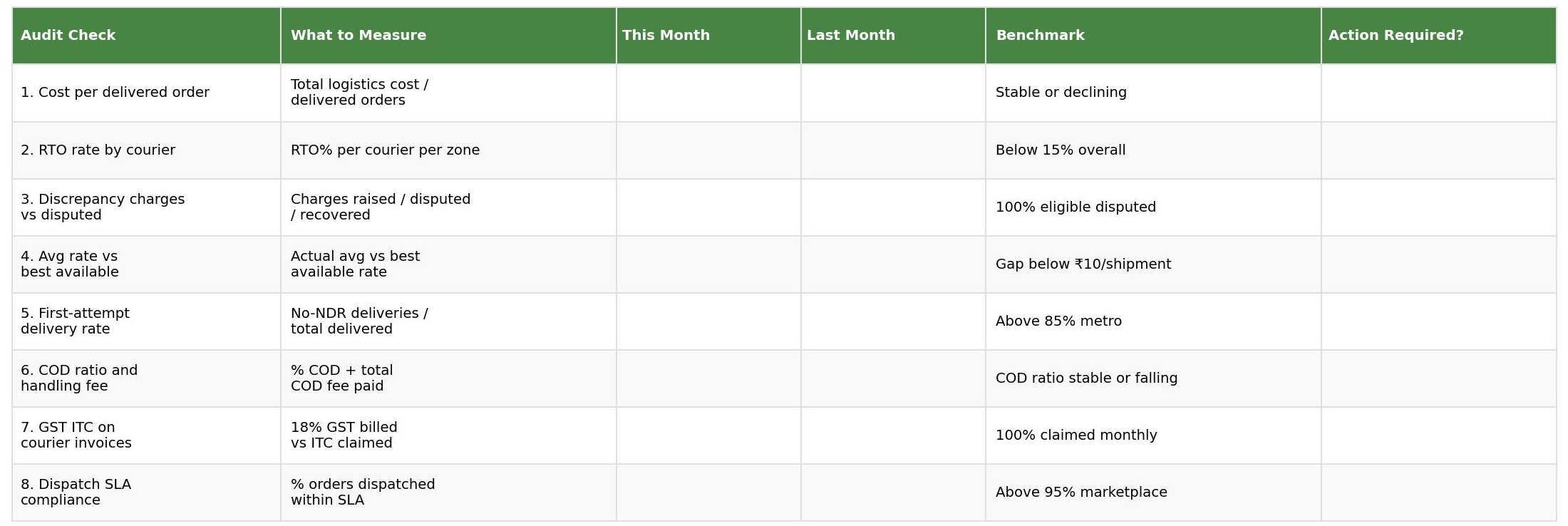
Fill this template at the end of every month. The action column is binary - yes or no. If yes, identify the specific fix and assign responsibility before next month's audit.
How iCarry® Supports Monthly Shipping Audits
iCarry® is a courier aggregator that gives Indian businesses the data needed to run all 8 checks from one platform: My Shipments dashboard for checks 1, 2, 5, and 8; weight discrepancy section for check 3; rate comparison for check 4; COD remittance dashboard for check 6; and GST-compliant monthly invoices for check 7.
The tools that improve the numbers after the audit - Delivery Boost, two-way WhatsApp communication, Address Quality Scoring - are also available from the same platform. Register at iCarry today - free plan, no minimum volume.
Final Thoughts
A shipping audit is not a one-time fix. It is a monthly discipline that compounds over time. The first audit almost always finds significant recoverable cost. Subsequent audits find smaller leaks faster because systemic problems have already been fixed.
The businesses that run monthly shipping audits at 200 daily shipments are significantly better positioned when they reach 2,000. Build the habit before the scale forces you to.
Frequently Asked Questions (FAQs)
How often should Indian businesses audit their shipping operations?
Monthly is the right frequency. Weekly is too frequent for meaningful trend data. Quarterly is too infrequent - three months of elevated RTO or unclaimed ITC is significant unnecessary cost. Monthly aligns with invoice cycles, GST filing, and operational planning.
What is cost per delivered order and why does it matter?
Cost per delivered order is total logistics spend divided by orders actually delivered. It is more meaningful than cost per shipment because it accounts for RTO losses. Tracking this monthly shows whether logistics efficiency is improving or worsening regardless of volume changes.
How do I dispute weight discrepancy charges in India?
You have 5 business days from the discrepancy notification to dispute. Submit pre-dispatch parcel photographs with the AWB visible as evidence. In iCarry®, pre-upload product images for standard SKUs to trigger disputes automatically within the window without manual action.
What is the GST ITC opportunity on courier invoices?
Courier services attract 18% GST. GST-registered businesses can claim this as Input Tax Credit every month. For a business paying ₹1 lakh per month in freight, this is ₹18,000 per month in recoverable ITC. Ensure your GSTIN is registered with your courier aggregator.
What should I do if my first-attempt delivery rate is below 75%?
Enable Address Quality Scoring to catch bad addresses before dispatch. Activate two-way WhatsApp communication for delivery coordination. Enable Delivery Boost for high-risk COD orders in problem zones. Analyse which specific pincodes and couriers are generating the most failures.
A monthly shipping audit is a structured discipline, not a one-time fix - reviewing 8 specific data points each month (cost per delivered order, RTO by courier and pincode, weight discrepancy disputes, rate comparison, first-attempt delivery rate, COD ratio, GST ITC claimed, and dispatch SLA compliance) catches margin leaks like unclaimed tax credit, undisputed discrepancy charges, and creeping RTO while they are still small and easy to fix, compounding into significant recovered margin over time for businesses that build the habit early.