Why the Middle East Is a Priority Export Market for India
The Gulf Cooperation Council (GCC) region - UAE, Saudi Arabia, Qatar, Kuwait, Bahrain, and Oman - is one of India's most important trading partners. With millions of Indian expatriates in the Gulf and strong demand for Indian food products, textiles, spices, Ayurvedic products, and handicrafts, India exported US$37.4 billion of merchandise to the UAE alone in FY2025-267, its largest free-trade-agreement export market.
For D2C brands and small exporters, the Middle East is also an accessible first international market - proximity means 3 to 5 day transit via courier, and the large Indian diaspora in Dubai and Riyadh creates ready demand for products they recognise from home.
What Is Involved in Shipping to the Middle East from India?
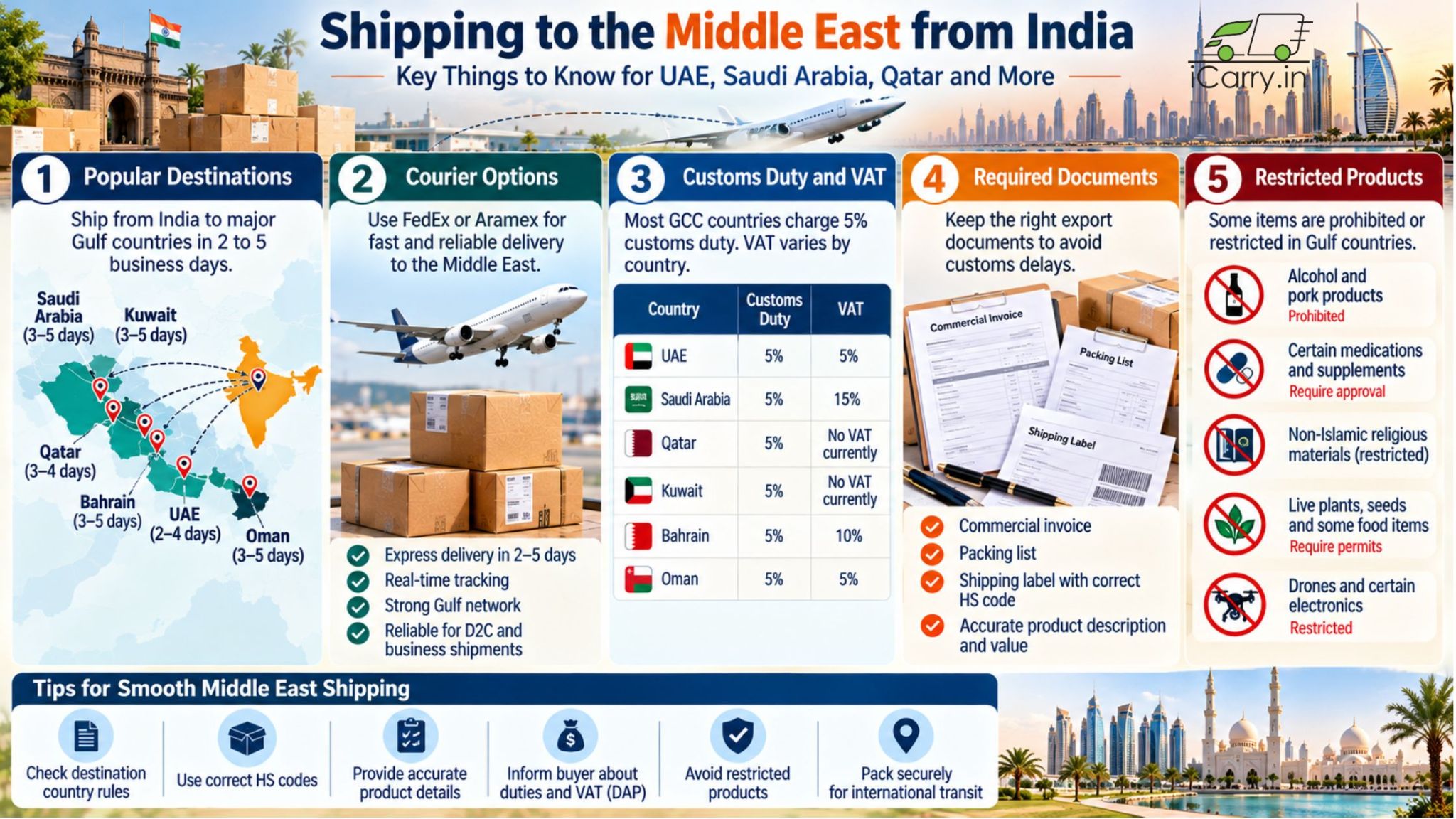
Shipping to the Middle East from India means sending courier-level export parcels to Gulf destinations such as the UAE, Saudi Arabia and Qatar, typically with FedEx or Aramex in 2 to 5 business days. Most GCC countries charge 5% customs duty, and VAT is 15% in Saudi Arabia, 10% in Bahrain, 5% in the UAE and Oman, and not in force in Qatar or Kuwait. Wrong paperwork or a restricted product, such as alcohol or uncertified food, is what gets parcels held at customs.
Transit Times and Courier Options
From India to major Gulf cities via express courier:
- UAE (Dubai, Abu Dhabi, Sharjah): 2 to 4 business days via FedEx or Aramex
- Saudi Arabia (Riyadh, Jeddah, Dammam): 3 to 5 business days
- Qatar (Doha): 3 to 4 business days
- Kuwait, Bahrain, Oman: 3 to 5 business days
FedEx and Aramex are the primary courier options for India-to-Gulf shipments. Aramex has a strong Gulf network - it was founded in Jordan and has deep regional infrastructure. FedEx is preferred for time-critical or high-value shipments. Both are available via iCarry® with rate comparison before every booking.
Customs Duties and VAT in Gulf Countries
Most GCC countries apply a standard 5% customs duty on imported goods, plus VAT:
- UAE: 5% customs duty + 5% VAT. Courier parcels valued up to AED 1,000 (roughly ₹25,000 to ₹27,000 at current exchange rates) may be exempt from customs duty - Dubai raised its e-commerce exemption from AED 300 to AED 1,000 from August 3, 2026 - but VAT still applies, and treatment of commercial consignments can differ, so confirm with your courier before relying on it
- Saudi Arabia: 5% customs duty + 15% VAT (raised from 5% in 2020). Saudi Arabia has stricter VAT compliance requirements for imported goods
- Qatar: 5% customs duty. No VAT is currently in force in Qatar
- Kuwait, Bahrain and Oman: 5% customs duty. Bahrain charges 10% VAT and Oman 5% VAT; Kuwait has no VAT currently
Who pays the duty: Under DAP (Delivered at Place) Incoterms - the most common arrangement for courier-level exports - the buyer pays import duty and VAT on receipt. Under DDP (Delivered Duty Paid), the seller pays. Most Indian D2C exports to the Gulf operate on DAP terms. Always inform your Gulf buyer that import duties will apply before they complete the purchase.
Restricted and Prohibited Products for Gulf Shipments
The Gulf countries have specific import restrictions that go beyond standard courier dangerous goods rules:
- Alcohol and pork products: Strictly prohibited across all GCC countries. Any product containing alcohol (including certain medicines, hand sanitisers above 70% alcohol) faces restrictions
- Religious materials: Non-Islamic religious texts and items in large quantities may face restrictions in Saudi Arabia
- Medications and supplements: Many prescription medications require prior import approval. Certain supplement ingredients are controlled substances in Gulf countries. Verify before shipping any health product
- Cosmetics: Products with specific restricted ingredients may be held at customs. Saudi Arabia has detailed approved ingredient lists for cosmetics
- Food products: Halal certification is required for all meat and poultry products. Non-certified food products may be detained
- E-cigarettes: Import restrictions vary by country. Check current regulations before shipping any vaping product to the Gulf
Documentation Required for Middle East Exports
- Commercial invoice: In English. Must state the country of origin ('Made in India'), HS code, unit price, total value, and Incoterm (typically DAP Dubai/Riyadh)
- Packing list: Itemised list matching the commercial invoice exactly
- Certificate of Origin: Required by many Gulf buyers to confirm Indian origin and to claim preferential duty rates under the India-UAE CEPA (in force since May 2022) or the India-Oman CEPA (in force since June 2026). There is no India-GCC FTA in force yet. Issued by FIEO or a Chamber of Commerce, and DGFT now offers paperless certificate of origin issuance for FTA shipments
- Halal certificate: For food, cosmetics, and supplements - required by most Gulf buyers to confirm no prohibited ingredients
- MSDS: Material Safety Data Sheet for any chemical, cosmetic, or potentially hazardous product - required by Gulf customs
Pricing for Gulf Shipments - What to Tell Buyers
Many Indian sellers quote prices that do not account for Gulf import duties, leading to buyer complaints when customs charges arrive at delivery:
- Quote DAP (Delivered at Place) prices clearly - this means the buyer pays import duty and VAT on arrival
- Inform the buyer of the estimated duty at the time of purchase: '5% customs duty + 5% VAT applicable in UAE on delivery'
- For repeat Gulf buyers who want seamless delivery: consider DDP pricing (you pay duties, add cost to product price). FedEx and Aramex both offer DDP billing options
How iCarry® Supports Gulf Exports
iCarry® is a courier aggregator with FedEx and Aramex access for India-to-Gulf shipments.
- Rate comparison: Compare FedEx and Aramex rates to UAE, Saudi Arabia, and Qatar before every booking. Aramex typically has competitive Gulf rates given its regional network
- International booking: Book Gulf exports directly from your iCarry® account - no separate accounts or negotiations with individual couriers needed
- Declared value coverage: Enable for high-value Gulf exports. Gulf transit involves multiple handling points across customs and delivery networks
Free Bronze plan, no minimum volume. Register at iCarry® today.
Frequently Asked Questions (FAQs)
How long does courier delivery from India to Dubai take?
Via FedEx or Aramex, standard international express from India to Dubai takes 2 to 4 business days. Saudi Arabia and Qatar take 3 to 5 business days. Economy or deferred services take 5 to 7 business days at lower rates. Compare both options at your shipment weight before booking.
Do Gulf countries charge customs duty on Indian imports?
Yes. Most GCC countries apply a 5% customs duty on imports. VAT also applies in four of them: 15% in Saudi Arabia, 10% in Bahrain and 5% in the UAE and Oman, while Qatar and Kuwait have no VAT in force. Under DAP Incoterms (the standard for courier exports), the buyer pays these charges on delivery. Inform your Gulf buyers about applicable duties before they purchase to avoid disputes when the courier collects charges at delivery.
Is a Halal certificate required to export food products to the Gulf?
Yes, for all meat, poultry, and food products containing animal-derived ingredients. Most Gulf countries require Halal certification from a recognised certification body before allowing import of food products. Without it, food shipments may be held or destroyed at customs. Cosmetics and supplements with animal-derived ingredients also increasingly require Halal certification for Gulf markets.
Which courier is better for India-to-Gulf shipments - FedEx or Aramex?
Both are reliable options. Aramex was founded in the Middle East and has deep regional infrastructure - often competitively priced for Gulf destinations and strong on last-mile in smaller Gulf cities. FedEx is preferred for time-critical shipments and has strong tracking visibility. Compare rates for your specific weight and destination via iCarry® before every booking rather than defaulting to one courier.
Shipping to the Gulf comes down to three things: knowing the duty and VAT for each destination country, quoting DAP prices so buyers are not surprised at delivery, and sending the right paperwork - commercial invoice, packing list, Certificate of Origin and Halal certificate where needed. Check the restricted goods list before you ship, and compare FedEx and Aramex rates before every booking.