Note: This is general information, not tax advice. Rules and thresholds can change, so confirm with your chartered accountant or the GST portal before acting.
Why Stock Transfers Confuse Sellers
A stock transfer feels internal. You own the goods before and after, so there is no sale, no customer and no payment. Yet under GST, moving stock between warehouses can be a taxable supply, can require an invoice, and can need an e-way bill. Getting this wrong leads to detained consignments, penalties and blocked input tax credit.
The rules matter more as sellers add warehouses to deliver faster. Multi-warehouse setups, marketplace fulfilment centres and 3PL storage in other states all create stock transfers. Understanding them early saves a lot of cleanup later.
What Is a Stock Transfer Under GST?
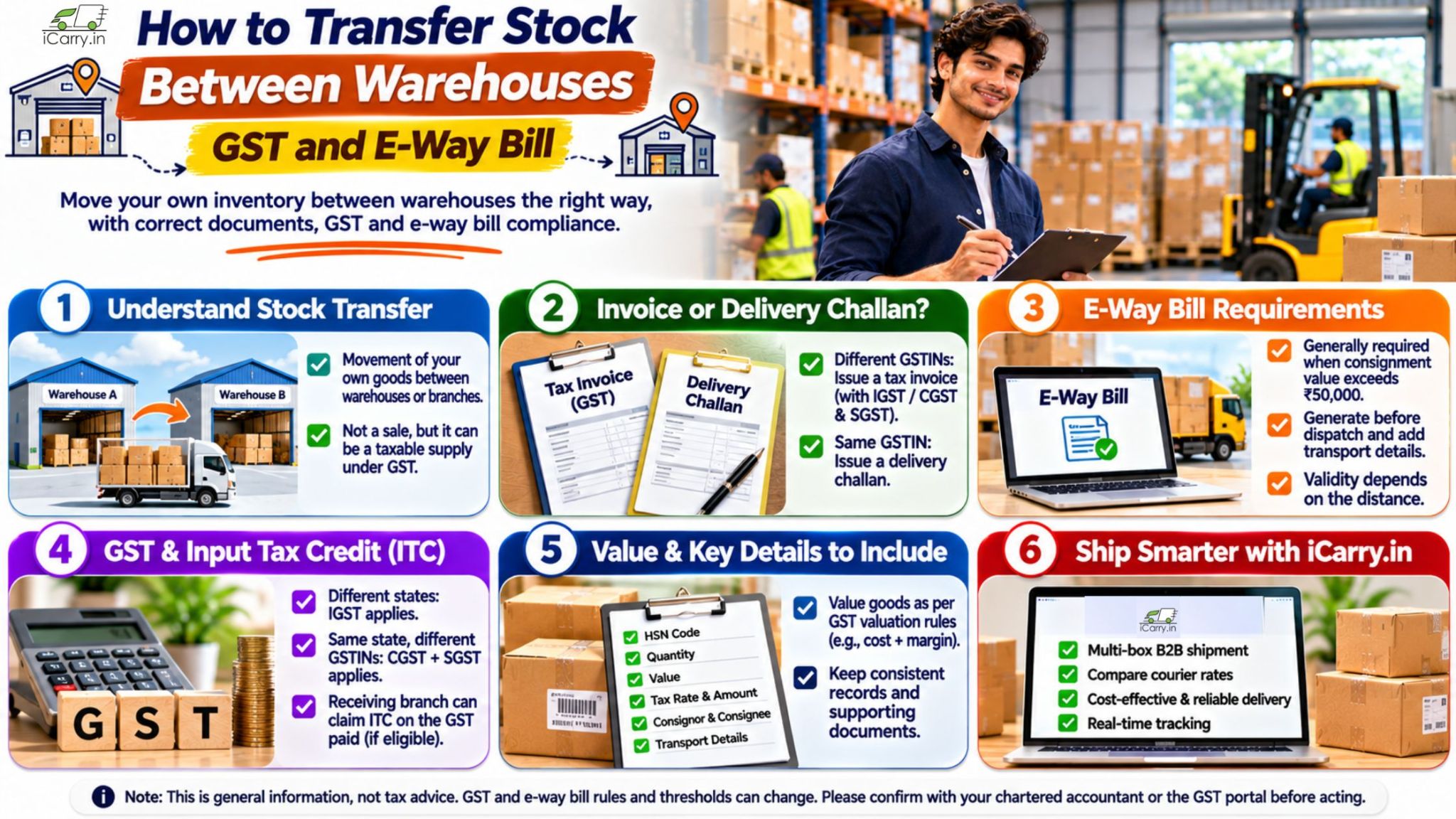
A stock transfer under GST is the movement of your own goods between your warehouses, branches or marketplace storage locations. It is not a sale, but it can still be a taxable supply when the locations hold different GST registrations. A transfer within one state under one GSTIN is not a supply and uses a delivery challan.
The Key Question: Same GSTIN or Different GSTIN?
Whether GST applies depends on where the stock moves and which GST registrations are involved:
- Same state, same GSTIN: If both warehouses are places of business under one registration, there is no supply. No GST is charged. You still need proper documents and, above the value limit, an e-way bill
- Different states: Warehouses in different states need separate GST registrations. Under GST, such branches are treated as distinct persons, so a transfer between them is generally an inter-state supply and attracts IGST
- Same state, different GSTINs: If the two locations hold separate registrations, the transfer is generally treated as a supply between distinct persons and attracts CGST and SGST
Practical point: A warehouse that holds stock for sale in another state usually needs its own GST registration as an additional place of business. Confirm this before you start moving inventory.
Which Document to Issue
- Transfer between different GSTINs: Issue a tax invoice from the sending branch to the receiving branch's GSTIN, showing the correct GST (IGST for inter-state, CGST and SGST within a state)
- Transfer within the same GSTIN: Issue a delivery challan with the details of the goods, quantity, value, consignor and consignee, and keep it with the consignment
- Always include: Description of goods, HSN code, quantity, value, tax rate and amount, consignor and consignee details, and the vehicle or transporter details
- E-invoice if applicable: If your aggregate turnover has crossed ₹5 crore in any financial year since 2017-18, a transfer invoice between GSTINs needs an IRN, and an invoice without one can be treated as invalid
How to Value the Transfer
Value the goods as per GST valuation rules. Where the receiving branch is eligible for full input tax credit, the value declared on the invoice is generally accepted as the open market value. Many businesses use cost price plus a small margin. Use a consistent method and keep records to support it.
E-Way Bill Rules for Stock Transfers
- Threshold: An e-way bill is required when the value of goods in a consignment exceeds ₹50,000. Some states have different rules for movement within the state, so check yours
- Applies even without a sale: A stock transfer needs an e-way bill if the value crosses the threshold, even though no customer is involved
- Generate before dispatch: Raise it on the e-way bill portal before the goods move, with the correct document type and the receiving branch's GSTIN
- Add transport details: Update the vehicle or transporter ID in Part B so the e-way bill is valid in transit
- Validity: The e-way bill validity depends on the distance covered. Plan transit so it does not expire before delivery
- Carry it: The transporter must be able to show the e-way bill and invoice or challan on request
You can generate and manage e-way bills on the GST e-way bill portal.
Moving many cartons between warehouses? See how to book a multi-box B2B shipment on iCarry®.
Input Tax Credit on Stock Transfers
- The receiving branch can claim input tax credit on the IGST or CGST and SGST shown on the transfer invoice, subject to normal ITC conditions
- IGST credit is the most flexible and can be used against IGST, CGST and SGST liability
- The sending branch must file the invoice in its GST return so the receiving branch's credit matches
- Mismatched or missing invoices cause credit reconciliation problems and notices
Common Mistakes to Avoid
- Moving stock to another state without registration: This creates a compliance gap and may lead to penalties
- No invoice or challan: Goods travelling without proper documents can be detained
- Skipping the e-way bill because it is not a sale: The threshold applies to the value of goods moved, whether or not it is a sale
- Charging the wrong tax type: IGST on a same-state transfer, or CGST and SGST on an inter-state one
- Not recording the transfer in your books: Stock registers, GST returns and ITC claims must match
- Ignoring marketplace and 3PL warehouses: Sending inventory to a marketplace or 3PL warehouse in another state has the same GST implications
How to Ship Stock Transfers by Courier
- Pack and label bulk transfers properly. Use strong cartons, number each carton and include a packing list
- Book as a multi-box shipment so all cartons travel and arrive together
- Enable declared value coverage for high-value transfers
- Share the invoice, challan and e-way bill details with the courier and the receiving warehouse
- Match carton counts at the receiving end and record any shortage or damage the same day
Compare couriers for each warehouse route with a free iCarry® account.
How iCarry® Supports Stock Transfers
iCarry® is a courier aggregator that handles the logistics of moving stock between your warehouses.
- Multiple courier partners: Compare rates across courier partners for each warehouse route
- Multi-box B2B booking: Link all cartons in a transfer under one booking
- Declared value coverage: Protect high-value inventory in transit
- Multiple pickup locations: Ship from each warehouse using the same account
- Tracking and Address Quality Scoring: Monitor transfers and avoid failed deliveries at warehouse addresses
Free Bronze plan, no minimum volume.
Frequently Asked Questions (FAQs)
Is GST charged on a stock transfer between my own warehouses?
It depends. Between two places of business under the same GSTIN in one state, there is generally no supply and no GST. Between different states, branches are treated as distinct persons, so the transfer is generally an inter-state supply and attracts IGST. Confirm your situation with your chartered accountant.
Do I need an e-way bill for a stock transfer?
Yes, if the value of goods in the consignment exceeds ₹50,000, even though there is no sale. Generate it on the e-way bill portal before dispatch, add the transport details in Part B, and keep the invoice or delivery challan with the goods.
What document do I use for a stock transfer within the same GSTIN?
Use a delivery challan showing the description of goods, quantity, value, HSN code, and the consignor and consignee details. Keep it with the consignment. If the value crosses the threshold, an e-way bill is also required.
Can the receiving warehouse claim input tax credit?
Yes, where the transfer is a taxable supply between different GSTINs. The receiving branch can claim ITC on the tax shown on the transfer invoice, subject to normal ITC conditions. The sending branch must report the invoice in its return so that the credit matches.
A stock transfer is not a sale, but under GST it can still be a taxable supply: issue a tax invoice between different GSTINs, a delivery challan within one GSTIN, and an e-way bill when the consignment value exceeds ₹50,000. Make sure the right tax type is charged, the sending branch reports the invoice so the receiving branch's ITC matches, and book multi-carton transfers together.