A D2C brand has 3,000 units of a new product at a Bengaluru warehouse. 800 orders are in transit across six courier partners. 12 shipments are showing NDR. 200 units are at a Mumbai fulfilment centre. Raw material for the next production run is on a truck from Surat.
The operations manager knows none of this in real time. Orders with NDRs are not visible until customers complain. The Mumbai inventory was last counted three weeks ago. The Surat truck has not been tracked since it left the supplier.
This is a supply chain visibility problem. For Indian businesses managing multi-location inventory, multiple courier partners, and complex inbound and outbound logistics, the inability to see what is happening across the supply chain in real time creates a consistent pattern of reactive decision-making: problems are discovered after they have escalated, not before. That complexity is only growing - logistics technology providers now connect Indian merchants to more than 40 courier partners across over 19,000 pincodes, per IBEF - which is exactly the fragmentation that makes visibility hard without a consolidated view.
Supply chain visibility is not a luxury reserved for large enterprises. Indian businesses at every scale benefit from knowing where their goods are, when anomalies occur, and what is happening across their logistics network. This guide covers what visibility means in practice, what tools enable it, and how to build it progressively without large technology investment.
What Is Supply Chain Visibility?
Supply chain visibility is the ability to see the real-time status and location of products, inventory, and shipments across every stage of the supply chain - from supplier to warehouse to customer delivery. For most Indian businesses it spans three domains: inbound, inventory, and outbound - and the gap between partial visibility in one domain and real-time visibility across all three is where reactive, after-the-fact decision-making happens.
Quick Checklist - How Visible Is Your Supply Chain Today?
- Can you see the current status of every in-transit shipment across all couriers in one view?
- Do you know how much inventory you have at each location right now - not as of last week's count?
- Are NDRs and delivery exceptions flagged to you automatically within the hour they occur?
- Do you know where your inbound supplier shipments are before they arrive?
- Can you identify which specific orders are at risk of missing their delivery window today?
- Do you know your real-time RTO rate this week, not just last month's blended average?
The Three Domains of Supply Chain Visibility
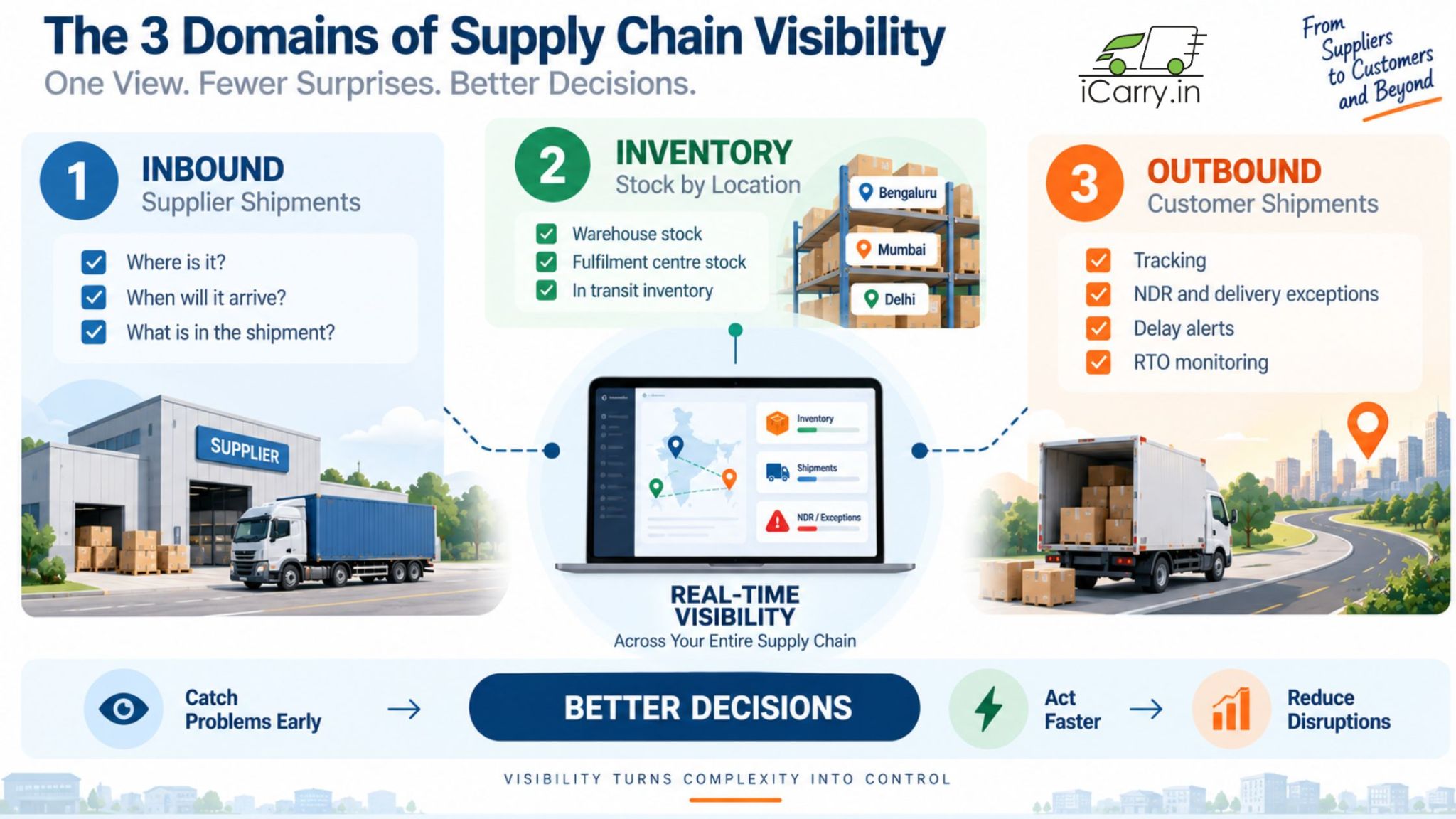
Supply chain visibility is the ability to track the movement and status of products, components, and shipments across every stage of the supply chain - from supplier to warehouse to customer delivery - in real time or near-real time.
For most Indian businesses, supply chain visibility spans three domains:
- Inbound visibility: Knowing where supplier shipments are, when they will arrive, and what they contain - before they land at your warehouse
- Inventory visibility: Knowing exactly how much of each SKU is at each location at any moment - warehouse, fulfilment centre, in transit as forward shipments, and in transit as returns
- Outbound visibility: Knowing the status of every customer order in transit - which courier has it, where it is in the delivery chain, and whether any exceptions (NDR, delay, loss) require action
Most Indian businesses have partial visibility in one of these three domains. Very few have real-time visibility across all three simultaneously. The gap between partial and full visibility is where reactive decision-making happens.
Why Supply Chain Visibility Matters for Indian Businesses
1. NDR and RTO Prevention
The most direct financial benefit of outbound visibility. An NDR that is visible within 1 hour of occurrence can be acted on before the reattempt window closes. An NDR that is discovered 3 days later when the customer complains has almost certainly already been converted to RTO.
For a business dispatching 500 daily COD orders at a 20% RTO rate, reducing RTO by 5 percentage points through faster NDR response saves ₹20,000 per month in double freight. This reduction is only possible with real-time outbound visibility that flags NDRs immediately rather than in a batched daily report.
2. Inventory Accuracy and Stockout Prevention
A business that does not know its real-time inventory position cannot prevent stockouts. When a fast-moving SKU runs out without warning, orders are accepted, the product cannot be fulfilled, customer expectations are violated, and the business pays for expedited restocking that would not have been necessary with earlier visibility.
Real-time inventory visibility allows reorder triggers to be set at the SKU level - when inventory at a location falls below X units, a purchase order is automatically initiated. This is only possible if the inventory number is known and current.
3. Proactive Customer Communication
A brand that knows a shipment is delayed before the customer knows is able to communicate proactively - sending an update before the customer sends an angry message. Proactive delay communication consistently generates more goodwill than reactive apology after the customer has already escalated.
Visibility enables this. Without it, the seller only knows about a delay when the customer reports it.
4. Supplier Accountability
Inbound visibility - knowing where supplier shipments are before they arrive - allows businesses to hold suppliers accountable for delivery commitments. If a supplier's truck is tracked and shown to be 2 days late, the buyer can adjust production schedules, reorder from an alternate supplier, or alert customers to a potential delay - all before the impact hits.
5. Operational Decision-Making
Supply chain decisions made with current data are better than decisions made with last week's data. Which courier is underperforming on Zone D this week? Which warehouse location is running critically low on a high-velocity SKU? Which 20 shipments need escalation today? These decisions require real-time visibility, not weekly reports.
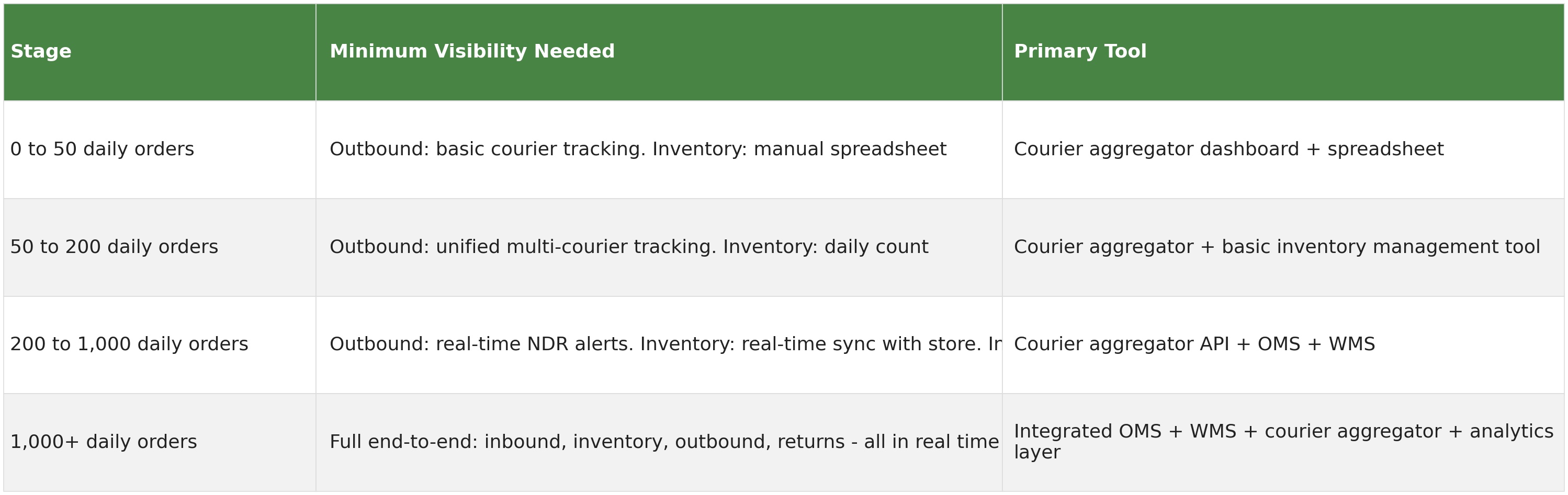
Supply Chain Visibility by Business Stage
The Tools That Enable Supply Chain Visibility in India
1. Courier Aggregator Dashboard (Outbound Visibility)
The most immediately accessible visibility tool for most Indian businesses. A courier aggregator that consolidates tracking from all courier partners into one view eliminates the need to log into multiple courier portals to understand the state of in-transit shipments.
What to look for in an aggregator dashboard:
- Real-time tracking updates from all couriers - not batched or delayed
- Exception flagging - NDRs, delayed shipments, and static tracking highlighted automatically
- Filterable by status, courier, date, and zone
- Exportable data for analysis and reporting
2. Order Management System (OMS)
An OMS connects all sales channels (Shopify, WooCommerce, marketplace) and centralises order information. Real-time order status - confirmed, dispatched, in transit, delivered, RTO - is visible from one interface regardless of which channel generated the order.
An OMS with courier aggregator integration provides end-to-end outbound visibility: from order placed to order delivered, with status updates from the courier flowing back automatically.
3. Warehouse Management System (WMS)
A WMS provides real-time inventory visibility at the warehouse or fulfilment centre level. As products are received, picked, packed, and dispatched, inventory counts update in real time. Businesses with multiple warehouse locations need a WMS that consolidates inventory across locations into one view.
At lower scale, a well-maintained spreadsheet inventory system with daily updates can provide adequate inventory visibility. As daily order volume exceeds 200, a purpose-built WMS becomes necessary to maintain accuracy.
4. Supplier Tracking and Inbound Visibility
For businesses with complex inbound supply chains, tracking supplier shipments requires either:
- Supplier-provided tracking numbers for freight movements (for courier-level inbound)
- GPS tracking on supplier vehicles (for businesses with owned or contracted transport)
- EDI (Electronic Data Interchange) integration with suppliers to receive advance shipment notices
- Regular supplier check-in protocol: supplier confirms dispatch, provides expected arrival, confirms any delays proactively
For most mid-sized Indian businesses, a structured supplier communication protocol - mandatory WhatsApp dispatch confirmation with tracking number and expected arrival date - provides adequate inbound visibility at zero technology cost.
5. Analytics and Reporting Layer
Visibility data is only valuable if it drives decisions. An analytics layer aggregates data from OMS, WMS, and courier aggregator to produce the metrics that matter: RTO rate by courier and zone, delivery success rate trends, NDR-to-RTO conversion rate, inventory turnover by SKU, order-to-dispatch SLA adherence.
At small scale: export data from your courier aggregator monthly and analyse in a spreadsheet. At a larger scale: a purpose-built analytics tool or a business intelligence layer connected to your OMS.
Building Supply Chain Visibility Step by Step
The mistake most businesses make is trying to build full visibility all at once. Start with the highest-value layer:
- Step 1 (immediate): Unify outbound visibility. Use a courier aggregator - such as iCarry® - that consolidates all courier tracking in one dashboard. Eliminate the daily ritual of logging into five courier portals to find problem shipments
- Step 2 (within 30 days): Set up NDR exception alerting. Configure your courier aggregator to flag NDRs within the hour they occur. Assign a specific person responsible for NDR response before 5 PM daily
- Step 3 (within 60 days): Connect store to courier aggregator. Shopify, WooCommerce, or marketplace integration creates automatic order sync and eliminates manual data entry - improving accuracy and speed
- Step 4 (within 90 days): Implement daily inventory counts and a reorder system. Even a daily manual count per location with a reorder trigger spreadsheet is significantly better than no inventory visibility
- Step 5 (as volume demands): Add OMS and WMS as order volume makes manual visibility inadequate. The trigger point is typically 150 to 200 daily orders where manual coordination starts breaking down
How iCarry® Provides Outbound Supply Chain Visibility
iCarry® is a courier aggregator that is the primary outbound visibility tool for thousands of Indian businesses - the starting point for supply chain visibility without enterprise software investment:
- Unified tracking dashboard: All shipments across all courier partners - Delhivery, Blue Dart, Xpressbees, Ekart, Amazon Shipping, Shreemaruti, and others - in one My Shipments view. Filter by status, courier, date, and zone. See everything in My Account > My Shipments
- Real-time NDR visibility: NDRs appear in the dashboard within hours of the courier filing them - not the next morning or after the customer complains
- Data export: Export complete shipment history for any period to build your delivery performance analysis and supply chain metrics
- Store integrations: Shopify, WooCommerce ,Zoho, and other channel integrations create automatic order sync - the foundation for real-time outbound order visibility
- API access: Full REST API for businesses that want to pipe iCarry® tracking data into their own OMS or analytics layer
- Free Bronze plan, no minimum volume.
Final Thoughts
Supply chain visibility is not an IT project. It is a decision-making infrastructure. The business that knows its NDR count by 10 AM every morning makes better logistics decisions than one that discovers yesterday's NDRs at 4 PM. The business that knows its inventory position in real time makes better purchasing decisions than one that discovers a stockout after customer orders have been accepted.
Start with the highest-value, lowest-cost visibility improvement: unifying outbound tracking across all couriers into one dashboard. This single change - typically achievable in one day with a courier aggregator setup - delivers immediate visibility into the most common and most costly supply chain failures: NDRs that become RTOs.
Build progressively from there. Visibility compounds - each layer of data feeds better decisions at the next layer. The businesses that start building supply chain visibility early, even imperfectly, develop institutional capabilities that become a structural competitive advantage as they scale.
Frequently Asked Questions (FAQs)
What is supply chain visibility and why does it matter for Indian businesses?
Supply chain visibility is the ability to track the status of products, shipments, and inventory across every stage of the supply chain in real time. For Indian businesses it matters most in three areas: knowing where in-transit orders are (to catch NDRs before they become RTOs), knowing real-time inventory levels (to prevent stockouts), and knowing where inbound supplier shipments are (to plan production and fulfillment accurately).
What is the most important supply chain visibility tool for a small Indian D2C brand?
A courier aggregator with a unified tracking dashboard is the highest-value first visibility tool for most Indian D2C brands. It consolidates tracking from all courier partners in one view, flags NDRs in real time, and provides the outbound visibility that has the most direct impact on RTO rate and customer satisfaction. It is also free or low-cost to implement.
How do I get real-time inventory visibility without expensive software?
For businesses below 200 daily orders: a daily inventory count at each location entered into a Google Sheet or Excel file with reorder trigger formulas provides adequate inventory visibility. For businesses above 200 daily orders: a purpose-built inventory management tool or WMS becomes necessary. The investment threshold is when manual counts become inaccurate faster than they can be corrected.
What is inbound supply chain visibility and how do I achieve it?
Inbound visibility is knowing where supplier shipments are before they arrive at your warehouse. The simplest approach: a mandatory supplier dispatch protocol where every supplier sends a WhatsApp message on dispatch day with the tracking number, expected arrival date, and any delay notification. This costs nothing and provides the early warning needed to adjust production and fulfilment plans around supplier delays.
How does supply chain visibility reduce RTO rate?
RTO rate reduces when NDRs are acted on within 24 hours. This is only possible if NDRs are visible within hours of occurrence - not discovered the next day or when the customer reports non-receipt. A courier aggregator dashboard that shows all NDRs in real time enables the immediate response that converts NDR into successful reattempt rather than RTO.
Supply chain visibility is not an IT project - it is a decision-making infrastructure. The business that knows its NDR count by 10 AM makes better logistics decisions than one that discovers yesterday's NDRs at 4 PM, and the business that knows its inventory position in real time makes better purchasing decisions than one that discovers a stockout after orders have been accepted. Start with the highest-value, lowest-cost improvement - unifying outbound tracking into one dashboard - then build progressively, since visibility compounds and each layer of data feeds better decisions at the next.