Your Shipping Bill Went Up - Here is Why?
Most businesses that ship parcels regularly notice it on their invoice but cannot explain it. The per-shipment rate looks the same - but the total bill is higher than last month. Whether you are an eCommerce seller, manufacturer, wholesaler, gifting company, pharmacy, distributor, or a business shipping customer orders across India, these rising logistics costs directly affect your margins. This is not accidental.
Courier companies in India apply several charges on top of the base freight rate. Most are legitimate. Some are disputable. Understanding each one is the first step to reducing shipping costs for your eCommerce business.
What Are Courier Charges in India?
Courier charges in India are fees applied per shipment by logistics companies - covering base freight, fuel surcharge, and applicable add-ons like ODA, volumetric weight, and RTO. The total billed amount is often higher than the base rate because of these layered charges, many of which change monthly without notice. Knowing what each charge is - and which ones are disputable - is the starting point for reducing your shipping costs.
6 Reasons Why Courier Charges Increase
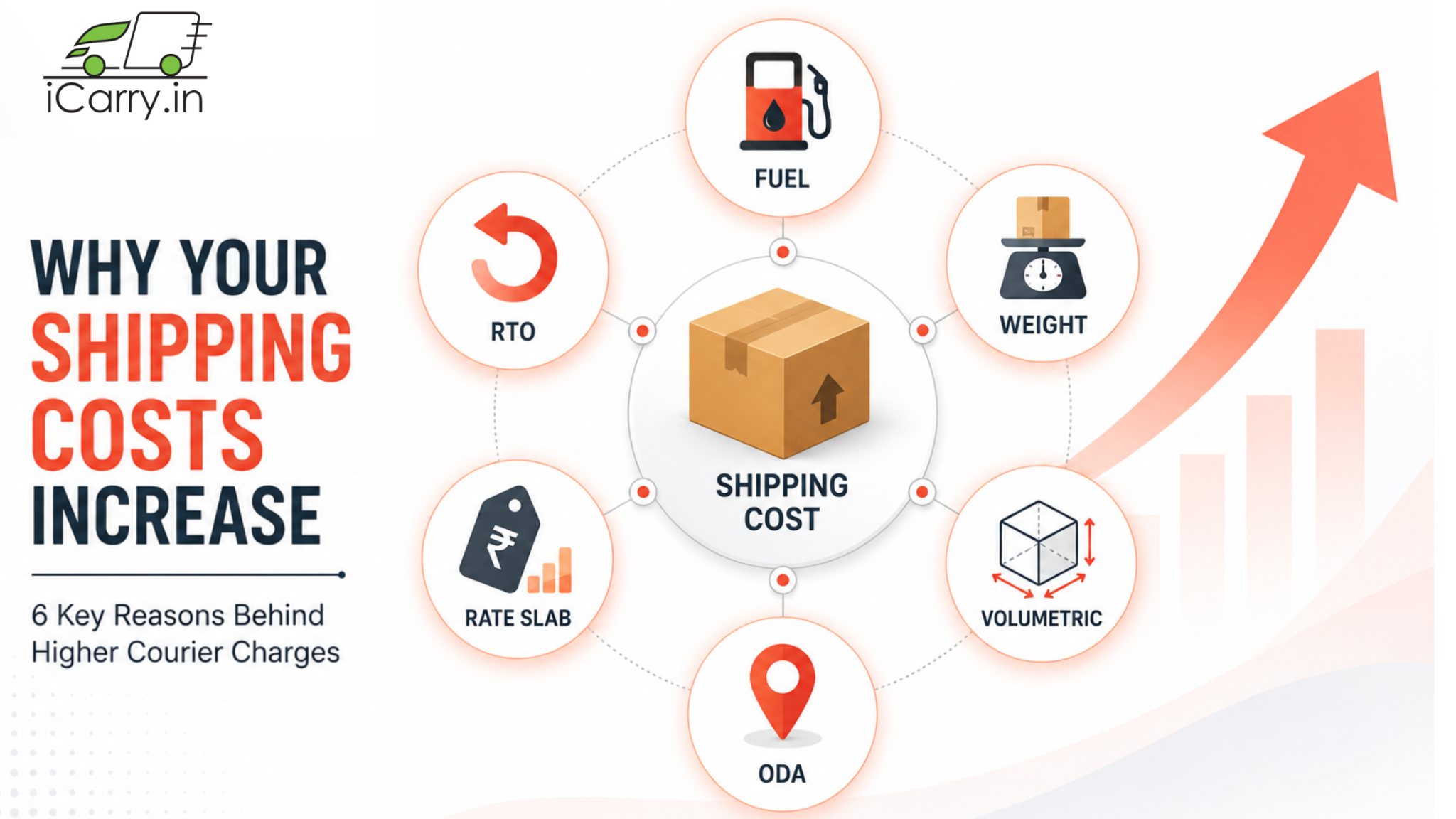
1. Fuel Surcharge Revision
Fuel surcharges are applied as a percentage of base freight and revised monthly by most couriers based on aviation turbine fuel prices. When fuel costs rise, this surcharge goes up automatically - even if your base rate agreement has not changed.
This is the most common reason sellers see higher bills without any change in their courier contract.
2. Weight Discrepancy Charges
When a courier's measurement of your parcel weight or dimensions differs from what you declared at booking, they raise a revised charge. This is one of the fastest-growing cost items for businesses shipping regularly in India.
Most sellers accept these charges without questioning them. But a significant percentage are disputable - especially when the revised weight is drastically different from what you packed. How to dispute weight discrepancy charges gives the exact process to follow within the 5-day dispute window.
Video: How to Resolve Weight Discrepancies on iCarry®
3. Volumetric Weight Billing
Couriers charge based on the higher of dead weight or volumetric weight. Volumetric weight is calculated as
Volumetric Weight = L×B×H / 5000
i.e. Length x Breadth x Height (cm) divided by 5000.
A light product, catalogue sample, garment, cosmetic item, spare part, or gift packed in an oversized box gets billed at the volumetric weight - which can be 2 to 3 times higher than the actual product weight. This silently inflates your shipping cost on every single order.
Example1:

Example 2: A 0.5 kg parcel billed at 1.2 kg volumetric weight can increase shipping cost by 40-70% depending on the zone.
4. ODA Surcharges
Out of Delivery Area (ODA) surcharges apply when couriers deliver to pincodes outside their standard service network. These charges are typically ₹30 to ₹100 extra per shipment and are added automatically at billing - often without a clear line item on the invoice.
5. Rate Slab Revisions
Courier partners revise their base rate slabs periodically - often annually or post-festive season. If your aggregator or courier has revised rates, you may be on a higher slab than before without realising it.
These and other charge types are covered in detail in the guide on hidden shipping charges in India.
6. Higher RTO Costs
Every failed delivery generates a return-to-origin charge - equal to the forward freight in most cases. This affects not just online sellers, but also manufacturers sending samples, pharmacies shipping medicines, gifting companies dispatching corporate orders, and distributors handling COD collections across India.
If your RTO rate has increased, your total monthly shipping cost goes up proportionally even if per-shipment rates are unchanged.
At 20% RTO on 500 orders per month with ₹100 average freight, you are paying ₹10,000 per month just in return charges. Reducing RTO systematically is the highest-leverage way to reduce total shipping cost.
Which Businesses Are Most Affected by Rising Courier Costs?
- eCommerce and D2C brands
- Manufacturers shipping samples or spare parts
- Wholesalers sending inventory to dealers
- Corporate gifting companies
- Pharmacies and healthcare suppliers
- Instagram and WhatsApp sellers
- Regional distributors handling COD deliveries
How Businesses Can Reduce Shipping Costs in India
Compare Rates Before Every Booking
Do not assume the same courier is always cheapest. Rates vary by weight, zone, and service type. Comparing rates across multiple courier partners before booking ensures you are always on the most cost-effective option for that specific order.
iCarry®'s free rate calculator shows live rates across multiple courier partners for your exact pincode and weight - no login required.
Right-Size Your Packaging
Shifting from a 30 cm box to a 20 cm box for the same product can cut volumetric weight by more than 50%. This alone can move a shipment down one weight slab - saving ₹20 to ₹50 per order at scale.
Dispute Weight Discrepancies Promptly
You have a very small window to raise a dispute after a weight discrepancy notification from a courier. At platforms like iCarry®, you get 5 business days to dispute such cases. Pre-uploading product images on iCarry® enables automatic dispute triggering and disputes are raised without manual action for every product with saved images.
Use a Courier Aggregator for Pre-Negotiated Rates
Individual sellers rarely have the volume to negotiate competitive rates directly with couriers. Aggregator platforms like iCarry® aggregate shipments from thousands of sellers - giving every seller access to bulk-negotiated rates from day one, even on the free plan.
Reduce RTO With Active NDR Management
Every RTO prevented is one less double-freight charge. iCarry®'s Delivery Boost feature deploys trained agents who call customers on your behalf and audit courier delivery claims - directly reducing the fake NDRs that generate avoidable RTOs.
How iCarry® Helps Reduce Shipping Costs
| Cost Driver | iCarry® Solution |
|---|---|
| High per-shipment rates | Pre-negotiated bulk rates across multiple courier partners from free plan |
| Volumetric weight billing | Rate calculator shows exact chargeable weight before booking |
| Weight discrepancy charges | Dedicated dispute dashboard - auto-raise disputes with pre-uploaded images |
| ODA surcharges | Pincode serviceability check before booking to avoid ODA surprises |
| RTO double freight | Delivery Boost, WhatsApp Engagement and NDR dashboard to reduce failed deliveries |
| Fuel surcharge increases | Switch to lower-cost courier partner for affected routes with one click |
Final Thoughts
Courier charges rarely increase because of one reason - usually it is a combination of fuel surcharges, volumetric weight, discrepancy charges, and rising RTO costs compounding silently over time.
The good news is that most of these costs are manageable with the right tools. Rate comparison, right-sized packaging, proactive weight discrepancy disputes, and RTO reduction together can meaningfully bring down your total monthly shipping bill.
iCarry® gives you all of these tools from a single platform - with a free plan, no minimum volume, and multiple courier partners to choose from. Start comparing rates at iCarry.in.
Frequently Asked Questions (FAQs)
Why did my courier charges suddenly increase?
The most common causes are fuel surcharge revisions, weight discrepancy charges on parcels measured differently by the courier, volumetric weight billing on oversized packaging, ODA surcharges for remote pincodes, higher RTO costs or rate slab revisions by the courier partner. Businesses shipping regularly across India often see total logistics costs rise even when the base freight rate appears unchanged.
What is a weight discrepancy charge?
A weight discrepancy charge is raised when the courier measures your parcel at a different weight or dimension than what you declared at booking. The difference is billed as an additional charge. You have 5 business days to dispute it with supporting evidence.
How do I reduce shipping costs for my eCommerce business?
Compare rates across multiple courier partners before every booking, right-size your packaging to reduce volumetric weight, dispute weight discrepancy charges within the 5-day window, reduce RTO with active NDR management, and use a courier aggregator to access pre-negotiated bulk rates. This is especially important for businesses shipping heavier B2B parcels, samples, replacement parts, or bulk orders where even small freight differences compound quickly.
What is volumetric weight and how does it affect shipping cost?
Volumetric weight is calculated as Length x Breadth x Height (in cm) divided by 5000. If your package is larger than it needs to be, the courier bills the volumetric weight instead of the actual weight - whichever is higher. Right-sizing packaging is the fastest way to reduce this cost.
Does iCarry® charge extra for weight discrepancy disputes?
No. iCarry's weight discrepancy dispute process is included for all sellers at no extra charge. You can pre-upload product images to enable automatic dispute triggering - so disputes are raised without any manual action when discrepancies arrive.
How does iCarry® help reduce shipping costs?
iCarry® provides live rate comparison across multiple courier partners, a dedicated weight discrepancy dispute dashboard, Delivery Boost for RTO reduction, and a free Bronze plan with no monthly fee - so you reduce costs without adding fixed overhead.
Courier charges in India rise due to a combination of fuel surcharges, volumetric weight billing, weight discrepancies, ODA surcharges, and increasing RTO costs - often compounding without a single line item explaining the full picture. Rate comparison, right-sized packaging, proactive dispute management, and RTO reduction together can meaningfully bring down your total monthly shipping bill.