B2B Shipping in India Is More Complex Than Most Businesses Expect
You're not sending one package to one customer. You're sending 50 cartons to a distributor in Ahmedabad, 12 boxes to a retail outlet in Coimbatore, and a pallet of goods to a warehouse in Delhi - all this week.
Each of these shipments has different weight, different urgency, different destination, and a very different risk profile if it goes wrong. A failed delivery isn't an unhappy customer - it's a delayed supply chain, a missed restock, and a business relationship under strain.
Yet most businesses in India approach B2B shipping the same way they approach sending a parcel home - pick a courier, book a shipment, hope for the best. That works at low volume. It breaks down fast as your business grows.
Here's how B2B shipping in India actually works, what it costs, and how to build a shipping process that doesn't create problems for your business or your buyers.
What Is B2B Shipping in India?
B2B shipping in India refers to the movement of goods between businesses - from a manufacturer to a distributor, a wholesaler to a retailer, or a brand to a fulfilment centre. Unlike B2C shipping (business to consumer), B2B shipments are typically larger in volume, higher in value, and involve commercial delivery terms, documentation requirements, and SLA commitments. In India, B2B shipping is handled by courier companies, freight forwarders, and logistics aggregators depending on shipment size and urgency.
How B2B Shipping Differs from B2C Shipping in India
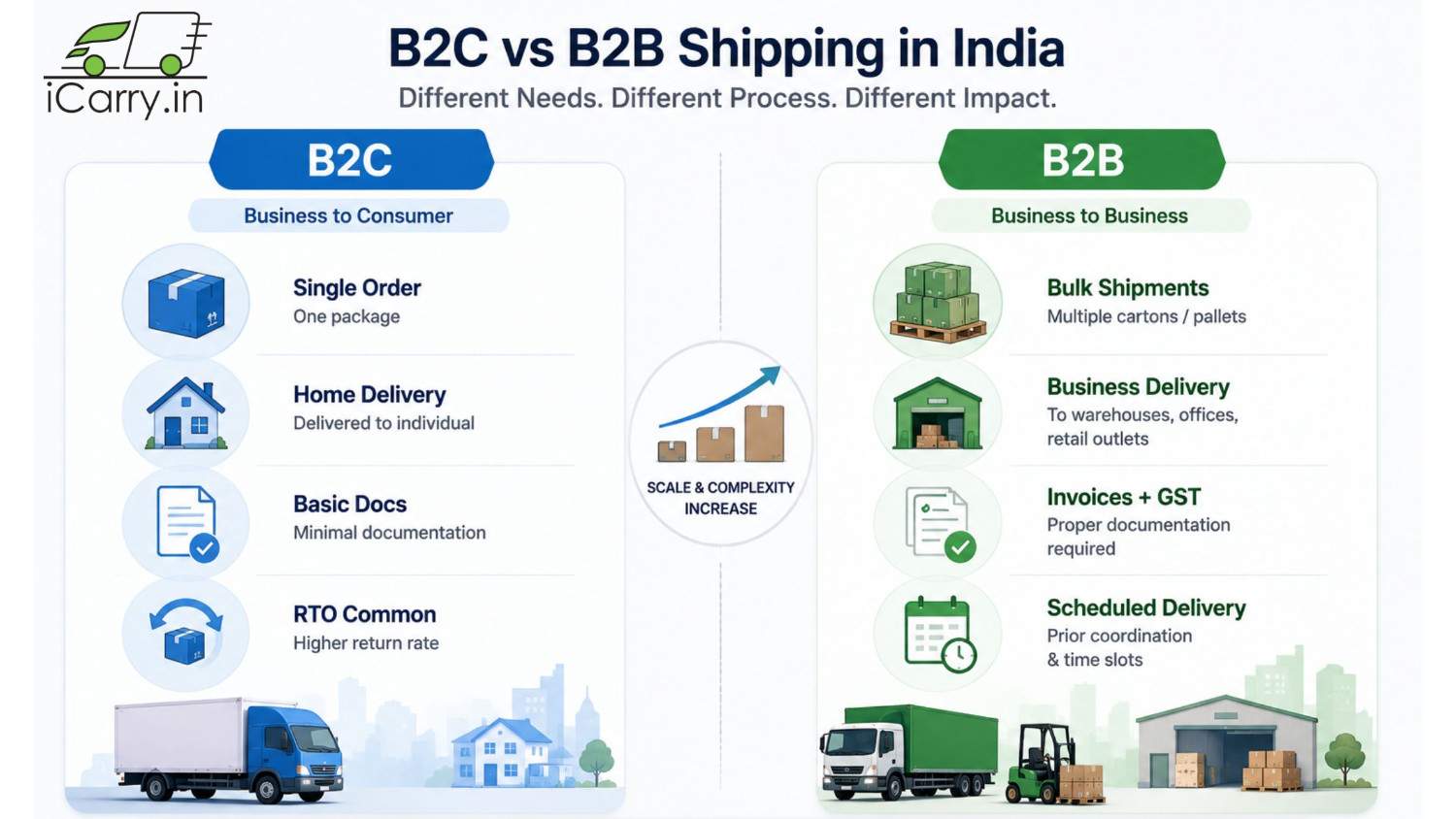
Most courier infrastructure in India was built for B2C - small packages, individual addresses, next-day delivery. B2B shipments have a different set of requirements, and not every courier handles them equally well.
| Factor | B2C Shipping | B2B Shipping |
|---|---|---|
| Shipment size | Single item or small package | Multiple cartons, bulk quantities |
| Recipient | Individual consumer | Business, warehouse, or retail outlet |
| Delivery address | Home or apartment | Commercial premises, often with restricted hours |
| Documentation | Minimal | Invoice, e-way bill, GST docs often required |
| Delivery attempt | 1-3 attempts, then RTO | Scheduled, often requires prior coordination |
| Value at risk | Low-medium per shipment | High - full consignment value |
| SLA sensitivity | Next-day convenience | Business-critical - delays affect supply chain |
| Returns/RTO | Common, managed via NDR | Less common, but higher cost when they happen |
The practical implication: a courier that's good for B2C eCommerce may not be the right choice for B2B shipments. Scheduling, documentation handling, and the ability to deliver to commercial addresses reliably matter far more in a B2B context.
How B2B Shipping Works in India - Step by Step
Whether you're a manufacturer dispatching to dealers or a brand sending stock to fulfilment partners, the process follows the same core steps:
- Order confirmation and documentation - Prepare your commercial invoice, packing list, and e-way bill (mandatory for shipments above ₹50,000 in value under GST rules).
- Packaging and labelling - B2B shipments often go as cartons or pallets. Each unit needs to be clearly labelled with consignee details, contents, and handling instructions.
- Courier or freight booking - Book through a courier aggregator like iCarry® or directly with a freight partner depending on volume and urgency.
- Pickup and hub processing - Courier picks up from your premises or warehouse. Shipment is scanned and routed through the courier's hub network.
- Line haul - Your shipment moves between origin and destination cities via road (surface) or air depending on the service type booked.
- Last mile delivery - Final leg from the destination hub to the buyer's warehouse, office, or retail outlet. This is where most B2B delivery problems occur.
- Proof of delivery (POD) - Authorised receiver signs off. POD is critical for B2B - it's your record that goods were delivered and received in good condition.
For businesses shipping regularly, automating steps 3-7 through a logistics platform significantly reduces manual effort and error. iCarry®'s courier API integration connects your order management system directly to multiple courier partners, so booking, tracking, and POD collection happen automatically.
B2B Shipping Modes in India - Which One Is Right for Your Business?
The right shipping mode depends on your shipment weight, urgency, and budget. Here's how the main options compare:
| Mode | Best For | Transit Time | Cost | Key Consideration |
|---|---|---|---|---|
| Surface / Road | Bulk orders, heavy goods, cost-sensitive B2B | 2-7 days | Lowest | Right choice for most regular B2B dispatch |
| Air Express | Urgent documents, high-value samples, time-critical parts | 1-2 days | Highest | Worth it only when delay has a real business cost |
| Part Load / Less Than Truckload (LTL) | Mid-volume shipments, multiple cartons | 3-6 days | Medium | Good for 50-5000 kg consignments without needing full truck |
| Full Truck Load (FTL) | High-volume, factory-to-warehouse | 2-5 days | Low per kg | Best for large regular dispatches above 5000 kg |
| Same Day / Hyperlocal | Urgent within-city B2B | Same day | Premium | Limited to metros or select cities, best for under 10kg |
For most small and mid-size businesses in India, surface shipping handles the bulk of B2B dispatch. It's 30-50% cheaper than air and perfectly adequate for shipments where next-day delivery isn't a hard requirement. Our breakdown of surface vs air shipping for businesses in India covers exactly when it makes sense to pay the air premium - and when surface is the smarter default.
B2B Shipping Costs by Zone in India
Where you're shipping to matters as much as what you're shipping. Indian courier networks divide the country into shipping zones, and costs increase significantly as you move from metro-to-metro routes to Tier 2/3 and remote areas. For businesses with dealers or buyers spread across India, this zone premium can meaningfully affect your per-shipment cost.
| Zone | Typical Route Examples | Surface Cost Premium | Air Cost Premium | Key Challenge |
|---|---|---|---|---|
| Zone A - Metro to Metro | Mumbai → Delhi, Bengaluru → Chennai | Base rate | Base rate | Competitive - optimise on courier performance |
| Zone B - Metro to Tier 2 | Delhi → Jaipur, Mumbai → Surat | 10-20% above base | 10-15% above base | Schedule delivery with commercial recipient |
| Zone C - Tier 2 to Tier 2/3 | Pune → Nashik, Bengaluru → Gulbarga | 20-35% above base | 20-30% above base | Fewer courier options, longer transit |
| Zone D - Remote / ODA | Hill stations, NE states, islands | 40-80% above base | 40-60% above base | Some couriers won't service or charge ODA surcharge |
If your business ships to dealers or buyers across mixed zones, your actual average shipping cost per consignment will be higher than your Zone A rate card suggests. Calculating your blended cost across zones is a necessary step before comparing courier partners.
India's logistics infrastructure gaps across zones are well-documented. The NITI Aayog National Logistics Policy framework, identifies last-mile cost inflation in non-metro zones as one of the primary reasons India's logistics costs as a share of GDP remain higher than comparable economies. For businesses shipping to Tier 2/3 buyers, choosing a courier with genuine coverage in those zones - not just nominal serviceability - is critical.
India's logistics costs have historically remained higher than many developed economies, largely due to infrastructure fragmentation, inter-state complexity, and last-mile inefficiencies. The World Bank's Logistics Performance Index also consistently evaluates countries on customs efficiency, infrastructure quality, shipment tracking, and timeliness - all of which directly impact B2B shipping reliability in India.
How to Calculate Your True B2B Shipping Cost
The rate card is not your shipping cost. Before committing to any courier for B2B dispatch, calculate your true cost per delivered consignment - including every variable that affects your actual freight bill.
- Base rate - Quoted per-kg rate or per-shipment flat rate*.
- Fuel surcharge - Typically 10-20% of base rate, applied automatically.
- Zone/ODA surcharge - 10-80% premium depending on destination zone.
- Dimensional weight - For bulky but lightweight goods (packaging materials, handbags, purses, certain electronics), volumetric weight = (L x W x H in cm) / 5000. If volumetric weight exceeds actual weight, you're billed on volumetric.
- GST on freight - 5% GST applies on freight charges. Factor this into your cost-per-shipment calculation.
- Failed delivery cost - B2B returns are less common than B2C but significantly more expensive when they happen - full return freight plus potential restocking cost.
* Flat rate means no separate COD charges and no RTO charges. Same rate is charged regardless of prepaid or cash on delivery and regardless of zone and regardless of delivered or returned.
Example: A 10 kg carton from Mumbai to a Tier 2 dealer in Jaipur (Zone B). Base rate ₹150. Fuel surcharge ₹22. Zone B premium ₹24. GST ₹10. Total: ₹206 per consignment. At 100 consignments a month, that's ₹20,600 in shipping costs - before any returns.
For businesses shipping at any meaningful volume, understanding this full cost picture is the foundation of intelligent courier selection. Our guide on how to reduce shipping costs for businesses in India covers every lever - from negotiating slab rates to zone-aware courier routing.
How to Choose the Right Courier for B2B Shipments in India
Not all couriers are equally suited for B2B. Here's what to evaluate:
| Courier | B2B Strength | Coverage | Surface Capability | Best B2B Use Case |
|---|---|---|---|---|
| Blue Dart | Excellent | Metro + Tier 2 strong | Yes | High-value goods, time-sensitive B2B |
| Delhivery LTL | Very Good | Pan-India | Yes | Balanced B2B, mixed zone distribution |
| Ekart LTL | Very Good | Wide Tier 2/3 | Yes | Balanced B2B, better coverage in 2/3 tier |
| XpressBees | Good | Strong metro | Yes | Cost-sensitive B2B in metro zones |
| Amazon Logistics | Very Good | Strong in select serviceable PIN codes | Yes | High-volume eCommerce & B2B, fast intra-city & regional fulfilment |
| FedEx / DHL | Excellent | Metro focus | Yes | High-value, international, premium SLA |
The honest answer is that no single courier covers every B2B need. Out of all the couriers available, Delhivery and eKart LTL are popular for their competitive rates and cover most of the country including Tier 2/3 ground.
The most effective approach for businesses with varied shipment profiles is multi-courier allocation - routing each consignment to the courier with the best combination of cost, coverage, and reliability for that specific destination. iCarry® does this automatically across multiple courier partners and also provides the ability to book B2B multi-box LTL shipments.
B2B Shipping Documentation in India
B2B shipments require more documentation than consumer deliveries. Getting this wrong causes delays at checkpoints, refused deliveries, and GST compliance issues.
- Commercial invoice - Required for all B2B shipments. Must include GSTIN of sender and receiver, HSN code, taxable value, and GST amount.
- E-way bill - Mandatory for goods worth more than ₹50,000 moving between states or within a state. Generated on the GST portal before dispatch.
- Packing list - Itemised list of contents, quantities, and weights. Helps with receiving verification and dispute resolution.
- LR (Lorry Receipt) / Consignment note - Issued by the courier or transporter as proof of booking. Also serves as the basis for insurance claims if goods are damaged.
- Proof of delivery (POD) - Signed acknowledgement from the receiver. Critical for payment reconciliation and dispute resolution in B2B.
E-way bill compliance is one of the most common pain points for businesses new to B2B shipping. The GST Council's official e-way bill guidelines cover generation, validity periods, and extension procedures. Getting this right before dispatch avoids detention charges and supply chain delays.
Common B2B Shipping Mistakes Indian Businesses Make
- Using a B2C courier for bulk B2B shipments - B2C networks aren't built for scheduled commercial deliveries. You'll get higher failure rates and no proper POD process.
- Ignoring volumetric weight - Bulky goods (packaging materials, garments, lightweight electronics) are almost always billed on volumetric weight, not actual weight.
- Not accounting for zone surcharges - A rate card that looks competitive on metro routes can become expensive when Zone C and D surcharges are applied to dealer network shipments.
- Skipping the e-way bill - Goods worth over ₹50,000 detained at checkpoints because of missing e-way bills cause supply chain delays and customer relationship damage.
- Using one courier for everything - A single courier partner will always have gaps - by zone, by shipment type, or by capacity at peak times. Diversifying reduces risk significantly.
- Not tracking until something goes wrong - B2B buyers expect proactive updates. Waiting for a buyer to report a missing shipment before you check is a relationship risk, not just a logistics one.
Most of these mistakes are fixable with the right platform and process. Our guide on how to reduce shipping costs for businesses in India covers the cost side of getting B2B shipping right - including how to negotiate better rates once you have volume history with a courier.
Who Should Read This?
- Manufacturers, wholesellers and distributors dispatching to dealers, retailers, or fulfilment centres
- SMEs and trading businesses sending regular commercial shipments across India
- D2C brands scaling into wholesale or B2B distribution channels
- Businesses currently using B2C couriers for commercial shipments and seeing problems
- Any business that ships and wants to understand what their logistics is actually costing them
Conclusion
B2B shipping in India is not complicated. But it is different from consumer delivery - and treating it the same way is one of the most common and expensive mistakes growing businesses make.
The right courier for your B2B shipments depends on your zones, your consignment sizes, your SLA requirements, and your buyers' delivery conditions. No single partner covers all of this equally well. The businesses that ship most efficiently are the ones that route intelligently across multiple partners - matching each consignment to the courier that actually performs best for that destination.
If you're ready to build a more systematic B2B shipping process, our breakdown of how multi-courier allocation works for businesses in India is a good starting point. And if documentation compliance is a challenge - particularly around e-way bills and GST invoicing - the GST Council's e-way bill portal has clear guidance on staying compliant without slowing down your dispatch process.
Businesses shipping LTL bulk shipments regularly can review the rate chart, compare rates via the B2B rate calculator, automate booking, and track B2B consignments across courier partners using iCarry®.
iCarry® connects businesses of all sizes to the top courier partners in India through one digital platform - with real-time rate comparison, zone-aware routing, automated booking, and full tracking. Lowest rates guaranteed - standard rate chart openly published on website. No monthly fee. No logistics team required.
Set up B2B shipping for your business on iCarry®. Free to start, no monthly fee.
Frequently Asked Questions
What is B2B shipping in India?
B2B shipping refers to the movement of goods between businesses - manufacturer to distributor, wholesaler to retailer, or brand to warehouse. It differs from B2C in shipment size, documentation requirements, delivery conditions, and SLA expectations. Most B2B shipments require a commercial invoice, packing list, and e-way bill (for consignments above ₹50,000).
Which courier is best for B2B shipments in India?
It depends on your zones and consignment type. Delhivery LTL is popular for pan-India balance for most businesses. eKart LTL is known to cover more Tier 2/3 dealer locations. For businesses with mixed shipment profiles, multi-courier allocation - routing each consignment to the best partner for that destination - consistently outperforms any single-courier approach.
Is an e-way bill required for all B2B shipments in India?
An e-way bill is mandatory for goods valued above ₹50,000 moving between states, and for intra-state movement above state-specific thresholds. It must be generated on the GST portal before dispatch. Shipments detained at checkpoints without a valid e-way bill are subject to penalties and supply chain delays.
How are B2B shipping charges calculated in India?
B2B shipping charges are calculated on billable weight (higher of actual or volumetric weight) plus fuel surcharge (10-20%), zone/ODA surcharge (10-80% depending on destination), and 5% GST on freight. For bulk shipments, Part Load (LTL) or Full Truck Load (FTL) pricing applies, which is calculated differently from per-kg courier rates. iCarry rates are openly published and inclusive of GST on the website itself - no hidden additional charges.
How can businesses reduce B2B shipping costs in India?
The most effective levers are: negotiate slab rates once you have consistent monthly volume (300+ consignments), use surface over air for non-urgent shipments (30-50% cheaper), right-size packaging to reduce volumetric weight billing, route zone-aware across multiple couriers to avoid paying premium rates where a cheaper partner performs equally well, and reduce failed deliveries through better scheduling with commercial recipients.
B2B shipping in India works differently from consumer delivery - larger consignments, stricter documentation, commercial recipients, and higher value at risk. The businesses that get it right route intelligently across multiple courier partners, match each consignment to the best option for that zone, and use documentation compliance to avoid costly delays. iCarry® makes all of this manageable from one platform, with transparent published rates and no monthly fee.