A garment manufacturer in Tirupur ships 1,200 units to a retail buyer in the Netherlands. The buyer's bank will not release payment until they receive the original bill of lading. The freight forwarder issues it, the Indian exporter sends it via courier to the buyer, the buyer presents it to their bank, and only then does the letter of credit payment get released.
This is the bill of lading at work - not just a transport document, but a financial instrument that controls who owns the cargo and when payment moves.
For Indian exporters shipping via ocean freight, the bill of lading is the single most important document in the entire transaction - India's major ports alone handled over 819 million tonnes of cargo in FY24 (IBEF), much of it moving under a bill of lading. It is the title of the goods in transit. Without it, the buyer cannot take delivery. Without an original copy, banks will not release payment under letters of credit. Understanding what it is, what it contains, and how to manage it correctly is non-negotiable for any business exporting from India via sea.
What Is a Bill of Lading?
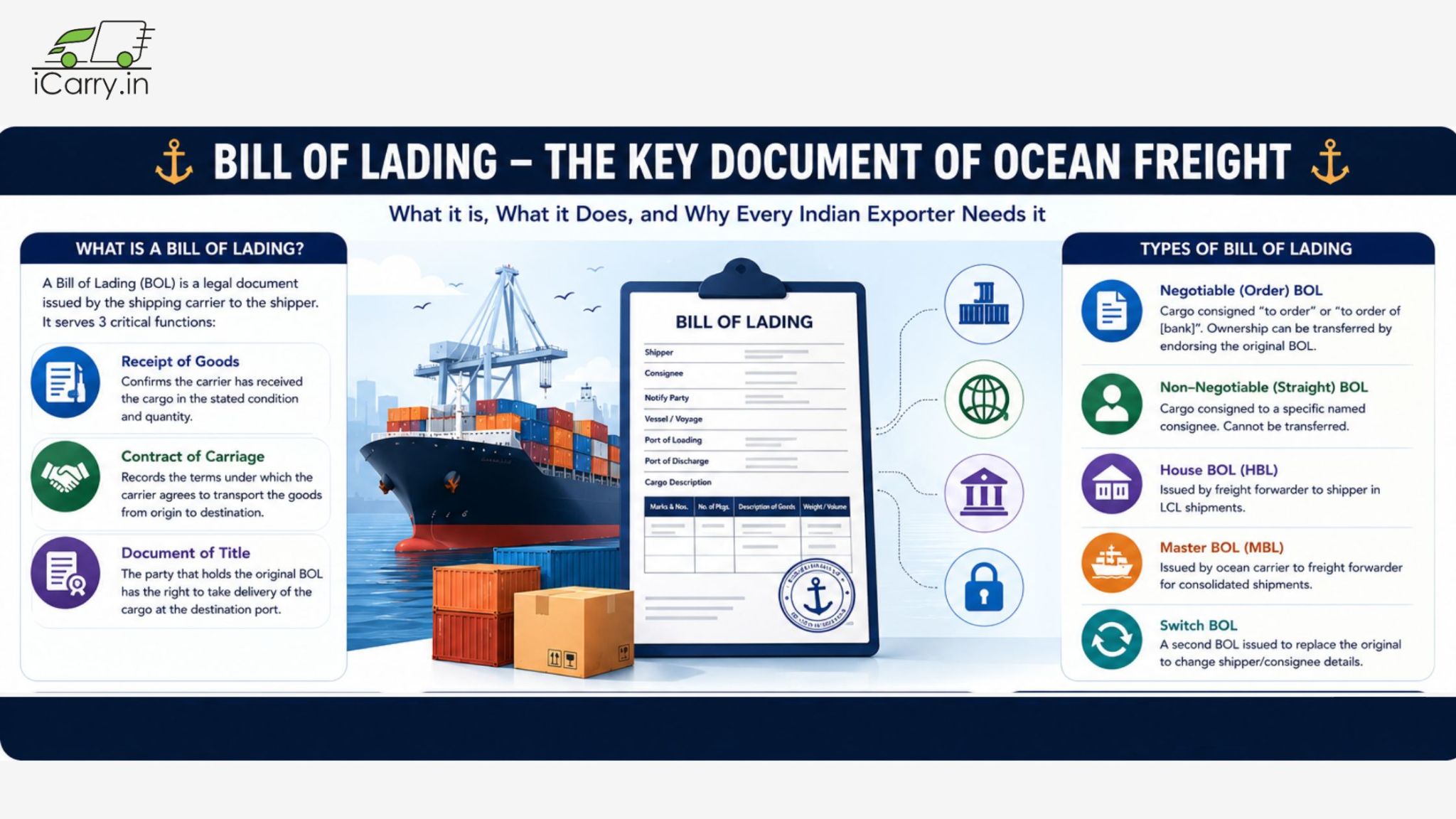
A Bill of Lading (BOL or B/L) is a legal document issued by a shipping carrier (ocean carrier or freight forwarder) to a shipper. It serves three distinct and simultaneous functions:
- Receipt of goods: Confirms the carrier has received the cargo in the stated condition and quantity
- Contract of carriage: Records the terms under which the carrier agrees to transport the goods from origin to destination
- Document of title: The party that legally holds the original BOL has the right to take delivery of the cargo at the destination port
This third function - document of title - is what makes the bill of lading fundamentally different from any other shipping document. The commercial invoice records a sale. The packing list records what is in the shipment. But the BOL is the document that controls physical ownership of the cargo while it is at sea.
Bill of Lading vs Air Waybill - Key Difference
Many Indian exporters confuse the bill of lading with the air waybill (AWB). They are not interchangeable.
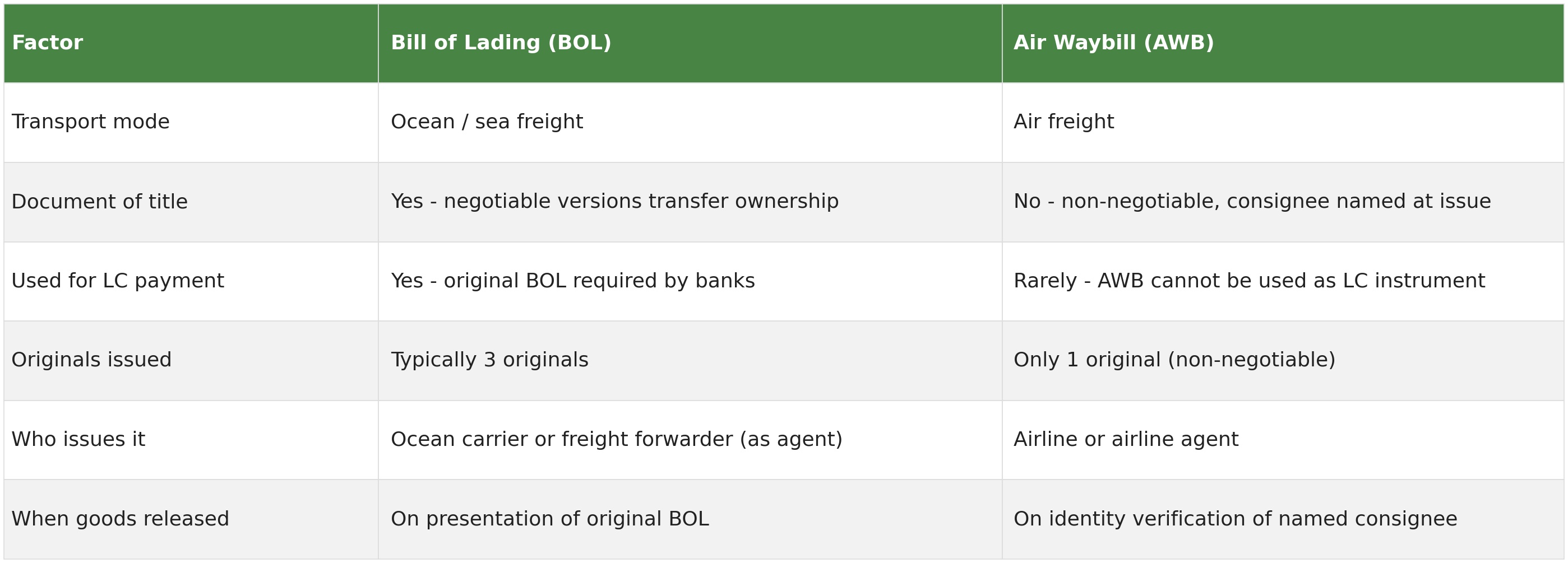
For Indian exporters using express couriers for parcel-sized shipments (FedEx, Aramex), neither a BOL nor an AWB in the traditional sense applies - the courier's own tracking system serves as the shipment contract and delivery confirmation.
How to Check Your Bill of Lading Essentials
- Do you know which type of BOL your trade term requires - negotiable or non-negotiable?
- Is your shipper name and address on the BOL exactly matching your IEC registration?
- Does the consignee field match your letter of credit terms if payment is LC-backed?
- Are the HS code and cargo description on the BOL consistent with your commercial invoice?
- Do you know how many original BOL copies are required by your buyer and their bank?
- Is the port of loading and port of discharge correct for your specific shipment route?
Types of Bill of Lading
1. Negotiable (Order) Bill of Lading
The most common type for international trade involving letters of credit. The cargo is consigned 'to order' or 'to order of [bank]' rather than to a specific named party. Ownership of the cargo can be transferred by endorsing and physically handing over the original BOL - similar to how a cheque is endorsed.
Banks use this mechanism for LC-backed trade: the seller presents the original BOL to their bank, the bank releases payment, and sends the BOL to the buyer's bank, which releases it to the buyer only after the buyer pays or accepts the draft.
2. Non-Negotiable (Straight) Bill of Lading
Cargo is consigned to a specific named consignee. Only that named party can take delivery - the document cannot be transferred. Used for shipments to trusted buyers where no LC or bank payment instrument is involved. The carrier releases cargo to the named consignee on identity verification without requiring an original document.
3. House Bill of Lading (HBL)
Issued by a freight forwarder to the shipper when the forwarder is consolidating multiple shippers' cargo into one container (LCL). The freight forwarder issues individual HBLs to each shipper while the ocean carrier issues one Master Bill of Lading (MBL) to the freight forwarder. Indian LCL exporters typically hold an HBL, not the MBL.
4. Master Bill of Lading (MBL)
Issued by the ocean carrier to the freight forwarder for consolidated (LCL) shipments. The freight forwarder uses the MBL to take delivery of the full container at destination and then releases cargo to individual consignees against their HBLs.
5. Switch Bill of Lading
A second set of BOL issued to replace the original, typically to change shipper or consignee details. Used in triangular trade where a middleman does not want the origin supplier and end buyer to know each other's identity. Requires careful handling as it involves replacing an already-issued title document.
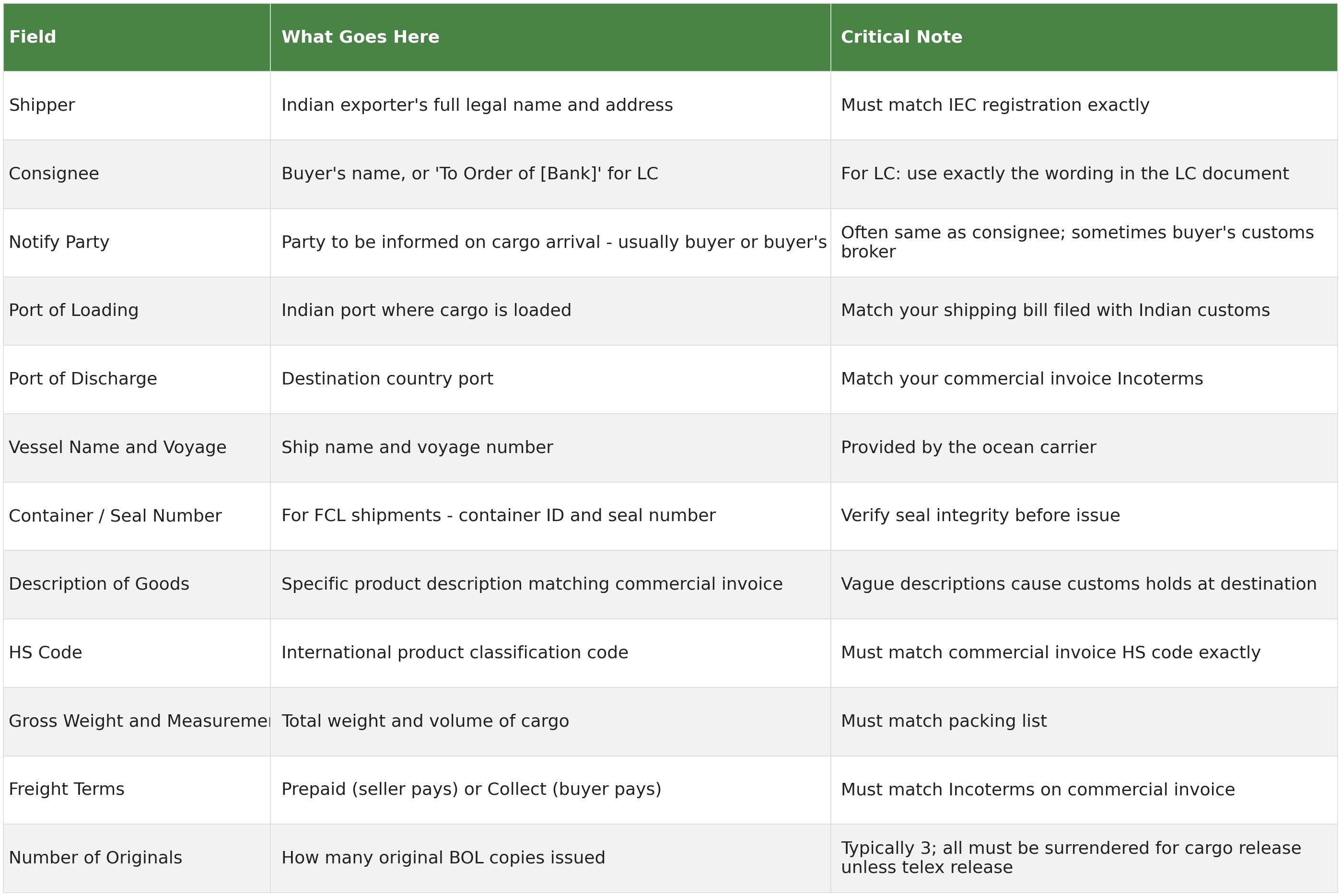
Every Field in a Bill of Lading - Explained
The BOL Process for Indian Exporters - Step by Step
- Step 1 - Booking: Freight forwarder or shipper books cargo space with the ocean carrier (shipping line)
- Step 2 - Shipping instructions: Exporter provides exact shipper, consignee, notify party, cargo description, and HS code to the freight forwarder
- Step 3 - Draft BOL: Carrier or forwarder issues a draft BOL. Exporter must review every field carefully before confirming
- Step 4 - Cargo loaded: Once cargo is loaded and verified, carrier issues the Original Bill of Lading - typically 3 original copies
- Step 5 - Originals to exporter: Original BOL copies are sent to the Indian exporter (or directly to the exporter's bank for LC transactions)
- Step 6 - Payment / LC: For LC transactions, exporter presents originals to their bank along with other LC documents to receive payment
- Step 7 - BOL to buyer: Bank sends BOL to buyer's bank; buyer presents original at destination port to take delivery of cargo
Telex Release and Seaway Bill - Modern Alternatives
Originating and receiving paper BOL originals across continents takes time - often longer than the ship's transit. Two modern alternatives address this:
Telex Release
Once the exporter has surrendered the original BOL copies to the carrier or freight forwarder at the origin port, the carrier sends a telex (electronic message) to their destination agent authorising release of cargo to the named consignee without requiring presentation of the physical original. Useful when buyer is trusted and no LC is involved.
Seaway Bill (Express Release Bill of Lading)
A non-negotiable document that does not require physical presentation at the destination. Cargo is released to the named consignee on identity verification. Cannot be used for LC transactions. Increasingly common for shipments between well-established trade partners where payment is not bank-guaranteed.
When Indian Exporters Need a BOL vs a Courier AWB
The decision is determined by shipment size and payment mechanism - not preference.
- Need a BOL: Ocean freight shipments (FCL or LCL), letter of credit transactions, shipments above approximately 100 to 150 kg where ocean freight is cost-effective, and any shipment where title transfer via document is required
- Need an AWB: Air freight shipments, time-sensitive cargo, high-value low-weight goods where transit time justifies air cost
- Neither (use courier): Individual parcels, D2C international orders, samples, and shipments under approximately 30 kg where express courier service is used. iCarry® provides FedEx and Aramex access for these shipments without BOL or AWB complexity
For Indian exporters whose shipment profile is primarily parcel-level exports - D2C orders, artisan products, small B2B consignments - international courier shipping via iCarry® handles the entire export process without requiring BOL management. Compare international courier rates for your specific weight and destination before booking.
Common BOL Mistakes Indian Exporters Make
- Shipper name mismatch: Name on BOL differs from IEC registration. Banks and customs reject this. Verify exact legal name before confirming the draft.
- Wrong consignee for LC: LC specifies 'To Order of [Bank Name]' but BOL names the buyer directly. The bank will reject the LC presentation.
- Description inconsistency: Product description on BOL differs from commercial invoice. Both must be identical in terms and HS code.
- Not reviewing the draft: Confirming the draft BOL without reading every field is the most common source of costly amendments. Amendment fees and delays are avoidable.
- Losing original copies: Original BOL is a title document. If lost, obtaining an LOI (Letter of Indemnity) is expensive and time-consuming. Store originals securely.
How iCarry® Fits Into the Export Picture
iCarry® is a courier aggregator - it serves the parcel and express courier segment of Indian exports.. For exporters who ship a mix of parcel-level and container-level cargo:
- Use iCarry® for D2C international orders, product samples, and small B2B consignments via FedEx and Aramex - no BOL required
- Use a freight forwarder and ocean carrier for bulk, container-level exports where BOL management is required
- Manage both from separate accounts - iCarry® for the courier portion, freight forwarder for the ocean portion
International account activation is required on iCarry® before first international booking. Contact iCarry® support to enable this. Free Bronze plan with no minimum volume.
Final Thoughts
The bill of lading is not just paperwork. It is the document that controls ownership of cargo at sea, enables bank-backed payment in letter of credit transactions, and determines whether your buyer can legally take delivery of the goods you shipped.
For Indian exporters using ocean freight, getting the BOL right - reviewing every draft field, matching the commercial invoice exactly, understanding which type of BOL your trade requires, and managing originals carefully - is as important as getting the cargo itself packed correctly.
For parcel-level exports and express shipments that do not require a BOL, iCarry® provides FedEx and Aramex access from one platform with simple documentation and no freight forwarder required.
Frequently Asked Questions (FAQs)
What is a bill of lading in simple terms?
A bill of lading is a document issued by the shipping carrier that acts as a receipt for the cargo, a contract for its transport, and a title to the goods. The party that holds the original bill of lading has the right to take delivery of the cargo at the destination port.
Is a bill of lading required for all Indian exports?
No. A bill of lading is required for ocean freight shipments. For air freight, an air waybill is used instead. For parcel-level exports via express courier (FedEx, Aramex), neither is required - the courier's AWB serves as the shipment contract and delivery reference.
What is the difference between a negotiable and non-negotiable bill of lading?
A negotiable (order) BOL consigns cargo 'to order' - ownership can be transferred by endorsing the original document. Used for letter of credit transactions where banks control cargo release. A non-negotiable (straight) BOL names a specific consignee who takes delivery on identity verification - it cannot be transferred and is not suitable for LC-backed payment.
How many original copies of a bill of lading are issued?
Typically three original copies. All three are equally valid - presenting any one original at the destination releases the cargo. The remaining originals become void once the first is presented. Banks often require all three originals for letter of credit document presentation.
What is a telex release and when is it used?
A telex release is an electronic instruction from the carrier to their destination agent authorising cargo release without requiring the physical original bill of lading. Used when the original has been surrendered at origin and the buyer is trusted or payment is already settled. Not suitable for LC transactions.
The bill of lading is not just paperwork - it is the document that controls ownership of cargo at sea, enables bank-backed payment in letter of credit transactions, and determines whether your buyer can legally take delivery of the goods you shipped. For Indian exporters using ocean freight, getting the BOL right - reviewing every draft field, matching the commercial invoice exactly, understanding which type of BOL your trade requires, and managing originals carefully - is as important as getting the cargo itself packed correctly.