A customer in the UK found your handmade kurtas on Instagram. Someone in Dubai wants your Ayurvedic skincare product. A corporate buyer in Singapore needs 50 units of your dress. These are real orders that Indian sellers receive every week - and most do not know how to fulfil them.
International shipping from India is more accessible than ever in 2026. But it is also more documented, more regulated, and more complex than domestic delivery. One wrong field in your commercial invoice, one missing HS code, or one undisclosed product restriction can hold your shipment in customs for weeks.
This guide gives Indian small businesses a clear, step-by-step roadmap for shipping internationally in 2026 - from IEC registration through customs clearance to final delivery.
What Is International Shipping from India?
International shipping from India is the process of exporting goods to customers in other countries using global logistics and courier networks. Unlike domestic delivery, it involves export customs clearance in India, international transit, and import customs clearance in the destination country.
The basic flow: Order placed - Packaging and documentation - Export customs clearance - International transit - Import customs clearance - Final delivery.
Why Small Businesses Should Consider Going Global
1. Access to Premium Markets
Indian products - fashion, handicrafts, wellness, spices, and electronics accessories - command premium pricing in the US, UK, UAE, Canada, and Australia. Markets where Indian diaspora communities create strong organic demand for authentic Indian products.
2. Higher Profit Margins
International buyers consistently pay more for Indian-made products than the domestic price. Fashion and handicraft exports lead this trend - IBEF data shows India's textile and apparel exports (including handicrafts) hit a record $44.4 billion, with the US alone taking a 27% share - categories where international buyers consistently pay more than the Indian domestic price, even after logistics costs.
3. Diversified Revenue
Selling globally reduces dependence on India's seasonal demand patterns and local market fluctuations. Multiple revenue streams across different countries create business resilience.
Can Small Businesses Ship Internationally Without Experience?
Yes. Many small businesses, handicraft sellers, manufacturers, and first-time exporters start international shipping without any prior export experience. Modern courier partners and aggregators handle much of the documentation support. That said, commercial exports do require two basic registrations: an IEC code from DGFT and a valid GSTIN. Both are straightforward to obtain and are one-time setups. Once in place, your first international shipment is operationally similar to a domestic one - just with additional documents attached.
Key Requirements to Start International Shipping
1. IEC - Import Export Code
Mandatory for all commercial exports from India. Apply online at DGFT's portal - registration takes 1 to 3 business days and costs ₹500. Lifetime validity. Without an IEC, customs clearance for commercial international shipments cannot be processed.
2. GST Registration
Valid GST registration is required for export invoicing. Export transactions are typically zero-rated for GST purposes - but you still need a GSTIN to generate compliant export invoices with the correct HSN codes.
3. Bank Account for Foreign Currency
A business bank account that supports foreign currency transactions is required for international payment receipt. Export proceeds must be repatriated to India within specified RBI timelines.
Essential Export Documents
1. Commercial Invoice
The most critical document in international shipping. Must include: buyer and seller details, product description, HS code, declared value per unit, total value, currency, Incoterms (DDP or DDU), and country of origin. Customs authorities in the destination country use this to assess import duties.
2. Packing List
Provides shipment details: number of packages, weight and dimensions per package, contents description. Helps logistics providers and customs officials verify the shipment against the commercial invoice.
3. Shipping Bill
Filed with Indian Customs as part of the export clearance process. The shipping bill contains details of the exporter, shipment value, product classification, and destination country. It is mandatory for all exports from India and is used by customs to process and approve the shipment for export.
4. Air Waybill (AWB)
A transport document issued by the courier or airline, serving as proof of shipment and a contract of carriage. It includes shipment details such as sender and receiver information, tracking number, and routing details. The AWB is also used for tracking the shipment and is required for customs clearance at the destination.
5. Certificate of Origin
Check CBIC guidelines for destination-specific certificate of origin requirements before shipping to countries with India FTA agreements.
Step-by-Step: How to Ship Internationally from India
Once your registrations are in place, every international shipment follows the same sequence. Here is the process end to end:
1. Get your IEC code
Apply at DGFT's portal. Takes 1 to 3 business days and costs ₹500. You cannot proceed with commercial exports without this.
2. Prepare your export invoice
Include the buyer's details, item description, HS code, quantity, unit price, total value in foreign currency, and Incoterms (DDP or DDU). This is the most error-prone document - one wrong field causes customs delays.
3. Pack to international standards
Use double-walled cartons, appropriate void fill, and weatherproof outer packaging. Weigh and measure the final box accurately - couriers bill on actual weight vs volumetric weight, whichever is higher.
4. Select your courier and compare rates
Sign up on your choice of a courier aggregator, enable your account for international shipments by completing KYC and then compare rates for your exact weight and destination before booking. Rates vary per shipment based on dimensional weight and fuel surcharges.
5. Generate the AWB (Air Waybill)
Book the shipment and print the AWB label. Attach it to the outer carton. The AWB number is your shipment's tracking reference from origin to destination.
6. Complete export customs clearance
The courier handles filing of the Shipping Bill with Indian customs. Ensure your invoice matches the Shipping Bill exactly. Customs may inspect the parcel before clearance.
7. Track delivery and manage NDRs
Monitor the shipment through the courier's tracking system. If a delivery attempt fails (NDR), act within 24 hours to update delivery instructions or reschedule - missed NDRs escalate to return-to-origin.
International Shipping Methods

For most Indian businesses, manufacturers, online sellers, and exporters, international express courier is the starting point. FedEx and Aramex are the two most established options for India-to-international express delivery.
iCarry® gives sellers access to FedEx and Aramex for international shipping from a single platform - alongside multiple domestic courier partners. Compare international rates for your specific weight and destination at iCarry.in for free. Watch How to Estimate International Shipping Cost for a step-by-step walkthrough.
What Affects Your Final International Shipping Cost?
The rates above are indicative. Your actual invoice will depend on:
- Actual weight vs volumetric weight: couriers bill whichever is higher. Light but bulky items get billed on dimensions.
- Destination country: remote areas and smaller cities attract additional surcharges on top of base rates.
- Fuel surcharge: applied as a percentage and changes monthly - check at time of booking, not when quoting.
- Customs handling fees: some destinations charge import processing fees separate from import duty.
- Declared value: higher declared values increase the customs duty your buyer (or you, under DDP) will pay.
- Packaging dimensions: right-sizing your box directly reduces volumetric weight and your final invoice.
For strategies to reduce international shipping costs, the guide on reducing shipping costs for eCommerce in India covers packaging optimisation and courier comparison that apply to international shipments as much as domestic ones. Most importantly, use optimum sized packaging to minimise volumetric weight billing - the same principle that applies to domestic shipping. Export packaging materials guide covers packaging specifically for international transit requirements.
DDP vs DDU - Which Should You Choose?
When shipping internationally, you must decide who pays import duties in the destination country.

Recommendation for D2C sellers: Use DDP for consumer markets (UK, USA, Australia, UAE). Your customer receives a fully landed price with no surprise charges at delivery - significantly reducing refusals and negative reviews. Always clearly communicate your shipping terms on your product page and at checkout.
Understanding the full duty and tariff landscape before pricing internationally is essential. Tariffs vs duties explained covers how import duty calculations work by destination country.
Real-World Examples
D2C Apparel Brand
A Jaipur fashion brand ships sarees and kurtas to UK diaspora customers using DDP via FedEx through iCarry®. Pre-paid duties mean zero customer surprises at delivery. Repeat purchase rate from UK customers is 3x their domestic repeat rate.
Handmade Products Seller
An Etsy seller shipping handmade brass decor uses eBay Global Shipping Program for US orders and direct FedEx via iCarry® for UAE and UK orders. Catalogue of 200 products visible globally with logistics managed from one platform.
Common Mistakes in International Shipping
- Incorrect or missing HS codes: The most common cause of customs delays. Verify your HS code on CBIC before every new product category you export.
- Under-declaring product value: Declaring a lower value to reduce destination duties is illegal and can result in shipment seizure, courier account blacklisting, and penalties.
- Not disclosing lithium batteries: Electronics with lithium batteries have strict IATA air transport regulations. Non-disclosure results in shipment rejection.
- Surprising customers with DDU duties: Customers who were not warned about destination import charges frequently refuse delivery - creating an expensive international return.
- Poor export-grade packaging: International shipments go through multiple handling points over 5 to 10 days. Domestic packaging standards are not sufficient for international transit distances.
Best Practices for International Shipping from India
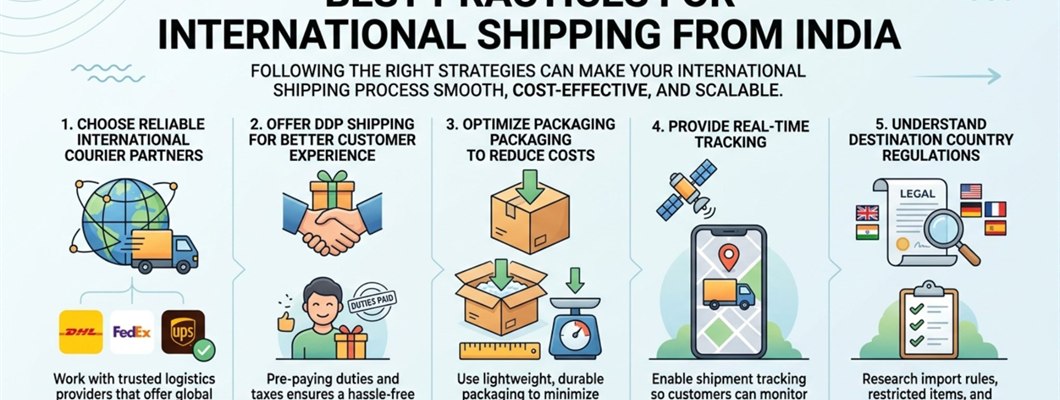
- Always verify HS codes before a new product category's first export
- Use DDP for consumer D2C markets to eliminate delivery friction
- Clearly state shipping terms (DDP or DDU) on your checkout page
- Right-size packaging to minimise volumetric weight billing
- Compare FedEx and Aramex rates before every booking via a courier aggregator
- Photograph parcels before handover for insurance and damage claim evidence
- Research destination country restrictions before listing products for international sale
How iCarry® Supports International Shipping
iCarry® is a courier aggregator that gives Indian businesses - sellers, manufacturers, and exporters - access to FedEx and Aramex for international shipping alongside domestic courier partners, all from one account. This means:
- Compare international rates across FedEx and Aramex before every booking
- Manage international and domestic shipments from the same My Shipments dashboard
- Access the same Delivery Boost and WhatsApp Engagement features for international COD orders where applicable
- No separate international courier contracts needed - you can access the international account activation through iCarry®
Note: International shipping via FedEx and Aramex on iCarry® requires a separate international account activation step. Contact iCarry® customer support to enable international shipping before your first export order.
Compare live international rates at iCarry® before every booking. Register free at iCarry.in - no monthly fee, no minimum volume.
Final Thoughts
International shipping from India is genuinely accessible for small businesses in 2026. The documentation requirements are manageable once you understand them. The courier infrastructure - via FedEx and Aramex through iCarry® - is reliable and globally connected.
The two biggest mistakes are documentation errors that cause customs holds, and customer experience failures from undisclosed import duties. Get these two right and international shipping becomes a predictable, scalable part of your business.
Start with one or two markets where you already have organic demand. Get the IEC. Verify your HS codes. Price for DDP. Use a courier aggregator for rate comparison. Document everything.
Getting started is straightforward - iCarry® gives access to multiple domestic & international courier partners - all from one free account. If you are a business, register for free and get started today.
Frequently Asked Questions (FAQs)
What is required to ship internationally from India?
You need an IEC (Import Export Code from DGFT), valid GST registration, correct export documentation (commercial invoice with HS code, packing list, shipping bill), and an international courier partner. For most D2C categories no additional licence is needed.
How much does international shipping cost from India?
Express courier rates typically start from ₹350 per 500g for South Asia and ₹1,000 to ₹2,000 per 500g for USA and Canada. Fuel surcharges and destination handling fees apply additionally. Compare live rates for your specific shipment before booking.
How long does international shipping from India take?
Express courier: 3 to 10 business days depending on destination. Middle East and South Asia are fastest at 2 to 5 days. USA, UK, Europe, and Australia typically take 4 to 8 business days via express. Sea freight takes 2 to 6 weeks.
What is DDP shipping and should I use it?
DDP (Delivered Duty Paid) means you pre-pay import duties and taxes so the customer receives the product without any additional charges. Strongly recommended for D2C consumer markets (UK, USA, UAE, Australia) as it eliminates customer surprise charges and significantly reduces delivery refusals.
Which countries are best to start shipping to from India?
UAE and GCC have strong demand for Indian fashion, food, and wellness. UK, USA, Canada, and Australia have large Indian diaspora communities actively buying authentic Indian products. These markets are established for Indian exports and have well-known customs procedures.
Can small businesses export from India?
Yes. An IEC code, GST registration, and a courier partner are all you need to start exporting. iCarry®'s free Bronze plan gives small businesses access to FedEx and Aramex for international shipping from the first shipment, with no minimum volume requirement.
Does iCarry® offer international shipping?
Yes. iCarry® provides access to FedEx and Aramex for international shipping alongside multiple domestic courier partners. International account activation is required - contact iCarry® support to enable before your first international shipment.
Can I ship internationally from India without an IEC?
No - not for commercial exports. An IEC (Import Export Code) is mandatory for any shipment exported for commercial purposes. Personal gifts below a certain value may be exempt, but if you are shipping goods you have sold, an IEC is required. The good news: IEC registration costs ₹500, takes 1 to 3 business days at DGFT's portal, and is valid for life. It is the first step every exporter takes.
Which courier is cheapest for international shipping from India?
It depends on weight, destination, and dimensions. For South Asia and the Middle East, Aramex often offers competitive rates. For USA, UK, and Europe, FedEx is the most widely used option for Indian exports. The best approach is to compare live rates for your exact shipment details before every booking - rates vary shipment to shipment based on dimensional weight and surcharges. iCarry® lets you compare FedEx and Aramex rates side by side before committing to a booking.
How do customs charges work when shipping from India?
On the India side, exports are zero-rated for GST - you do not pay GST when exporting goods. On the destination side, your buyer's country will charge import duties based on the declared value and HS code of your product. Under DDU (Delivered Duty Unpaid), the buyer pays these at customs. Under DDP (Delivered Duty Paid), you collect the estimated duty from the buyer at checkout and pay it on their behalf. Using the correct HS code is essential - an incorrect code can lead to wrong duty calculation or customs holds.
What products can I ship internationally from India?
Most physical goods can be shipped internationally from India. The most common export categories are: fashion and apparel, handicrafts and home decor, wellness and Ayurvedic products, spices and specialty foods, electronics accessories, and B2B industrial goods. Some categories have restrictions - certain food products require FSSAI export compliance, chemicals require safety data sheets, and items like lithium batteries or live plants have airline-specific restrictions. Always check the destination country's import regulations for your specific product category and HS code before shipping for the first time.
International shipping from India is accessible for any business with an IEC code, GST registration, and the right courier partner. Getting documentation right and choosing DDP for consumer markets are the two decisions that determine whether your first international shipments delight customers or get stuck in customs.