
An Indian exporter ships a consignment of handcrafted brass items to a buyer in the UK. Customs holds the shipment for five days. The reason: the commercial invoice does not include an HS code, the declared value does not match the buyer's purchase order, and the country of origin field is blank.
Three missing or incorrect fields. Five days of customs dwell. Storage charges. An unhappy buyer. A relationship damaged before it could be properly established.
The commercial invoice is the most important document in any shipment - domestic or international. For Indian businesses, getting it right is not optional. It determines whether your goods clear customs smoothly, whether your buyer can claim the correct import duty treatment, and in the event of a dispute, whether you have the documentation to stand behind your claim.
This guide explains what a commercial invoice is, how it differs from other invoices, what every field means, the most common errors Indian businesses make, and how to prepare one correctly for both domestic and international shipments.
What Is a Commercial Invoice?
A commercial invoice is a formal document issued by a seller to a buyer that records the details of a commercial transaction - what was sold, how much it cost, and the terms under which it was sold. It serves as the primary record of a sale for accounting, taxation, and logistics purposes.
For shipments - both domestic and international - the commercial invoice travels with the goods and is used by:
- Customs authorities to assess import duty and verify the shipment against declared contents
- Logistics providers and couriers to identify the shipment and its declared value for insurance purposes
- Buyers to verify receipt against their purchase order
- Both parties for accounting, tax reconciliation, and dispute resolution
How to Check Before Issuing Any Commercial Invoice?
- Is the buyer's complete legal name, address, and (for GST transactions) GSTIN on the invoice?
- Is the product description specific enough for customs classification - not just 'handicraft' or 'goods'?
- Is the HS code included for international shipments?
- Is the declared value the actual transaction value - what the buyer is actually paying?
- Is the currency clearly stated?
- Are Incoterms specified for international shipments (DDP, DDU, FOB)?
- Is the invoice numbered sequentially and dated?
Commercial Invoice vs Tax Invoice vs Proforma Invoice
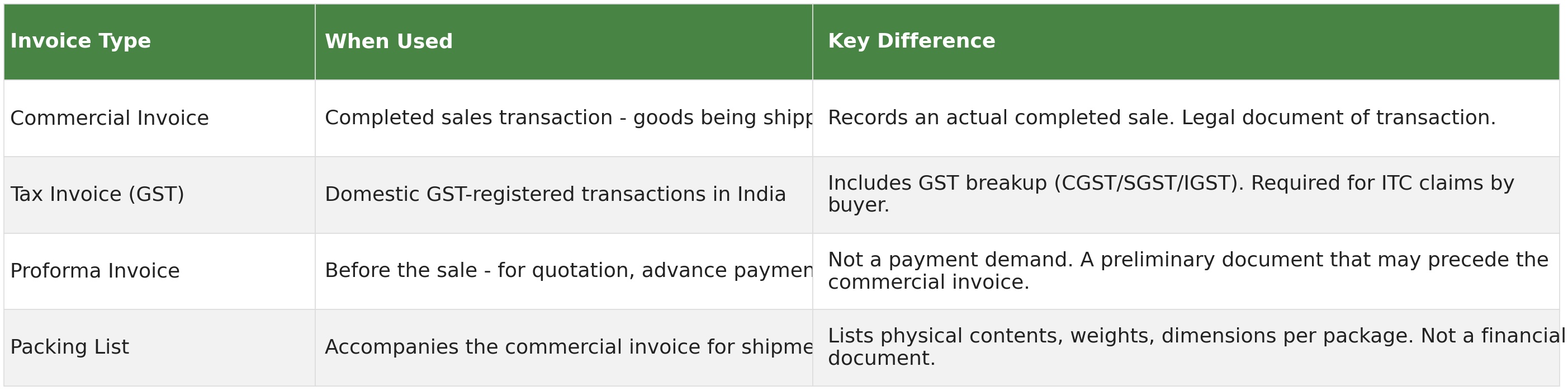
Key distinction for Indian exporters: For international shipments, a commercial invoice is required by customs. For domestic GST transactions, a GST Tax Invoice is the primary document. Many international shipments require both - the commercial invoice for customs, and a GST invoice (or export invoice with zero-rated GST treatment) for Indian tax compliance.
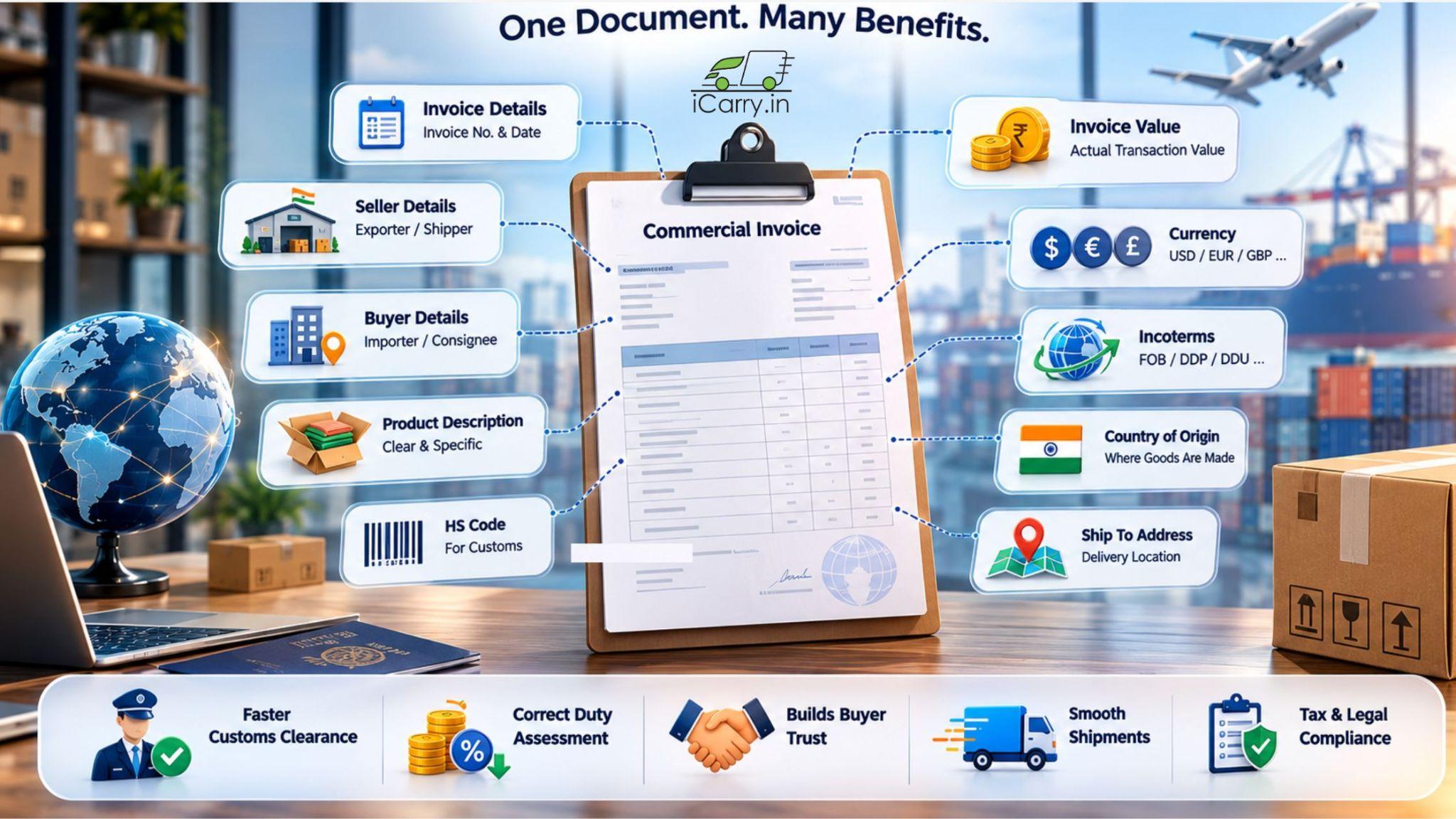
Every Field in a Commercial Invoice - Explained
1. Invoice Number and Date
A unique sequential invoice number and the date of issue. The invoice number must be traceable in your accounting system. For exporters, the invoice number should also appear on the shipping bill filed with Indian customs for cross-referencing.
2. Seller Details (Exporter / Shipper)
Full legal name of the selling entity, complete address including city, state, and postal code, country, phone number, email, and GSTIN (for GST-registered sellers). For export, also include the IEC (Import Export Code) number.
3. Buyer Details (Importer / Consignee)
Full legal name of the buyer, complete delivery address, country, phone number, and email. For B2B international transactions, include the buyer's VAT or tax registration number in their country where applicable. This is required for import duty assessment in many countries.
4. Ship To Address (if different from buyer)
When goods are shipped to a location different from the buyer's billing address - a warehouse, a third-party fulfilment centre, or a dropship destination - the ship-to address must be shown separately. Customs examines both addresses.
5. Product Description
This is where most errors occur. The product description must be specific enough for a customs officer to classify the goods correctly.
- Correct: 'Hand-embroidered cotton dupatta, 100% cotton, 200cm x 100cm, multicolour floral pattern'
- Incorrect: 'Textile item' or 'Handicraft' or 'Goods as per sample'
- Incorrect: 'Gift' - never describe a commercial sale as a gift regardless of relationship between parties
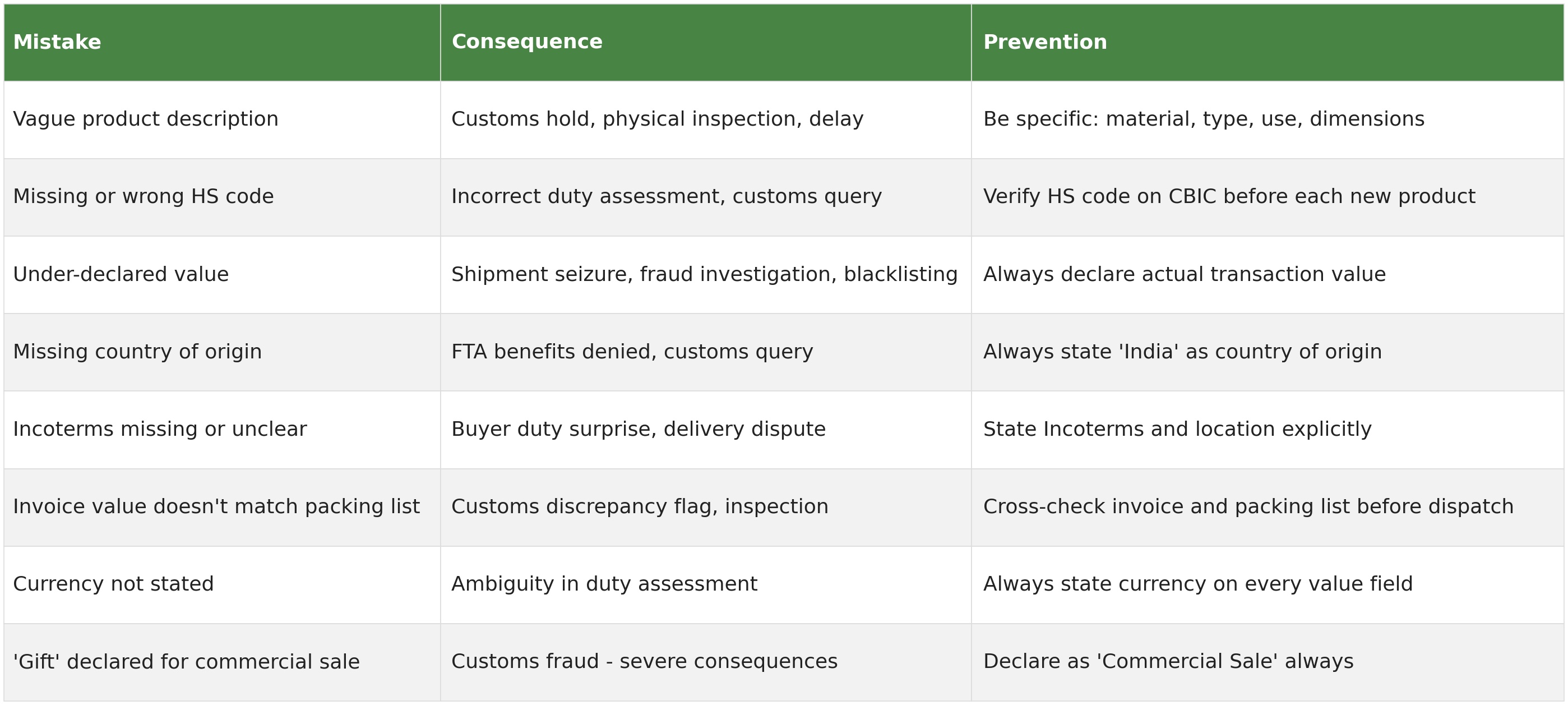
Vague descriptions are the single most common cause of customs holds on Indian exports. Customs officers flag shipments whose descriptions do not allow them to classify the goods with confidence.
6. HS Code (Harmonised System Code)
For international shipments, the HS code is mandatory. It is the international standardised 6-digit (or 8-digit in India) product classification code that determines the applicable import duty rate in the destination country. Verify your product's HS code at CBIC's customs tariff portal before issuing any export commercial invoice.
Each product category has a specific HS code. A single invoice covering multiple product types must include the HS code for each line item separately.
7. Quantity and Unit of Measure
Number of units and the unit of measure - pieces, sets, kilograms, litres, metres. Both quantity and unit must match the packing list exactly. Discrepancies between the commercial invoice and packing list are a common customs flag.
8. Unit Price and Total Value
Price per unit and total line value. The currency must be explicitly stated - USD, GBP, EUR, INR. For international transactions, use the agreed transaction currency. The total invoice value is the basis on which customs assesses import duty in the destination country.
Declaring accurate value is non-negotiable. Under-declaring to reduce the buyer's import duty is illegal in most countries and constitutes customs fraud. If discovered, consequences include shipment seizure, courier account blacklisting, and potential legal action against both shipper and buyer.
9. Total Invoice Value
Sum of all line items. Show the total in both figures and words. For international shipments, also show any freight charges, insurance, and other charges separately if they are included in the total - as these affect the CIF (Cost, Insurance, Freight) value on which some countries assess duty.
10. Country of Origin
Where the goods were manufactured. For Indian sellers, this is India. Do not leave this blank. Country of origin determines whether preferential duty rates under trade agreements (such as India's FTAs with UAE, ASEAN, Japan, South Korea, and others) apply to the shipment. Verify which FTAs apply for your destination at DGFT's trade agreement portal.
11. Incoterms
The agreed trade terms that define who pays for shipping, insurance, and import duties. The most common Incoterms for Indian exporters:
- DDP (Delivered Duty Paid): Seller pays all costs including import duties. The buyer receives goods with no additional charges. Best for D2C exports where customer experience is the priority
- DDU / DAP (Delivered at Place): Seller pays shipping but buyer pays import duties at destination. Most common for B2B exports
- FOB (Free on Board): Seller pays until goods are loaded on the vessel at origin port. Buyer pays ocean freight and import charges
- CIF (Cost, Insurance, Freight): Seller pays shipping and insurance to the destination port. Buyer pays import duties and inland transport
Incoterms must be stated clearly on the commercial invoice - e.g. 'DDP London' or 'FOB Mumbai'. Missing Incoterms creates ambiguity about who is responsible for which costs.
12. Payment Terms
How and when payment will be made - advance payment, 30 days from invoice, letter of credit, COD. For letter of credit transactions, the payment terms on the commercial invoice must match the LC terms exactly.
13. Authorised Signature and Stamp
The commercial invoice should be signed by an authorised representative of the selling entity and stamped with the company seal where applicable. Some destination countries and all letter of credit transactions require a signed original commercial invoice.
Commercial Invoice for Domestic Shipments in India
For domestic shipments within India, the commercial invoice serves as the proof of transaction accompanying the goods. Requirements differ from international:
- GST Tax Invoice is the primary document for GST-registered sellers. The commercial invoice and tax invoice are often the same document in domestic transactions
- Must include seller's GSTIN, buyer's GSTIN (if B2B), HSN code, GST rate, and GST amount broken out by CGST/SGST (intrastate) or IGST (interstate)
- For B2C domestic transactions, a simplified tax invoice is acceptable for individual orders below certain thresholds
- E-way bill is required for domestic goods movement above ₹50,000 in value - a separate document linked to the invoice
Common Commercial Invoice Mistakes Indian Sellers Make
Commercial Invoice for Export from India - Additional Requirements
For export shipments from India, the commercial invoice must additionally:
- Quote IEC number: The exporter's 10-digit Import Export Code must appear on export invoices
- GST treatment: Exports are zero-rated under GST. The invoice must state 'Export under LUT' (if exporting without payment of IGST under Letter of Undertaking) or 'Export under Bond' as applicable
- Shipping bill reference: Once the shipping bill is filed with Indian customs, the shipping bill number and date should be noted on the invoice for cross-referencing
- FIRC / BRC requirement: For foreign currency payments, the Foreign Inward Remittance Certificate (FIRC) or Bank Realization Certificate (BRC) links the invoice to the payment receipt for RBI compliance
How Shipping Platforms Use the Commercial Invoice
When booking a domestic shipment through a courier aggregator, the declared value from your commercial invoice is used to:
- Calculate the insurance or declared value coverage for the shipment
- Determine applicable COD amount if the order is COD
- Generate the shipping label with correct invoice details
- Create the e-way bill if the transaction value requires one
For international shipments through iCarry®'s FedEx and Aramex access, the commercial invoice is submitted electronically to the courier's customs pre-clearance system. Accurate, complete invoices result in faster customs clearance and fewer holds at destination.
iCarry® supports all Indian businesses - from domestic sellers managing GST invoices to exporters managing complex international commercial invoice requirements.
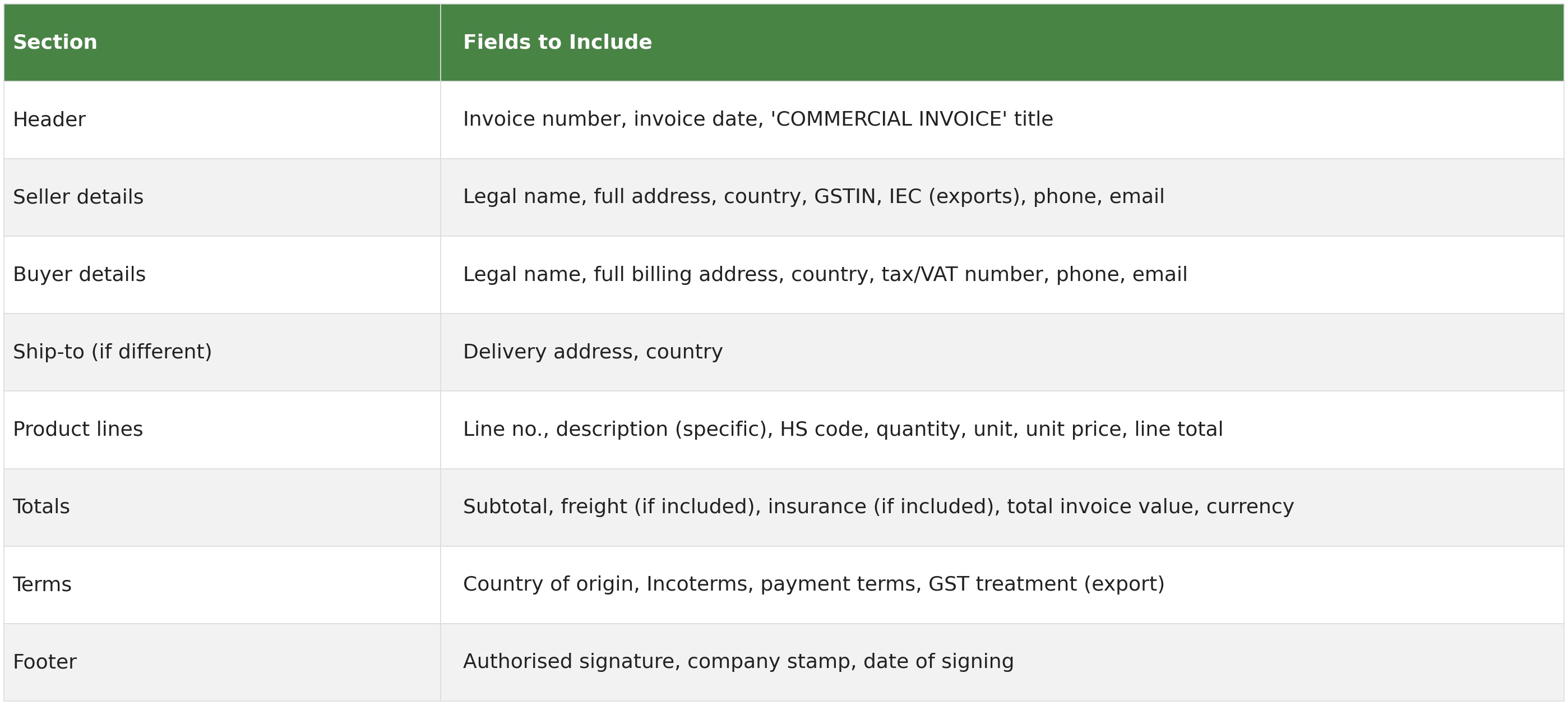
Commercial Invoice Template - What to Include
Final Thoughts
The commercial invoice is a document that most businesses treat as administrative overhead - fill in quickly, attach to the parcel, move on. In reality, it is the document that determines whether your shipment clears customs or sits in a bonded warehouse for a week, whether your buyer pays the correct import duty or faces a surprise bill, and whether you have the paper trail to support any claim, dispute, or GST reconciliation that arises.
Getting it right every time is not difficult. It requires knowing which fields matter, what level of specificity is required, and what common mistakes to avoid. This guide covers all three.
For Indian exporters building international sales through platforms like Etsy, direct buyer relationships, or B2B export channels - a correctly prepared commercial invoice is the first step toward building a reliable, scalable export operation.
Frequently Asked Questions (FAQs)
What is a commercial invoice?
A commercial invoice is a formal document issued by a seller to a buyer recording the details of a completed sale - what was sold, quantity, price, and transaction terms. It travels with the goods and is used by customs authorities for duty assessment, by logistics providers for shipment identification, and by both parties for accounting and dispute resolution.
Is a commercial invoice the same as a GST invoice?
Not exactly. For domestic transactions in India, a GST Tax Invoice serves both purposes - it is the commercial invoice with GST breakup added. For international exports, a commercial invoice is required by customs, and separately a GST export invoice (with zero-rated GST treatment under LUT or bond) is required for Indian tax compliance. Many exporters use one document that meets both requirements.
What happens if the commercial invoice value is wrong?
If the declared value is lower than the actual transaction value, customs authorities may classify this as under-declaration - a customs fraud offence in most countries. Consequences include shipment seizure, investigation, courier blacklisting, and potential legal penalties. Always declare the actual price the buyer is paying.
What is an HS code and where do I find it?
HS (Harmonised System) code is the international 6-digit (or 8-digit in India) product classification code used by customs to determine applicable import duty rates. Find the correct HS code for your product at CBIC's customs tariff portal. Each product category and sub-category has a specific code - verify for each new product type before first export.
What are Incoterms and which should I use?
Incoterms are international trade terms defining who pays for shipping, insurance, and import duties. DDP (Delivered Duty Paid) is best for D2C exports where buyers should not face surprise charges. DDU/DAP is most common for B2B exports. FOB is standard for bulk ocean freight. State Incoterms explicitly on every commercial invoice.
Do domestic shipments in India need a commercial invoice?
For GST-registered domestic transactions, a GST Tax Invoice is the required document. It functions as both the commercial invoice and the tax document. An e-way bill is additionally required for goods movement above ₹50,000 in value. Small B2C transactions may use a simplified invoice below certain thresholds.
The commercial invoice determines whether your shipment clears customs or sits in a bonded warehouse for a week, whether your buyer pays the correct import duty or faces a surprise bill, and whether you have the paper trail to support any claim, dispute, or GST reconciliation that arises. Getting it right every time is not difficult - it requires knowing which fields matter, what level of specificity is required, and what common mistakes to avoid.