
A seller ships a ₹8,000 silver jewellery set. At booking, they declare the value as ₹500 to avoid paying the declared value coverage fee. The parcel is lost in transit. The courier's liability is limited to the declared value - ₹500. The seller recovers ₹500 and absorbs a ₹7,500 loss on a product they can never get back.
This happens to Indian businesses every week. And it is entirely avoidable.
Declared value is one of the most misunderstood fields at shipment booking. Most sellers either leave it at the default, enter the order value without thinking, or deliberately under-declare to avoid insurance fees. Each approach creates a different category of risk - some financial, some legal, some both. India's e-commerce market is projected to nearly triple from roughly $125 billion in 2024 to $345 billion by 2030. As Indian commerce scales across categories and geographies , getting declared value right is increasingly important for businesses that want to protect their margins and stay compliant.
This guide explains what declared value is, how it is used by couriers, customs, and banks, what the consequences of getting it wrong are, and exactly how to declare correctly for domestic and international shipments. If you book through a platform like iCarry®, declared value coverage is shown as a line item before you confirm - so the choice is visible, not buried.
What Is Declared Value in Shipping?
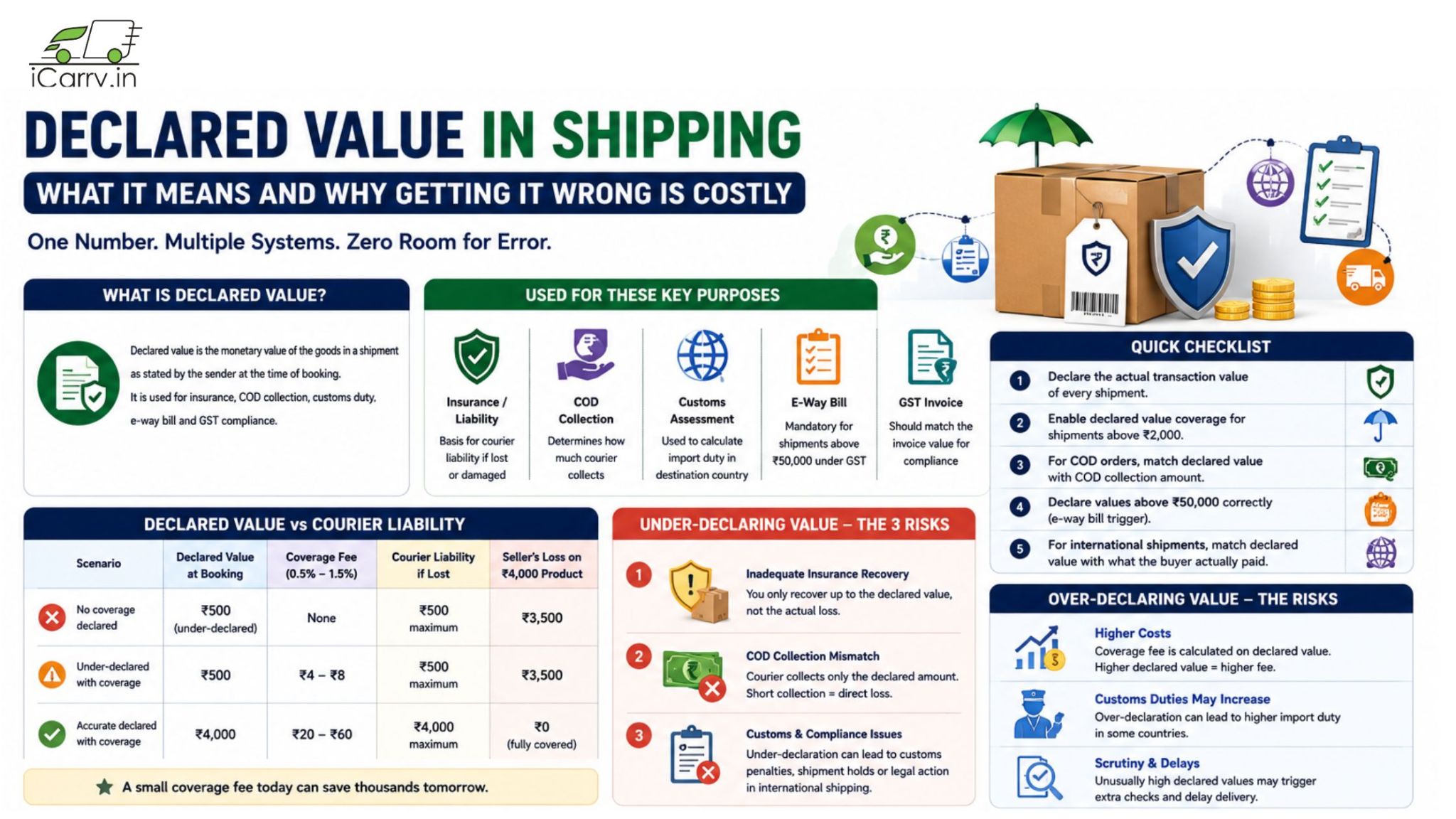
Declared value is the monetary value of the goods in a shipment as stated by the sender at the time of booking. It tells the courier, customs authority, and insurer what the contents are worth.
Declared value serves multiple functions simultaneously:
- Insurance / liability: The basis on which the courier's liability is calculated if a shipment is lost or damaged
- COD collection: For cash-on-delivery orders, the declared value determines how much the courier collects from the customer at the door
- Customs assessment: For international shipments, customs authorities use the declared value to calculate import duty in the destination country
- E-way bill trigger: For domestic shipments above ₹50,000 in declared value, an e-way bill is mandatory under GST
- GST invoice alignment: The declared value should match the invoice value accompanying the shipment for consistency in compliance documentation
One number. Four different systems use it. Getting it wrong in any direction creates problems in at least one of these systems.
How to Get Declared Value Right: Quick Checklist
- Are you declaring the actual transaction value of every shipment - what the buyer paid?
- Have you enabled declared value coverage for shipments above ₹2,000 in value?
- For COD orders, is your declared value matching the COD collection amount?
- Are you declaring values that trigger e-way bills correctly (above ₹50,000)?
- For international shipments, is your declared value on the commercial invoice matching what the buyer actually paid?
Declared Value vs Courier Liability - The Most Misunderstood Relationship
Most couriers in India have a default liability limit - typically ₹50 to ₹100 per kg of actual weight. On a 500g parcel, the courier's maximum liability without declared value coverage is ₹25 to ₹50.
If that 500g parcel contains a ₹4,000 skincare set and it is lost in transit, the courier owes you ₹25 to ₹50 under their standard terms. Not ₹4,000. Not ₹2,000. ₹25 to ₹50.
Declared value coverage changes this. When you declare the actual value and opt for coverage at booking, the courier extends their liability up to the declared amount in the event of loss or damage - typically at a fee of 0.5% to 1.5% of the declared value.

The maths: A ₹40 coverage fee on a ₹4,000 shipment is 1% of the value. The seller who skips this to save ₹40 and then experiences a lost shipment absorbs ₹3,500 to ₹4,000 in loss. The expected value of the ₹40 saving is negative - it only pays off if every single shipment arrives safely. Coverage always pays off on the one that doesn't.
Under-Declaring Value - The 3 Risks
Risk 1: Inadequate Insurance Recovery
Covered above. The most common outcome of under-declaration is that when a high-value shipment is lost or damaged, the recovery is far below the actual loss. Sellers who under-declare to save the coverage fee are effectively self-insuring at the courier's liability rate - which is close to nothing.
Risk 2: COD Collection Mismatch
For COD shipments, the declared value determines what the courier collects from the customer. If the order is ₹1,199 but the declared value is entered as ₹500, the courier will collect ₹500 from the customer. The seller receives ₹500, having shipped a ₹1,199 product. The remaining ₹699 is irrecoverable.
This is not a rare edge case. It is a common operational error that happens when teams enter declared value without checking the order value, or when system integrations map the wrong field to declared value. Always verify that your declared value equals your COD collection amount for every COD order.
This is the exact mismatch a platform like iCarry® is built to prevent - it maps the order value straight to the COD collection field at booking, so the two numbers can't drift apart by mistake.
Risk 3: International Customs Under-Declaration
For international shipments, under-declaring value is not just a financial risk - it is a legal one. Customs authorities in destination countries compare the declared value on the commercial invoice against the transaction price on the buyer's payment record, the selling price on the shipper's website, and market price data. When discrepancies are found, consequences include shipment seizure, import ban, courier account blacklisting, and in some jurisdictions, fraud investigation of both the exporter and importer. Indian customs also cross-checks export declarations through the ICEGATE system - under-declaration on the Indian side is also a customs offence.
Over-Declaring Value - Less Common, Still Problematic
Over-declaring is less common than under-declaring but creates its own issues:
- Excess coverage fee: You pay a higher declared value coverage fee than necessary on every shipment
- E-way bill triggered unnecessarily: Declaring a value above ₹50,000 when the actual value is lower triggers an e-way bill requirement for what should be a standard domestic shipment
- International customs over-duty: For exports, over-declaring causes the buyer to pay higher import duty than the transaction requires - damaging the commercial relationship
- Insurance fraud risk: Declaring a higher value than the actual product and then claiming on a lost shipment constitutes insurance fraud - a serious legal exposure
The E-Way Bill Trigger - Declared Value at ₹50,000
For domestic shipments in India, an e-way bill is mandatory under GST when the value of goods being transported exceeds ₹50,000. The declared value at booking is what triggers this requirement.
Businesses that consistently under-declare to avoid e-way bill compliance are violating GST regulations. Tax authorities monitor high-frequency shippers and cross-reference shipment records against GST filings. Non-compliance with e-way bill requirements can result in penalties of ₹10,000 or the tax amount evaded, whichever is higher, plus seizure of goods in transit.
The correct approach: declare accurately, generate the e-way bill for consignments above ₹50,000, and ensure the e-way bill number is on the shipment documentation before dispatch.
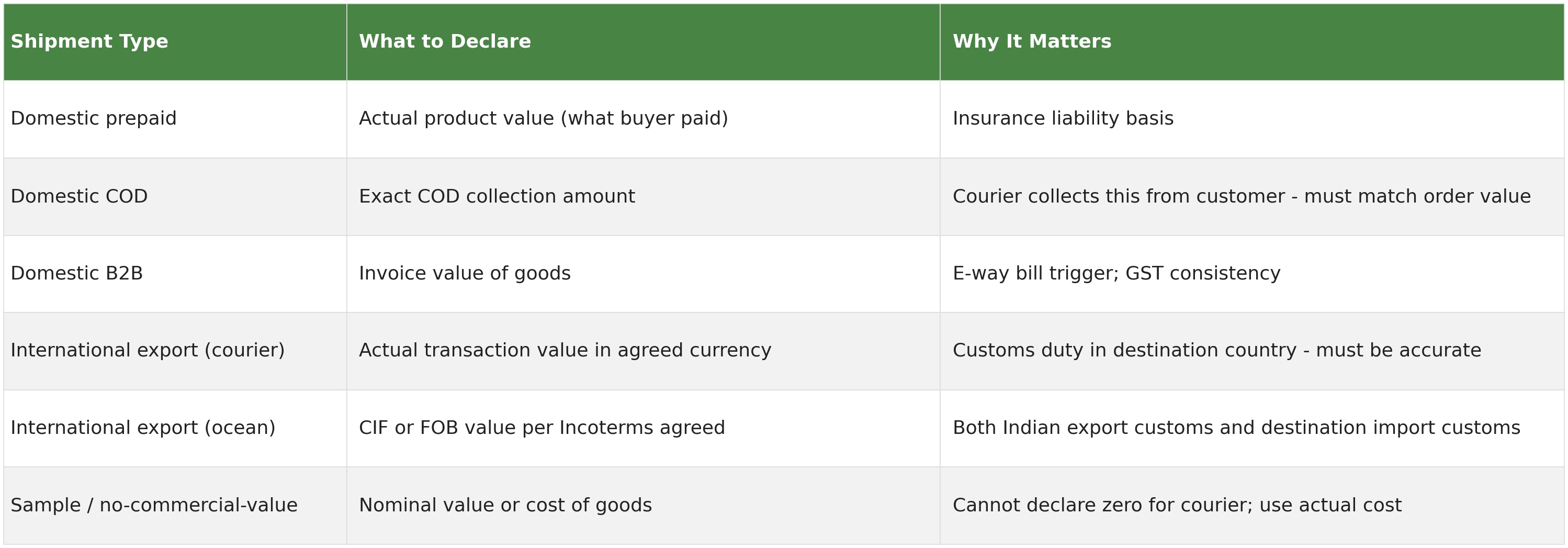
Declared Value for Different Shipment Types
What to Do When a High-Value Shipment Is Lost
If a shipment is lost and you have declared value coverage, the claim process:
- Step 1: Report the loss to the courier within their claim window - typically 15 to 30 days from expected delivery date
- Step 2: Submit: original booking confirmation with declared value, commercial invoice showing product value, proof of dispatch (pre-dispatch parcel photograph with AWB), and any tracking evidence showing the shipment was last scanned at a specific point
- Step 3: Courier investigates, typically taking 15 to 45 days for resolution
- Step 4: Settlement is made up to the declared value minus any applicable deductible
Without pre-dispatch photographs of the sealed parcel, claims are significantly harder to substantiate. Make photographing sealed parcels with the AWB visible a standard step in your dispatch process for all shipments above ₹2,000 in value.
How iCarry® Handles Declared Value
iCarry® is a courier aggregator that enables Indian businesses to declare accurate shipment values at booking with declared value coverage available across multiple courier partners.
- COD amount and declared value: For COD orders, iCarry® maps the order value to the COD collection amount at booking - reducing the manual error risk of COD mismatch
- Declared value coverage: Enable coverage at booking for shipments above your risk threshold. The coverage fee is shown transparently before booking confirmation
- E-way bill integration: Shipments above ₹50,000 declared value trigger e-way bill prompts in the booking flow
- Weight discrepancy management: Pre-upload product images with declared value visible for auto-dispute if couriers raise discrepancy charges
- Transit Loss Insurance: During booking, iCarry® lets businesses optionally add Transit Loss Insurance for eligible shipments, with coverage available up to ₹15,000. The additional insurance cost is displayed transparently before booking confirmation, allowing businesses to make an informed decision before shipping.
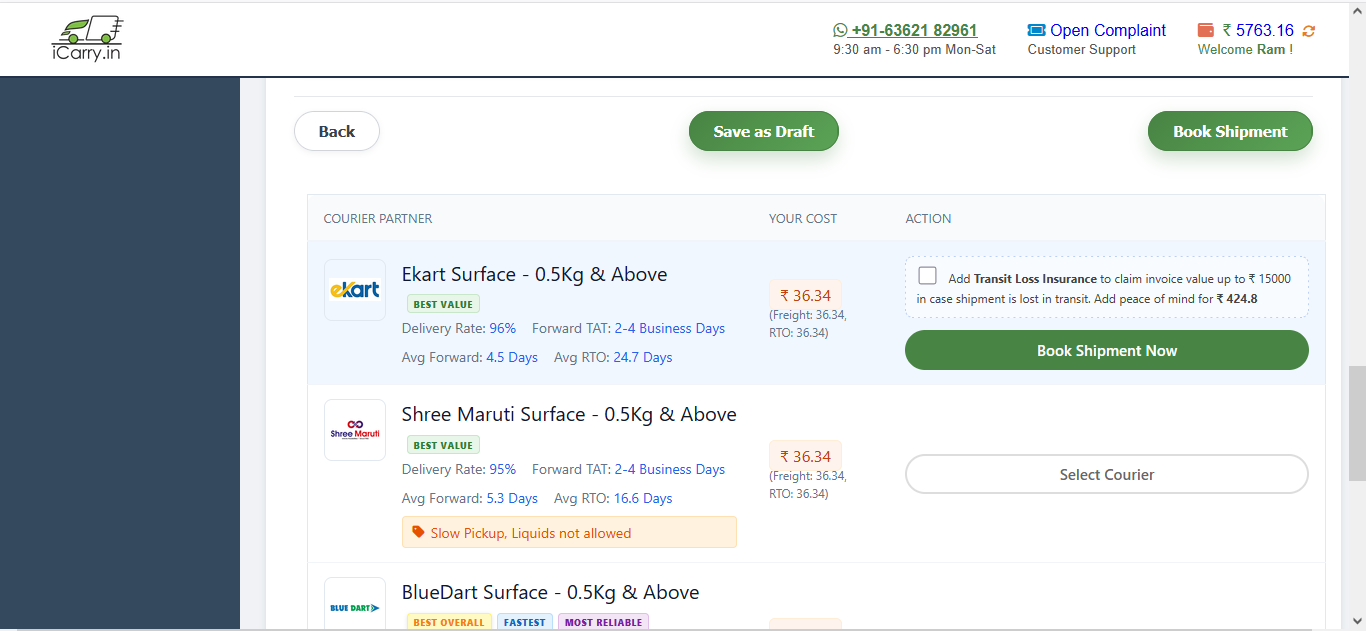
Watch How to Estimate Shipment Cost to see how declared value, COD amount, and coverage options appear at booking in iCarry® before you confirm any shipment.
Free Bronze plan, no minimum volume. Register at iCarry today
Final Thoughts
Declared value is a single field at booking. It takes five seconds to fill in correctly. The cost of filling it in wrongly - whether through under-declaration, COD mismatch, or international customs non-compliance - ranges from a few thousand rupees on a lost shipment to serious legal exposure on international orders.
The rule is simple: declare the actual value. Enable coverage for shipments above ₹2,000. Verify COD amounts match order values. For international shipments, declare exactly what the buyer paid.
The businesses that follow this consistently spend a small amount on declared value coverage fees every month. The ones that don't follow it spend a large, unpredictable amount on losses when things go wrong - which in any shipping operation at scale, they inevitably do.
Frequently Asked Questions (FAQs)
What is the declared value in shipping?
Declared value is the monetary value of the goods in a shipment as stated by the sender at booking. It is used by the courier to determine liability limits for loss or damage, by customs to assess import duty on international shipments, by the GST system to trigger e-way bill requirements, and by the courier to determine COD collection amounts.
What happens if I under-declare the value of my shipment?
For domestic shipments, under-declaration limits your insurance recovery to the declared amount - not the actual product value. For COD orders, under-declaring means the courier collects less than the order amount. For international exports, under-declaration constitutes customs fraud with potential shipment seizure, account blacklisting, and legal consequences in the destination country.
Should I always enable declared value coverage?
For shipments above ₹2,000 in value, yes. The declared value coverage fee is typically 0.5% to 1.5% of declared value. On a ₹4,000 shipment that is ₹20 to ₹60. Without coverage, a lost ₹4,000 shipment recovers ₹25 to ₹50 under default courier liability. The fee is always worth paying on valuable shipments.
Why must COD declared value match the order amount exactly?
The courier's delivery executive collects the declared COD amount from the customer - not the order value. If the declared COD value is ₹500 but the order is ₹1,199, the courier collects ₹500 and remits ₹500. The seller loses ₹699 with no recourse. Always verify COD declared value equals order value before dispatch.
When does declared value trigger an e-way bill in India?
An e-way bill is mandatory for movement of goods with a declared value above ₹50,000 within India. The e-way bill must be generated before goods leave the dispatch premises and must accompany the shipment. Deliberately under-declaring to avoid the e-way bill requirement is a GST compliance violation with penalties.
What declared value should I use for sending product samples internationally?
Even product samples that are free of charge cannot be declared as zero value for courier shipments. Declare the actual cost of manufacturing or the fair market value of the sample. Some couriers accept 'Samples - No Commercial Value' with a nominal cost declared. Never declare zero - it will be rejected by courier customs systems.
Declared value is a single field at booking that takes five seconds to fill in correctly - the cost of filling it in wrongly ranges from a few thousand rupees on a lost shipment to serious legal exposure on international orders. The rule is simple: declare the actual value, enable coverage for shipments above ₹2,000, verify COD amounts match order values, and for international shipments, declare exactly what the buyer paid.