If your eCommerce business runs on Cash on Delivery, you already know the problem: the money your customer pays on delivery does not arrive in your account for days. This COD payment delay is one of the most common cash flow challenges for Indian online sellers. Under the standard cycle used by most courier companies, you wait 7 business days after delivery before the COD payout is credited. This gap between when orders are delivered and when you can use that revenue is a real operational cost.
iCarry.in does something no other courier aggregator in India does by default: free, automatic daily COD settlement on the T+7 cycle, six days a week, for every seller on every plan - including the free Bronze plan. No lock-in, no minimum volume, no special approval required. If your order is delivered on Monday, your COD payout is automatically processed on the following Tuesday.
And for sellers who want their money even faster, iCarry offers early COD payout options down to T+0 which means - the next business day after delivery. This guide explains exactly how the system works, what it costs, and why iCarry built it this way.
What is COD Remittance? (COD Payout / COD Settlement)
COD remittance - also called COD payout or COD settlement - is the process by which the cash collected from your customers at delivery is transferred to your bank account by the courier company.
When a courier delivers a COD order, the delivery agent collects payment from the customer - cash or UPI - and takes it back to the courier company. The courier then batches all collected amounts across deliveries and transfers them to the seller's bank account on a fixed cycle. This cash on delivery payment cycle is what determines when your money actually arrives.
The industry standard cash on delivery payment cycle in India is T+7 - meaning the seller receives the COD payout 7 business days after the shipment is marked as delivered. Sundays, public holidays, and bank holidays do not count. This means if an order is delivered on a Friday, the clock starts on Monday and the COD settlement lands the following Tuesday.
For a seller with 200 COD deliveries per day at an average order value of ₹ 500, this COD payment delay means ₹ 7 lakh is locked in transit at any given time - earned but inaccessible. For smaller sellers at 50 orders per day at ₹ 600 average, it is still nearly ₹ 2.1 lakh permanently sitting in the pipeline.
What Makes iCarry's COD Settlement Different From Other Platforms
Early COD payout (also called early COD remittance or early COD settlement) is the option to receive your cash-on-delivery collections faster than the standard cycle, in exchange for a small fee. Most platforms offer some version of this. What makes iCarry different is what happens before you even need to ask for it.
The difference is not just about speed - it is about default behaviour and financial risk.
Free daily remittance - for everyone, always
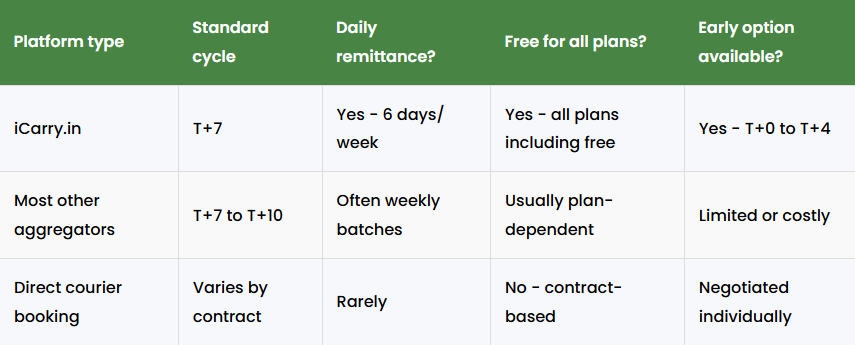
On iCarry.in, the T+7 remittance cycle is completely free for all sellers on all plans, including Bronze (the free plan). Remittance runs six days a week - Monday through Saturday. There are no hidden charges, no plan upgrades required, and no minimum shipment volume to qualify.
Most other logistics platforms either delay remittance beyond T+7, charge fees for standard settlement, or restrict better cycles to only paid plan tiers
iCarry's position is that sellers should receive their money reliably and automatically - the T+7 default is a commitment, not a best-effort service.
Why early remittance has a fee - and why that is fair
When a seller opts for T+0, T+1, T+2, T+3, or T+4 remittance, iCarry pays the seller before the courier partner has transferred the collected COD to iCarry. iCarry.in takes on the financial risk of that gap - paying out of its own working capital to ensure the seller gets their money faster.
This is not a processing fee or a platform margin. It is a direct cost of capital which means - iCarry is effectively providing a short-term advance on your COD collections, backed by its own funds, so you do not have to wait. The fee reflects that risk and capital commitment - and it is significantly lower than the cost of a business loan or credit line to bridge the same gap.
iCarry's Early COD Payout Options: Full Tier Breakdown
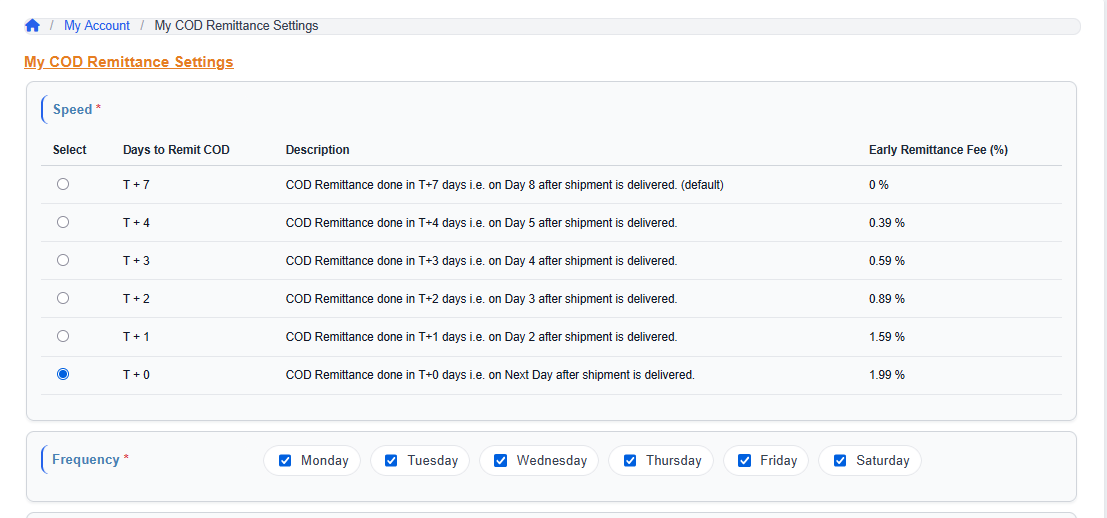
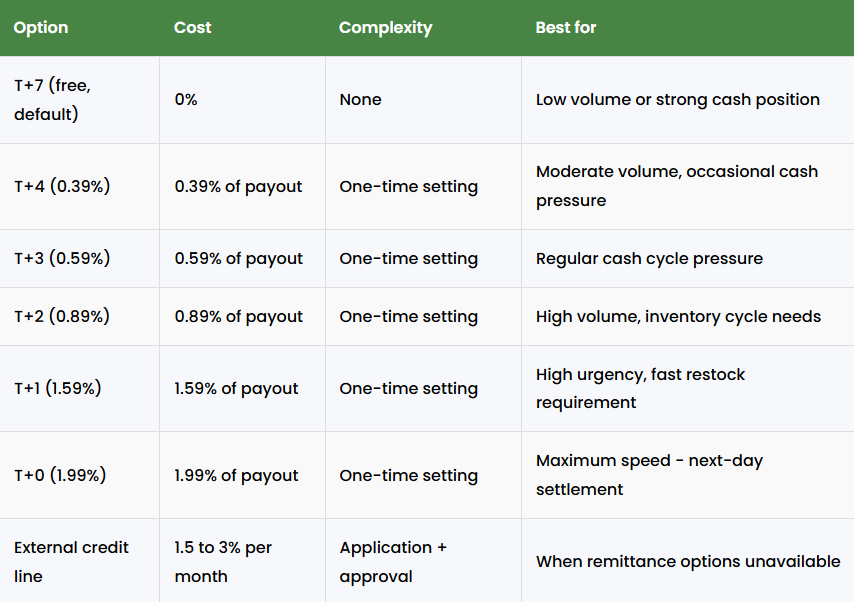
These are the live rates on iCarry.in - the complete early COD remittance tiers available to all clients:
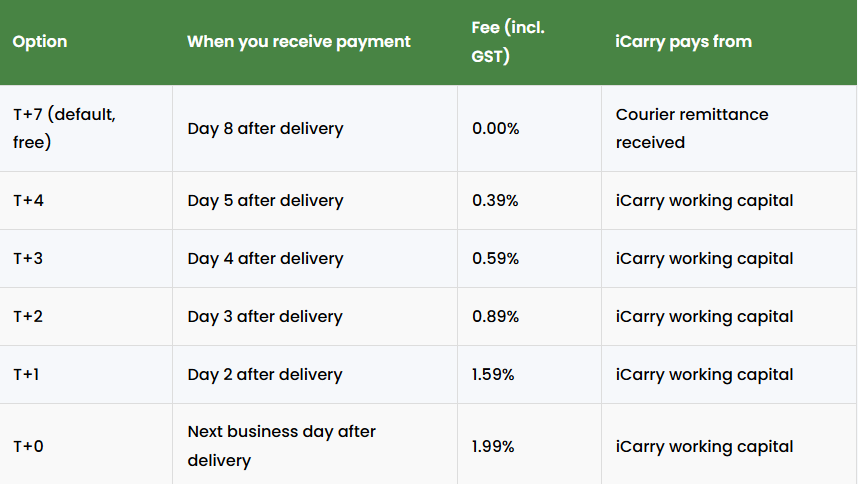
All fees are applied on the total remittance amount credited in that cycle. The fee is deducted automatically and you receive the net amount. Remittance runs Monday through Saturday - not on Sundays, public holidays, or bank holidays.
Important: T+0 on iCarry means the next business day after delivery - not same-day. If an order is delivered on Wednesday, T+0 remittance is processed on Thursday. This is still the fastest settlement available on any Indian courier aggregator platform.
The Real Cost of COD Payment Delay: A Working Capital Calculation
Before deciding whether to pay for early COD payout, calculate what the COD payment delay is actually costing your business.
Example: 100 COD orders per day, ₹ 600 average order value
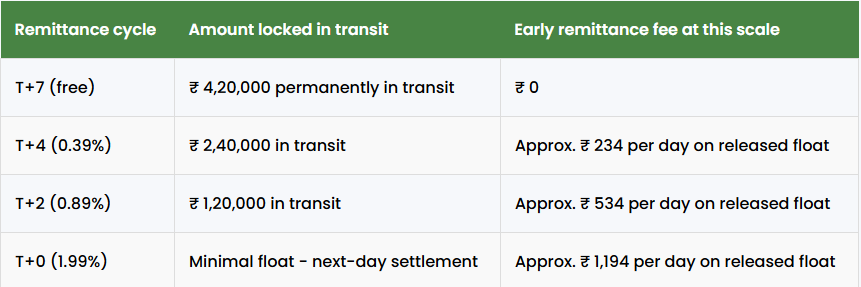
The float is capital your business has earned but cannot deploy. If you are using a credit line or informal financing to bridge the inventory gap this creates, compare that interest cost against the remittance fee.
When T+2 becomes cheaper than credit
At T+2, the fee is 0.89% of the remittance amount. A business credit line or overdraft facility in India typically costs 1.5 to 3% per month. If your COD delay creates a financing gap of even 10 to 15 days per month, the annualised cost of that credit easily exceeds what you would pay for T+2 remittance.
For most sellers operating at 50 or more COD deliveries per day, T+2 or T+3 remittance pays for itself through reduced financing costs within the first month.
How to Set Up Your COD Remittance Preference on iCarry
The setup takes under two minutes and applies to all future remittances automatically.
- Log in to your iCarry.in account
- From the left side menu, click on COD, then select Settings
- Under the Speed section, select your preferred remittance timeline
- Under Frequency, confirm the days you want remittance to run (Monday through Saturday by default)
- Save - your preference applies from the next remittance cycle
You can change this setting at any time without contacting support. Switch to T+0 during a festive sale, revert to T+7 in a slower month - it is fully self-service.
The iCarry wallet and COD remittance settings video covers the complete dashboard walkthrough, including where to find the COD Settings page and how to configure both speed and frequency preferences.
How Wallet Shortfall Affects Remittance
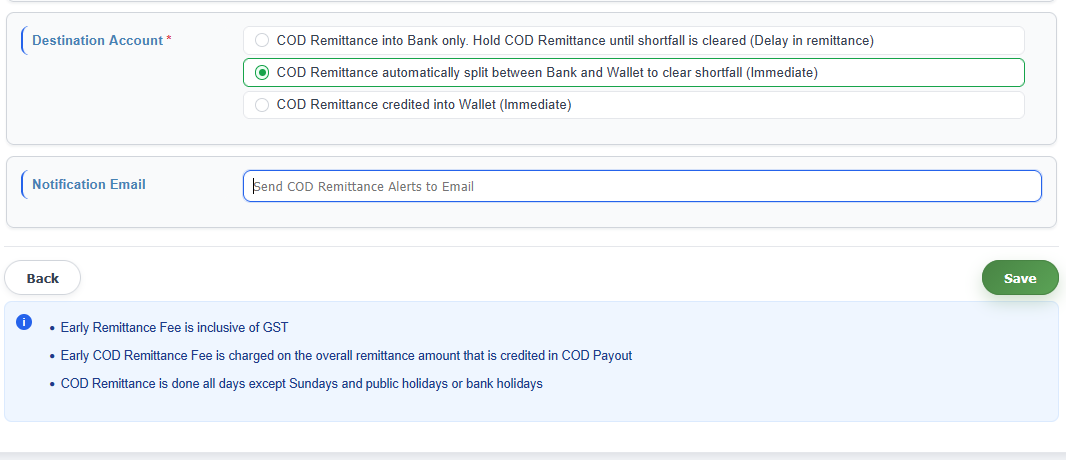
When setting up COD remittance, iCarry gives you three options for how the money is credited - this is called the Destination Account setting:
Bank only - hold if shortfall: COD remittance goes to your bank account. If your iCarry wallet has a shortfall, remittance is held until the shortfall is cleared before any amount is credited.
Auto-split between Bank and Wallet (Immediate): iCarry automatically splits each remittance - part goes to your bank account, part goes to your wallet to clear the shortfall simultaneously. Settlement continues without interruption.
Wallet only (Immediate): The full COD remittance amount is credited directly into your iCarry wallet instead of your bank account. Useful if you want to use COD collections to fund future shipments directly from your wallet balance.
The auto-split option is selected by default and works best for most sellers - it keeps money moving to your bank while resolving any wallet deficit automatically. The wallet-only option is particularly useful for sellers who recharge their shipping wallet frequently and prefer to use COD collections to self-fund shipments.
You can also set up a Notification Email to receive COD remittance alerts whenever a settlement is processed, so you always know exactly when money has been credited.
When to Stick With T+7 (Free)
T+7 is the right choice when:
- Your business carries sufficient cash reserves to fund operations without relying on COD float
- Your daily COD volume is under 30 to 40 orders and the float amount is manageable
- You are well-stocked and do not need to reinvest COD proceeds into inventory immediately
Even in these cases, iCarry's T+7 is better than what most platforms offer as their standard - many do not run daily, and some charge fees even for weekly settlement.
When Early COD Payout India Makes Clear Financial Sense
- You are using credit or a business loan to buy inventory while waiting for the COD payment delay to clear
- Your daily COD deliveries consistently result in ₹ 2 lakh or more in transit at any given time
- You are heading into a high-volume period - festive season, brand launches, sale events - where cash cycle speed determines how quickly you can restock
- Your supplier payment terms require faster turnaround than T+7 allows
The broader relationship between COD settlement and business cash flow is covered in the guide on working capital management for eCommerce businesses. For COD-heavy sellers, optimising remittance speed is one of the highest-leverage financial decisions available.
iCarry vs Other Platforms: COD Payout and Settlement Comparison
Full Fee Comparison: Early Remittance vs External Credit
Final Thoughts
iCarry's COD settlement system is built around one principle: sellers should receive their COD payout reliably, automatically, and without having to negotiate for it. The T+7 free daily cycle is available to every seller from day one - no plan upgrade, no volume requirement, no waiting for approval.
For sellers who need to eliminate the COD payment delay faster, the early COD payout tiers from T+4 down to T+0 offer a transparent, self-service option that is almost always cheaper than the financing alternatives. The fee is not a platform charge - it is the cost of iCarry advancing your money before courier partners have settled with iCarry, a financial risk the platform takes on so you do not have to.
To see how the COD settlement cycle fits into the full shipping cost picture, the guide on right courier aggregator for COD orders covers how courier selection affects remittance reliability, RTO rates, and overall COD profitability.
Bottomline - to grow your business working capital, Stop Waiting 7 Days for COD Payments - Get Paid Faster with iCarry
Frequently Asked Questions
What is the difference between COD remittance, COD payout, and COD settlement?
They all refer to the same thing: the transfer of cash collected from your customers at delivery back to your bank account. COD remittance is the most technical term, COD payout is commonly used by sellers, and COD settlement is used in a financial context. On iCarry, all three describe the same process.
Is the T+7 COD payout truly free on iCarry for all plans?
Yes. T+7 is the default COD settlement cycle on iCarry.in and carries zero fee for every seller on every plan, including the free Bronze plan. There are no hidden charges.
How many days a week does iCarry process COD remittance?
Six days a week - Monday through Saturday. COD remittance is not processed on Sundays, public holidays, or bank holidays. This applies to both the default T+7 cycle and all early remittance options.
What does T+0 actually mean on iCarry?
T+0 on iCarry means remittance is processed the next business day after delivery. If your order is delivered on Wednesday, T+0 remittance is processed on Thursday. This is the fastest available settlement on any Indian courier aggregator.
Why does iCarry charge a fee for early remittance?
When you opt for T+0, T+1, T+2, T+3, or T+4, iCarry pays you from its own working capital before the courier partner has transferred the collected COD to iCarry. iCarry takes on that financial risk on your behalf. The fee reflects the cost of that capital - not a platform margin.
Can I switch remittance settings whenever I want?
Yes. COD Remittance Settings on iCarry are fully self-service. You can change your tier at any time and the new setting applies to the next remittance cycle immediately.
What happens to remittance if my iCarry wallet has a shortfall?
iCarry gives you three destination account options to handle this. You can hold remittance to your bank until the shortfall clears, use auto-split which pays your bank and wallet simultaneously to resolve the deficit, or credit the full remittance into your wallet. The auto-split option is recommended for most sellers as it keeps bank settlements running while also clearing the shortfall automatically.
iCarry.in provides free automatic daily T+7 COD settlement six days a week for all sellers on all plans - and for sellers who need faster access to cash, early COD payout tiers from T+4 (0.39%) down to T+0 (1.99%) allow next-day settlement, with every rupee advanced from iCarry's own working capital before the courier has transferred the collected amount.