When exporting certain products, quality alone isn't enough. Many importing countries require official proof that the product is legally sold and consumed in its country of origin. That proof comes in the form of a Free Sale Certificate (FSC).
This guide explains what an FSC is, who needs it, how to get it, and why it's critical for exports.
If you're building a long-term export business, understanding certifications and compliance documents is essential. You may also find our guide on How to Get an Export House Certificate in India useful.
What Is a Free Sale Certificate?
A Free Sale Certificate is an official export document issued by a government authority confirming that:
- The product is freely sold in the domestic market
- It is approved by local regulatory bodies
- It is not banned or restricted in the country of origin
In simple words: It proves your product is legally sold in your own country. Importing countries use this as a trust signal for product legitimacy.
Why Is a Free Sale Certificate Required?
Importing countries demand an FSC to:
- Verify product legitimacy and compliance
- Ensure consumer safety
- Avoid importing unsafe or banned products
- Speed up regulatory and customs approvals
If a product isn't allowed or approved locally, other countries typically won't allow its import either.
For guidelines on export documentation, please see the World Trade Organization (WTO) export requirements overview.
Products That Commonly Require a Free Sale Certificate
FSCs are most often requested for:
- Cosmetics & personal care products
- Pharmaceuticals & medical devices
- Food & dietary supplements
- Nutraceuticals & health products
- Consumer health goods
- Certain chemical products (non-industrial)
Regulated products usually need FSCs, while many industrial goods do not.
High-value and regulated products also require secure logistics handling. If you ship premium or sensitive goods, read our guide on How to Ship High-Value Items Across India.
Who Needs a Free Sale Certificate?
You generally need an FSC if you are:
- Exporting regulated or consumable products
- Entering a new international market
- Supplying to government or institutional buyers
- Applying for product registration abroad
Most first-time exporters in regulated categories will need one.
Many exporters simplify documentation management and courier selection using centralized platforms. Learn how this improves efficiency.
Managing export documentation and courier selection manually can be time-consuming. Platforms like iCarry.in help automate this process.
Who Issues a Free Sale Certificate?
The FSC issuing authority varies by product type:
- Food Safety Authorities (e.g., FSSAI in India)
- Drug Regulatory Authorities (e.g., FDA in the USA, CDSCO in India)
- Export Promotion Councils (e.g., APEDA, PHDEC)
- Government export facilitation departments
Check the DGFT guidelines for India-specific export documentation and export promotion councils.
Eligibility for Getting a Free Sale Certificate
To be eligible, exporters must ensure:
- Product is legally manufactured
- Required licenses are valid
- Product is sold or permitted for sale locally
- Manufacturing facility is registered and compliant
If a product is not approved domestically, an FSC cannot be issued.
Documents Required for a Free Sale Certificate
Typically required documents include:
- Exporter registration and business license
- Manufacturing or import license
- Product formulation or composition
- Product labels and packaging details
- Invoices or proof of domestic sale
- Destination country requirements
Incomplete documentation is a common cause of delays or rejection.
Delays caused by missing documentation often increase logistics costs and operational inefficiencies. Learn how this impacts businesses so that you can be better prepared.
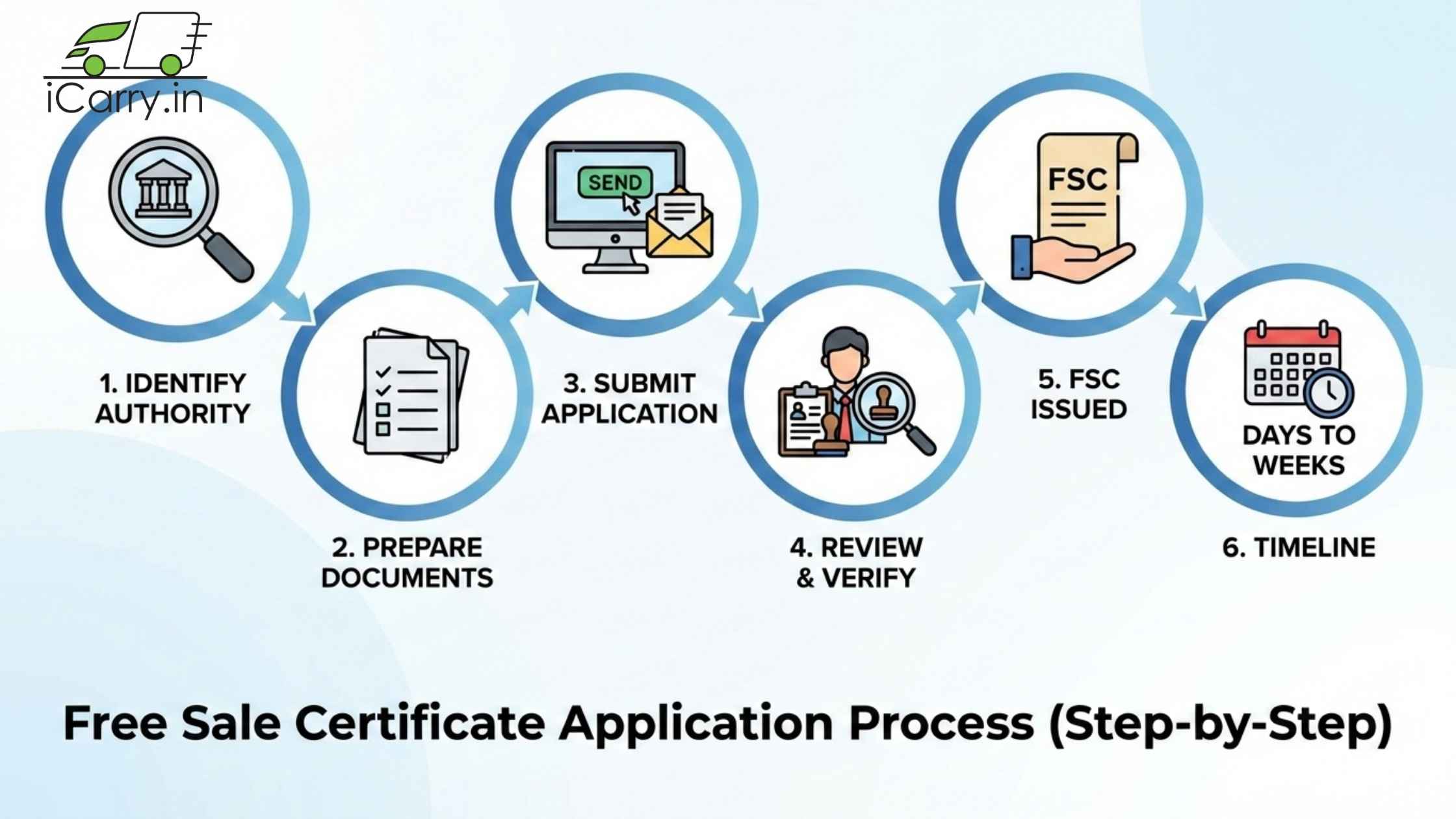
Free Sale Certificate Application Process (Step-by-Step)
Step 1: Identify the Correct Issuing Authority
Determine which government body issues FSCs for your product category.
Step 2: Prepare All Required Supporting Documents
Gather licenses, product details, and proof of domestic sale.
Step 3: Submit the Application (Online/Offline)
Apply through the authority's portal or physical office.
Step 4: Authority Reviews and Verifies
The regulatory body checks your documents and product compliance.
Step 5: FSC Is Issued
Once approved, you receive the Free Sale Certificate.
The process may take a few days to weeks depending on product and authority.
Validity of a Free Sale Certificate
- FSCs are usually valid for a specific period
- Some countries accept one FSC for multiple shipments
- Others require revalidation or updated issuance
Always check destination country requirements before shipping.
Free Sale Certificate vs Health Certificate
Many exports require both FSC and Health Certificate.
Here is an example of an Export Health Certificate.
What Happens If You Don't Have an FSC?
Without a valid Free Sale Certificate:
- Product registration may be rejected abroad
- Shipments can be delayed or denied
- Buyer confidence drops
- Export opportunities are lost
Lack of FSC is a common reason for failed export clearance.
Failed deliveries and compliance issues also increase return rates and losses. Learn how businesses reduce these failures in How to Reduce Returns (RTO) Business Strategies.
Common Mistakes Exporters Make
- Assuming FSC is optional
- Applying too late
- Using expired certificates
- Wrong or incomplete product details
- Ignoring destination format rules
Exports punish assumptions.
Tips to Get a Free Sale Certificate Faster
- Ensure domestic approvals are complete
- Maintain updated licenses
- Keep product documentation ready
- Consult importing country requirements early
- Avoid last-minute applications
Prepared exporters move faster.
Why Free Sale Certificates Matter in Global Trade
As global regulations tighten:
- Countries demand stronger legal proof
- Documentation requirements rise
- Regulatory expectations become stricter
FSCs act as a baseline credibility document that enables market access and smooth customs clearance.
Final Thoughts
A Free Sale Certificate is not just paperwork - it's proof of legitimacy.
For exporters, it:
- Builds international trust
- Simplifies product registration abroad
- Prevents shipment rejection
- Protects long-term market access
Understanding FSC requirements early can make the difference between export success and failure.
To further optimize your logistics operations, explore our actionable guide on How to Reduce Shipping Cost.
Free Sale Certificates aren't optional extras - they're fundamental proof documents that unlock international markets. The combination of proper certification and efficient export logistics creates sustainable competitive advantage in global trade.