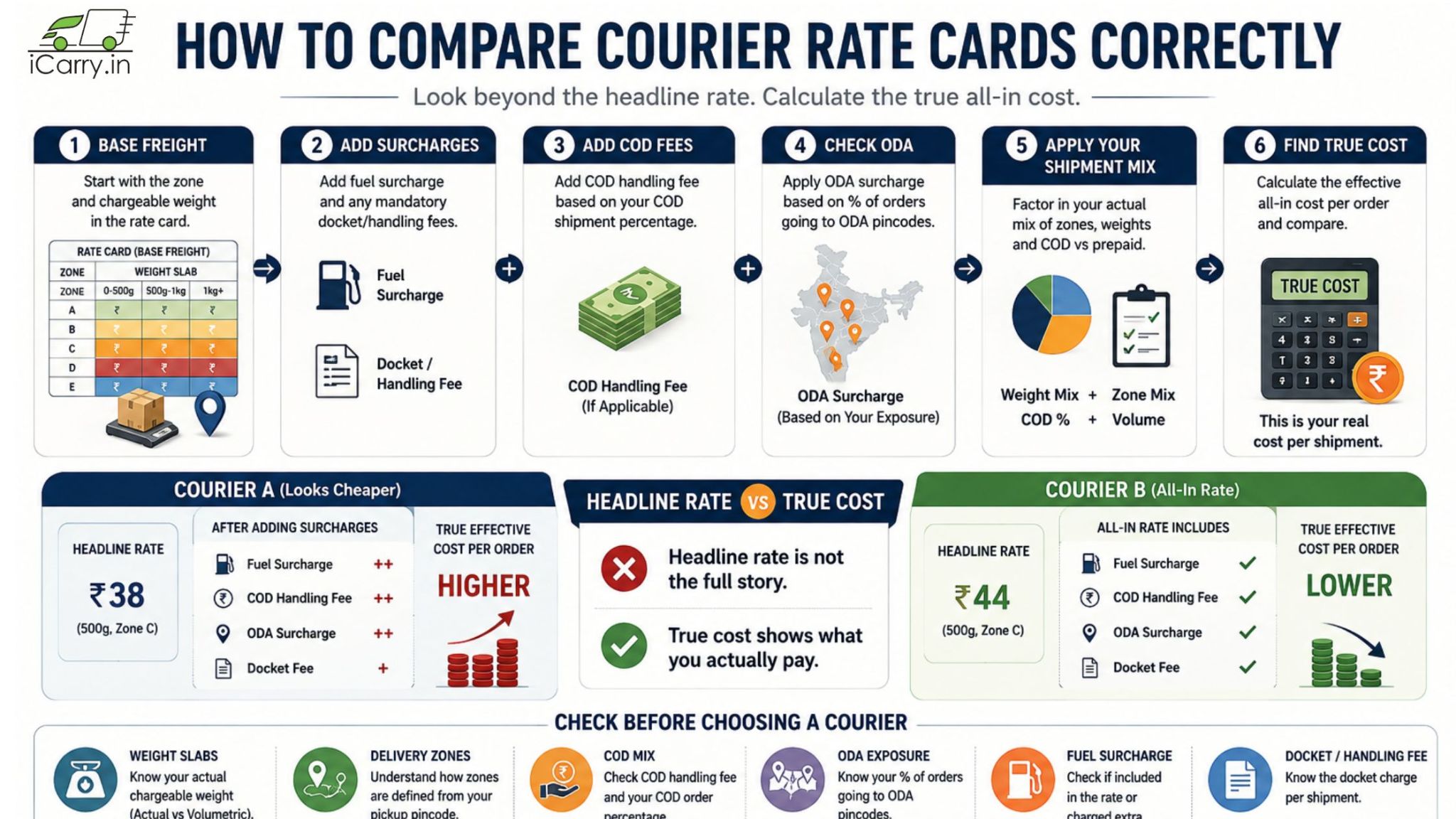
Two courier rate cards. Courier A quotes ₹38 for a 500g Zone C shipment. Courier B quotes ₹44. Courier A looks cheaper by ₹6. Decision made.
Three months later, the business reviews its actual courier invoices. Courier A's effective per-order cost is ₹62. Courier B's effective cost is ₹58. Courier A - the 'cheaper' option - is costing ₹4 more per shipment.
The difference: Courier A's rate card excluded fuel surcharge, had a higher COD handling fee, and applied a ₹15 ODA surcharge on 22% of the business's customer pincodes. Courier B's rate card included all of these - the ₹44 was the all-in rate.
Courier rate cards in India are not standardised. They vary in structure, what they include, how surcharges are applied, and how weight slabs are defined.India's express parcel market is projected to reach 24 to 29 billion shipments by FY30 - at that volume, small per-shipment rate differences compound fast, which is why reading a rate card correctly, and comparing multiple rate cards on a like-for-like basis, is one of the most impactful financial skills in logistics management.
This guide explains every component of an Indian courier rate card and how to build a comparison that reveals your true cost per shipment.
What Is a Courier Rate Card?
A courier rate card is the pricing document a courier or aggregator uses to charge for a shipment, structured by delivery zone and weight slab. The headline number in a rate card is rarely the full cost - fuel surcharge, COD handling fees, ODA charges, and docket fees are usually listed separately and have to be added to get the real per-shipment price. With iCarry, businesses can view a single rate card that clearly shows the applicable shipping charges, helping them compare courier rates with transparent pricing and no hidden charges before booking.
Quick Checklist - Are You Reading Rate Cards Correctly?
- Do you know whether the quoted rate includes or excludes fuel surcharge?
- Have you checked whether the rate applies to actual weight or includes volumetric weight billing?
- Do you know the COD handling fee structure for each courier you use?
- Have you verified ODA surcharge applicability for your specific customer pincodes?
- Are you comparing rate cards at your actual shipment weight - not the minimum slab?
- Have you calculated your total effective cost per order including all surcharges?
How a Rate Card Is Structured?
A courier rate card is a document that defines the charges for shipping a parcel from one location to another, structured by weight, delivery zone, and service type. It is the pricing schedule that a courier or aggregator uses to bill a business for shipments.
In India, rate cards are typically provided as Excel or PDF tables with columns for zones and rows for weight slabs. The intersection of zone and weight slab gives the base freight rate. Surcharges are listed separately - sometimes on the same document, sometimes in a separate schedule.
The challenge: no two rate cards are structured identically. Comparing them requires converting all of them to a common format before any comparison is meaningful.
The Components of an Indian Courier Rate Card
1. Delivery Zones
Indian couriers divide the country into zones based on distance from the pickup pincode. Most use a 5-zone system:
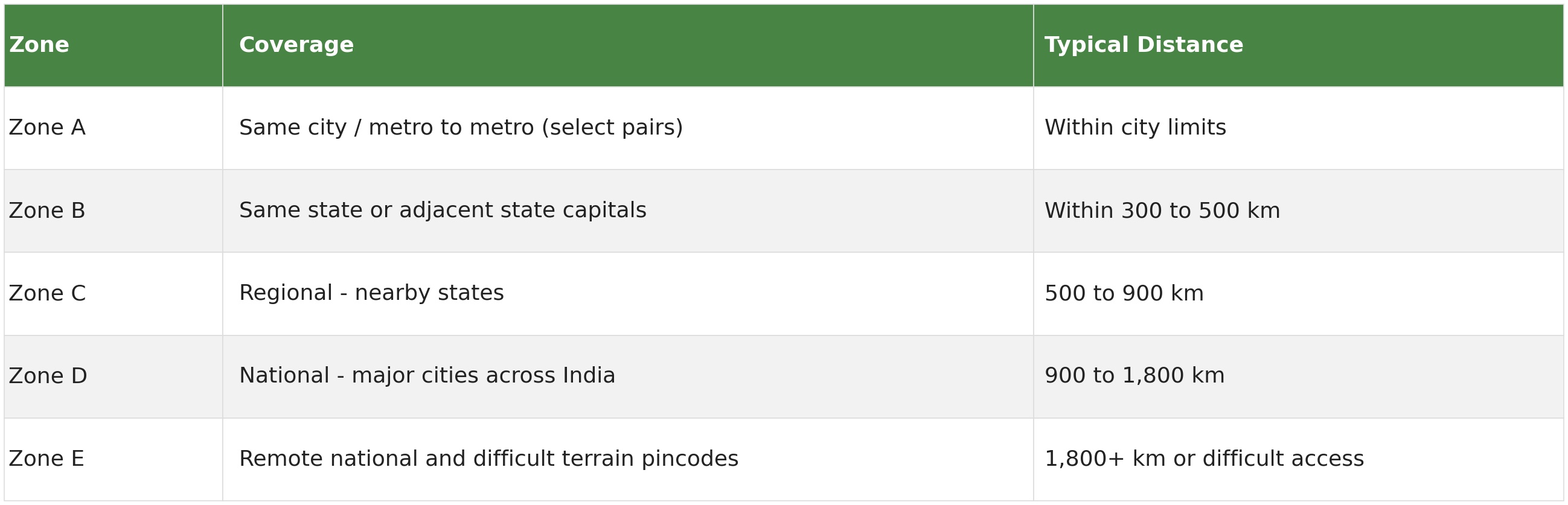
Important: Zone classification is relative to the pickup pincode. A shipment from Bengaluru to Delhi is Zone D from Bengaluru. A shipment from Delhi to Bengaluru is also Zone D from Delhi. The zone is always calculated from the dispatch point, not a fixed origin.
2. Weight Slabs
Base freight rates are structured by weight slabs. Common slab structures in Indian rate cards:
- 0 to 500g: The minimum chargeable weight for most couriers. A 50g parcel and a 450g parcel are billed identically
- 500g to 1 kg: Additional slab for parcels between 500g and 1 kg
- 1 kg and above: Usually a per-kg rate above the 1 kg base. Some couriers use 500g increments above 1 kg
Slab vs per-kg pricing: Some rate cards quote a flat rate for the first 500g and then an 'additional per 500g' or 'additional per kg' rate. Always calculate the total rate at your actual weight, not the minimum slab. A 1.2 kg shipment on a slab-based rate card may be billed at the 1 kg rate plus one additional 500g increment - meaning you are effectively billed for 1.5 kg.
3. Actual Weight vs Volumetric Weight
Indian couriers bill based on whichever is higher - actual weight or volumetric weight. Volumetric weight = L x B x H (in cm) / 5,000 . This is the source of the biggest billing surprises for businesses that do not account for it when reading rate cards.
A rate card showing ₹38 for 500g Zone C applies to 500g chargeable weight - which is the higher of actual or volumetric. If your 500g product is in a 25 x 20 x 15 cm box, the volumetric weight is 1,500g. You are billed at the 1.5 kg rate, not the 500g rate.
When reading any rate card: calculate the volumetric weight of your standard packaging before reading the rate table. Your effective weight for billing purposes is likely higher than your product weight.
4. Fuel Surcharge
Almost every Indian courier applies a fuel surcharge on top of base freight. This is typically 10 to 20% of the base freight rate, revised monthly based on fuel prices.
The trap: Many courier rate cards quote base freight only. The fuel surcharge is listed in footnotes or a separate schedule. A ₹38 base rate with a 15% fuel surcharge is ₹43.70 effective - a significant difference when comparing across couriers, especially if one courier includes fuel surcharge in the quoted rate and another does not.
How to compare correctly: Always ask: 'Is fuel surcharge included in this rate?' If not, ask for the current fuel surcharge percentage and calculate the inclusive rate for comparison.
5. COD Handling Fee
For COD shipments, couriers charge an additional fee to cover cash collection and remittance. In Indian rate cards, COD handling fee is typically structured as:
- Fixed component: ₹15 to ₹25 per COD shipment
- Percentage component: 1 to 2% of the declared order value
- Total COD fee: fixed + percentage. On a ₹699 order at ₹20 + 1.5%: ₹20 + ₹10.49 = ₹30.49 per COD shipment
For a business with 60% COD ratio, the COD handling fee is the third-largest shipping cost component after base freight and fuel surcharge. It must be factored into any rate card comparison.A 60% ratio is not unusual - cash on delivery still accounts for roughly 55 to 60% of Indian e-commerce transactions , per IBEF, which is exactly why the COD fee structure deserves as much scrutiny as the base freight rate.
6. ODA (Out of Delivery Area) Surcharge
Pincodes outside a courier's standard delivery network attract an ODA surcharge - typically ₹30 to ₹100 per shipment. This is almost never included in the headline rate and is frequently listed only in a separate ODA pincode schedule.
The ODA problem: if 15% of your customer pincodes are ODA for a given courier, that courier's effective rate on those orders is ₹30 to ₹100 higher. A courier with slightly higher headline rates but fewer ODA pincodes in your customer geography may be significantly cheaper in total.
How to evaluate ODA: Download the courier's ODA pincode list. Cross-reference against your customer delivery pincode distribution from the last 3 months. Calculate what percentage of your orders would attract ODA surcharges under each courier's rate card.
7. Docket / Handling Fee
Some couriers charge a small per-shipment docket or handling fee (₹3 to ₹10) in addition to freight. This is typically listed as a footnote. Small per shipment but material at scale - at 500 daily shipments, a ₹5 docket fee is ₹75,000 per month.
8. Special Service Surcharges
- Express / priority surcharge: For guaranteed next-day delivery within a zone, typically 30 to 50% above standard rates
- Saturday/Sunday delivery: Some couriers charge an additional fee for weekend delivery commitment
- High-value declared shipment fee: For shipments above a certain declared value threshold, some couriers charge an additional declared value coverage fee beyond the standard rate
How to Compare Rate Cards: A Step-by-Step Framework
Comparing rate cards on their face value gives the wrong answer almost every time. The correct comparison accounts for all components at your actual shipment profile.
Step 1: Define Your Shipment Profile
- Average actual weight (grams) of your standard shipment
- Average volumetric weight of your standard packaging
- Zone distribution of your last 3 months of orders (% Zone A, B, C, D, E)
- COD vs prepaid ratio
- Average COD order value
- Your customer pincode list for ODA cross-reference
Step 2: Calculate All-In Rate for Each Zone
For each courier and each zone, calculate:
All-in rate = Base freight + Fuel surcharge + Docket fee (if applicable)
COD surcharge = Fixed COD fee + (COD % x average order value)
Effective prepaid rate = All-in rate
Effective COD rate = All-in rate + COD surcharge
Step 3: Apply Your Zone Distribution
Weight each zone's rate by the percentage of your orders going to that zone. If 40% of orders are Zone D and 25% are Zone C:
Blended rate = (Zone A rate x % Zone A) + (Zone B rate x % Zone B) + (Zone C rate x % Zone C) + (Zone D rate x % Zone D) + (Zone E rate x % Zone E)
Step 4: Apply ODA Adjustment
From your ODA analysis in Step 1, calculate what percentage of your orders fall in ODA pincodes for each courier. Add the ODA surcharge to those orders:
ODA adjusted blended rate = Blended rate + (ODA % x ODA surcharge)
Step 5: Apply COD Ratio
Calculate the weighted effective rate accounting for your COD/prepaid mix:
Effective per-order rate = (COD % x effective COD rate) + (Prepaid % x effective prepaid rate)
This final number is your true cost per order for each courier at your actual shipment profile. Compare this across all couriers. The courier with the lowest number is your cheapest option - which is almost never the one with the lowest headline rate.
Rate Card Red Flags to Watch
- Rate card with no fuel surcharge stated: It exists - it is just not shown. Ask for it explicitly
- Rate card with no ODA pincode schedule attached: Request the ODA list before accepting the rate card as complete
- Rate card valid for 1 month only: Monthly rate revisions are common. Build the comparison again before each contract renewal or major volume decision
- Weight slabs with unusual breakpoints: Some rate cards have 100g or 250g slabs rather than 500g. Calculate your effective billing weight against the actual slab structure, not an assumed one
- Zone classification ambiguity: Ask for the specific zone of your top 10 delivery pincodes to verify the courier's zone assignment matches your expectation
How iCarry® Simplifies Rate Card Comparison
iCarry® is a courier aggregatorhat gives Indian businesses live rate comparison across multiple courier partners before every booking - eliminating the need to maintain and compare individual rate cards manually.
- Live rate display: Enter origin pincode, destination pincode, weight, and dimensions. iCarry® displays the all-in rate from all available couriers instantly. Estimate your shipment cost before confirming any booking
- Pre-negotiated rates: iCarry®'s aggregated volume means rates are already below what any single business can negotiate directly. No manual rate card comparison required to access competitive pricing
- Volumetric weight applied automatically: Enter dimensions and iCarry® calculates chargeable weight automatically - no manual volumetric weight calculation needed at booking
- All surcharges included: The rate displayed in iCarry® includes fuel surcharge. COD fee is shown separately and clearly when COD is selected. ODA surcharges are flagged for ODA pincodes before booking is confirmed
- Historical rate data: Your iCarry® shipment history shows actual billed amounts per AWB - the source data for your own effective cost analysis by courier and zone
- Free Bronze plan, no minimum volume.
Final Thoughts
A rate card is a starting point, not a cost. The actual cost of shipping with any courier is the rate card rate after all surcharges are applied at your specific shipment weight, zone distribution, COD ratio, and ODA exposure.
The business that reads rate cards correctly - calculating all-in rates at their actual shipment profile rather than comparing headline numbers - consistently makes better courier selection decisions and keeps freight cost at the true minimum available to them.
Build the comparison framework once. Apply it to every new rate card you receive. Update it quarterly as your order geography and volume evolve. And use a courier aggregator to access live rate comparison on every booking, which makes the framework an input to strategy rather than a daily operational task.
Frequently Asked Questions (FAQs)
What is a courier rate card?
A courier rate card is a pricing document that defines what a courier charges to ship a parcel, structured by delivery zone and weight slab. It typically shows base freight rates but may or may not include fuel surcharge, COD handling fees, ODA surcharges, and other components. The headline rate on a rate card is almost never the all-in cost per shipment.
What is a fuel surcharge and is it always included in quoted rates?
A fuel surcharge is an additional charge applied on top of base freight, typically 10 to 20% of base freight, revised monthly based on fuel prices. It is frequently not included in headline rate card quotes. Always ask explicitly whether the quoted rate includes fuel surcharge. If not, add it before comparing across couriers.
What is an ODA surcharge and how do I check if it applies?
ODA (Out of Delivery Area) surcharge is an additional ₹30 to ₹100 per shipment applied to pincodes outside the courier's standard service network. Request the courier's ODA pincode list and cross-reference against your last 3 months of customer delivery pincodes. The percentage of your orders falling in ODA pincodes determines the effective impact on your blended rate.
How do I compare two courier rate cards accurately?
Define your shipment profile: average weight, packaging dimensions, zone distribution, COD ratio, average COD order value, and ODA pincode exposure. For each courier, calculate the all-in rate per zone (base + fuel surcharge + docket fee), add the weighted COD surcharge at your COD ratio, apply ODA adjustment, and weight by zone distribution. The final blended effective rate is what you compare - not the headline rate.
Why is the cheapest rate card not always the cheapest courier?
Because rate cards are not all-in. A courier with a lower base rate but higher fuel surcharge, higher COD fee, and ODA surcharges on your customer geography may cost more per delivered order than a courier with a higher base rate that includes these components. Only comparing all-in effective rates at your actual shipment profile reveals the true cost ranking.
How does iCarry® help with rate comparison?
iCarry® displays live all-in rates from multiple courier partners for any origin-destination-weight-dimension combination before every booking. Fuel surcharge is included, COD fee is shown separately, ODA is flagged. No manual rate card comparison required. Rates are pre-negotiated across aggregated volume - typically lower than what individual businesses can negotiate directly regardless of their own volume.
A rate card is a starting point, not a cost - the actual cost of shipping with any courier is the rate card rate after all surcharges are applied at your specific shipment weight, zone distribution, COD ratio, and ODA exposure. The business that reads rate cards correctly, calculating all-in rates at their actual shipment profile rather than comparing headline numbers, consistently makes better courier selection decisions and keeps freight cost at the true minimum available to them.