The Same Shipment. Two Very Different Costs. Here's Why.
Two sellers ship an identical 1 kg product to the same city. One pays ₹90. The other pays ₹145. Same weight. Same destination.
The difference? Volumetric weight billing, courier selection, and whether it's COD or prepaid.
Most businesses and sellers in India don't fully understand how shipping charges in India are calculated - which means they're routinely overpaying on every shipment. Whether you're looking for a shipping cost calculator or just trying to understand why your eCommerce shipping charges keep coming in higher than expected, here's exactly what you're paying for and how to bring it down.
What Is Shipping Cost Per KG in India?
Shipping cost per kg in India is the rate charged by a courier based on billable weight - whichever is higher between actual weight and volumetric weight. For surface shipping, rates typically range from ₹60-120/kg depending on the distance the parcel has to travel and air/express rates from ₹120-250/kg, before surcharges are added. Your real courier rates in India are almost always higher once fuel surcharge, COD fee, and zone premium are included.
How Shipping Costs Per KG Are Calculated in India
There are 4 core factors that determine your final per-kg rate:
- Actual vs volumetric weight - Formula: (L x W x H in cm) / 5000. The higher value is your billable weight. This single factor catches most sellers off guard.
- Surface vs air - Surface is 30-50% cheaper but takes 1-3 more days. Most eCommerce orders default to surface.
- Delivery zone - Metro-to-metro is cheapest. Remote or Tier 3 pincodes attract a zone surcharge of 20-80% depending on the courier.
- COD vs prepaid - COD shipments carry a handling charge of ₹20-50 or 1-2% of order value on top of base rate.
Average Shipping Cost Per KG in India (2026)
| Weight | Surface | Air / Express | Notes |
|---|---|---|---|
| 0.5 kg | ₹40-80 | ₹80-150 | Check volumetric first - box size matters |
| 1 kg | ₹60-120 | ₹120-250 | Most standard eCommerce orders |
| 2 kg | ₹100-200 | ₹200-400 | Add fuel surcharge to all figures |
| 3 kg | ₹140-260 | ₹280-520 | COD adds ₹20-50 per shipment |
| 5 kg | ₹200-380 | ₹400-750 | Remote area may add 20-30% more |
Note: All figures above are base rates only. Add fuel surcharge (10-20%) and COD fee (if applicable) for your real per-shipment cost. Zone D and remote area deliveries add a further 40-80% on top.
According to Economic Times on India's eCommerce logistics cost challenges, small and mid-size D2C brands are disproportionately affected by logistics costs because they lack the order volume to negotiate competitive rates with couriers. Logistics accounts for 10-15% of total revenue for most mid-size Indian eCommerce businesses.
Why Shipping Costs Vary So Much Between Sellers
- Courier Choice Example - XpressBees may quote ₹70/kg where Blue Dart quotes ₹150/kg for the same shipment.
- Pincode - Metro-to-metro is base rate. Deliveries to remote or hill-station pincodes can cost 30-50% more.
- Packaging - Oversized boxes trigger volumetric billing. A 500g product in a 25x25x25cm box bills at 1.5 kg volumetric.
- COD vs prepaid - COD adds a collection charge per shipment, plus the full return freight cost if the customer refuses.
The choice between surface and air is another major cost variable that most sellers don't evaluate carefully enough. Our comparison of surface vs air shipping for eCommerce in India explains the cost difference, transit time trade-off, and when each mode is the right default for your product category.
Shipping Cost Per KG by Zone in India
Zone is one of the biggest variables in your per-kg shipping cost - and one of the most overlooked. Most sellers know their metro-to-metro rate. Few have properly costed out what Tier 2/3 or remote zone deliveries actually add to their average shipping spend.
| Zone Type | Typical Route | Cost Premium Over Base | RTO Risk |
|---|---|---|---|
| Metro to Metro (Zone A) | Mumbai → Delhi, Bengaluru → Chennai | Base rate (0% premium) | Lowest |
| Metro to Tier 2 (Zone B) | Delhi → Jaipur, Mumbai → Pune | 10-20% above base | Low-Medium |
| Inter-state Tier 2/3 (Zone C) | Pune → Nashik, Bengaluru → Gulbarga | 20-35% above base | Medium-High |
| Remote / ODA (Zone D+) | Hill stations, NE states, islands | 40-80% above base | Highest |
If 30% of your orders are going to Zone C and D pincodes, your blended average shipping cost will be significantly higher than your Zone A rate card suggests. Most sellers discover this when they run a proper per-order cost analysis for the first time.
Zone performance also differs by courier - some are strong on metro routes but thin in Tier 3, while others have built specifically for wider coverage. Our comparison of the best courier services in India for eCommerce by zone maps out which couriers actually perform in which zones - so you can match your pincode mix to the right partner.
India's logistics cost disparity across zones is structural. The NITI Aayog National Logistics Policy framework identifies last-mile cost inflation in non-metro areas as one of the primary drivers of India's higher-than-benchmark logistics cost as a share of GDP.
Real Cost Example: What You're Actually Paying
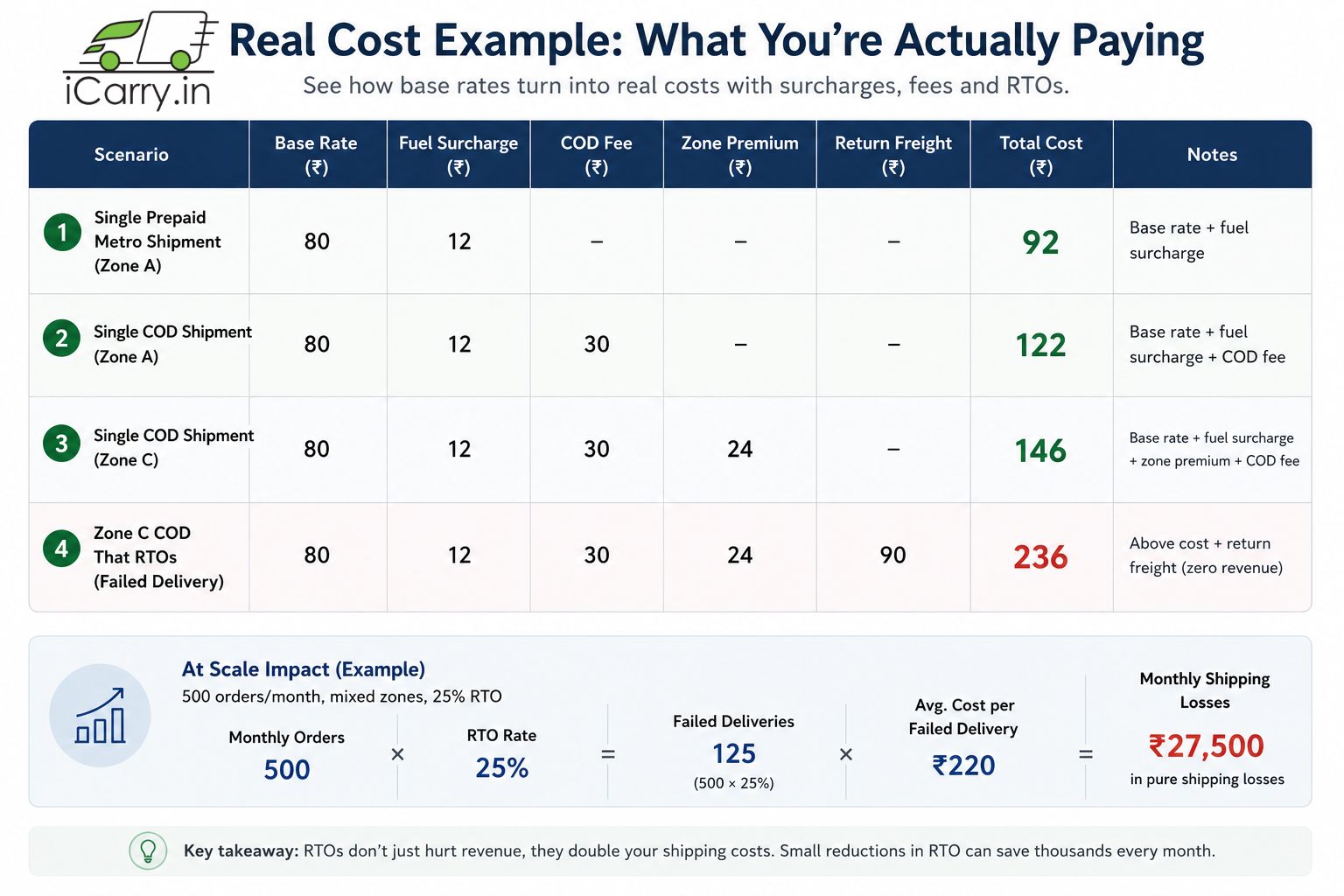
Single Prepaid metro shipment (Zone A): Base rate ₹80. Fuel surcharge ₹12. Total: ₹92.
Single COD shipment (Zone A): Base rate ₹80. Fuel surcharge ₹12. COD fee ₹30. Total: ₹122.
Single COD shipment (Zone C): Base rate ₹80. Fuel surcharge ₹12. Zone C premium ₹24. COD fee ₹30. Total: ₹146.
Zone C COD that RTOs: Add return freight ₹90. Total cost of one failed delivery: ₹236 with zero revenue.
At scale (500 orders/month, mixed zones, 25% RTO): 125 failed deliveries averaging ₹220 each = ₹27,500 in pure shipping losses every month.
Reducing RTO is one of the highest-leverage moves any D2C seller can make. Livemint's analysis of return costs in Indian eCommerce notes that for every 10% reduction in COD RTO, sellers can expect a 5-8% improvement in net shipping margins - without changing a single rate card.
The fastest way to reduce that ₹27,500 monthly loss isn't to find a cheaper courier - it's to fix the RTO rate. Our complete guide to reducing RTO for eCommerce sellers in India covers every lever: pre-dispatch confirmation, NDR workflows, address validation, and zone-level courier routing.
How to Calculate Your Actual Shipping Cost Per Order
Your headline rate card is not your actual shipping cost. Here's how to calculate what you're really spending per delivered order:
- Start with base rate - Quoted per-kg or per-shipment rate from your courier contract.
- Add fuel surcharge - Multiply base rate by 1.10 to 1.20.
- Add zone premium - Add 0% (Zone A) to 80% (Zone D+) depending on delivery location.
- Add COD fee - Add ₹20-50 per shipment if COD.
- Factor in RTO cost - Multiply your RTO rate by your return freight cost. Add this proportional cost to every order.
Formula: True cost per delivered order = (Forward cost + (RTO rate x Return freight)) / (1 - RTO rate)
Example: Forward cost ₹120, return freight ₹100, RTO rate 20%. True cost = (₹120 + (0.20 x ₹100)) / 0.80 = ₹140 / 0.80 = ₹175 per delivered order.
Once you know your true cost per delivered order across different couriers and zones, multi-courier allocation becomes an obvious lever - routing each shipment to the courier where the total delivered cost (not just base rate) is lowest for that specific pincode.
How to Reduce Your Shipping Cost Per KG
- Right-size your packaging - Reducing box volume directly cuts volumetric weight. A 20% smaller box can drop your billable weight by a full slab.
- Use multiple couriers by pincode - Route each order to the cheapest courier for that zone. Multi-courier routing can cut average cost by 8-15%.
- Use surface over air where possible - Surface is 30-50% cheaper. For orders where 1-2 extra days is acceptable, default to surface.
- Cut RTO - Every return doubles your shipping spend on that order. Reducing RTO from 25% to 15% on 500 orders saves 50 double-charges a month.
- Negotiate at volume - Above 300-500 monthly shipments, most couriers will offer better slab rates. Ask for them directly or use a courier aggregator such as iCarry® that provides the lowest rates and best support nation-wide.
Who Should Read This?
- Sellers spending more than ₹90/kg on average and not sure why
- D2C brands where shipping is above 10% of revenue
- Anyone quoted different rates by different couriers and wants to understand the gap
- Shopify or WooCommerce or social media sellers manually comparing courier rate cards
- Manufacturers, wholesalers, traders, gifting businesses, pharmacies, distributors, and retail stores shipping products across India
- Businesses looking to reduce shipping cost per kg, courier surcharges, and return losses
Conclusion
Shipping cost per kg is not just a number on a rate card. It's the output of your packaging choices, your courier selection, your delivery zone mix, your COD ratio, and your RTO rate.
Most sellers see the base rate and assume that's what they're paying. The reality is that fuel surcharges, COD fees, zone premiums, and RTO costs can push the actual cost per shipment 30-40% above the headline rate.
The good news is that every one of these components is controllable. Right-sized packaging. Zone-aware courier routing. Lower RTO. These aren't big projects - they're small, practical adjustments that compound into significant margin improvement over time.
If you want to take this further, the full guide on how to reduce shipping costs for eCommerce in India covers every cost lever available - from packaging to courier selection to zone routing. Also understand about the hidden charges that couriers don't tell you.
iCarry® gives you transparent rate comparison across all the top couriers in India, zone-level routing, and active RTO reduction tools - all in one place, with no monthly fee. If you need to see the entire rate chart at a glance across all zones, that is also openly published on the website here. Rates start as low as Rs. 21 per 500gms and all the rates here are inclusive of GST - so no hidden additional charges.
Frequently Asked Questions
What is the cheapest shipping option per kg in India?
eKart LTL typically offer the most competitive surface rates for B2B shipments (minimum weight 10kgs) - ₹6-10/kg. For B2C (eCommerce Shipments) the rate offered by Amazon Logistics on iCarry starts from ₹25 / 500gms as per this rate chart. Air via budget couriers runs ₹50-150/kg. Always check volumetric weight before comparing, and factor in zone and COD surcharges.
Is surface or air shipping better for eCommerce?
Surface is better for most eCommerce orders where next-day delivery isn't required. It's 30-50% cheaper with 1-3 days additional transit. Air is worth it only for high-value or time-sensitive shipments where delivery speed directly affects conversion or brand perception.
How do I calculate volumetric weight?
Formula: (L x W x H in cm) / 5000. Example: 30cm x 25cm x 10cm = 7500 / 5000 = 1.5 kg. If actual weight is 0.8 kg, you'll be billed for 1.5 kg. Right-sizing your packaging to reduce volumetric weight is one of the fastest ways to cut per-shipment cost.
Why are my actual shipping charges higher than the quoted rate?
Quoted rates typically exclude fuel surcharge (10-20%), COD handling fees, zone/remote area surcharges, and RTO return charges. Once these are added, your actual per-shipment cost is often 30-40% above the base rate. Always request an all-inclusive rate card that shows total cost across zones before signing with any courier.
How do I compare shipping costs fairly across different couriers?
Don't compare base rates - compare total cost per delivered order. The formula is: (Forward cost + (RTO rate x Return freight)) / (1 - RTO rate). A courier with a lower base rate but a higher RTO will almost always cost more in total. Run this calculation for each courier across your actual pincode mix before making any routing decision.
Shipping cost per kg in India is the result of multiple stacked charges - base rate, fuel surcharge, zone premium, COD fee, and RTO costs. Understanding each component, using the true-cost formula, and routing zone-aware across multiple couriers is how businesses reduce their per-shipment spend without sacrificing coverage or service. iCarry® gives you transparent rate comparison across all top couriers, with openly published rates and no hidden charges.