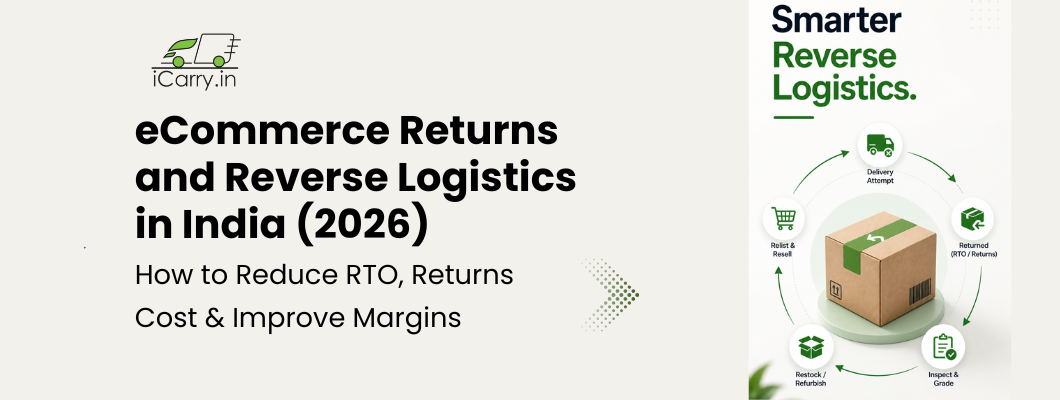
An order ships out on Monday. By Friday it is back at your warehouse - undelivered, unopened, and costing you the same freight charge twice. You repackage it, relist it, and ship it again. It comes back a second time.
This is reverse logistics. And for most Indian eCommerce sellers, it is the single most underestimated operational cost in their business.
According to Economic Times reporting on Indian eCommerce logistics costs, reverse logistics is one of the biggest drains on seller profitability - and most sellers are managing it reactively rather than systematically.
Return rates for online purchases in India are 2 to 3 times higher than in-store, according to Shopify's analysis of eCommerce returns - making reverse logistics management a direct driver of whether a business is profitable at scale.
For eCommerce brands, D2C sellers, and logistics teams, building a systematic reverse logistics process is not optional - it is a core competency that directly determines whether the business is profitable at scale.
This guide explains what reverse logistics is, the types of returns in Indian eCommerce, how to manage the process efficiently, and the specific strategies and tools that reduce reverse logistics costs.
Data-Driven Industry Estimates
- Reverse logistics costs Indian eCommerce sellers 1.5 to 2 times the cost of forward shipping per return
- RTO rates in India range from 5 to 10% for prepaid to 25 to 35% for COD in high-return categories
- Fashion and footwear have the highest return rates in Indian eCommerce - often 20 to 40% of orders, according to the Unicommerce India Ecommerce Index Report
- Sellers who process returns within 48 hours recover 15 to 25% more revenue from returned inventory than those who take 7 or more days
- Active NDR management can reduce avoidable RTO by 8 to 15 percentage points within the first month
Healthy Reverse Logistics Benchmarks for Indian Sellers
- Fashion: return rate 20 - 40%
- Beauty: 5 -10%
- Electronics: 8 -15%
- Target RTO <15%
- Return processing <48 hrs
What Is Reverse Logistics?
Reverse logistics is a core part of the supply chain management framework that supports the full order lifecycle.
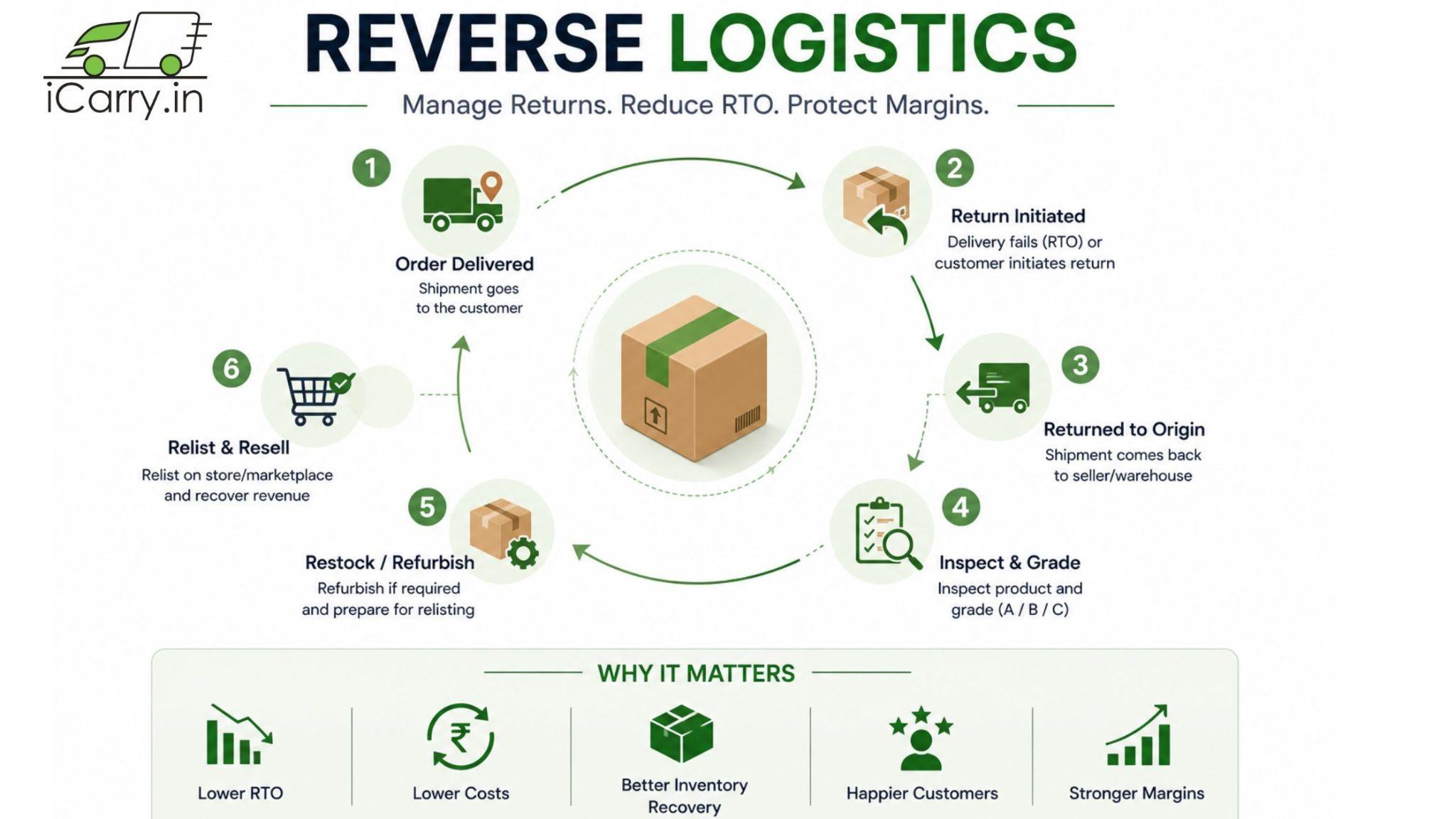
In simple terms: everything that happens to a shipment after the customer decides not to keep it - or the courier fails to deliver it - is reverse logistics.
Reverse logistics includes:
- Return to Origin (RTO) - shipments returned by the courier after failed delivery attempts
- Customer-initiated returns - products sent back by customers after delivery
- Refurbishment and restocking - inspection, grading, and re-listing of returned products
- Disposal or liquidation - for products that cannot be resold
Why Reverse Logistics Matters for Indian eCommerce?
In India's eCommerce ecosystem, reverse logistics is particularly challenging - and expensive - because of high COD penetration, delivery infrastructure gaps in Tier-2 and Tier-3 cities, and buyer behaviour patterns that include placing multiple orders and returning most of them.
Revenue Recovery
Effective reverse logistics helps businesses recover value from returned products through restocking, refurbishment, or resale - rather than writing off the inventory entirely.
Cost Control
The guide on unit economics of shipping for D2C brands shows how double freight charges on RTO shipments compound into significant losses at scale - especially for high-COD, high-RTO categories like fashion and footwear.
Customer Satisfaction
A well-managed return process improves customer confidence and trust. Customers who know they can return products easily are more likely to complete their initial purchase - and return for future orders.
Sustainability
Efficient reverse logistics reduces product waste through better repair, refurbishment, and resale cycles. For brands focused on sustainability, managing returns well is both a financial and environmental imperative.
Quick Checklist - Is Your Reverse Logistics Under Control?
Most sellers absorb reverse logistics costs without ever measuring them. These 7 checks tell you where the biggest losses are:
- Do you know your RTO rate broken down by courier, pincode, and product category?
- Are you tracking the cost per returned shipment - forward freight + return freight + restocking?
- Do you have a defined return inspection and grading process for every returned item?
- Are you following up on NDR shipments within 24 hours? NDR data management is the most direct lever for reducing avoidable RTO
- Is your return policy clear and easy to find? Vague return policies generate more disputes, not fewer returns
- Are returned products being inspected, graded, and relisted within 48 hours of receipt?
- Are you separating RTO (courier-initiated returns) from customer-initiated returns in your reporting? They require different responses.
Types of Returns in Indian eCommerce
1. Return to Origin (RTO)
RTO occurs when a shipment cannot be delivered to the customer and is sent back to the seller. Common RTO reasons in India include:
- Customer not available at the delivery address on all 3 delivery attempts
- Incorrect or incomplete delivery address
- Customer refused delivery at the door - common on COD orders where the buyer has lost interest
- Fake non-delivery reports filed by courier delivery executives
RTO is the most expensive form of reverse logistics because the seller pays both forward and return freight while receiving zero revenue. How to reduce RTO systematically covers the data-driven strategies for bringing RTO rates down across courier partners, pincodes, and product categories.
2. Customer-Initiated Returns
Returns requested by customers after receiving the product - due to wrong size, product not matching description, damaged product, or simply changed mind. The customer typically has a return pickup scheduled from their address, and the item is brought back to the seller's warehouse.
3. Exchange Requests
Customers requesting a size change, colour swap, or product replacement. Exchanges require managing both a reverse pick-up and a fresh forward shipment - doubling the logistics touchpoints while creating an opportunity to retain the sale.
4. Damaged or Defective Returns
Products returned due to manufacturing defects, transit damage, or quality issues. These typically go through a separate inspection and disposition process to determine whether they can be repaired, refurbished, or written off.
The Reverse Logistics Process - Step by Step
Step 1: Return Request Initiation
The customer requests a return through the seller's website, app, or support channel. A clear, easy-to-find return policy reduces friction at this stage - sellers who bury their return process in FAQs tend to generate more support tickets, not fewer returns.
Step 2: Pickup Scheduling
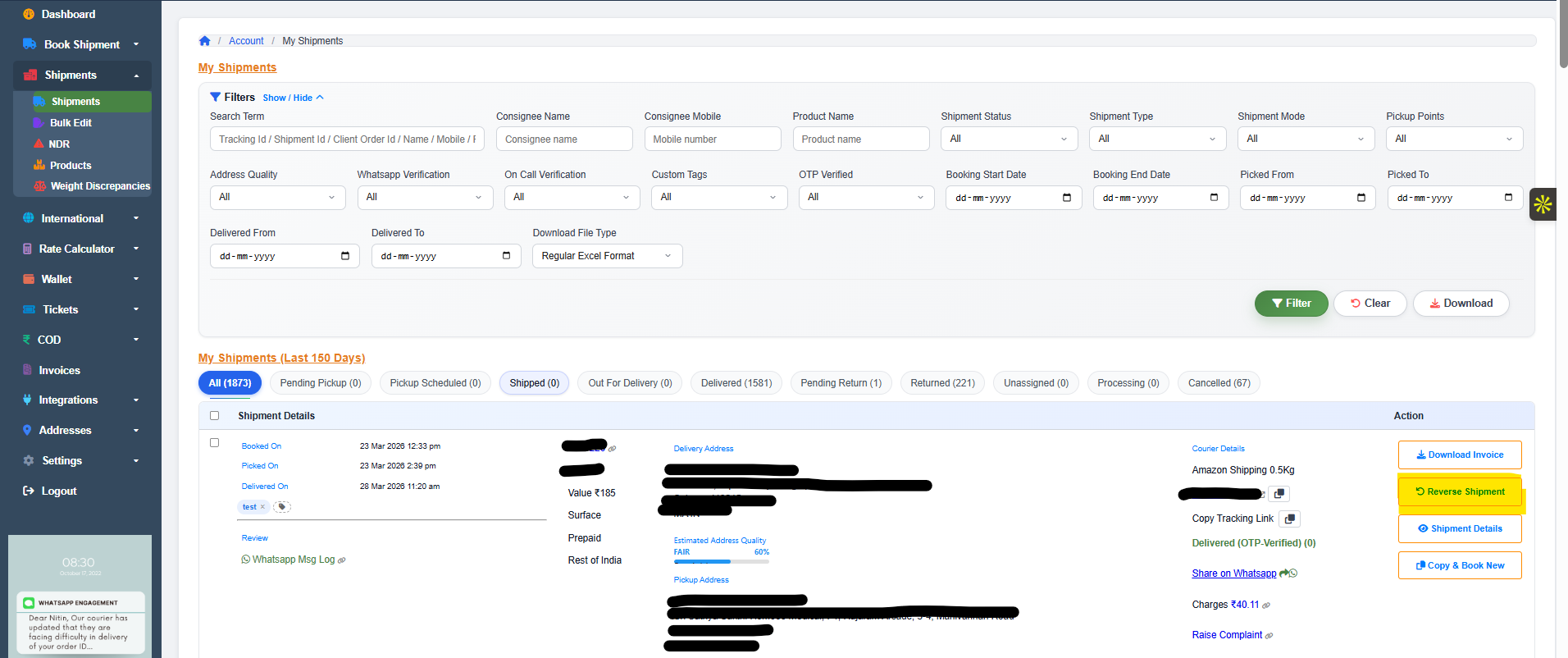
Once the return is approved, a courier pickup is scheduled from the customer's address. On iCarry®, reverse shipments can be booked directly from the My Shipments section - either via the Reverse Shipment button on a delivered order, or as a new forward shipment with the customer's address set as the pickup point.
Step 3: Product Collection and Transit
The courier collects the returned product from the customer and transports it back to the seller's warehouse or return centre. Sellers should instruct customers to seal the return parcel properly to protect contents during transit - unsealed returns are frequently received with missing or damaged contents.
Step 4: Quality Inspection and Grading
On receipt, each returned item is inspected and graded:
- Grade A: Unused, original packaging intact - can be relisted as new
- Grade B: Used but functional, packaging opened - relist at a discount or sell through secondary channel
- Grade C: Damaged or defective - repair, refurbish, or dispose
A documented inspection process with photos taken at receipt is essential for any courier damage claim or customer dispute. Without evidence taken at the moment of receipt, claims are almost impossible to support.
Step 5: Disposing or Restocking
Based on the inspection grade, the product is restocked at full price, relisted at a discount, sent for repair or refurbishment, or disposed of by the seller. Speed matters here - every day a returned product sits un-inspected and non-relisted is a day of lost revenue from inventory you have already paid for.
Step 6: Refund or Exchange Processing
Once the return is received and inspected, the refund or exchange order is triggered. Fast refund processing is directly correlated with customer retention - sellers who refund within 24 to 48 hours of return receipt retain customers at much higher rates.
RTO vs Customer Return - Key Differences
| Factor | RTO (Courier Return) | Customer-Initiated Return |
|---|---|---|
| Who initiates | Courier - after failed delivery | Customer - after delivery |
| Primary cause | Fake NDR, address error, refusal, unavailability | Wrong product, quality issue, changed mind |
| Cost to seller | Double freight - forward + return | Return pickup + restocking |
| Revenue recovered | Zero - no delivery was completed | Partial - product may be re-listable |
| Prevention approach | NDR management, address validation, COD conversion | Better product descriptions, right sizing guides, quality control |
| Most common in India | COD orders, Tier-2/3 pincodes | Fashion, electronics, home |
Cost Structure of Reverse Logistics in India
Reverse logistics typically costs 1.5 to 2 times more than forward shipping when all elements are accounted for. The full cost breakdown includes:
- Return freight: This is typically equal to forward shipping charge - some courier partners charge separately for reverse pickup
- Inspection and grading: Labour cost to inspect, photograph, and classify each returned item
- Restocking: Repackaging, relabelling, and restoring inventory to sellable condition
- Refurbishment: Repair costs for Grade C items that can be recovered
- Storage: Holding cost for returns awaiting inspection and disposition
- Refund processing: Payment gateway fees and administrative overhead
Healthy reverse logistics benchmarks for Indian sellers: target RTO below 15%, process returns within 48 hours, and track return cost as a percentage of net fulfilled revenue to ensure reverse logistics does not silently erode margins.
Sellers who want to reduce this cost load systematically, should start with reducing shipping costs at the operational level, packaging optimisation, courier selection, and volumetric weight management - all apply to reverse shipments as much as forward ones.
Understanding the full picture of charges - including those that appear weeks after dispatch - is covered in detail in the guide on hidden shipping charges in India.
GST Compliance in Reverse Logistics
Full details are available in the GST guidelines from the Government of India.
Key compliance points:
- Sellers must issue a credit note for returned goods to reverse the original GST invoice
- For COD returns, the GST on the COD amount must also be adjusted
- Input Tax Credit (ITC) adjustments are required for returned inventory
- Documentation - return receipt, inspection report, credit note - must be maintained for every return
Consult your accountant or GST practitioner for specific guidance on reverse logistics tax treatment for your business type and product category.
Common Mistakes Businesses Make
Treating RTO and customer returns the same: They have different causes and different solutions. Blending them in reporting hides the insight you need to fix each one.
No return inspection process: Returned products that go directly back into inventory without inspection contaminate your sellable stock with damaged or used items that generate more returns.
Slow refund processing: Customers who wait 7 to 10 days for a refund do not come back. Fast refunds are a retention investment, not a cost.
No data on return reasons: If you are not recording why each item was returned, you cannot fix the root cause. Even a basic 5-category reason code on each return generates actionable data within 2 to 3 weeks.
Not tracking the full cost of each return: Most sellers know the freight cost. Few track inspection time, restocking labour, and holding cost. Without the full number, you cannot make the business case for reducing returns.
Reverse Logistics Comparison
| Factor | Managed Reverse Logistics | Unmanaged Returns |
|---|---|---|
| RTO rate | Below 15% with active NDR management | 25 to 35% absorbed as unavoidable |
| Return processing time | 48 hours to relist | 5 to 10 days before restocking |
| Cost per return | Tracked and optimised | Unknown - absorbed into overhead |
| Customer retention | Higher - fast refund builds trust | Lower - slow process frustrates customers |
| Data availability | Return reason tracked per order | No systematic tracking |
| Revenue recovery | 70 to 85% of returned inventory resold | Under 50% due to handling and delays |
How to Reduce Reverse Logistics Costs
1. Reduce RTO at Source
The most impactful lever - preventing the return before it happens. This means:
- Validating customer addresses before dispatch using an order confirmation process that confirms delivery intent for COD orders
- Sending WhatsApp delivery notifications or using features like WhatsApp Engagement by iCarry® to reduce missed delivery attempts
- Enabling OTP verified delivery to eliminate fake delivery completion reports
- Using multi-courier allocation to route orders away from couriers with high fake NDR rates in specific pincodes
2. Improve Product Listings
Most customer-initiated returns in fashion and electronics are caused by products not matching expectations set at the listing level. Accurate size guides, multiple product images, detailed descriptions, and honest reviews all reduce return rates without changing the product itself.
3. Improve Packaging
Products damaged in transit generate both a return and a replacement shipment. Strong, right-sized packaging that protects the product during handling reduces transit damage returns while also reducing volumetric weight charges.
4. Build a Fast Return Processing System
The faster a return is inspected and restocked, the lower its total cost to the business. Set a target of 48 hours from return receipt to relisting for Grade A and B items. Every additional day of processing time is lost revenue from inventory you have already paid to carry.
5. Use Returns Data to Fix Root Causes
The guide on 7 logistics KPIs every eCommerce business should track includes return rate and RTO rate benchmarks alongside delivery performance metrics. Regular review of this data identifies systemic issues - a specific courier generating disproportionate RTOs on a specific route, or a product category with consistently high customer return rates - that targeted intervention can fix.
How iCarry® Handles Reverse Logistics, NDRs and Fake Deliveries
iCarry® handles the operational infrastructure for each of these - reverse booking, NDR action and fake delivery auditing - all from a single dashboard.
Reverse Shipment Booking
iCarry® makes reverse shipment booking simple. For orders originally delivered via iCarry®, the Reverse Shipment button appears directly on the delivered shipment record in My Shipments. For orders originally shipped outside iCarry®, a standard forward booking with the customer's address as the pickup point achieves the same result.
When you click on Reverse Shipment button, the system automatically selects the optimum and most efficient courier based on the pincodes of sender & receiver.
NDR Management Dashboard
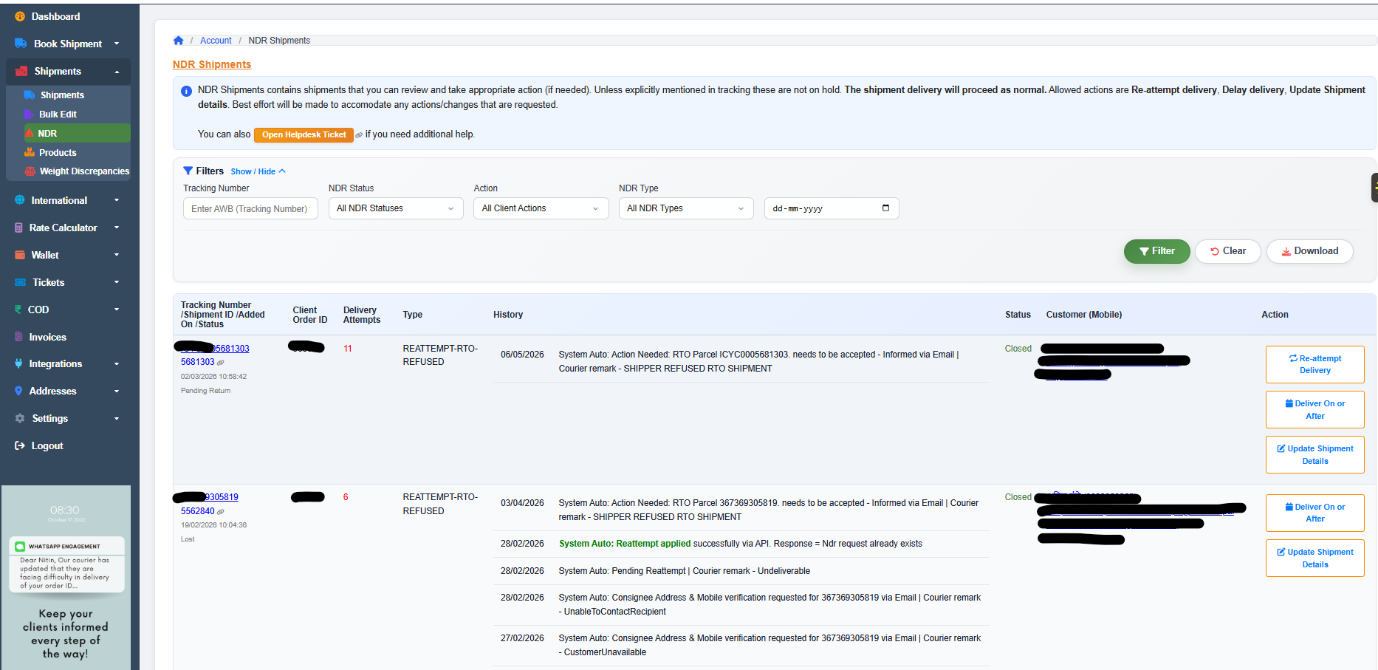
The NDR section in My Shipments shows every shipment that failed delivery, with the courier's stated reason. Acting on NDRs within 24 hours which may include updating address details, requesting reattempt, or initiating return - can reduce avoidable RTO by 8 to 15% within the first month. How to use NDR data effectively to improve delivery success walks through the full NDR management workflow.
Last-Mile Delivery Accountability
iCarry®'s Delivery Boost feature deploys trained agents who call customers on the seller's behalf, audit courier delivery claims, and open tickets for fake NDRs. This directly reduces the fake non-delivery reports that are the biggest single driver of avoidable RTO in India. How last-mile delivery challenges in India create reverse logistics costs explains the structural reasons why fake NDRs are so prevalent.
Video: How to Enable Delivery Boost
Conclusion
Reverse logistics is not a cost of doing business that must simply be absorbed - it is a system that can be measured, managed, and improved. The sellers who treat reverse logistics as a strategic priority - rather than an operational afterthought - consistently outperform on margins, customer retention, and inventory efficiency.
Start by separating RTO from customer returns in your reporting. Measure the full cost per return. Build a systematic inspection and restocking workflow. And use the NDR and return data you collect to address root causes rather than just processing symptoms.
iCarry® supports the full reverse logistics cycle - from NDR management and Delivery Boost that reduce avoidable RTO, to reverse shipment booking and multi-courier access that make return operations efficient.
Frequently Asked Questions (FAQs)
What is reverse logistics in eCommerce?
Reverse logistics is the process of managing goods moving from the customer back to the seller - including failed deliveries (RTO), customer-initiated returns, exchanges, and defective product handling.
How much does reverse logistics cost in India?
Typically 1.5 to 2 times the forward shipping cost per return when all elements are included - return freight, inspection labour, restocking, refurbishment, and refund processing overhead.
What is the difference between RTO and a customer return?
RTO is a courier-initiated return when delivery fails after 3 attempts. A customer return is initiated by the customer after receiving the product. They have different causes, different cost structures, and require different prevention strategies.
How can I reduce RTO in India?
Reduce RTO by validating addresses before dispatch, acting on NDR within 24 hours, restricting COD on high-risk pincodes, and using courier performance data to route orders away from poor-performing partners. A guide to systematic RTO reduction strategies by courier and pincode lists the most effective approaches used by Indian eCommerce sellers.
Does iCarry® support reverse shipments?
Yes. iCarry® allows sellers to book reverse shipments directly from the My Shipments dashboard. For orders delivered via iCarry®, a Reverse Shipment button appears on the delivered order. For other orders, a standard booking with the customer as the pickup address achieves the same result.
How should I handle GST on returned goods?
Refer to the GST portal guidelines or your GST practitioner for specific treatment based on your business type and product category.
How can I use reverse logistics data to reduce returns?
Track return reasons by product, courier, pincode, and payment type. Use logistics KPIs to identify patterns - a specific product with 30% returns suggests a listing or quality issue; a specific courier with high RTO on a specific pincode suggests an operational problem. The data tells you exactly where to intervene.
What is the best way to manage customer returns efficiently?
Set a 48-hour inspection and restocking target from return receipt. Grade every return (A/B/C), photograph it on arrival, and relist Grade A and B items immediately. Slow return processing is one of the highest-cost operational inefficiencies in Indian eCommerce - and one of the most fixable.
The two highest-impact actions in reverse logistics are both free: separate RTO from customer returns in your reporting, and start recording why each item was returned. Within 4 weeks you will have enough data to identify the couriers, pincodes, and products driving the most avoidable cost - and fix them one by one.