Introduction
Shipping unit economics is one of the most critical factors affecting profitability for D2C brands. Every order shipped includes multiple logistics costs such as forward shipping, packaging, payment gateway fees, and return-to-origin (RTO) expenses, which is why many online sellers actively implement strategies to reduce return-related losses. When these costs are not properly calculated, brands often overestimate their margins.
This guide explains shipping unit economics for D2C brands, including logistics cost per order, RTO impact, shipping benchmarks, and strategies to optimize shipping costs.
Many D2C founders focus heavily on customer acquisition costs (CAC), marketing spend, and product margins, but ignore a major cost center: shipping unit economics.
A brand might sell a product for ₹999 with a ₹400 production cost and believe they are profitable. But once shipping, returns, payment gateway fees, and packaging are included, the actual profit may shrink dramatically.
Understanding shipping unit economics helps D2C brands control logistics costs, price products correctly, improve contribution margins, and scale their operations profitably.
Understanding logistics cost structures is increasingly important as global supply chains become more complex and delivery expectations continue to rise according to the World Bank's Logistics Performance Index.
What Is Unit Economics of Shipping?
Unit economics of shipping refers to the total logistics cost incurred to deliver one order to a customer and handle potential returns.
In simple terms:
Shipping Unit Economics =
- Forward Shipping Cost
- + Packaging Cost
- + Payment Gateway Fees
- + COD Charges
- + Expected Return Cost
It includes every cost associated with fulfilling a single order.
Example
A D2C skincare brand sells a product online.
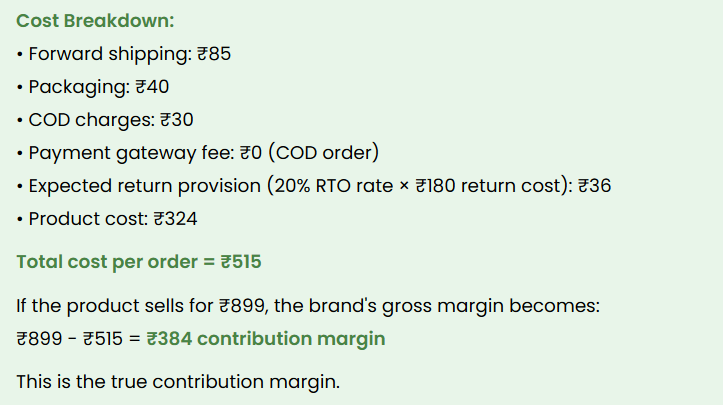
Shipping unit economics refers to the total logistics cost incurred to fulfill and deliver a single order, including forward shipping, packaging, payment fees, and return costs. For D2C brands, understanding shipping unit economics helps calculate true contribution margins and optimize logistics profitability.
Key Components of Shipping Unit Economics
Understanding the individual cost drivers behind shipping is essential for D2C brands to accurately calculate logistics cost per order.
1. Forward Shipping Cost
Forward shipping cost refers to the expense of transporting a product from the warehouse to the customer's address. This cost varies depending on several factors such as delivery distance (shipping zone), package weight, courier partner pricing, and the type of service used (express or surface delivery).
Typical eCommerce shipping cost per order in India varies by delivery zone, courier partner, and package weight as documented in Invest India's eCommerce sector overview.
2. Packaging Cost
Packaging cost includes all materials used to safely ship the product. This typically involves shipping boxes, protective materials like bubble wrap, sealing tape, labels, and sometimes branding inserts. Many D2C brands underestimate this expense, but it can significantly impact overall logistics costs.
For most online brands, packaging costs typically range between ₹20 and ₹80 per order, depending on packaging quality and product category.
3. COD Charges
Cash-on-delivery (COD) orders usually involve additional handling charges from logistics providers. These fees typically range between ₹25 and ₹50 per order.
In India, COD remains highly popular due to customer trust factors and limited digital payment access in certain regions. For many D2C brands, COD still accounts for 50 - 70% of total orders, making COD charges an important part of shipping unit economics. Cash-on-delivery remains widely used in emerging eCommerce markets due to trust factors and payment accessibility as reported by UNCTAD's trade and logistics research.
4. Return to Origin (RTO) Cost
Return to Origin (RTO) occurs when a customer refuses delivery or the courier cannot complete the shipment. In such cases, the product is shipped back to the warehouse, and the brand must bear both forward and return shipping costs.
For example, if forward shipping costs ₹90 and return shipping also costs ₹90, the total RTO cost becomes ₹180 for a single order.
High RTO rates can significantly damage shipping unit economics, which is why many brands implement verification strategies to reduce returns and RTO risk.
5. Payment Gateway Fees
For prepaid orders, brands must pay payment gateway processing fees. These fees typically range between 2% and 3% of the order value.
For example, a ₹1000 order may incur a payment gateway fee of ₹25 - ₹30 depending on the provider and payment method used.
Step-by-Step: How to Calculate Shipping Unit Economics
D2C brands should calculate the logistics cost per order to understand the true shipping unit economics of their business. This can be done by adding all logistics-related expenses involved in fulfilling a single order.
Step 1: Identify Forward Shipping Cost
Start by determining the forward shipping cost, which is the amount paid to the courier partner to deliver the product to the customer.
Example:
Forward shipping cost = ₹80 per shipment
Step 2: Add Packaging Cost
Next, include the cost of packaging materials such as boxes, protective wrapping, labels, and sealing tape.
Example:
Packaging cost = ₹40 per order
Step 3: Include Payment or COD Charges
If the order is placed using cash-on-delivery (COD), logistics providers usually charge an additional COD handling fee.
Example:
COD handling charge = ₹30
For prepaid orders, this step would instead include payment gateway processing fees.
Step 4: Add Return Cost Provision
Returns are a common part of ecommerce logistics, especially for COD-heavy businesses. To account for this, brands should estimate the expected return cost based on the RTO rate.
For example, if the RTO rate is 20% and the return shipping cost is ₹160, the expected return provision would be calculated as:
0.20 × 160 = ₹32
Step 5: Calculate Total Logistics Cost Per Order
After identifying all relevant cost components, the final step is to add them together to determine the total logistics cost per order.
Total Logistics Cost = ₹80 + ₹40 + ₹30 + ₹32 = ₹182
This total represents the shipping unit cost per order, which helps D2C brands understand how logistics expenses impact their contribution margins and overall profitability.
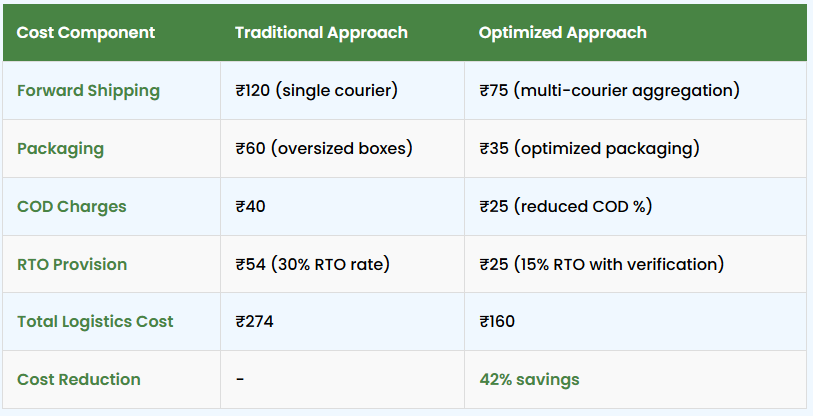
Traditional vs Optimized Shipping Economics
Real-World Example: D2C Apparel Brand
A D2C fashion brand selling T-shirts online began noticing that its profit margins were shrinking despite steady sales. While the product price and manufacturing costs appeared sustainable, rising logistics expenses were significantly impacting contribution margins.
Initial Metrics
The brand's cost structure looked like this:
- Selling price: ₹799
- Product cost: ₹300
- Forward shipping: ₹115
- Packaging: ₹55
- COD charges: ₹35
- RTO provision (28% rate): ₹56
- Total logistics cost: ₹261
- Contribution margin: ₹238
With high shipping expenses and a significant RTO rate, the brand's contribution margins remained very low, limiting its ability to scale profitably.
Logistics Optimization Strategy
To improve shipping unit economics, the brand implemented several operational improvements such as:
It began using a multi-courier shipping aggregator, which allowed the company to compare courier partners and choose the most cost-effective option for each delivery zone through a centralized courier aggregation platform. The team also introduced zone-based courier selection to reduce long-distance shipping costs.
In addition, the brand started COD confirmation through WhatsApp, which helped reduce fake or unconfirmed orders.
Packaging was also redesigned to reduce unnecessary weight, lowering volumetric shipping charges.
Results After Optimization
- Forward shipping: ₹85 (26% reduction)
- Packaging: ₹38 (31% reduction)
- RTO provision (18% rate): ₹36 (36% reduction)
- Total logistics cost: ₹194
- New contribution margin: ₹305
- Margin improvement: 28%
By optimizing its shipping operations, the brand significantly improved its shipping unit economics and overall contribution margin, allowing the business to operate more profitably while continuing to scale.
Benefits of Optimizing Shipping Unit Economics for D2C Brands
1. Higher Contribution Margins
Lower logistics cost means more profit per order.
2. Competitive Pricing
Brands can:
- Offer free shipping
- Run discounts without losing margins
3. Better Customer Experience
Efficient logistics improves delivery time, tracking visibility, and customer satisfaction by creating a seamless delivery experience for online shoppers.
4. Scalability
A profitable unit model allows faster growth without cash burn.
Major Challenges for D2C Brands
High RTO Rates
In India, RTO rates can reach 20 - 35% for COD orders - sometimes even higher depending on the category of products being sold.
Courier Rate Volatility
Shipping costs fluctuate based on:
- Fuel prices
- Zone surcharges
- Peak season demand
Fuel volatility and transportation costs are among the largest contributors to global logistics price fluctuations as analyzed in McKinsey's travel and logistics insights.
Weight Discrepancies
Incorrect weight declarations can result in extra charges and courier penalties, making it essential for sellers to understand how weight discrepancies increase shipping costs.
Fragmented Logistics Network
India's logistics ecosystem includes multiple regional courier companies with varying reliability.
India's logistics infrastructure continues to evolve rapidly as digital commerce expands across tier-2 and tier-3 cities according to NITI Aayog's LEADS Report.
Common Mistakes D2C Brands Make
Many D2C brands struggle with shipping profitability because of a few common operational mistakes. These errors often lead to higher logistics costs, increased return rates, and reduced contribution margins.
Ignoring RTO Impact
One of the most frequent mistakes founders make is calculating only the forward shipping cost while ignoring the impact of returns. In reality, when an order is returned, brands must pay both the forward shipping and the return shipping cost. Without accounting for the Return to Origin (RTO) rate, the actual logistics cost per order can be significantly higher than expected.
Offering Free Shipping Too Early
Many brands introduce free shipping in the early stages of their business to attract customers. However, if product margins are not strong enough, absorbing the entire shipping cost can quickly eliminate profits. Free shipping strategies should ideally be introduced only after optimizing shipping unit economics and ensuring sustainable margins.
Choosing the Cheapest Courier
Selecting a courier partner based only on price can often lead to operational problems. Low-cost couriers may struggle with delivery reliability, which can result in delayed shipments, poor customer experience, and higher RTO rates. Over time, these issues can increase overall logistics costs rather than reduce them.
Poor Packaging Design
Packaging design also plays a significant role in shipping economics. Oversized packaging increases the volumetric weight of shipments, which directly raises courier charges. Optimizing packaging size and weight can help reduce shipping costs while still ensuring product safety during transit.
By avoiding these common mistakes, D2C brands can improve their shipping unit economics, reduce logistics expenses, and build a more sustainable ecommerce operation.
Best Practices to Improve Shipping Economics
1. Use Multi-Courier Aggregation
Shipping aggregators help compare courier rates automatically, which is why many growing brands rely on courier aggregation platforms for shipping optimization.
Benefits:
- Lower costs
- Faster delivery
- Better coverage
2. Reduce RTO With Order Verification
Use:
- WhatsApp confirmation
- OTP verification
- COD incentives for prepaid
3. Optimize Packaging Weight
Smaller packaging reduces:
- Volumetric weight charges
- Shipping fees
4. Segment Shipping Zones
Use multiple fulfillment centers to reduce long-distance deliveries.
5. Incentivize Prepaid Orders
Strategies:
- Prepaid discount
- Faster delivery
- Free shipping
Shipping Cost Benchmarks for D2C Brands in India
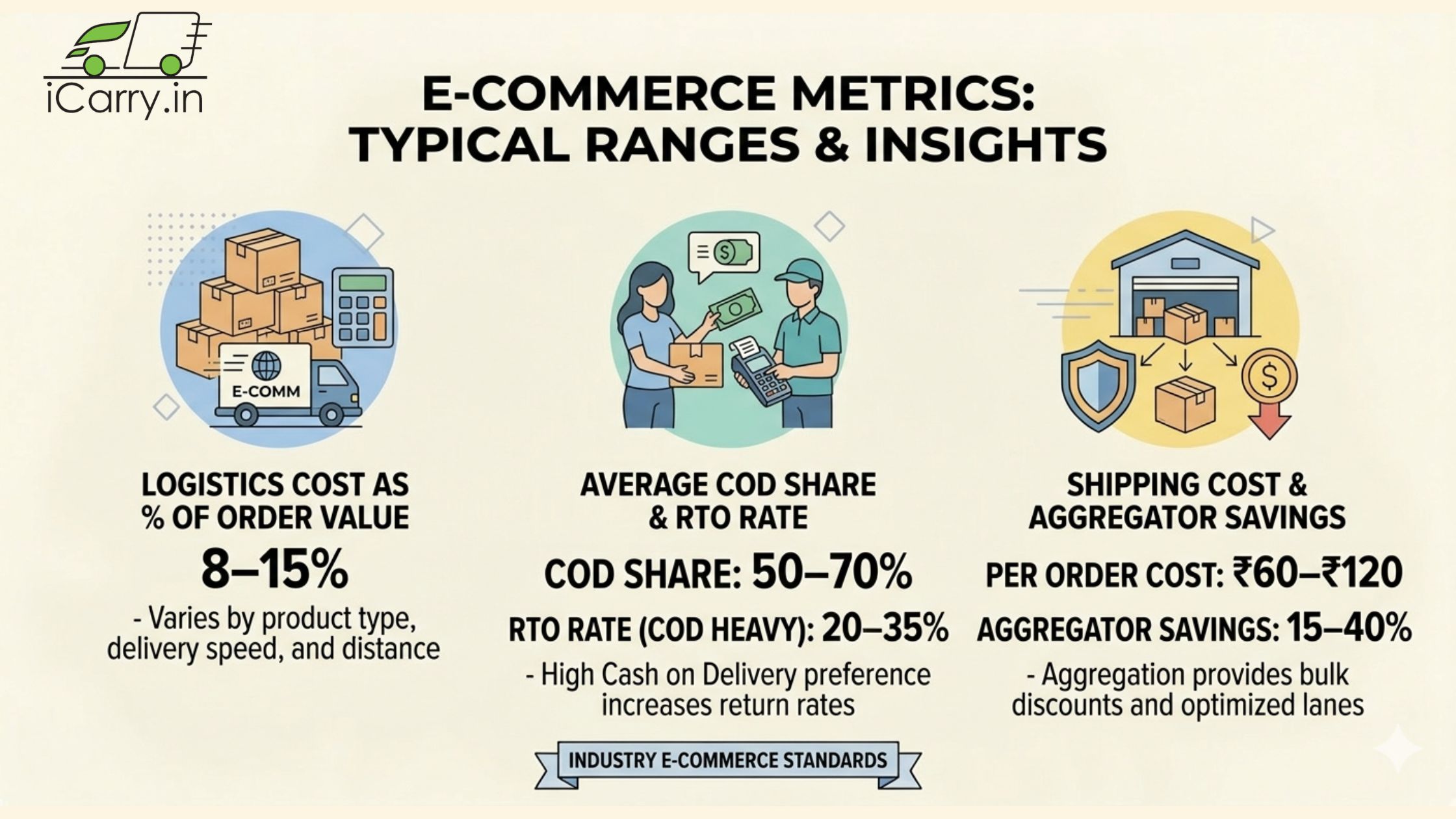
Shipping benchmarks vary by product category, order value, and courier network efficiency. However, most D2C brands in India operate within the following logistics cost ranges.
These benchmarks help D2C brands evaluate whether their shipping unit economics and logistics costs are competitive within the industry.
Key trends:
- Logistics cost typically represents 8% - 15% of order value
- RTO rates average 20 - 30% for COD-heavy brands
- Shipping aggregators can reduce logistics costs by 15 - 40%, especially when brands use multi-courier allocation strategies to route shipments intelligently
- Prepaid orders reduce RTO risk by up to 90%
As India's eCommerce ecosystem grows, logistics efficiency will become a major competitive advantage.
Global consulting studies consistently show that logistics efficiency directly impacts profitability and customer satisfaction.
Beyond cost optimization, improving shipping unit economics also depends on reducing failed deliveries and improving order confirmation rates. Many D2C brands now use WhatsApp-based order confirmation and proactive customer communication to reduce RTO and fake orders.
In such workflows, systems like iCarry enable automated customer engagement through WhatsApp notifications, order verification, and branded tracking pages. This not only improves delivery success rates but also strengthens customer trust and post-purchase experience.
Final Summary
Understanding shipping unit economics for D2C brands is essential for businesses that want to scale profitably. By analyzing logistics cost per order, reducing RTO rates, optimizing packaging weight, and selecting the right courier partners, businesses can significantly improve contribution margins.
As eCommerce competition increases, companies that actively optimize their shipping cost structure and logistics efficiency will gain a major advantage in profitability and customer experience.
In the highly competitive D2C landscape, the brands that win are not just those that sell more - but those that ship smarter.
Efficient shipping is not just about delivering orders - it is about building a cost structure that supports sustainable growth. When logistics costs, RTO rates, and courier performance are actively optimized, businesses gain better control over margins and customer experience.
For D2C brands operating in India's COD-heavy environment, shipping unit economics directly determines profitability. Brands that continuously refine their logistics strategy - from courier selection to return management - are able to scale faster without increasing cost pressure.
iCarry enables this by helping businesses bring visibility into shipping performance, reduce RTO impact, and optimize courier allocation through a centralized logistics workflow.
Because in D2C, profitability is not just driven by sales - it is driven by how efficiently you deliver every order.
Frequently Asked Questions About Shipping Unit Economics
What is shipping unit economics in eCommerce?
Shipping unit economics refers to the total logistics cost required to fulfill one customer order, including forward shipping, packaging, payment gateway charges, and return costs.
Why are shipping unit economics important for D2C brands?
Shipping unit economics help brands calculate real contribution margins, control logistics costs, and optimize profitability while scaling operations.
How much do logistics costs typically represent in D2C?
For most D2C brands, logistics costs represent 8 - 15% of order value, depending on shipping zones, RTO rates, and courier pricing.
How can brands reduce shipping unit costs?
Brands can reduce shipping unit costs by using multi-courier aggregators, optimizing packaging weight, encouraging prepaid orders, and implementing strategies to reduce RTO rates.
Shipping unit economics refers to the total logistics cost to fulfill one order—including forward shipping, packaging, payment fees, COD charges, and return costs—enabling D2C brands to calculate true contribution margins, optimize profitability, and scale sustainably by reducing RTO rates, using multi-courier aggregation, and improving delivery efficiency.