Why This Decision Costs Sellers Money Every Day
You dispatched 50 orders last week. Half arrived late. A customer left a 2-star review because their order came in 6 days instead of 3. The fix wasn't a faster courier - it was choosing the wrong shipping mode entirely - impacting delivery speed, customer satisfaction, and logistics costs. Global logistics research highlights that transportation mode selection plays a key role in supply chain efficiency and cost optimization.
The two primary shipping methods used by courier networks are:
- Surface Shipping (Road-based transport)
- Air Shipping (Air cargo transport)
Each method comes with its own trade-offs between cost, speed, and serviceability. While air shipping enables faster deliveries, surface shipping is significantly more cost-effective for most orders.
For eCommerce founders and logistics operators, understanding when to use each mode can help optimize shipping costs while maintaining delivery performance through smarter shipping strategies.
This guide breaks down surface vs air shipping in India - costs, speed, and exactly when to use which.
What is Surface Shipping vs Air Shipping?
Surface Shipping
Surface shipping refers to transporting goods through road (trucks) or rail networks, making it one of the most commonly used logistics methods for domestic deliveries. Road and rail networks form the backbone of domestic logistics infrastructure in large economies like India.
It is primarily used for shipments within the country where delivery timelines are flexible. Although slower compared to air transport, it is significantly more cost-efficient and is ideal for non-urgent orders.
Air Shipping
Air shipping involves transporting goods via Air cargo flights, making it the fastest mode of delivery in logistics. Air cargo plays a critical role in global trade by enabling fast transportation of high-value and time-sensitive goods.
It is typically used for urgent shipments where speed is critical. While it ensures quicker delivery, it comes at a higher cost compared to surface shipping.
The Quick Answer
Surface shipping is slower but more affordable, making it suitable for standard deliveries. Air shipping, on the other hand, is faster but more expensive, making it ideal for urgent shipments.
Why Getting This Wrong Costs You Money
Choosing the right shipping mode directly impacts cost, delivery performance, and overall customer satisfaction by influencing the overall shipping experience.
Cost Optimization
Surface shipping helps reduce logistics expenses significantly, making it the preferred choice for cost-sensitive operations.
Delivery Speed
Air shipping enables faster deliveries, which improves customer experience and supports time-sensitive orders.
Customer Expectations
Different customers have different urgency levels, so offering the right shipping option helps meet their expectations effectively.
Profit Margins
Shipping costs directly affect profitability, making it important to balance speed and cost based on business needs.
Surface vs Air Shipping: Head-to-Head
Surface and air shipping differ across multiple operational factors such as cost, speed, and coverage.
| Factor | Surface Shipping | Air Shipping |
|---|---|---|
| Transport mode | Road / Rail | Air cargo |
| Cost | Low | High |
| Delivery time | 3-7 days | 1-3 days |
| Coverage | Wider (including remote areas) | Limited (metro-focused) |
| Suitable for | Bulk & non-urgent orders | Urgent & high-value orders |
Surface vs Air Shipping Costs Comparision in India
Shipping costs vary based on weight, distance, and courier.
| Shipment Type | Surface Cost | Air Cost |
|---|---|---|
| Local | ₹40-₹70 | ₹70-₹120 |
| Regional | ₹60-₹100 | ₹100-₹180 |
| National | ₹80-₹150 | ₹150-₹300 |
👉 Air shipping can be 1.5x to 3x more expensive than surface shipping.
Surface vs Air Shipping Delivery Speed Comparision
| Route Type | Surface Delivery Time | Air Delivery Time |
|---|---|---|
| Metro to Metro | 2-4 days | 1-2 days |
| Metro to Tier-2 | 3-5 days | 1-3 days |
| Remote areas | 5-7 days | Limited availability |
How Surface Shipping Works
Step-by-Step Process
Step 1: Order Pickup
The order is picked up from the warehouse and prepared for transportation.
Step 2: Move to Regional Hub
The shipment is sent to a nearby regional hub where multiple orders are consolidated.
Step 3: Line-Haul Transportation
The shipment is transported via long-distance trucks (line-haul) to the destination city.
Step 4: Sorting at Destination Hub
At the destination hub, the shipment is sorted based on delivery routes.
Step 5: Last-Mile Delivery
The order is handed over to the last-mile delivery network and delivered to the customer, making last-mile efficiency critical for successful delivery.
Surface shipping typically operates on a hub-and-spoke logistics model, ensuring cost-effective transportation across supply chain operations. Hub-and-spoke models are widely used in logistics to optimize routing efficiency and reduce transportation costs.
How Air Shipping Works
Step-by-Step Process
Step 1: Order Pickup
The shipment is picked up from the warehouse and prepared for air transport.
Step 2: Transfer to Airport Cargo Facility
The package is moved to the nearest airport cargo terminal for processing.
Step 3: Air Transportation
The shipment is transported via air cargo to the destination airport.
Step 4: Arrival at Destination Airport
The shipment is received and processed at the destination airport cargo facility.
Step 5: Last-Mile Delivery
A local courier partner picks up the shipment and delivers it to the customer.
Air shipping significantly reduces transit time, making it ideal for urgent deliveries.
How Indian eCommerce Brands Use Both Modes
Different businesses use shipping modes strategically based on their operational needs.
Example 1: Cost Optimization Strategy
A D2C brand uses surface shipping for 70-80% of its orders to reduce logistics costs while reserving air shipping for urgent deliveries.
Example 2: Premium Product Delivery
A premium electronics brand relies on air shipping to ensure faster and secure delivery of high-value products.
Example 3: Tier-2 Delivery Strategy
An eCommerce business uses surface shipping for Tier-2 and Tier-3 cities where air connectivity is limited.
When to Use Surface Shipping
Use surface shipping when you don't need the order there tomorrow. It's your best bet for heavy or bulky items, Tier-2 and Tier-3 deliveries, and any order where saving on shipping cost matters more than speed. Most D2C brands route 60-80% of orders via surface - because it makes financial sense.
When to Use Air Shipping
Use air shipping when the order can't wait. Think: ₹5,000+ electronics, same-day-dispatch SLAs, metro-to-metro express orders. Yes, it costs 1.5x-3x more than surface - but a failed delivery on a premium order costs you more in returns and bad reviews.
Best Shipping Strategy for eCommerce in India
The smartest Indian eCommerce brands don't pick one mode. They use surface for standard orders (60-80% of volume) and reserve air for express or high-value shipments. This hybrid approach keeps logistics costs in check while still hitting fast delivery SLAs where it counts. Platforms like iCarry® automate this split - so you're not making the call manually for every order.
Surface vs Air Shipping Benefits
Both surface and air shipping offer unique advantages depending on business requirements, delivery urgency, and cost considerations.
Surface Shipping Benefits
Surface shipping offers lower transportation costs, wider geographic coverage, and is highly suitable for bulk or heavy shipments. It is particularly effective for long-distance ground transportation where cost efficiency is more important than speed.
Air Shipping Benefits
Air shipping ensures faster delivery timelines, improves customer experience, and is ideal for urgent or high-priority shipments. It also helps businesses meet tight delivery commitments in competitive markets.
Surface vs Air Shipping Challenges
Selecting the right shipping mode involves balancing cost, speed, and serviceability. Businesses must carefully evaluate trade-offs to optimize logistics performance.
Surface Shipping Challenges
Surface shipping may involve longer delivery timelines and potential delays due to road conditions or infrastructure limitations, which can impact customer satisfaction.
Air Shipping Challenges
Air shipping comes with higher costs and may have limited serviceability in remote or low-demand regions, making it less suitable for all types of deliveries.
4 Mistakes That Are Eating Into Business Margins
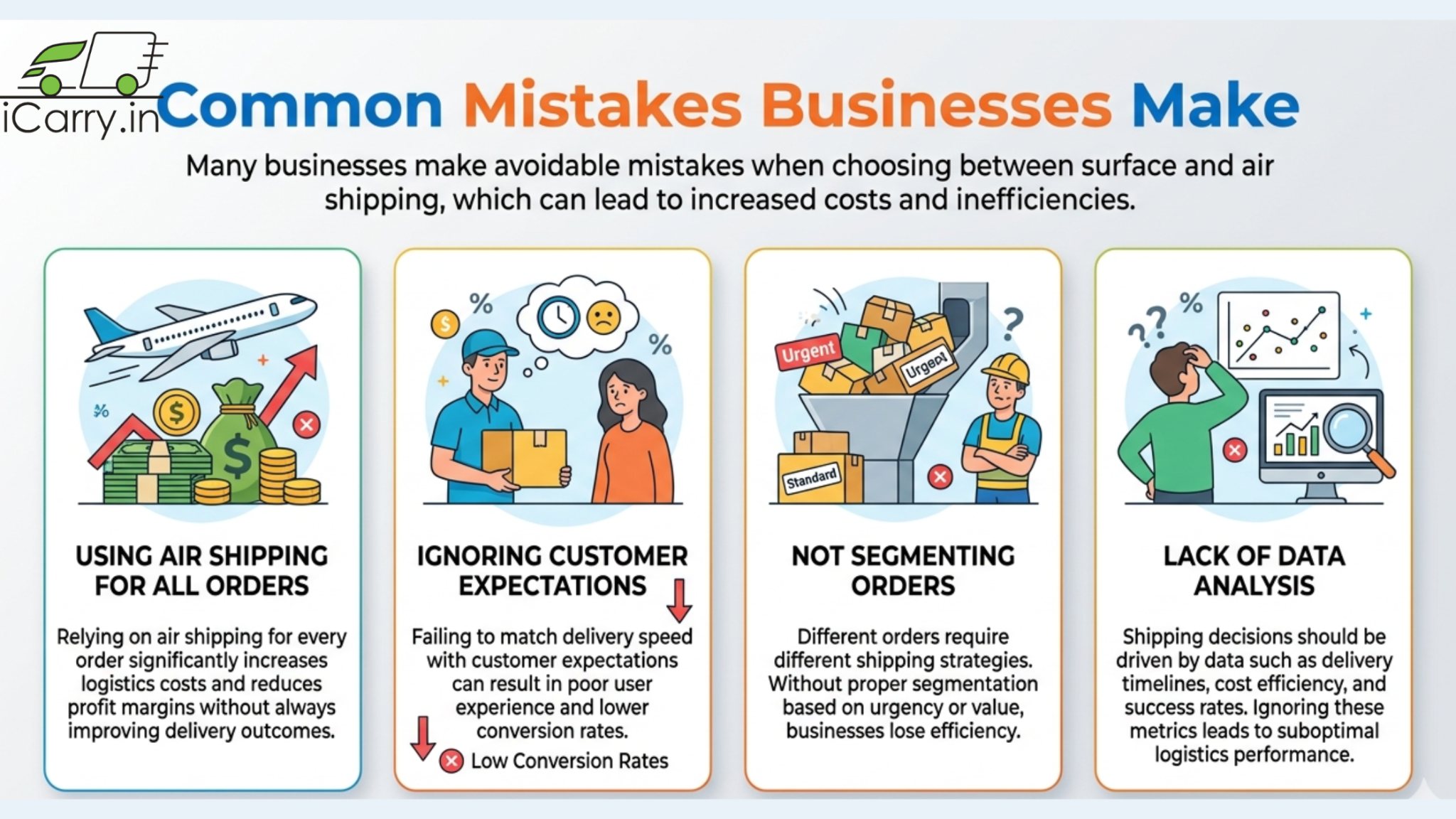
Many businesses make avoidable mistakes when choosing between surface and air shipping, which can lead to increased costs and inefficiencies.
1. Using Air Shipping for All Orders
Relying on air shipping for every order significantly increases logistics costs and reduces profit margins without always improving delivery outcomes.
2. Ignoring Customer Expectations
Failing to match delivery speed with customer expectations can result in poor user experience and lower conversion rates.
3. Not Segmenting Orders
Different orders require different shipping strategies. Without proper segmentation based on urgency or value, businesses lose efficiency.
4. Lack of Data Analysis
Shipping decisions should be driven by data such as delivery timelines, cost efficiency, and success rates. Ignoring these metrics leads to suboptimal logistics performance.
How to Choose the Right Mode Every Time
To improve shipping efficiency and optimize logistics costs, businesses should follow structured and data-driven strategies.
1. Segment Orders by Priority
Categorize orders into standard and express shipments to apply the most suitable shipping method.
2. Use Multi-Courier Platforms
Use platforms that automatically pick the best courier and shipping mode based on cost, speed, and serviceability - using intelligent courier allocation systems.
3. Optimize Inventory Placement
Distributing inventory across regional warehouses reduces reliance on air shipping and improves delivery timelines.
4. Offer Shipping Options to Customers
Providing both standard and express delivery options enhances flexibility and improves overall customer satisfaction.
Key Numbers Indian Sellers Should Know
Shipping mode optimization plays a crucial role in improving logistics efficiency, reducing costs, and enhancing delivery performance. Businesses that leverage data-driven decision-making can significantly improve both operational efficiency and customer experience.
| Metric | Insight |
|---|---|
| Surface shipping usage | 60-80% of orders |
| Air shipping cost increase | 1.5x-3x |
| Delivery speed improvement | 30-50% faster |
Optimizing shipping modes can reduce logistics costs by 10-20%. Global eCommerce research shows that efficient logistics and transportation strategies are critical for scaling online businesses.
Conclusion
Surface or air - the answer isn't always one or the other. The right choice depends on your order type, your customer's expectations, and your margins.
Most sellers who get this right use a data-driven hybrid model - surface for most orders, air where speed is non-negotiable.
Get this split right and you can cut logistics costs by 10-20% without sacrificing delivery quality. That's the real balance between cost optimization and delivery performance.
Stop Guessing. Start Shipping Smarter with iCarry®
The right shipping mode decision starts with data - costs, delivery times, courier performance. iCarry® gives you all of that in one place, so you stop overpaying for air shipping and start routing smarter. Businesses that use data-driven logistics tools can optimize shipping decisions and improve overall efficiency by leveraging advanced logistics technologies.
Ready to cut shipping costs by up to 20%? Try iCarry® today - free setup, no lock-in.
Frequently Asked Questions (FAQs)
What is surface shipping in India?
Surface shipping refers to transporting goods via road or rail networks, offering a cost-effective but slower delivery option.
What is air shipping in logistics?
Air shipping involves transporting goods via aircraft, providing faster delivery but at a higher cost.
Which is cheaper: surface or air shipping?
Surface shipping is significantly cheaper than air shipping and is widely used for standard deliveries.
When should businesses use air shipping?
Air shipping is ideal for urgent, high-value, or time-sensitive deliveries.
Can businesses use both shipping methods?
Yes, most eCommerce businesses use a hybrid strategy combining surface and air shipping.
How much faster is air shipping compared to the surface?
Air shipping is typically 30-50% faster than surface shipping, depending on the route and courier network.
Surface shipping (road/rail, lower cost, 3-7 day delivery) and air shipping (faster, 1.5x-3x more expensive, 1-3 day delivery) each serve different order types - most D2C brands route 60-80% of orders via surface and reserve air for urgent or high-value shipments, cutting logistics costs by 10-20% through a data-driven hybrid approach.