
Introduction
A furniture brand in Jodhpur fulfills a sofa order to a buyer in Pune. A home decor brand in Jaipur ships a large wall mirror to a customer in Hyderabad. An office furniture distributor in Delhi dispatches a conference table to a client in Kochi. An industrial shelving manufacturer needs to move 50 units to a warehouse in Chennai.
Furniture and large item shipping in India is one of the most operationally complex logistics challenges a business can face. Extreme volumetric weight, multi-point handling damage risk, Out of Delivery Area surcharges on residential pincodes, and carrier limitations on oversized dimensions all combine to make each large-item shipment a decision that requires more thought than a standard parcel.
India's home furniture market is worth USD 15.80 billion and is projected to reach USD 33.80 billion by 2033 (IMARC Group, India Home Furniture Market Report), driven by rising homeownership and the shift to organised retail and eCommerce - businesses that can ship furniture and large items reliably and cost-effectively have a significant market advantage. This guide covers exactly how to do it.
What Is Furniture and Large Item Shipping in India?
Furniture and large item shipping in India means managing extreme volumetric weight, Out of Delivery Area (ODA) surcharges on residential pincodes, multi-point handling damage risk, and carrier dimension limits - all at once, on every shipment. Getting it right requires choosing the correct freight mode, packaging for repeated handling, and documenting conditions before every handover so damage claims hold up.
How to Check If You're Ready to Ship a Large Item
- Have you calculated the volumetric weight of the packaged item and compared it to actual weight?
- Have you checked whether the destination pincode attracts an ODA surcharge from your chosen carrier?
- Is your packaging capable of surviving multiple handling points - forklift loading, warehouse stacking, transit vehicle movement?
- Have you documented the item condition with photographs before packaging and before handover?
- Have you declared the correct value for insurance purposes?
- Do you know the carrier's maximum weight and dimension limits before booking?
The Core Challenge: Volumetric Weight on Large Items
Standard couriers bill based on whichever is higher - actual weight or volumetric weight. For furniture and large items, volumetric weight almost always dominates, often massively exceeding actual weight.
Volumetric weight formula: L x B x H (in cm) / 5,000
Examples:
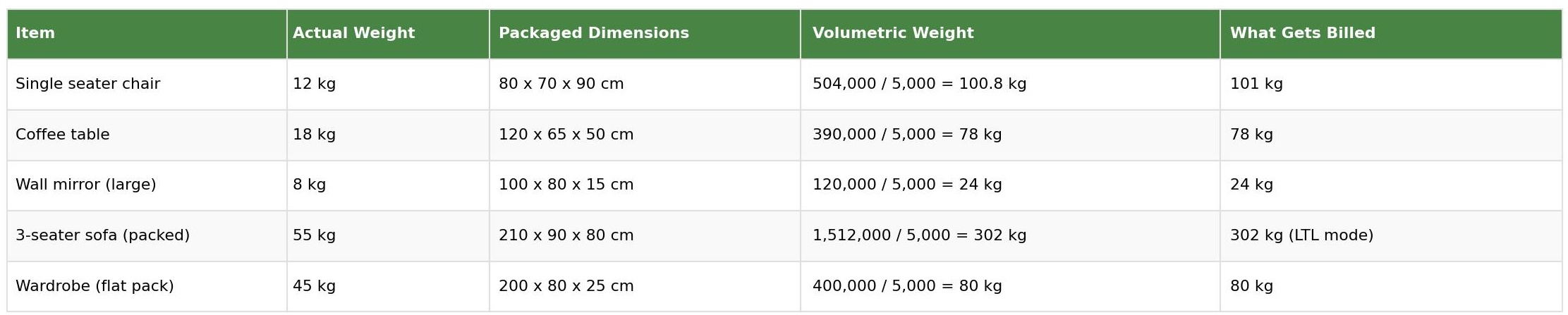
A 12 kg chair billed at over 100 kg, a 45 kg wardrobe billed at 80 kg. These numbers are not errors - they are how freight pricing works for large items. Understanding this before setting your product prices is the difference between profitable shipping and selling at a loss.
ODA Surcharges: The Hidden Cost of Residential Delivery
Out of Delivery Area (ODA) surcharges apply when the destination pincode falls outside a carrier's standard service area. For large items in particular, ODA surcharges are especially common because most carriers' standard serviceability networks cover commercial and hub pincodes more reliably than residential addresses in Tier 2 and smaller cities.
For furniture and large items shipped to residential customers across India, ODA charges are one of the most common hidden shipping costs that appear on invoices without advance warning. Always check ODA applicability for the destination pincode before quoting shipping cost to the customer.

Courier vs Surface Freight vs LTL - Which Mode for Large Items?
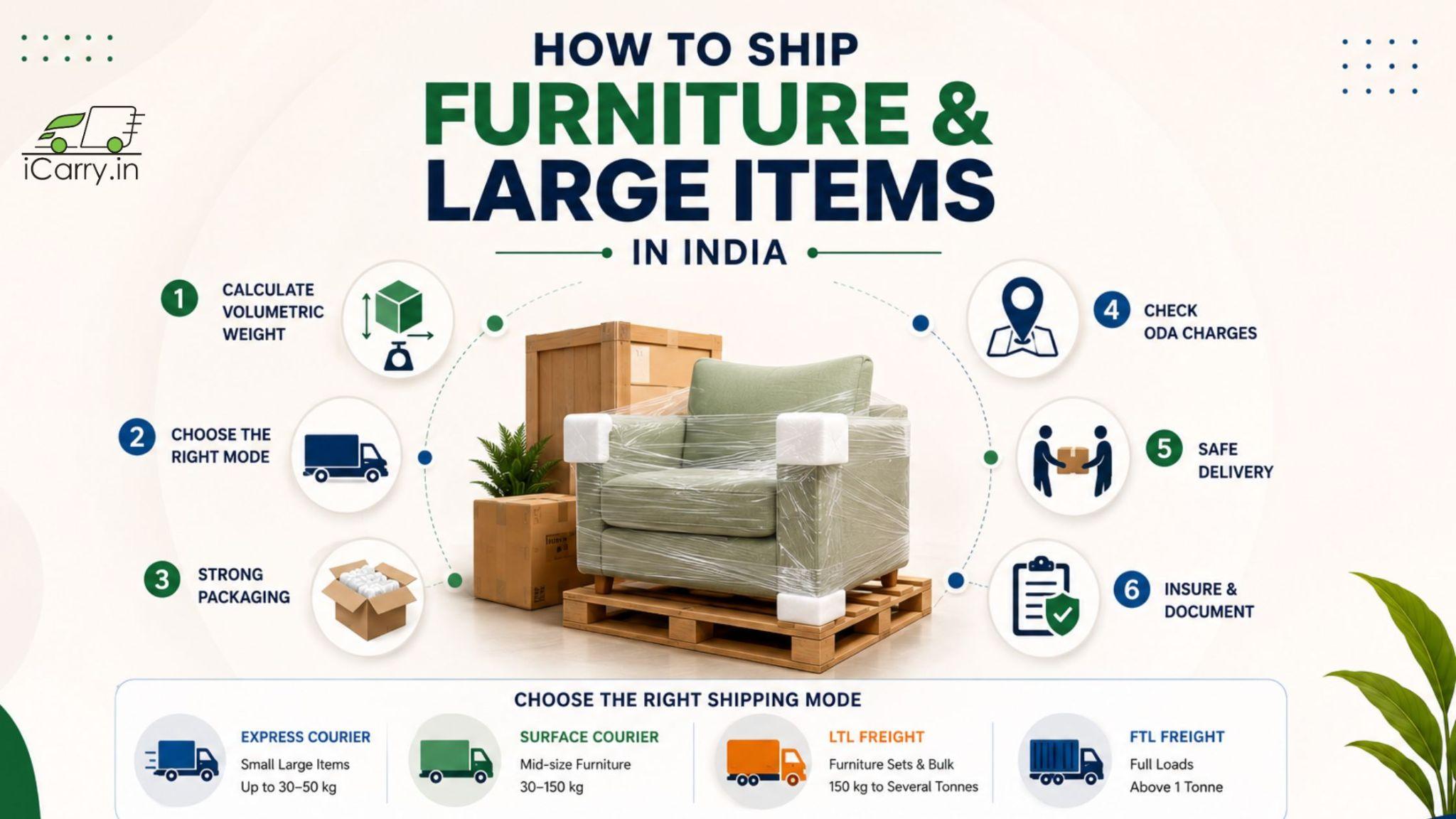
Not all large items should go through the same mode. The right choice depends on weight, dimensions, destination, and urgency.

For most furniture and home decor businesses, the right mode depends on order size. A single accent chair shipped to one customer is a surface courier docket. A five-piece dining set is LTL. A B2B order of 50 units to a retailer is LTL or FTL depending on weight. Using courier mode for LTL-appropriate shipments significantly overpays per kg; using LTL for a single small item adds unnecessary complexity.
Compare rates across modes before committing to any booking. iCarry®'s rate calculator shows available options and rates for your specific dimensions, weight, and pincode.
Packaging Large Items for Safe Transit in India
Furniture and large items go through more handling points and more physical stress during transit than standard parcels. A sofa that travels from Jodhpur to Pune passes through origin hub sorting, line haul vehicle loading, transit hub re-sorting, destination hub processing, and last-mile loading - each handling point a damage risk.
Packaging Layers for Large Items
First layer - product protection: Bubble wrap, foam sheets, or stretch wrap directly on the furniture surface. Cover all protruding corners, legs, and edges. Fabric furniture needs plastic sheeting before bubble wrap to prevent moisture contact
Second layer - structural support: Cardboard corner protectors or L-profiles on all corners and edges. For glass elements (tabletops, mirrors, cabinet doors), foam-padded plywood boards on both faces
Outer layer - transit packaging: Heavy-duty 5-ply corrugated for items up to 30 kg. For heavier items, wooden crating or pallet-mounting provides the structural integrity that corrugated alone cannot
Internal fill: No movement inside the outer packaging. Foam inserts, air cushions, or crumpled paper fill voids completely. An item that shifts during transit will damage itself against the packaging walls
External marking: FRAGILE, THIS SIDE UP, and DO NOT STACK markings in large text on all sides. While not guaranteed to be respected by all handlers, they reduce casual mishandling at some points in the chain
Special Packaging for Glass and Mirrors
Glass items - mirrors, glass tabletops, cabinet doors - require specific treatment:
Apply masking tape in a star pattern across the glass face before any other packaging. If the glass cracks in transit, the tape holds the shards together
Foam-padded plywood boards on both faces, larger than the glass by at least 5 cm on all sides
Wooden frame or crate as outer packaging - corrugated is not sufficient for large glass items
Mark GLASS - HANDLE WITH CARE on all faces of the outer crate
Flat Pack vs Assembled
Furniture that can be shipped flat-packed is significantly easier and cheaper to package and ship than fully assembled furniture. Flat-packed dimensions are smaller, actual weight per carton is lower (split across multiple cartons), and damage risk is lower because individual components are easier to protect than assembled structures with joints and protrusions.
If your product can reasonably be delivered flat-packed with clear assembly instructions, this significantly improves your unit economics on shipping versus shipping assembled.
Declaring Value and Arranging Insurance
For large items with high declared values - premium furniture, custom pieces, imported goods - standard courier liability limits are often insufficient to cover the full replacement value in the event of loss or damage.
Standard courier liability in India is typically limited to a fixed amount per kg or a percentage of declared value - often far below the actual product value. For furniture items valued above ₹10,000, explicitly arranging cargo insurance coverage either through the carrier at booking or through a third-party insurer is strongly recommended.
Document the following before every large item shipment:
Photographs of the item in undamaged condition before packaging
Photographs of the item mid-packaging showing the protection layers
Photographs of the fully sealed outer packaging before handover
Weight on a scale with the packaging visible
Measurement of all three dimensions of the packaged item
This documentation set is your evidence for any damage claim. Without pre-handover photographs, damage claims are extremely difficult to substantiate - the carrier will dispute that damage occurred in transit rather than before pickup.
How to File a Damage Claim for Large Shipments in India
Despite good packaging, damage does occur - particularly for glass, fragile finishes, and complex assembled furniture. When it does:
Step 1: Customer must note damage at the time of delivery - on the delivery challan or through an immediate written record. Damage reported more than 24 to 48 hours after delivery is significantly harder to claim
Step 2: Customer photographs all damage - outer packaging condition, inner packaging condition, and damaged item - before moving or using the item
Step 3: Seller opens a formal damage claim with the carrier within the carrier's claim window - typically 3 to 7 days from delivery date
Step 4: Claim is submitted with: original booking details, declared value, pre-shipment photographs, delivery photographs, customer's damage report
Step 5: Carrier investigates and responds. Resolution can take 15 to 45 days depending on carrier and claim complexity
For businesses shipping large items at volume, a standardised claim documentation process - including customer instructions on unboxing video recording and immediate damage reporting - significantly improves claim success rates.
ODA and Serviceability Check Before Accepting Orders
Furniture businesses that accept orders from any pincode without checking serviceability and ODA status regularly face two problems: informing the customer after order placement that delivery is not possible to their area, and discovering ODA charges on invoices that were not factored into product pricing.
The right approach is to build a pincode serviceability check into your order process before the customer completes purchase. For each available courier and mode, check:
Is the pincode serviceable by at least one carrier for large items?
Does the pincode attract an ODA surcharge, and if so, how much?
What is the estimated transit time for this pincode?
iCarry®'s pincode serviceability check covers 29,000+ pincodes across India. Before accepting any furniture order, checking the destination pincode against available couriers and ODA status prevents both the customer disappointment of post-order cancellation and the invoice surprise of undisclosed ODA charges.
Courier Partners Available for Large Item Shipping Through iCarry®
iCarry® is a courier aggregator that gives Indian businesses access to multiple courier and surface freight partners - relevant for large item shipping across different weight and dimension categories:
Delhivery: Strong pan-India surface coverage including B2B LTL for larger furniture consignments
Blue Dart: Best for high-value premium furniture and large items where carrier accountability and POD reliability matter more than rate
Ekart: Competitive for South India large item delivery
DTDC: Deep Tier 2 and Tier 3 coverage for furniture brands with customers in smaller cities
For large item shipments, multi-courier allocation - routing each order to the best available carrier for that specific pincode and weight - ensures you are not paying express rates for shipments that could move on more cost-effective surface mode.
Track all active large item shipments across all carriers in one view - watch Overview of My Account > My Shipments.
Delivery Coordination for Large Item Shipments
Large item delivery has specific challenges that standard parcel delivery does not. The customer needs to be physically present. They often need to arrange for help unloading. High-rise buildings may require advance coordination with building management. Industrial and office deliveries have receiving hours and designated access points.
This makes pre-delivery customer coordination especially important for furniture and large item shipments. iCarry®'s two-way WhatsApp communication allows the coordination team to reach the consignee before delivery and confirm:
Availability at the delivery address on the expected date
Any access requirements - building entry, floor level, elevator availability
Whether unloading assistance is arranged
Preferred delivery window if the customer needs to schedule around the delivery
All communication between iCarry®'s team and the consignee is logged and visible to the sender. Failed deliveries on large items are particularly expensive - the re-attempt window for an oversize shipment at a residential address is often very narrow, and a second failed attempt frequently results in costly return freight.
Pricing Your Shipping for Large Items
Large item shipping costs are high enough that absorbing them into product prices is not always feasible. Businesses have three approaches:
Add actual shipping cost to the order: Most transparent for the customer. Use a pincode-based shipping calculator at checkout to show the actual cost before the customer confirms. Some buyers abandon here, but those who complete have realistic expectations
Flat-rate shipping above a threshold: A fixed shipping fee regardless of pincode. Simple for customers but means you overpay on shorter routes and underpay on longer ones. Works best when your customer geography is geographically concentrated
Free shipping: Build shipping cost into product pricing. Works for premium furniture where the customer expects delivery included, but requires very accurate cost modelling per zone to avoid margin erosion on long-haul orders
Whichever approach you use, model your actual fully-loaded shipping cost per order - including volumetric weight, ODA surcharge, insurance, and packaging material cost - before setting prices. The gap between headline courier rate and true per-order delivery cost is wider for large items than for any other product category.
Final Thoughts
Furniture and large item shipping in India is demanding - volumetric weight billing, ODA surcharges, packaging complexity, and the high cost of damage claims all require more operational attention than standard parcel shipping. The businesses that manage it profitably invest in the right packaging from day one, check ODA status before accepting orders, use the right freight mode for each shipment size, and document every handover for damage claim protection.
The returns and RTO economics of large items are particularly punishing. A returned sofa costs more in reverse freight than a returned T-shirt costs in ten reverse shipments. Every preventable return and every preventable damage claim recovered has an outsized impact on unit economics for this category.
iCarry® supports large item and furniture businesses with multi-carrier rate comparison, ODA surcharge visibility, delivery coordination tools, and weight discrepancy dispute management. Register at iCarry - free plan, no minimum volume.
Frequently Asked Questions (FAQs)
How is furniture shipping cost calculated in India?
Furniture shipping is billed on chargeable weight - whichever is higher between actual weight and volumetric weight (L x B x H in cm divided by 5,000). For most furniture, volumetric weight significantly exceeds actual weight. A 12 kg chair in an 80 x 70 x 90 cm package has a volumetric weight of over 100 kg and bills at volumetric rate.
What is an ODA surcharge and does it apply to furniture delivery?
ODA (Out of Delivery Area) surcharges apply when the destination pincode falls outside a carrier's standard service network. For furniture delivered to residential addresses - especially in Tier 2 cities or newer developments - ODA surcharges are common and typically range from ₹100 to ₹500 per consignment. Always check before accepting an order.
Which carrier is best for shipping furniture across India?
Delhivery's surface network is strong for pan-India furniture delivery including LTL for larger items. Blue Dart is best for high-value furniture where delivery accountability and POD matter most. DTDC covers deep Tier 2 and Tier 3 pincodes. The right choice depends on item size, destination, and priority.
How should furniture be packaged for courier delivery in India?
Bubble wrap all surfaces including corners and legs. Add cardboard corner protectors. Use 5-ply corrugated outer packaging for items up to 30 kg; wooden crating for heavier or higher-value items. Fill all internal voids to prevent movement. Mark FRAGILE and DO NOT STACK on all faces. Photograph the item before packaging, mid-packaging, and after sealing.
How do I file a damage claim for a furniture shipment in India?
The customer must note damage at delivery and photograph it immediately - including outer packaging, inner packaging, and item condition. The seller then opens a formal claim with the carrier within 3 to 7 days of delivery, submitting pre-shipment photographs, declared value, booking details, and the customer's damage evidence. Pre-handover photographs are essential for any successful claim.
Does iCarry® support large item and furniture shipping?
Yes. iCarry® provides access to multiple carrier partners including Delhivery surface freight and B2B LTL alongside express options, with ODA surcharge visibility and pincode serviceability check before booking. Delivery coordination via two-way WhatsApp communication helps manage the pre-delivery coordination that large item delivery requires.
Furniture and large item shipping in India is demanding - volumetric weight billing, ODA surcharges, packaging complexity, and the high cost of damage claims all require more operational attention than standard parcel shipping. The businesses that manage it profitably invest in the right packaging from day one, check ODA status before accepting orders, use the right freight mode for each shipment size, and document every handover for damage claim protection.