
Why Shipment Insurance Matters
A ₹4,500 order goes missing in transit. Without any cover, the courier's standard liability may return only a small fraction of that amount, and the seller absorbs the rest along with the freight and the lost customer. Across hundreds of shipments, that gap becomes a regular drain on margin.
Loss, damage and theft are a small percentage of parcels but a large share of cost for sellers who ship high-value or fragile goods. As Indian eCommerce volumes grow, understanding what protects you, and what does not, is a basic part of running a shipping operation.
What Is Shipment Insurance for eCommerce in India?
Shipment insurance is cover that pays you when a parcel is lost, stolen or damaged in transit. In India it comes in two main forms: declared value coverage bought from the courier at booking, and a transit (marine cargo) insurance policy bought from an insurer. Without either, the courier's default liability is usually far below the invoice value.
Courier Liability - What You Get by Default
Every courier limits its liability for loss or damage. In most standard courier terms, compensation without extra cover is capped at a small fixed amount or a low multiple of the freight charge, not the product value.
- Default liability is usually far lower than the invoice value of the goods
- Liability depends on the courier's terms and on how the shipment was booked
- Consequential loss such as lost sales or customer compensation is typically excluded
- Claims need proof that the shipment was handed over, was lost or damaged, and had the declared contents
Practical point: Do not assume the courier will pay the invoice value. Check the liability terms on your rate card or booking terms before dispatching valuable orders.
Types of Cover Available to eCommerce Sellers
1. Declared Value Coverage
You declare the value of the goods at booking and pay a fee, typically a small percentage of declared value. If the shipment is lost or damaged, the courier's liability extends up to the declared value, subject to their terms and proof.
- Simplest option for most sellers because it is arranged at booking
- Typical cost is around 0.5% to 1.5% of declared value, depending on the courier and goods
- Declare the true invoice value. A claim is paid against what you declared, not what the goods were worth
Add declared value coverage when you book with a iCarry® account, so a loss is paid against the real value.
2. Transit or Marine Cargo Insurance
An insurance policy from an insurer, covering goods against loss or damage while in transit. Sellers with high volumes or high-value goods often buy a policy covering all shipments over a year.
- Can offer wider cover and higher limits than courier liability
- Choose the clause carefully: Inland Transit Clause A covers all risks subject to exclusions, B covers named perils and C covers only fire and lightning, so pick A for fragile or high-value goods
- Premium is a small percentage of insured value and varies by goods, route and claims history
- Claims go through the insurer, so keep documents ready: invoice, proof of dispatch, courier report. If an insurer delays or rejects a valid claim, you can complain on the IRDAI Bima Bharosa portal
3. Stock and Warehouse Insurance
Covers inventory in your warehouse or fulfilment centre against fire, theft, flood and similar risks. It does not cover goods once they are with the courier, so it complements, not replaces, transit cover.
4. Marketplace and Platform Protection
Some marketplaces offer seller protection for specific loss scenarios, under their own terms. Read the conditions carefully. Protection often applies only when you use the platform's logistics or follow specific procedures.
What Is Usually Covered and What Is Not
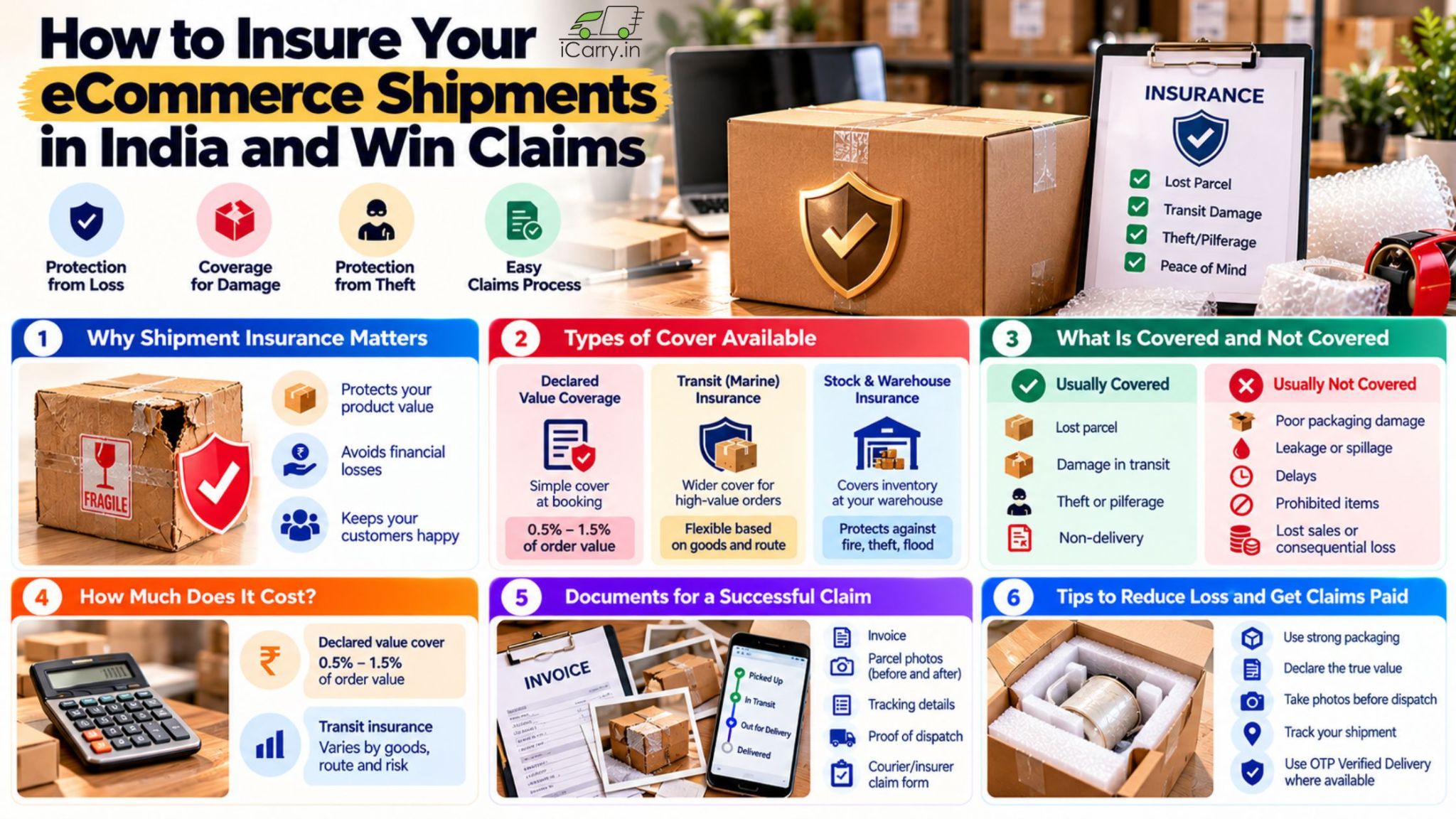
Typically covered: Loss of the entire parcel, damage in transit that is not caused by poor packaging, theft or pilferage, and non-delivery with no tracking after the claim window.
Typically excluded: Damage caused by inadequate packing, natural wear or leakage from improper sealing, prohibited or restricted items, undeclared contents, delays, and consequential loss. Some categories, such as gold jewellery, cash and certain valuables, may be excluded by the courier or the insurer..
How Much Does Insurance Cost?
- Declared value coverage: Around 0.5% to 1.5% of declared value. On a ₹5,000 order, roughly ₹25 to ₹75
- Transit insurance policy: Premiums vary by insurer and risk. Compare quotes for your shipping volume and product type
- Compare to loss cost: If 1 in 200 parcels is lost and the average order is ₹5,000, expected loss is ₹25 per shipment. At 0.5% a ₹5,000 order costs about ₹25 to cover, which only matches that expected loss, and at 1.5% (₹75) cover costs more. Cover pays off when your loss rate is higher, the goods are fragile or high-value, or one loss would hurt your margin. Add the cost of dealing with claims to your own comparison
Rule of thumb: Enable cover on shipments above ₹2,000 on routes where you have seen losses and on all fragile or high-value categories. For low-value orders, the cost of cover may exceed the risk, so many sellers self-insure small orders.
Example: Checking Transit Loss Insurance During Shipment Booking
Suppose you are shipping a product worth ₹10,000 from Mumbai to Bengaluru. While comparing available courier options on iCarry®, you can review the shipping charges and check whether Transit Loss Insurance is available for your selected courier.
As shown in the example below, the booking screen displays the additional insurance fee and the coverage details before you confirm your shipment. You can review the information and decide whether to opt for the insurance based on your product value and shipping requirements.
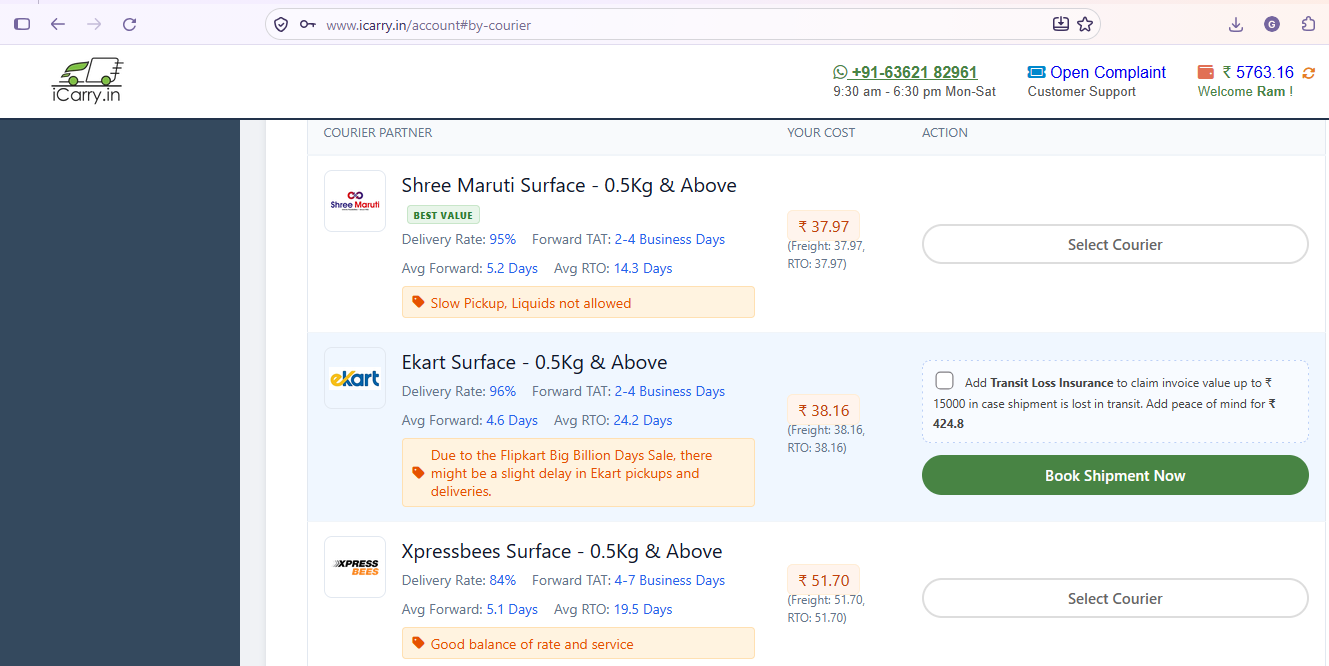
Tip: Always check the applicable insurance fee, coverage limit, and terms displayed during booking before making your decision.
To see how to book a domestic shipment and select Transit Loss Insurance, watch our domestic shipment booking video.
How to File a Claim That Gets Paid
- Check the claim window: Domestic damage claims are usually time-limited, often within 7 to 15 days of delivery, and loss claims within a set period from dispatch. Missing the window ends the claim
- Report damage immediately: Photograph the outer box and contents before moving anything and note damage on the proof of delivery where possible
- Send complete evidence: Invoice, pre-dispatch photographs, weight record, signed manifest, tracking history, damage photographs and, where relevant, unboxing video
- Follow up in writing: Keep ticket numbers and replies. Escalate if the first level does not respond within the committed time
- Match claim to declared value: Claim only up to the declared value, with invoice support
Reduce Claims Before They Happen
- Pack correctly for the product type. Poor packaging is the most common reason claims are rejected
- Photograph high-value parcels before sealing, with the label and weight visible
- Get a signed pickup manifest for every handover
- Monitor tracking in the first 48 hours and raise a trace request quickly if there is no scan
- Use better handling for valuable goods, such as express couriers and OTP verified delivery
Compare courier rates and cover options for your order value with the iCarry® domestic rate calculator.
How iCarry® Supports Shipment Protection
iCarry® is a courier aggregator that gives sellers access to multiple courier partners and shipment management tools to help manage shipping risks.
- Transit Loss Insurance at Booking: During booking, you can choose to add Transit Loss Insurance for eligible shipments. The applicable fee and coverage details are displayed before you confirm the booking, so you can review the additional cost before proceeding.
- Shipment Tracking and Support: Track shipments using their AWB details and raise support tickets for shipment-related issues, helping you maintain a record for follow-up.
- OTP Verified Delivery: OTP verification helps confirm receipt by the intended recipient and provides a verifiable delivery record.
- Multiple Courier Partners: Compare available courier options based on destination, serviceability, and shipping cost to make informed booking decisions.
Start with the free Bronze plan, with no minimum shipment volume.
Frequently Asked Questions (FAQs)
Does the courier pay the full value if my parcel is lost?
Not by default. Standard courier liability is usually capped at a small amount, far below the invoice value. To protect the full value, enable declared value coverage at booking, or buy a transit insurance policy, and declare the true invoice value.
How much does declared value coverage cost?
Typically around 0.5% to 1.5% of the declared value, depending on the courier and the type of goods. On a ₹5,000 order that is roughly ₹25 to ₹75. Always compare the fee with the cost of an uncovered loss before deciding.
What evidence do I need to file a shipment claim?
The invoice, pre-dispatch photographs with label and weight visible, a signed pickup manifest, tracking history, photographs of the damage, and an unboxing video where possible. Claims with strong evidence and filed within the claim window are far more likely to be paid.
Is transit insurance better than declared value coverage?
It depends on volume and value. Declared value coverage is simple and arranged at booking. A transit insurance policy can offer wider cover and higher limits for high-volume or high-value sellers but needs a separate purchase and claims process. Many sellers use declared value coverage for everyday orders and a policy for high-value goods.
A courier's default liability is almost never the invoice value, so the gap between the two is yours to cover. Declare the true invoice value for declared value coverage at booking (around 0.5% to 1.5%), consider a transit insurance policy for high-volume or high-value goods, and keep your claim evidence ready: invoice, pre-dispatch photographs, signed manifest and tracking history. Pack correctly, since poor packaging is the most common reason claims are rejected, and file within the claim window.