An electronics brand ships 50 power bank orders via an express courier. The courier accepts the booking. Two days later, all 50 shipments were returned. Reason: the power banks contain lithium ion batteries above the Watt-hour threshold permitted for air freight without prior dangerous goods approval. The courier's screening caught what the seller's booking did not declare.
The seller re-ships via surface freight. The orders arrive 18 days late. Three customers cancel. The business absorbs the freight cost twice.
Lithium batteries - in phones, laptops, power banks, e-cigarettes, electric mobility accessories, and thousands of other consumer electronics - are classified as dangerous goods for shipping purposes. India's rapidly growing consumer electronics market means millions of lithium battery-containing products are shipped every day. Most are shipped without the shipper giving any thought to battery regulations. Many are shipped in violation of domestic and international dangerous goods rules - creating fire risk, liability exposure, and the kind of courier rejection that disrupts business operations without warning.
This guide covers what Indian businesses need to know about lithium battery shipping regulations for domestic and international courier shipments.
What Are Lithium Battery Shipping Regulations in India?
Lithium battery shipping regulations are the rules that govern how products with lithium ion or lithium metal batteries can be packaged, declared, and transported by courier or air freight. In India, they combine IATA's international Dangerous Goods Regulations with individual courier policies and DGCA oversight for air cargo. They cover battery type, Watt-hour rating, packaging, labelling, and declaration at booking - get any of these wrong and a shipment can be rejected, seized, or fined.
How to Check If You're Ready to Ship a Lithium Battery Product
- Do you know whether your product contains a lithium ion or lithium metal battery?
- Do you know the Watt-hour (Wh) rating of the battery in your product?
- For international shipments: have you checked whether your courier allows lithium battery shipments to the destination country?
- Is the battery charge level set to 30% or below for air freight (as required by IATA)?
- Is the battery terminal protected from short circuits?
- Have you declared the lithium battery content to the courier at booking?
- Does your packaging protect against battery damage that could cause thermal runaway?
Lithium Ion vs Lithium Metal - The Critical Distinction
Regulations differ significantly between the two primary types of lithium batteries. Misidentifying your battery type is one of the most common compliance errors:

Key practical point: The rechargeable battery in your phone, laptop, or power bank is almost certainly lithium ion. The small flat coin cell in a watch, calculator, or key fob is almost certainly lithium metal. The regulations for lithium metal are stricter than for lithium ion in most courier and air freight contexts.
The Watt-Hour Rating - Why It Determines What You Can Ship
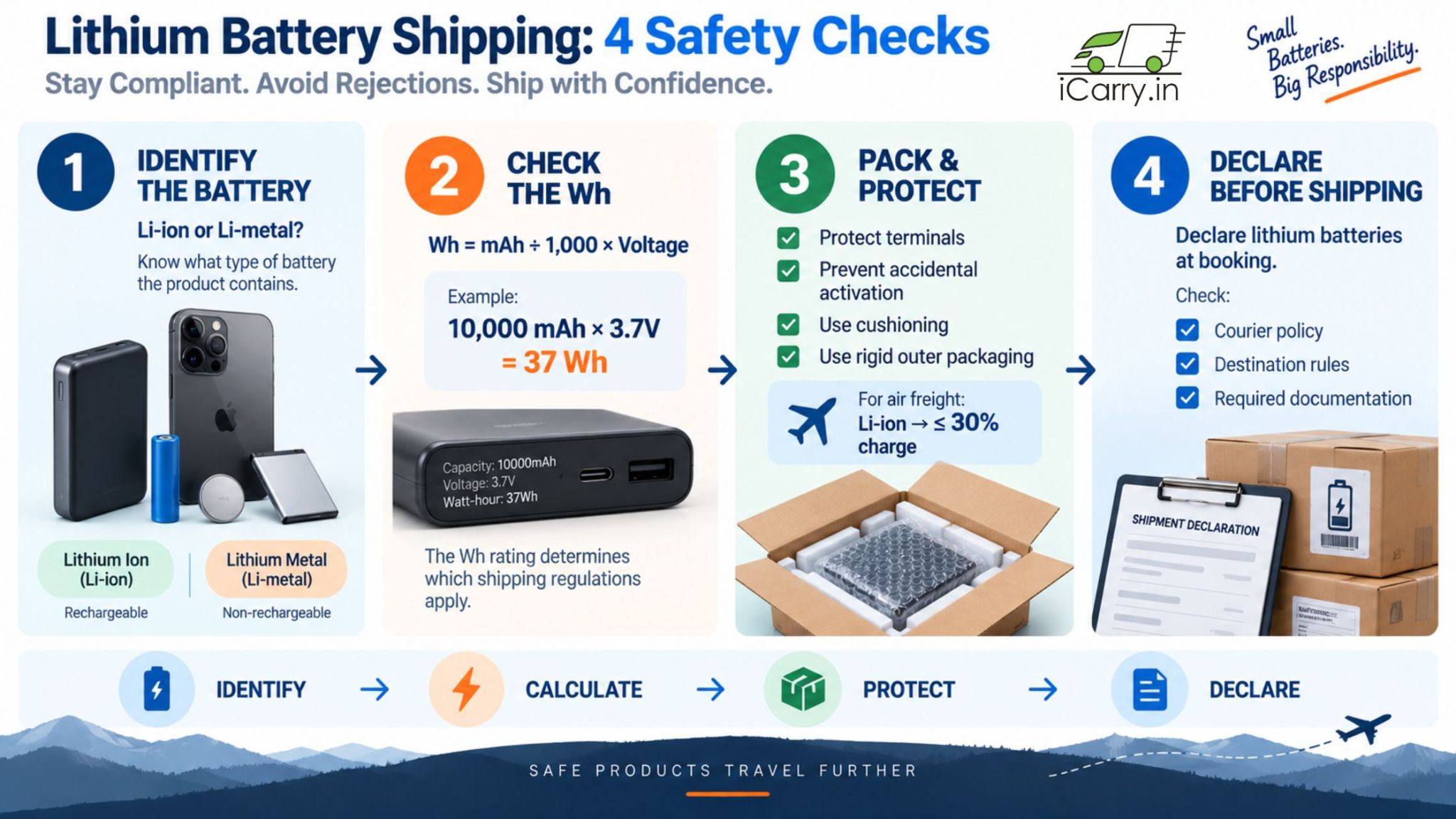
The Watt-hour (Wh) rating of a lithium ion battery is the key number that determines which shipping regulations apply. It is calculated as:
Wh = Battery capacity (mAh) / 1,000 x Nominal voltage (V)
Examples:
- A 10,000 mAh / 3.7V power bank: 10,000 / 1,000 x 3.7 = 37 Wh
- A 5,000 mAh / 3.85V phone battery: 5,000 / 1,000 x 3.85 = 19.25 Wh
- A 100 Wh laptop battery: 100 Wh (usually marked on the battery itself)
The Wh rating determines the applicable IATA (International Air Transport Association) regulations and most courier policies for both domestic and international air freight.
IATA Regulations - The International Framework
IATA's Dangerous Goods Regulations (DGR) are the primary international framework for lithium battery air shipments. Indian courier companies and airlines follow IATA DGR for international shipments. Many apply similar rules domestically for air-transported parcels.
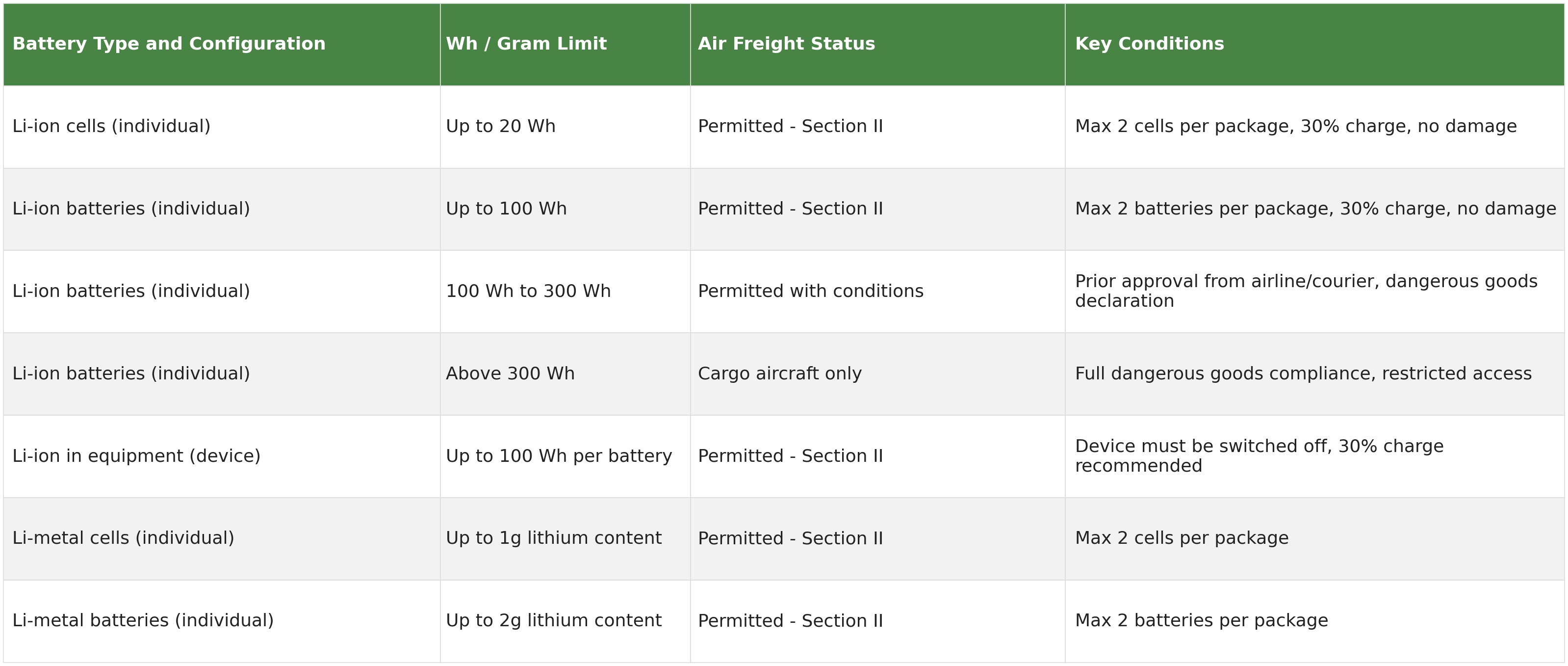
The 30% charge rule: IATA requires lithium ion batteries shipped as cargo (not in devices carried by passengers) to be at or below 30% state of charge. This reduces the energy available in a thermal runaway event. For consumer electronics being shipped as orders, this means batteries should be partially discharged before packaging for air freight.
Domestic Lithium Battery Shipping in India
For domestic courier shipments within India via surface (road) transport, the rules are less restrictive than for air freight:
- Consumer electronics with lithium batteries (phones, laptops, tablets, power banks) can generally be shipped via surface courier without special dangerous goods documentation
- The battery must be installed in the device or securely packaged to prevent short circuit if shipped separately
- Batteries must not be damaged, leaking, or swollen
- Terminals must be protected - tape over exposed terminals or place in individual plastic bags
For domestic air freight (where the parcel travels via air within India), IATA regulations apply to the airline segment. Most domestic express couriers use a combination of air and surface, and apply IATA rules to any parcel that will transit via air. Check with your courier whether lithium battery products require special declaration for domestic air-routed shipments.
International Lithium Battery Shipping
International shipping of lithium battery products - whether via courier or cargo - is significantly more regulated than domestic surface shipping:
Express Courier (FedEx, Aramex via iCarry®)
- Consumer electronics (phones, tablets, laptops) with installed batteries are generally accepted for international shipment when batteries are within IATA Section II limits
- Power banks: policies vary by courier and destination. Some couriers do not accept standalone power banks for international shipment. Some accept those below 100 Wh. Always check before booking
- Spare or standalone batteries (not installed in a device): more restricted. Many couriers do not accept spare lithium batteries in consumer quantities for international shipment
- Declaration required: at booking, declare that the shipment contains lithium batteries. Failure to declare is a violation that can result in shipment seizure, fine, and future account restrictions
Destination Country Restrictions
Beyond the courier's own rules, destination countries have import regulations that may restrict or prohibit certain lithium battery products:
- Some countries restrict power bank imports above certain Wh ratings
- E-cigarettes and vaping devices with lithium batteries face specific import restrictions in many countries
- E-bike and electric vehicle batteries face customs classification and import duty issues in most markets
- Always verify destination country import regulations for lithium battery products before accepting international orders
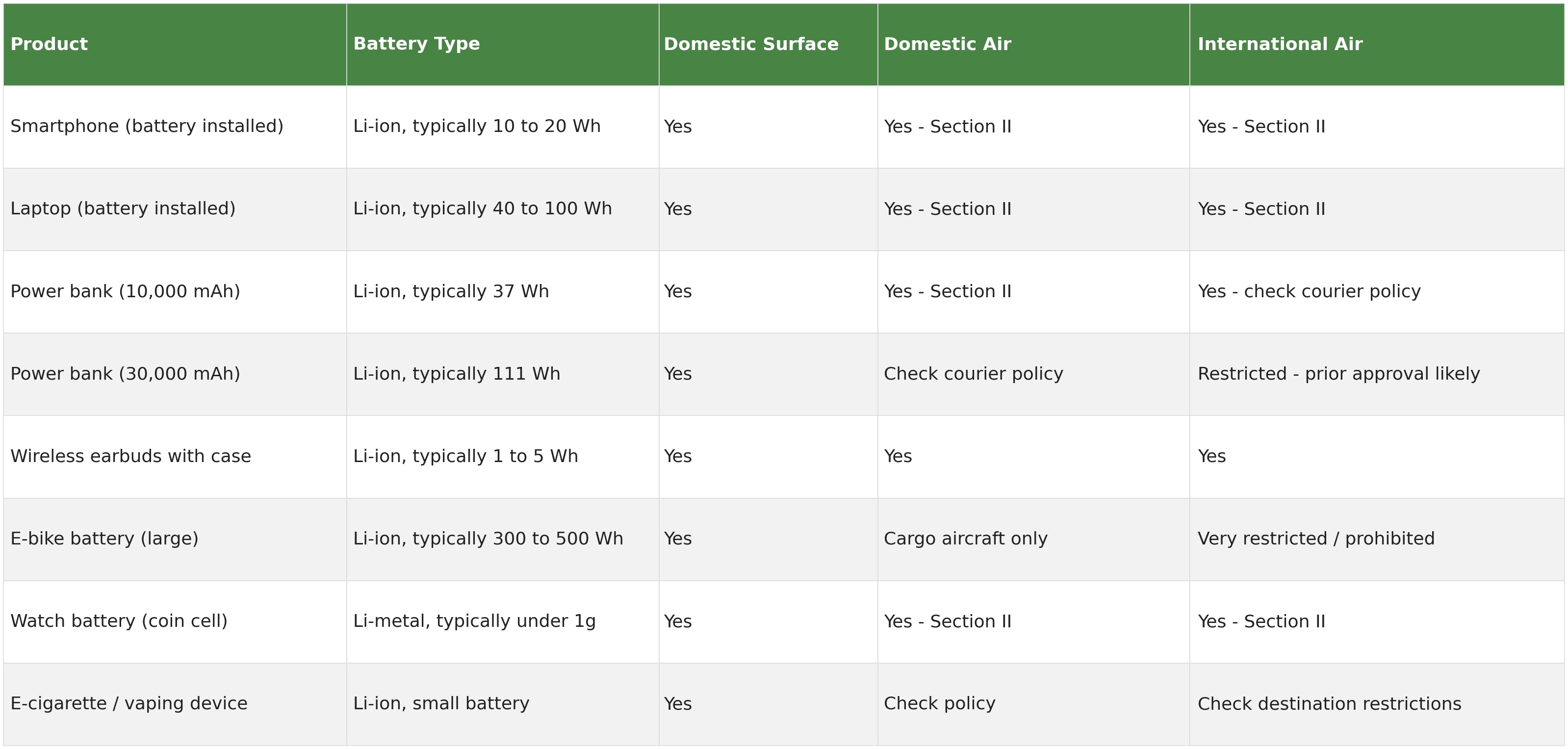
Common Lithium Battery Products and Their Shipping Status
Packaging Requirements for Lithium Battery Shipments
For Products With Batteries Installed
- Device must be switched off and protected against accidental activation - tape power button or use packaging that prevents switch activation
- Anti-static bag around the device before any outer packaging
- Rigid corrugated outer box - no poly mailers for any electronics with lithium batteries
- Adequate cushioning to protect against impact that could damage the battery
- Battery at recommended charge level (30% or below for air freight)
For Standalone or Spare Batteries
- Each battery in an individual sealed plastic bag - prevents terminal contact between batteries
- Tape over all exposed terminals
- No more than two batteries per package for Section II shipments (IATA)
- Corrugated outer with cushioning - batteries must not shift inside the box
- For lithium ion batteries at or below 30% charge before packaging
For Products Shipped With Lithium Batteries (Device + Separate Battery)
- Device and spare batteries must meet separate packaging requirements for each component
- If the total Wh of all batteries in the shipment exceeds Section II limits, different rules apply
- Consult the courier's dangerous goods acceptance criteria for your specific configuration before booking
Labelling Requirements for Lithium Battery Shipments
International lithium battery shipments and some domestic air shipments require specific labelling:
- Lithium battery handling label (Li-ion): The IATA lithium battery mark - a rectangular label with battery and warning symbol. Required for most international air freight lithium battery shipments
- UN number marking: UN3480 (lithium ion batteries alone), UN3481 (lithium ion batteries contained in equipment), UN3090 (lithium metal batteries alone), UN3091 (lithium metal batteries in equipment)
- Shipper's Declaration: For consignments requiring dangerous goods documentation, a completed shipper's dangerous goods declaration form is required. For Section II shipments via courier, this is often simplified to a declaration at booking
Most consumer electronics brands shipping individual consumer orders through courier aggregators operate under Section II exemptions and do not need to apply the full dangerous goods label set. The battery declaration at booking is the key compliance action.
What Happens If You Do Not Declare Lithium Batteries
Undeclared lithium battery shipments are a serious compliance violation:
- Shipment rejection or return at the courier's own screening (as in the introduction scenario)
- Seizure by aviation security if detected at an Indian airport
- Fines from aviation safety authorities (DGCA in India)
- Courier account suspension or permanent blacklisting
- Liability exposure if an undeclared lithium battery shipment causes a fire incident during transit
India's DGCA (Directorate General of Civil Aviation) enforces aviation dangerous goods regulations including lithium battery restrictions. Non-compliance with IATA DGR for air cargo is a regulatory offence in India. Always declare lithium battery content at booking - the compliance requirement is straightforward and the consequences of non-compliance are disproportionate to the effort of declaring correctly.
How iCarry® Handles Lithium Battery Shipments
iCarry® is a courier aggregator that gives Indian electronics and consumer goods businesses access to multiple courier partners for both domestic and international shipments. For lithium battery products:
- Domestic shipments: Surface courier partners handle most consumer electronics with installed batteries without special requirements. Rate comparison across multiple surface and express options before booking
- International courier: FedEx and Aramex access via iCarry® for international shipments. Compare international rates before booking. Declare lithium battery content at booking for all electronics products
- Delivery Boost: For high-value electronics orders, pre-delivery coordination reduces the failed first attempts that are particularly costly given the longer return journey
- Two-way WhatsApp engagement: Keep customers informed and coordinate delivery or pickup through two-way WhatsApp engagement, allowing them to confirm availability, respond to delivery messages, update their address, or reschedule when needed.
- Address Quality Scoring: Check the quality of customer addresses before dispatch to identify incomplete or potentially problematic addresses and reduce avoidable delivery attempts and NDRs, which can be particularly important when serving remote or difficult-to-service locations.
- COD remittance: COD collections are settled automatically, with Early COD options from T+0 allowing businesses to receive COD funds as early as the next day after delivery. This helps businesses maintain cash flow even when serving customers across longer-distance delivery routes.
- Free Bronze plan, no minimum volume.
Final Thoughts
Lithium battery regulations exist because lithium batteries can and do cause fires in transit when damaged, overcharged, or improperly handled. The regulations are not bureaucratic friction - they are the logistics industry's response to real fire incidents on aircraft and in sorting centres.
For most consumer electronics businesses in India, compliance is not complex. Declare the battery content at booking. Set batteries to 30% charge for air freight. Protect terminals. Use appropriate packaging. Do not ship damaged or swollen batteries.
For products near or above the Wh limits - high-capacity power banks, multi-battery kits, EV batteries - consult your courier's dangerous goods team before booking. The additional time investment prevents the shipment rejections, account suspensions, and liability exposures that come from getting it wrong.
Frequently Asked Questions (FAQs)
Can I ship power banks internationally from India?
It depends on the Wh rating. Power banks up to 100 Wh can generally be shipped via international express couriers with proper declaration. Power banks 100 to 300 Wh require prior airline/courier approval. Above 300 Wh, cargo aircraft only. Courier-specific policies also vary - some couriers do not accept standalone power banks at all. Always declare and verify before booking any international power bank shipment.
What is the 30% charge rule for lithium batteries in air freight?
IATA requires lithium ion batteries shipped as cargo (not carried by passengers) to be charged to 30% or below. This reduces the energy available if a thermal runaway event occurs during transit. For consumer electronics orders shipped via air courier, discharge batteries to below 30% before packaging. This rule applies to spare batteries and batteries in devices shipped as freight.
How do I calculate the Watt-hour rating of a lithium battery?
Wh = Battery capacity in mAh divided by 1,000, multiplied by nominal voltage in volts. Example: 10,000 mAh / 3.7V power bank = 10,000 / 1,000 x 3.7 = 37 Wh. The Wh rating is also often printed on the battery itself or in the product specifications. The Wh rating determines which IATA regulation section applies to your shipment.
What happens if I ship lithium batteries without declaring them?
Undeclared lithium battery shipments risk: rejection or return by the courier's screening, seizure by aviation security, fines from India's DGCA, courier account suspension or blacklisting, and serious liability exposure if the undeclared battery causes a fire incident during transit. Always declare lithium battery content at booking - it is a brief disclosure that prevents consequences disproportionate to the effort.
Can I ship smartphones domestically in India via courier?
Yes. Smartphones with installed lithium ion batteries (typically 10 to 20 Wh) can be shipped via surface courier domestically without special dangerous goods documentation. The phone should be switched off, protected against accidental power-on, and in appropriate packaging. For domestic air-routed courier shipments, the same IATA Section II permissions apply - smartphones are well within the permitted limits.
Lithium battery regulations exist because lithium batteries can and do cause fires in transit when damaged, overcharged, or improperly handled - the regulations are not bureaucratic friction, they are the logistics industry's response to real fire incidents on aircraft and in sorting centres. For most consumer electronics businesses in India, compliance is not complex: declare the battery content at booking, set batteries to 30% charge for air freight, protect terminals, use appropriate packaging, and do not ship damaged or swollen batteries.