An Indian garment exporter hands over a consignment to their freight forwarder for air freight to a buyer in the UK. The freight forwarder issues a document. The exporter expects an Air Waybill. They receive a document marked 'House Air Waybill.' Their buyer's bank is asking for a 'Master Air Waybill' as specified in the letter of credit.
Are these the same document? Are they interchangeable? Which one does the bank actually need?
Air freight documentation confuses many Indian exporters precisely because two types of Air Waybills exist and both are legitimately used - but in different contexts and by different parties. Understanding the structure of air freight documentation is essential for exporters who use air cargo regularly, work with freight forwarders, operate under letters of credit, or need to track consignments through the international air cargo system.
Indian airports handled about 3.71 million tonnes of freight in FY25, and every consignment moves on an AWB. Here is how Master AWB and House AWB differ, when each is issued, and what Indian exporters must verify before accepting either one.
What Is the Difference Between a Master AWB and a House AWB?
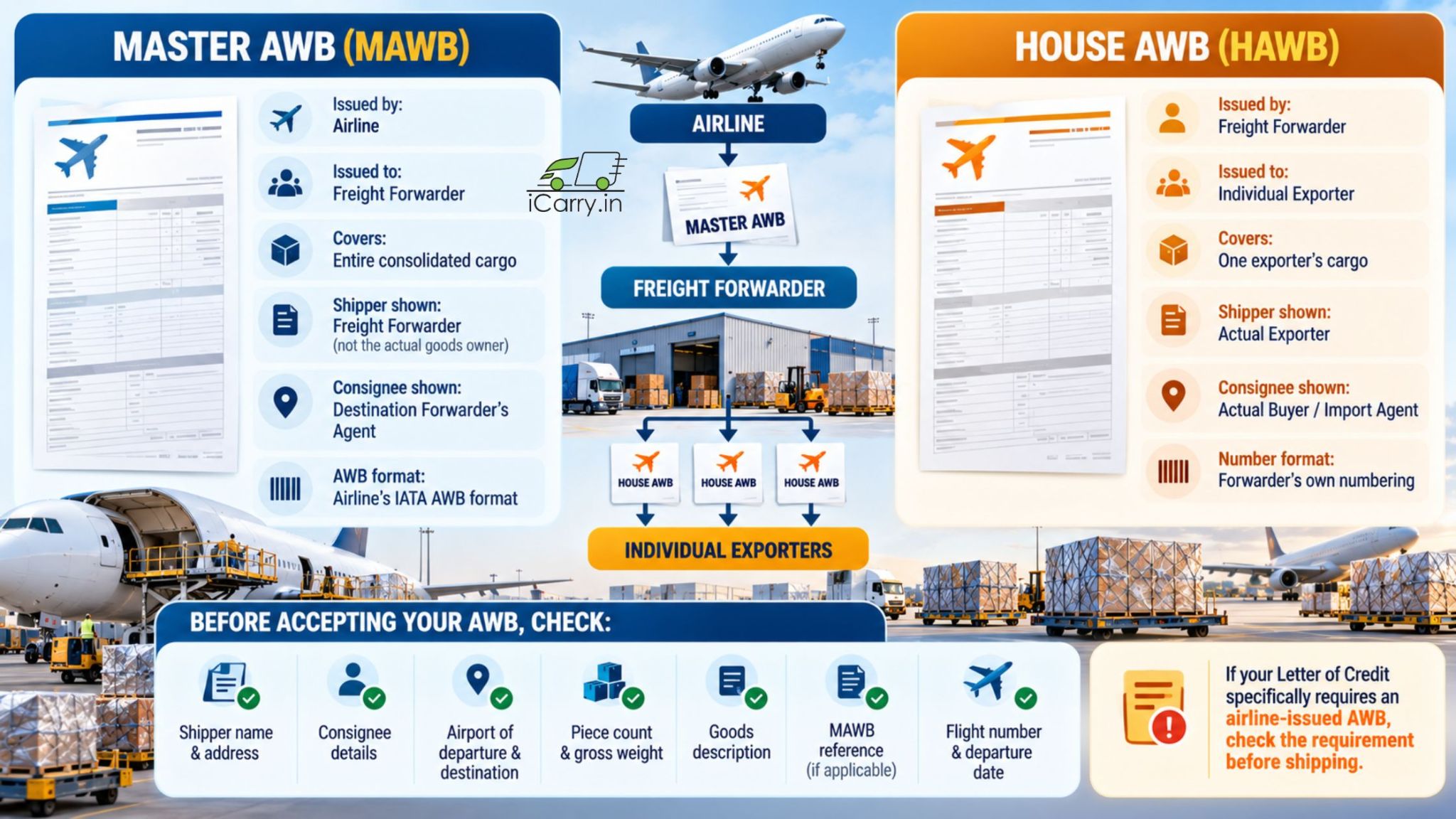
A Master AWB (MAWB) is issued by the airline to the freight forwarder and covers the whole consolidated load. A House AWB (HAWB) is issued by the forwarder to each exporter and covers only that exporter's cargo. Most Indian exporters receive a HAWB, and need a MAWB only if their letter of credit says so.
How to Verify Your AWB Before Accepting It
- Do you know whether your freight forwarder will issue a House AWB or Master AWB for your shipment?
- If operating under a Letter of Credit: has the LC specified which type of AWB is acceptable?
- Is the consignee name on the AWB correct - buyer's name, not the freight forwarder's agent?
- Are the airport of departure and airport of destination correct on the AWB?
- Does the gross weight and piece count on the AWB match your packing list and commercial invoice?
- Is the flight number and departure date confirmed - or is it a pending / to be advised entry?
What Is an Air Waybill (AWB)?
An Air Waybill (AWB) is the primary transport document for air freight shipments. It serves as:
- A contract of carriage between the shipper and the air carrier
- A receipt for goods accepted by the carrier
- A document that contains shipment details including origin, destination, consignee, goods description, weight, and handling instructions
- A tracking reference for the shipment through the air cargo network
Unlike a Bill of Lading (used in ocean freight), an Air Waybill is a non-negotiable document. It cannot be endorsed or transferred to a third party. The consignee named on the AWB is the party who can take delivery - the document itself cannot be used as a title document or traded like a negotiable Bill of Lading.
An AWB is always issued in three originals - one for the carrier, one for the shipper, and one for the consignee - plus multiple copies for other parties involved in the shipment. Indian export rules list the Air Waybill (or Bill of Lading) as one of three mandatory export documents, along with the commercial invoice cum packing list and the shipping bill.
Master AWB (MAWB) - Issued by the Airline
A Master AWB (MAWB) is issued by the airline to the freight forwarder (or consolidator) who is the direct customer of the airline. The MAWB covers the entire consolidated consignment that the freight forwarder tenders to the airline - which may contain the cargo of multiple individual shippers.
Key characteristics of the Master AWB:
- Issued by: The airline (e.g. Air India, IndiGo, Emirates, Lufthansa)
- Shipper named: The freight forwarder / consolidator (not the actual goods owner)
- Consignee named: The freight forwarder's agent at the destination (not the final goods buyer)
- Covers: The entire consolidated cargo load tendered by the forwarder - may contain multiple individual shipper consignments
- Format: Follows IATA standard AWB format with an 8-digit AWB number prefixed by the airline's 3-digit carrier code. Example: 098-12345678 (Air India carrier code 098)
- Who holds it: The freight forwarder - the actual exporter often never sees the MAWB directly
House AWB (HAWB) - Issued by the Freight Forwarder
A House AWB (HAWB) is issued by the freight forwarder to each individual shipper whose cargo is included in the consolidation. The HAWB covers only that specific shipper's portion of the consolidated load.
Key characteristics of the House AWB:
- Issued by: The freight forwarder / consolidator (not the airline)
- Shipper named: The actual goods owner / exporter (e.g. the Indian manufacturer)
- Consignee named: The actual buyer or import agent at the destination
- Covers: Only that one exporter's portion of the consolidated shipment
- Format: Follows the freight forwarder's own numbering format. Not an IATA airline AWB number
- Who holds it: The exporter receives the HAWB as their transport document
How Master and House AWBs Relate to Each Other
The relationship between MAWB and HAWB is a two-level structure that enables air freight consolidation:
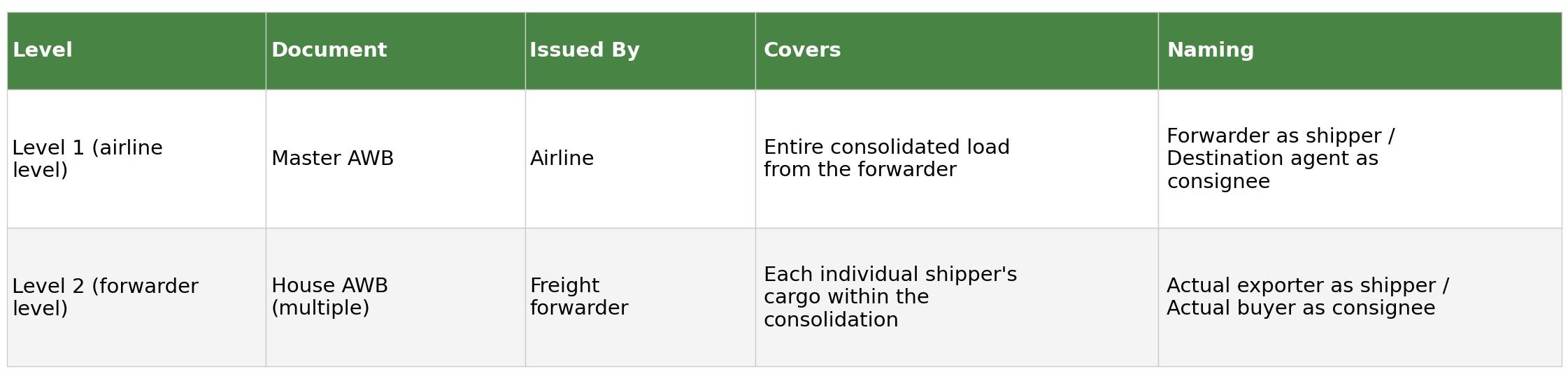
The airline only knows the freight forwarder - it issues one MAWB for the whole consolidated load. The freight forwarder knows each individual shipper - it issues a separate HAWB to each. The HAWB references the MAWB number so the two can be matched throughout the supply chain.
Example: A freight forwarder consolidates garments from 5 Indian exporters into one ULD (Unit Load Device) on an Air India flight to Heathrow. Air India issues one MAWB to the forwarder covering all 5 exporters' cargo. The forwarder issues 5 separate HAWBs - one to each exporter showing their specific cargo details, weights, and their buyer as consignee.
When to Expect Which Document
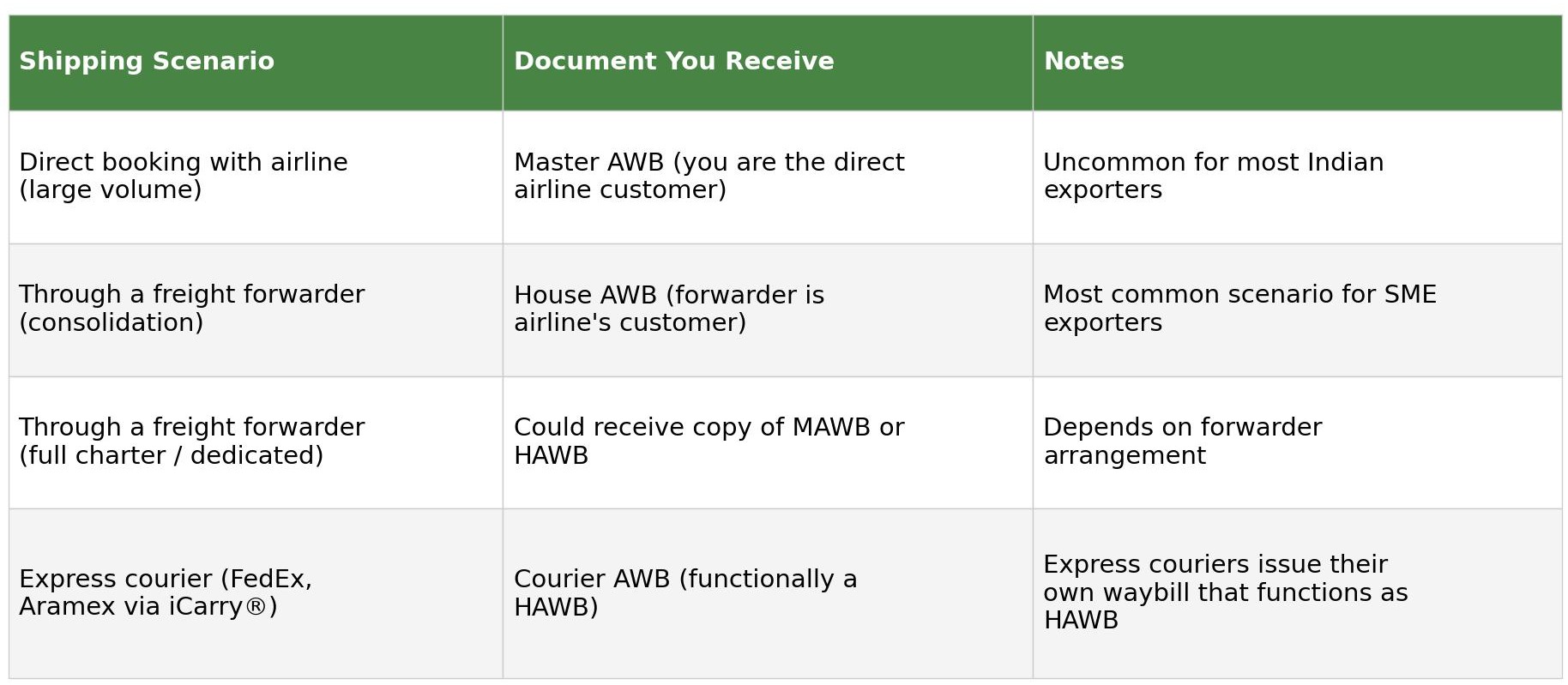
For most Indian SME exporters: You will receive a House AWB from your freight forwarder. The Master AWB is held by the forwarder. You typically do not need the Master AWB unless your letter of credit specifically requires it or the destination agent requires it for customs clearance.
Want to send samples or small parcels instead of consolidated cargo? Read the guide to customs, packaging and rates for parcel exports, then compare FedEx and Aramex options on iCarry®.
Letters of Credit and AWB Requirements
The most frequent source of AWB-related problems for Indian exporters is a Letter of Credit that specifies AWB requirements the exporter does not meet. Common LC AWB clauses:
- 'Air Waybill issued by airline': Requires a Master AWB - a House AWB issued by the freight forwarder will not be accepted by the bank
- 'House Air Waybill acceptable': A HAWB is accepted - most common in modern trade where consolidation is normal
- 'Consigned to applicant': The consignee on the AWB must be the buyer (LC applicant) - if the HAWB names the destination forwarder's agent as consignee, it will be rejected
- 'Notify party': The party the airline or forwarder must inform on arrival - often the buyer's customs broker. Must match the LC specification exactly
Always review the LC's transport document clause before arranging freight. If the LC requires an airline-issued MAWB and your freight forwarder issues a HAWB, the bank will reject the documents and the LC payment will not be released. Clarify with your buyer to amend the LC to accept HAWB if consolidation is your intended shipping mode.
What to Verify on Your House AWB
When your freight forwarder issues a HAWB, verify these fields before accepting the document:
- Your name and address as shipper: Must match your commercial invoice and shipping bill exactly
- Consignee name and address: Must be your buyer (or as specified in the LC). Not the destination forwarder's name unless that is what was agreed
- Airport of departure: The Indian airport the goods depart from (e.g. DEL, BOM, MAA, BLR)
- Airport of destination: The destination airport (e.g. LHR for London Heathrow, FRA for Frankfurt)
- Piece count and gross weight: Must match your packing list. An AWB with wrong weight will cause customs issues at destination
- Goods description: Must match the description on your commercial invoice and shipping bill - not a generic 'merchandise' or 'goods'
- MAWB reference: The HAWB should reference the Master AWB number - verify this is present
- Flight number and departure date: Confirm the goods are actually booked on the stated flight. 'Flight TBD' on an AWB means the space is not confirmed
Chargeable weight can differ from the actual weight on your packing list, so check how volumetric weight is calculated before you compare freight quotes.
AWB for Express Courier Shipments via iCarry®
For parcel-level international exports via iCarry®'s express courier partners (FedEx and Aramex), the waybill issued functions as a House AWB - the courier is the freight forwarder and the airline component is managed internally by the courier. Compare international shipping rates and book for D2C exports, product samples, and small B2B consignments via iCarry®'s international courier access.
For express courier shipments:
- The courier AWB (FedEx waybill, Aramex waybill) is the transport document - equivalent to a HAWB in function
- The AWB number is used for tracking throughout the international delivery journey
- Express courier AWBs are generally not accepted under Letters of Credit that require airline-issued MAWBs - express courier shipments are typically for commercial sales on open account terms
Register at iCarry®: open your account for access to FedEx and Aramex international courier with rate comparison before every booking
Final Thoughts
The Master AWB and House AWB distinction is not bureaucratic complexity - it reflects the real structure of how air freight works, with airlines dealing with freight forwarders and freight forwarders dealing with individual exporters. Understanding which document you will receive, what it must contain, and what your buyer or bank requires is essential logistics knowledge for any Indian exporter using air freight.
For most SME exporters working with freight forwarders: the House AWB is your document. Verify it carefully before accepting it. If your letter of credit requires something different from what your forwarder provides, raise it before the shipment departs - not after the bank rejects your documents.
Frequently Asked Questions (FAQs)
What is the main difference between a Master AWB and House AWB?
A Master AWB (MAWB) is issued by the airline to the freight forwarder and covers the entire consolidated consignment. A House AWB (HAWB) is issued by the freight forwarder to each individual exporter and covers only that exporter's cargo within the consolidation. Most Indian exporters working with freight forwarders receive a HAWB, not a MAWB.
Is a House AWB legally valid for export documentation?
Yes. A House AWB is a legally valid transport document issued by a licensed freight forwarder and is accepted for most commercial export transactions. The exception is Letters of Credit that specifically require an airline-issued (Master) AWB. Always check your LC's transport document clause before arranging shipment.
Can I get a Master AWB as an Indian exporter?
Only if you book directly with the airline - which requires significant volume that most SME exporters do not have. For most Indian exporters, the freight forwarder is the airline's direct customer and holds the MAWB. The exporter receives the HAWB. If your LC requires an MAWB, ask your buyer to amend the LC to accept HAWBs, which is the norm in consolidation-based air freight.
What should I check on my House AWB before accepting it?
Verify: your name and address as shipper, buyer's name and address as consignee (not the destination forwarder unless specified), correct airport of departure (Indian airport) and airport of destination, piece count and gross weight matching your packing list, goods description matching your commercial invoice, MAWB reference number, and confirmed flight number and departure date.
How is an express courier AWB (FedEx, Aramex) different from a freight forwarder HAWB?
Functionally similar - both are issued by the company arranging the transport (courier / forwarder) rather than by the airline directly. The express courier AWB is used for tracking throughout the delivery journey. The main practical difference is that express courier AWBs are not accepted under Letters of Credit that require airline-issued MAWBs. Express courier shipments typically operate on open account commercial terms rather than LC-based payment.
Two AWBs, two issuers: the airline issues one Master AWB to the freight forwarder for the whole consolidated load, and the forwarder issues a separate House AWB to each exporter for their own cargo. Most Indian SME exporters will only ever hold a HAWB - that's normal and legally valid - except when a Letter of Credit specifically names an airline-issued MAWB. Check that clause before you ship, not after the bank rejects your documents.