
If you have ever received a courier invoice that seemed higher than expected, volumetric weight could be the reason. This is one of the most common - and least understood - billing factors in Indian eCommerce shipping. Understanding how couriers calculate chargeable weight can save sellers thousands of rupees every month.
This guide explains how volumetric weight works, how Indian courier companies apply it, and the practical steps sellers can take to avoid unnecessary overcharges.
What is Volumetric Weight?
Volumetric weight (also called dimensional weight or DIM weight) is a calculated weight based on the space a package occupies in a delivery vehicle, rather than its actual physical weight.
Courier companies use this because a large, lightweight box occupies the same cargo space as a heavy compact one - and space in delivery vehicles is finite. To account for this, couriers charge for whichever is higher: the actual weight or the volumetric weight.
This is known as the "higher of the two" rule, and it catches many new sellers off guard.
How is Volumetric Weight Calculated in India?
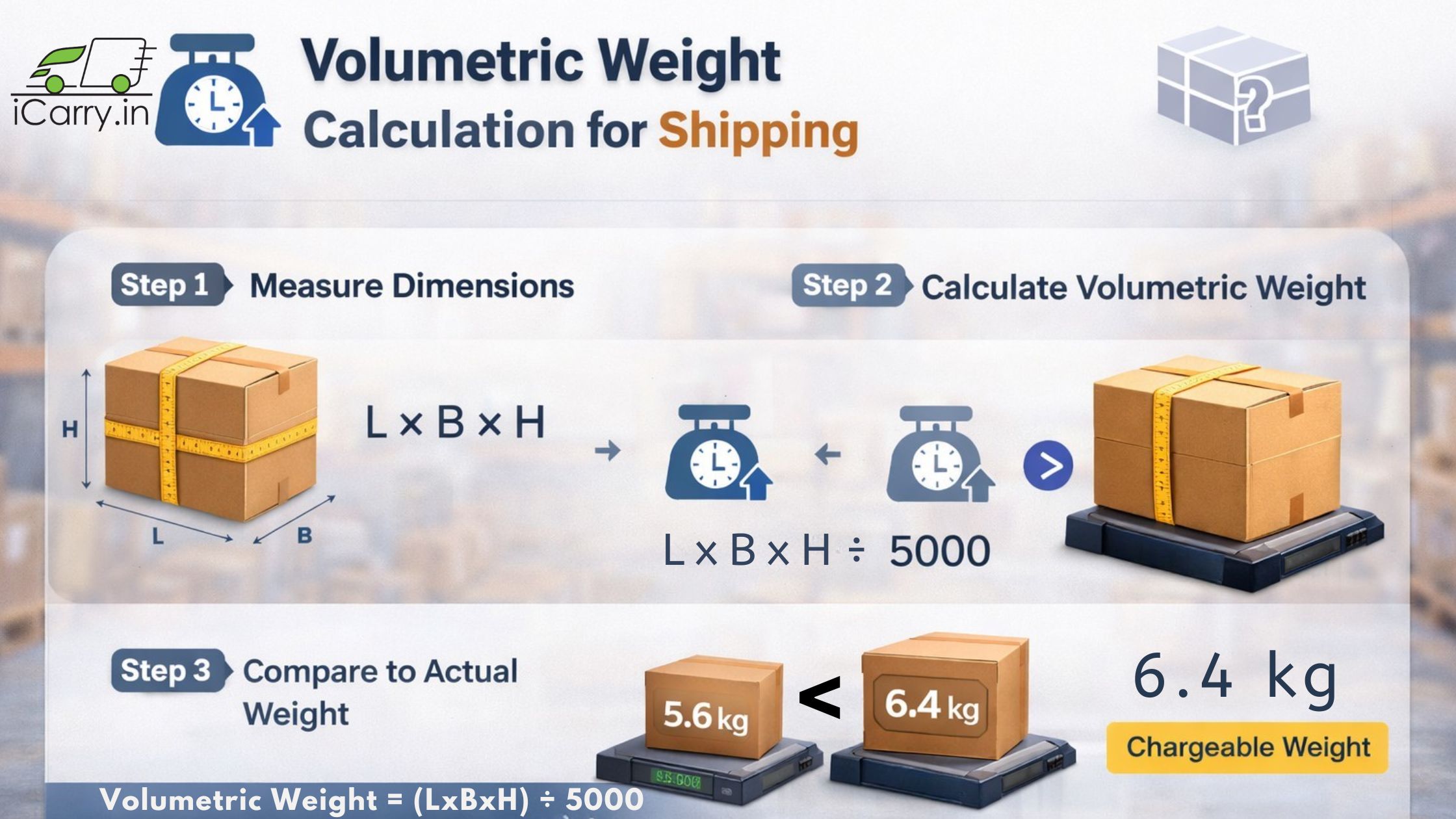
Most Indian courier partners use the following formula:
Volumetric Weight = Length (cm) × Breadth (cm) × Height (cm) ÷ 5000
(Note: Some courier companies may specify a different divisor such as 3000 or 4000)
Example: A box measuring 30 cm × 20 cm × 15 cm has a volumetric weight of:
30 × 20 × 15 ÷ 5000 = 1.8 kg
If the actual (dead) weight of the parcel is 500 grams, the courier will bill for 1.8 kg - not 500 grams.
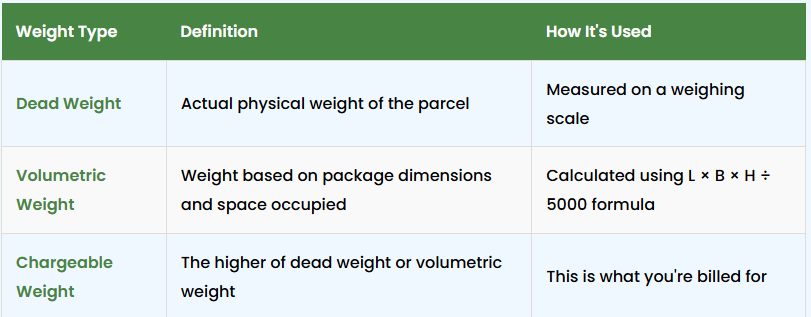
Dead Weight vs. Volumetric Weight vs. Chargeable Weight
When Does Volumetric Weight Affect Your Shipping Cost?
Volumetric weight matters most when shipping:
- Light but bulky products - air pillows, large electronics accessories, home décor
- Fashion items with large boxes relative to product size - such as handbags, purses, etc.
- Items packed with excessive void fill or oversized packaging for protection
- Products with irregular shapes requiring large outer dimensions
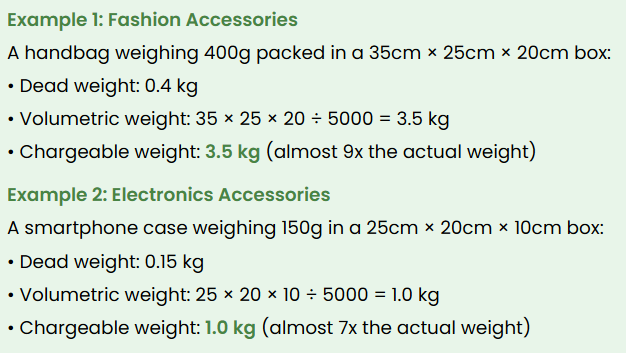
Real examples: When volumetric exceeds dead weight
How Weight Slabs Work in Indian Courier Billing
Couriers don't bill per gram - they bill in slabs. The chargeable weight is rounded up to the next slab (commonly 500g or 1 kg intervals). This means:
- A chargeable weight of 1.1 kg gets billed at the 1.5 kg slab
- A chargeable weight of 2.1 kg gets billed at the 2.5 kg or 3 kg slab, depending on the courier
Across hundreds of shipments monthly, this rounding effect alone can result in significant extra charges - especially for sellers in categories where volumetric weight frequently exceeds dead weight. Weight discrepancy charges, fuel surcharges, and ODA fees are among the hidden shipping charges Indian sellers most commonly overlook. Understanding how ecommerce logistics and fulfillment billing works is fundamental to margin management as explained in Shopify's fulfillment setup guide.
Why Sellers Get Surprised by Weight Discrepancy Charges
A weight discrepancy occurs when the courier measures your parcel at a sorting hub and finds that the weight or dimensions differ from what you declared during booking. The difference is then billed as an additional charge.
Common reasons this happens:
1. Not measuring accurately before booking
Many sellers enter weight estimates rather than measured values. Even a 10–15% difference per shipment adds up quickly at volume.
2. Packaging additions after weight estimation
Bubble wrap, extra tape, invoice inserts, and void fill added after weighing increase the final parcel weight beyond what was entered during booking.
3. Oversized boxes
Using a large standard box for a small product creates a wide gap between dead weight and volumetric weight. The seller may be thinking about dead weight while the courier is billing volumetric.
4. Rounding and slab differences
Even small differences in measurement - a few centimetres in dimension or a few grams in weight - can push a shipment into the next billing slab.
How to Reduce Volumetric Weight and Shipping Costs
Pack efficiently
Use the smallest box that adequately protects your product. There is no reason to use a 40 cm box for a product that fits in a 20 cm box. Every extra centimetre directly increases your volumetric weight and shipping cost. Choosing between cardboard and corrugated boxes - and matching box strength to product weight - also directly reduces the oversizing that drives unnecessary volumetric charges.
Calculate before booking
Always apply the L × B × H ÷ 5000 formula before entering dimensions at booking. Compare this against the actual weight and use the higher number as your expected chargeable weight. This avoids surprises on the invoice.
Use lightweight packing materials
Bubble wrap and foam padding add volume. Where possible, use form-fitting packaging or lightweight poly mailers for soft goods like apparel and accessories.
Compare courier rates using a calculator
Different couriers have different weight slabs and minimum chargeable weights. Using a rate calculator before booking - such as the one available on iCarry.in lets you see the estimated cost across multiple couriers, accounting for volumetric billing. This takes less than a minute and can identify the most cost-effective option for each shipment type. iCarry has a step-by-step video tutorial on estimating shipment costs, including how volumetric weight is calculated live on the platform.
Keep packaging records
Photograph your packaged parcels with dimensions and weight visible before every pickup. This is not just good practice - it is your primary defence if you need to dispute a weight discrepancy charge later.
How to Handle a Weight Discrepancy Dispute
If a courier raises a discrepancy, you typically have 5 business days to contest it with photographic evidence. The required evidence includes:
- A clear photo of the parcel on a weighing scale, weight reading visible
- Photos of each dimension (L, B, H) with a measuring tape or ruler
- A photo of the parcel showing the AWB/tracking barcode
Managing weight discrepancies at scale becomes difficult when shipment data, documentation, and courier communication are handled separately. In practice, businesses reduce disputes and operational delays when these workflows are centralized. iCarry helps streamline this by enabling sellers to track discrepancies, upload evidence, and manage shipment-level issues across multiple couriers in a single workflow, improving both efficiency and control.
For high-volume sellers, having a structured process for handling discrepancies is critical. This video guide on handling weight discrepancies explains how to raise disputes correctly, including how to capture and store product images for future use. For a deeper focus on prevention, the guide on how to reduce weight discrepancy charges covers long-term practices that help eliminate most discrepancies before they occur.
A lot more of these questions that are faced by sellers on a day to day basis are also captured in our FAQs.
Final Thoughts
Volumetric weight is not just a calculation. It directly affects your shipping costs, profit margins, and overall logistics efficiency.
For Indian sellers, especially in categories where packaging volume exceeds product weight, small mistakes in dimensions can lead to significant cost increases over time. This is because the chargeable weight by couriers is the higher of Dead Weight or Volumetric Weight. So it is always advised to use the Estimate Shipment Cost feature to understand both the dead weight and volumetric weight of your shipments.
The real advantage comes from building consistency. When packaging, measurement, and courier selection are aligned, shipping costs become predictable and controllable.
Sellers who actively manage volumetric weight do not just reduce overcharges. They build stronger operational discipline, better cost visibility, and more scalable logistics systems.
Frequently Asked Questions
What is the volumetric weight formula used by Indian couriers?
L × B × H (in cm) ÷ 5000. This applies to most domestic B2C surface couriers.
Do all Indian couriers use the same volumetric divisor?
Most B2C surface couriers use 5000 as the divisor. Air/express couriers may use a different divisor - check with your courier at time of booking.
What if I believe the courier has incorrectly measured my parcel?
You can dispute weight discrepancy charges, typically within 5 business days. You need photographic evidence of dimensions and weight taken before dispatch.
Can I be charged on dead weight if my product is heavy and compact?
Yes. If dead weight exceeds volumetric weight, you are charged on dead weight. This is the less common scenario for light-but-bulky products.
Volumetric weight is a calculated weight based on package dimensions rather than physical weight—Indian couriers charge whichever is higher between dead weight and volumetric weight (L × B × H ÷ 5000), making efficient packaging, accurate measurement, and courier comparison essential to avoid overcharges and reduce shipping costs.