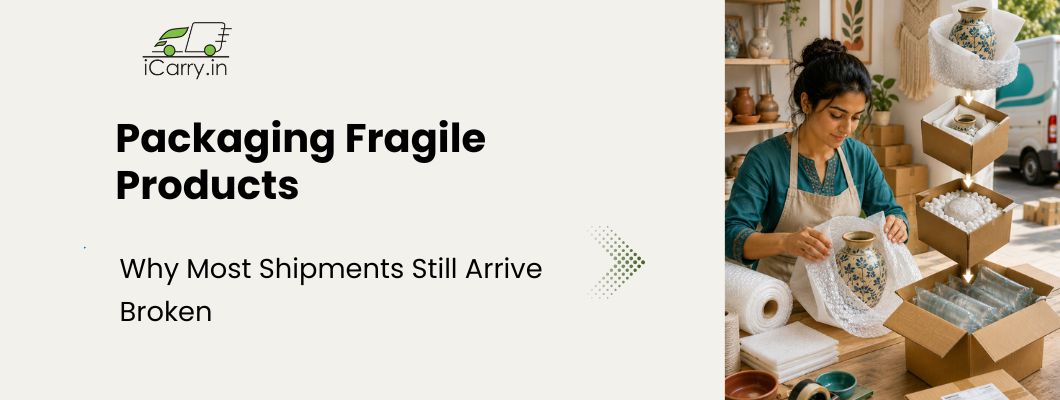
A ceramic artist in Jaipur ships a handmade vase to a buyer in Bengaluru. The vase is wrapped in a single layer of bubble wrap and placed in a cardboard box with crumpled newspaper for fill. Three days and four courier handling points later, the box arrives. The vase is in pieces.
The courier's liability: ₹50 per kg on a 600g shipment. The seller's recovery: ₹30. The actual loss: ₹3,500 for the vase plus ₹80 in freight and ₹600 in lost time creating it.
Fragile product damage during Indian courier transit is one of the most preventable losses in commerce - yet it remains one of the most common. The cause is almost always the same: packaging that was adequate for gentle handling but not for the reality of courier sorting centres, vehicle loading, and the 4 to 6 handling points a standard pan-India shipment goes through. India's courier networks process an enormous and growing volume - ecommerce alone accounted for 4.8 to 5.5 billion express parcel shipments in FY24 (per IBEF) - with automated and manual sorting that applies significant physical stress to every package.
This guide covers exactly how to package fragile products to survive Indian courier transit - with specific guidance by product type, a pre-dispatch checklist, and the documentation to protect your claim if damage does occur.
What Is Fragile Product Packaging?
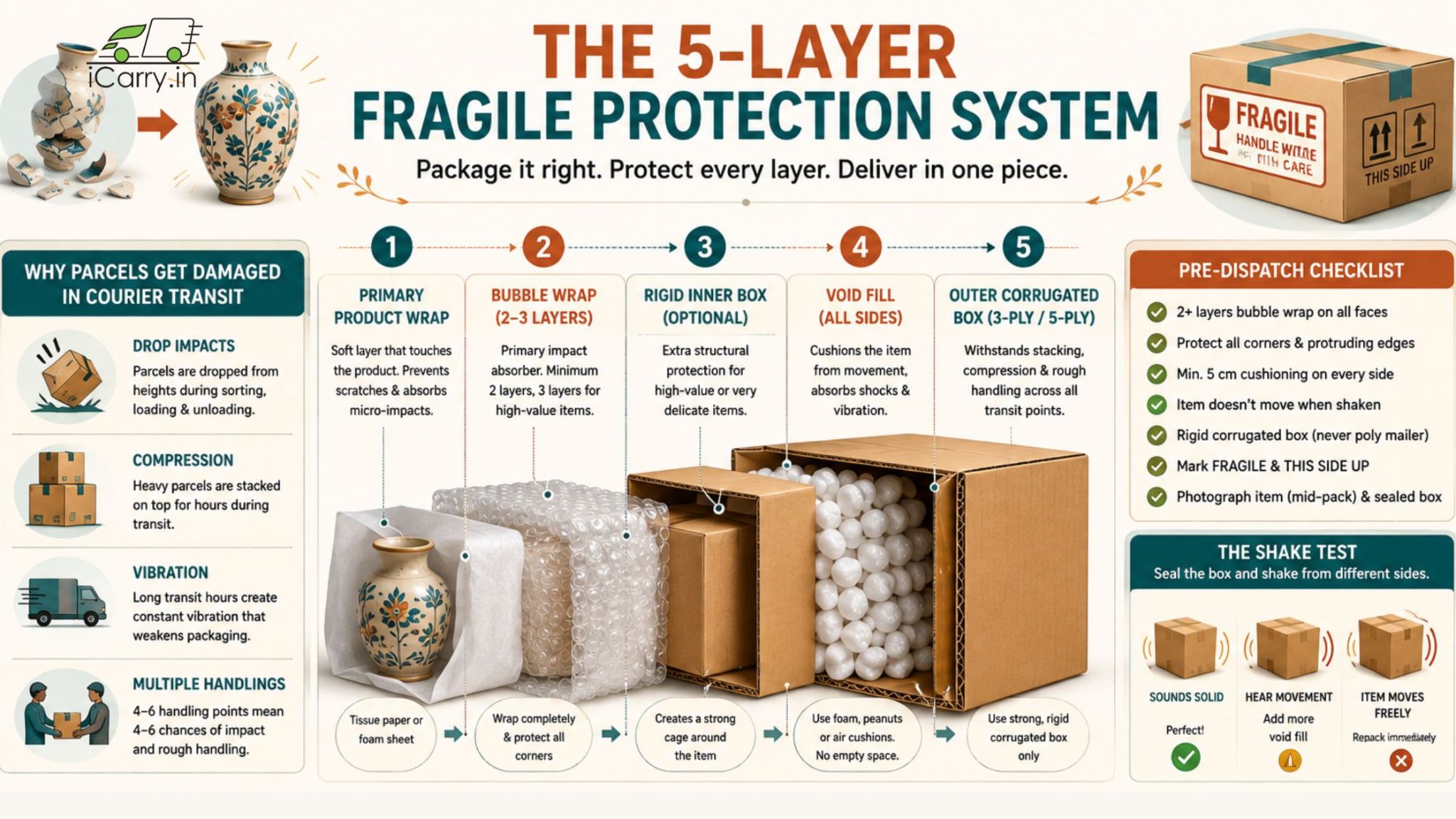
Fragile product packaging is the layered protection a breakable item needs to survive Indian courier transit intact - typically 4 to 6 handling points involving drops, stacking compression, and hours of vibration. Unlike ordinary packaging, it can't just cushion a single impact; it has to hold up under all of these stresses at once, which is why a single layer of bubble wrap in a plain box is rarely enough for anything ceramic, glass, or otherwise breakable.
How to Check Before Sealing Any Fragile Parcel
- Is the item individually wrapped with at least 2 layers of bubble wrap on all faces?
- Are all corners and protruding edges specifically protected?
- Is there at least 5 cm of cushioning on every side between the item and the outer box wall?
- Does the item move when you shake the sealed box? If yes, add more void fill.
- Is the outer box rigid corrugated - not a poly mailer - for any breakable product?
- Have you marked FRAGILE and THIS SIDE UP on all faces of the outer box?
- Have you photographed the item mid-packaging and the sealed parcel for damage claim evidence?
Understanding Why Parcels Get Damaged in India
Before getting to packaging solutions, it helps to understand what parcels actually go through:
- Drop impacts: Parcels are dropped from conveyor belts onto sorting tables, loaded from heights into vehicles, and unloaded at destination hubs. Standard drop height during sorting: 60 to 90 cm. For heavy parcels, often higher.
- Compression: In sorting centres and delivery vehicles, parcels are stacked. A Zone D pan-India shipment may have 10 to 20 kg of other parcels stacked on top of it for hours during transit.
- Vibration: 12 to 24 hours in a moving vehicle creates constant vibration. An item that is loose inside its packaging will shift, impact the walls, and eventually fracture.
- Multiple handovers: 4 to 6 handling points for a Zone D shipment means 4 to 6 opportunities for an impact event. Each handling point multiplies the probability of a damaging impact.
Good fragile packaging must survive all of these simultaneously - not just one or two. A package that can handle a single drop but collapses under compression has failed.
The 5-Layer Fragile Protection System
Every fragile product needs five distinct protection layers working together:
Layer 1: Primary Product Wrap
The first material to touch the product. Purpose: protect the surface finish and absorb micro-impacts.
- Tissue paper or foam sheet directly on any polished, painted, or delicate surface to prevent scratch from bubble wrap contact
- For ceramic and glass: foam sheet wrap before bubble wrap. Foam compresses differently from bubble wrap and absorbs vibration better
- For electronics: anti-static foam or bags before any other material to prevent static discharge damage
Layer 2: Bubble Wrap
The primary impact absorber. Minimum 2 layers for standard fragile products. 3 layers for high-value or very delicate items.
- Wrap completely - no surface of the item should be exposed to direct contact with the box
- Tape the bubble wrap closed so it cannot unwrap during transit
- For corners and edges: fold bubble wrap to create double or triple thickness at all corner points - these are the highest impact risk zones
- Bubble wrap with larger bubbles provides better cushioning for heavier items. Small-bubble wrap is for surface scratch protection, not impact absorption
Layer 3: Inner Box or Rigid Secondary
For high-value fragile products, a rigid inner box provides structural protection before the outer shipping box. The inner box prevents compression from deforming the bubble wrap protection around the product.
For premium ceramics, glassware, and electronics, a foam-fitted inner box - where the foam is cut or moulded to the exact shape of the product - is the most effective protection available. The item cannot move. The foam absorbs all impact. The inner box provides structural rigidity.
Layer 4: Void Fill
The space between the wrapped item and the outer box walls must be completely filled with cushioning material. This serves two purposes: prevents the item from shifting (which causes repeated impact with box walls), and provides a secondary impact absorption layer.
- Air cushions: Most effective void fill. Compressible, lightweight, and consistent. Preferred for e-commerce at scale
- Foam peanuts: Effective but messy for customers. Good for industrial fragile products, less suitable for premium consumer goods
- Crumpled kraft paper: Acceptable for light items. Not suitable for heavy items where the paper compresses under weight and leaves void
- What NOT to use: Crumpled newspaper (compresses too easily, leaves no protection under stacking weight)
The shake test: After packing and before sealing, shake the box firmly. If anything moves, shifts, or makes a sound, add more void fill. A properly packed fragile shipment makes no sound when shaken.
Layer 5: Outer Shipping Box
The last line of defence. Must be structurally sufficient to withstand stacking weight and drop impact without collapsing onto the inner layers.
- 3-ply corrugated: Minimum for products up to 2 kg
- 5-ply corrugated: Required for products above 2 kg or any product in a large box (above 30 x 30 x 30 cm)
- New boxes only: Reused boxes have weakened corrugation that fails under stacking weight. Never reuse boxes for fragile shipments
- Right-sized: The outer box should allow 5 cm of void fill on all six sides. More than 8 to 10 cm creates excessive void that allows the inner package to shift during transit
- Double-tape all seams: Top, bottom, and all side seams. A box that opens in transit is a guaranteed damage event
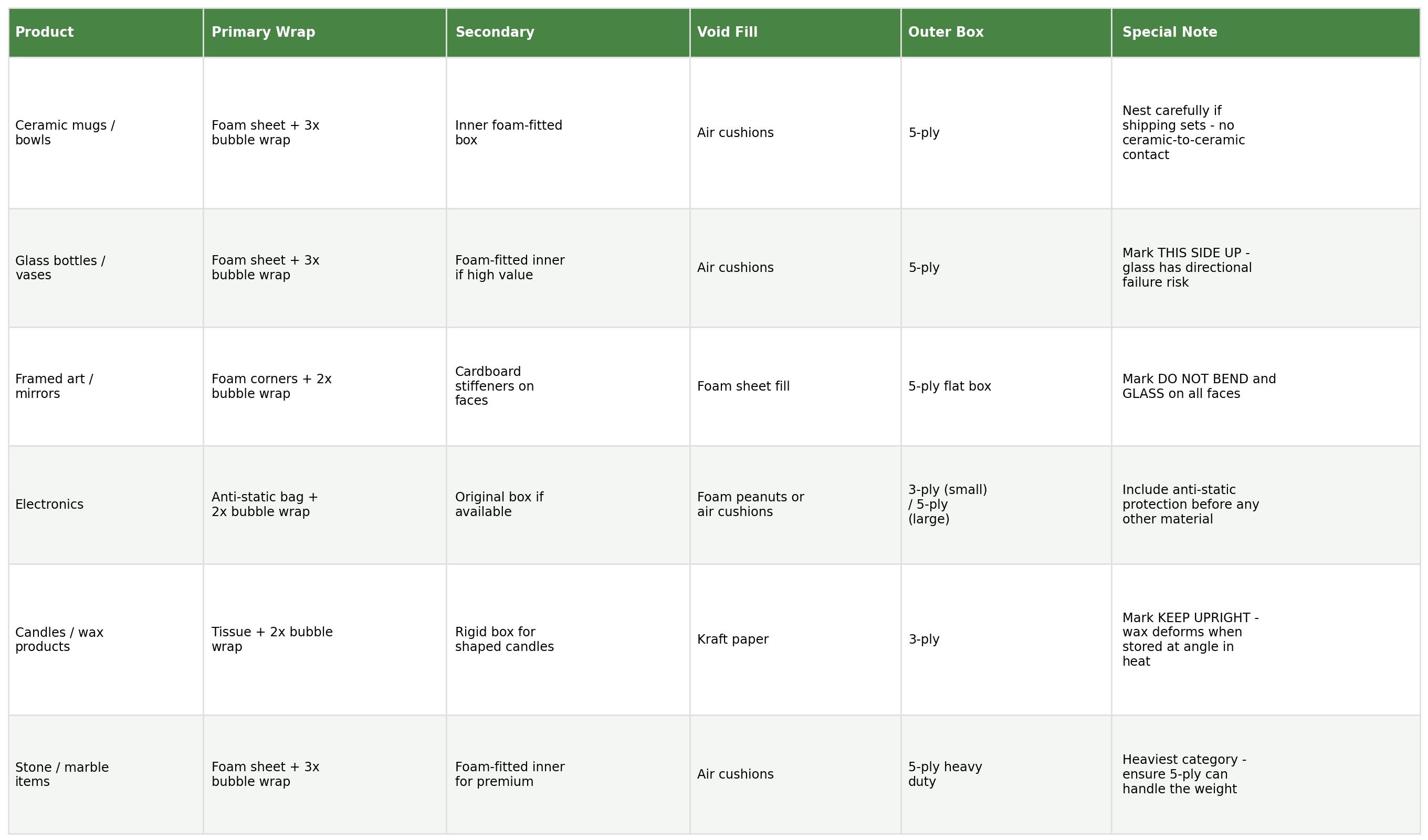
Packaging by Fragile Product Category
Marking and Labelling Fragile Parcels
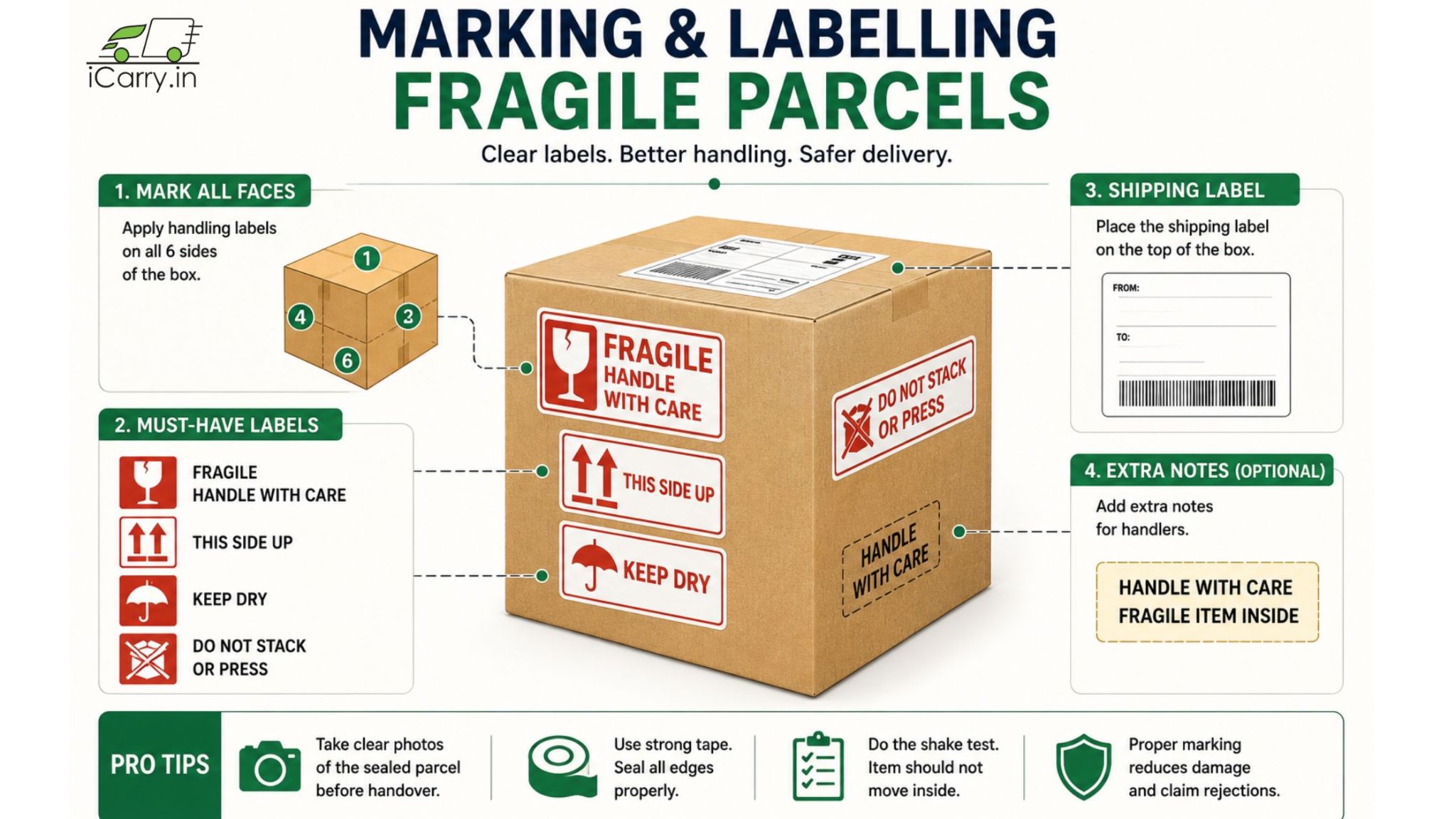
Markings do not guarantee careful handling - but they reduce casual mishandling at some points in the courier chain. Use all of the following on every fragile shipment:
- FRAGILE: In large text on all four sides and the top. Red text on white background is most visible to handlers
- THIS SIDE UP with arrows: On all four sides. Prevents inverted storage which puts maximum stress on the wrong part of the packaging
- DO NOT CRUSH / DO NOT STACK: Particularly important for flat or wide items like framed art and glass panels
- HANDLE WITH CARE: On the top face
Marking is the cheapest fragile protection measure available. Use permanent marker or printed stickers in large format. A handler who notices the markings is less likely to toss the parcel than one who does not.
Pre-Dispatch Photography - Your Damage Claim Protection
The most common reason fragile product damage claims fail: no pre-dispatch evidence. Without photographs showing the product's condition before packaging and the packaging integrity before handover, the courier will claim damage occurred before they received the parcel.
Photograph the following for every high-value or fragile shipment:
- The product itself - undamaged - before any packaging is applied
- The product after primary wrap (tissue/foam + bubble wrap)
- The sealed outer box with the shipping label visible
- The outer box on a weighing scale showing weight
These four photographs, timestamped and stored against the AWB number, are the evidence set for any successful damage claim. The damage claim process requires proof that the item left your premises undamaged and correctly packaged.
Courier Selection for Fragile Products
Not all couriers handle fragile shipments with equal care. For high-value fragile products above ₹2,000, courier selection matters:
- Express couriers (Blue Dart, FedEx): Fewer handling points than surface couriers. Air-based for long distances means shorter physical transit duration and less vibration exposure. Higher cost but significantly lower damage probability for premium fragile items
- Surface couriers: More handling points and longer transit. Suitable for fragile items that are well-packaged and not extremely high-value.
- Avoid poly mailer mode: Some couriers offer poly mailer pricing for lightweight items. Never use poly mailer mode for any fragile product regardless of weight
Compare rates across available couriers before every fragile shipment booking. How to estimate shipment cost shows the rate comparison process in iCarry® - including courier options and their service levels for your specific route.
How iCarry® Supports Fragile Product Businesses
iCarry® is a courier aggregator that gives Indian businesses selling fragile products the tools to ship more safely and manage damage claims effectively:
- Multi-courier access: Route high-value fragile items to Blue Dart or FedEx for fewer handling points. Route standard fragile items to the most cost-effective surface option with rate comparison before every booking
- Declared value coverage: Enable declared value coverage at booking for fragile items above ₹2,000. The coverage fee (0.5 to 1.5% of declared value) covers the full declared value in the event of courier-caused damage
- Pre-uploaded product images: Upload standard product images per SKU so damage claim disputes are triggered automatically with photographic evidence
- Weight discrepancy management: Fragile products in 5-ply corrugated with substantial void fill often weigh more than the product alone. Always weigh after sealing and declare the full packaged weight
- Delivery Boost: For high-value fragile orders, pre-delivery customer contact reduces the probability of failed deliveries - which for fragile products increases the risk of damage on a second handling cycle
Final Thoughts
Fragile product packaging is not complicated - but it requires discipline. The five-layer system (primary wrap, bubble wrap, inner rigid, void fill, outer corrugated) applied consistently to every fragile shipment eliminates the vast majority of courier-caused damage. The shake test before sealing catches the packaging failures that good intentions miss.
The businesses that build a reputation for delivering fragile products safely are those who treat packaging as part of the product experience - not a cost to minimise. A ₹40 packaging investment on a ₹3,500 ceramic piece that arrives perfectly is the foundation of the five-star review that drives the next 10 orders.
Document every fragile shipment before handover. Enable declared value coverage for anything worth more than ₹2,000. Choose the right courier for the product value and route. The combination of good packaging, good documentation, and good courier selection turns fragile shipping from a high-risk operation into a manageable, repeatable process.
Frequently Asked Questions (FAQs)
How many layers of bubble wrap do fragile products need for courier delivery in India?
Minimum 2 layers for standard fragile products. 3 layers for high-value ceramics, glass, and art pieces. The bubble wrap must cover all surfaces completely with no exposed areas, and must be taped closed to prevent unwrapping during transit. Corners and edges need additional thickness - fold the bubble wrap to create double or triple protection at all protruding points.
What is the shake test for fragile packaging?
The shake test is a pre-sealing check: after packing the item with all layers in place but before sealing the outer box, shake the box firmly in all directions. If you hear or feel the item moving, shifting, or making any sound inside, there is insufficient void fill. Add more cushioning material until the box can be shaken with no internal movement. A correctly packed fragile shipment is completely silent when shaken.
Should I use a poly mailer for a lightweight fragile item?
No. Never use a poly mailer for any fragile product regardless of weight. Poly mailers provide zero structural protection against compression, dropping, or stacking. A lightweight ceramic item in a poly mailer will be crushed under the weight of other parcels in a sorting centre. Use corrugated boxes only for fragile products.
How do I claim compensation if my fragile shipment is damaged by the courier?
File a damage claim through your courier aggregator within the claim window (typically 7 to 15 days from delivery for domestic shipments). Submit: pre-dispatch photographs of the item and sealed packaging, the signed pickup manifest, the tracking history, and the customer's photographs of the damage on arrival. Claims without pre-dispatch photographs are very difficult to recover. Enable declared value coverage at booking for recovery up to the declared amount.
Fragile product packaging is not complicated - but it requires discipline. The five-layer system, applied consistently to every fragile shipment, eliminates the vast majority of courier-caused damage. The shake test before sealing catches the packaging failures that good intentions miss, and pre-dispatch photographs are what actually win a damage claim when something does go wrong. A ₹40 packaging investment on a ₹3,500 ceramic piece that arrives perfectly is the foundation of the five-star review that drives the next 10 orders.