
A D2C brand launches with a ₹699 product and offers free shipping to compete with marketplaces. Six months later, the business is profitable on paper but constantly short on cash. The problem: shipping to Zone D customers costs ₹95 per order on a product with a ₹180 gross margin. After shipping, the margin is ₹85. After packaging (₹20) and COD handling fee (₹30 for the 60% COD mix), the effective margin is ₹35 per delivered order.
The business is growing but bleeding. Not because the product is wrong. Because shipping was priced without modelling the full cost.
Shipping pricing is one of the most consequential and least structured decisions Indian businesses make. As Indian eCommerce scales across more geographies - India's D2C segment alone is projected to reach USD 60 billion by 2030 (IBEF), the difference between Zone A and Zone E shipping costs - easily ₹60 to ₹100 per order on the same product - makes a blanket free shipping offer a margin trap for businesses with a geographically distributed customer base.
This guide shows you how to calculate your true per-order shipping cost, choose the right shipping pricing model for your business, and build a pricing structure that protects margin across all zones.
What Does It Mean to Price Products to Include Shipping?
Pricing products to include shipping means building your true per-order delivery cost - base freight, fuel surcharge, COD handling fee, packaging, and RTO provision - into your selling price, instead of treating shipping as a flat, unmodelled cost or absorbing it silently as a marketing offer. Because these costs vary sharply by delivery zone, a single blended shipping assumption tends to hide the fact that Zone D and Zone E orders can quietly wipe out most or all of the product margin, even when Zone A orders remain healthy.
How to Check If You Know Your True Shipping Cost
- Have you calculated your average shipping cost by zone - not a single blended average?
- Are you including fuel surcharge and COD handling fee in your shipping cost model?
- Have you calculated the impact of your RTO rate on your effective per-delivered-order cost?
- Do you know your packaging material cost per order?
- Have you stress-tested your free shipping threshold against Zone D order economics?
Step 1: Calculate Your True Per-Order Shipping Cost
Most businesses know their headline courier rate. Very few know their true per-order shipping cost - which includes every component that leaves with the order.
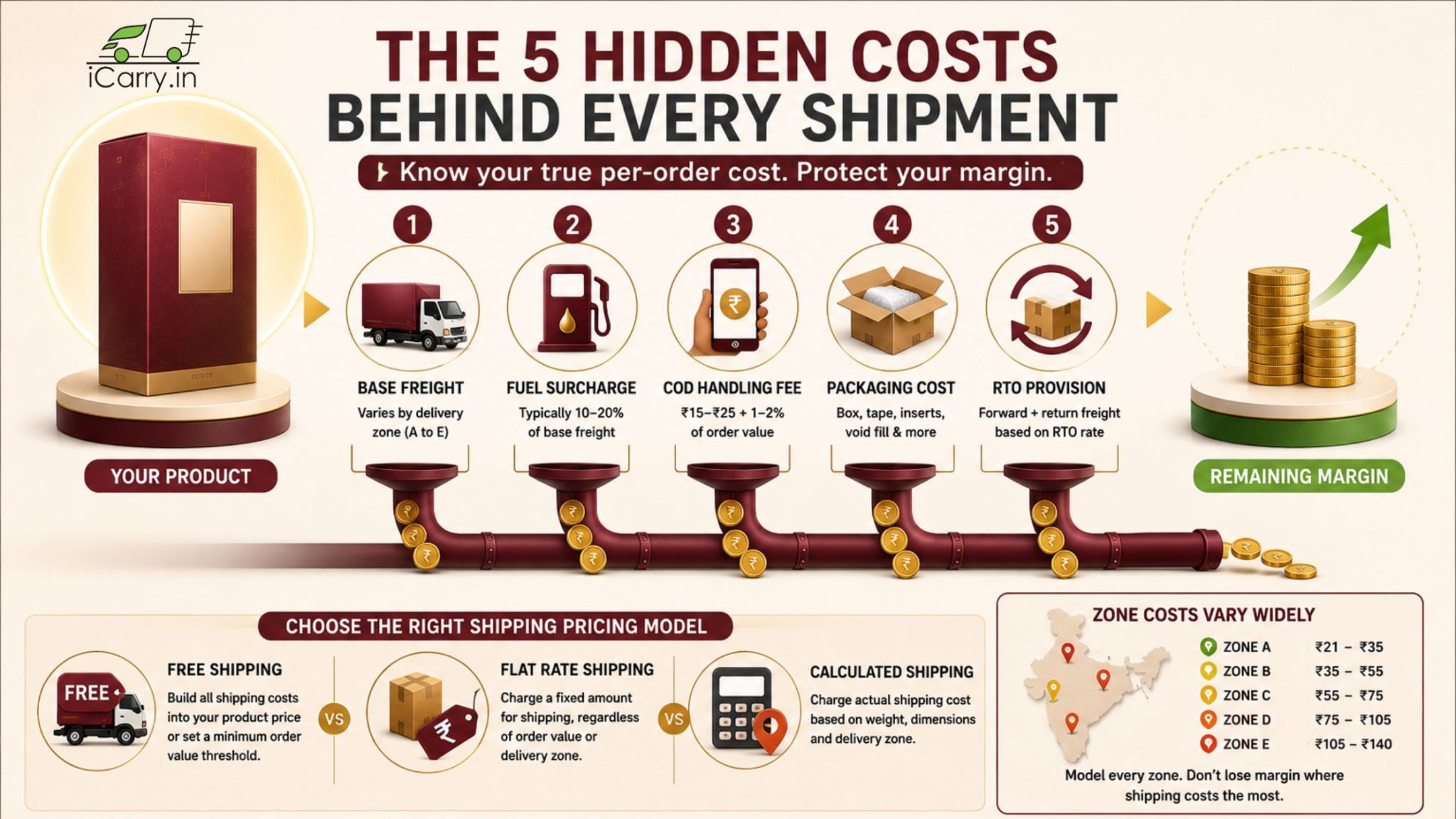
True shipping cost per order = Base freight + Fuel surcharge + COD handling fee (if COD) + Packaging material cost + RTO provision
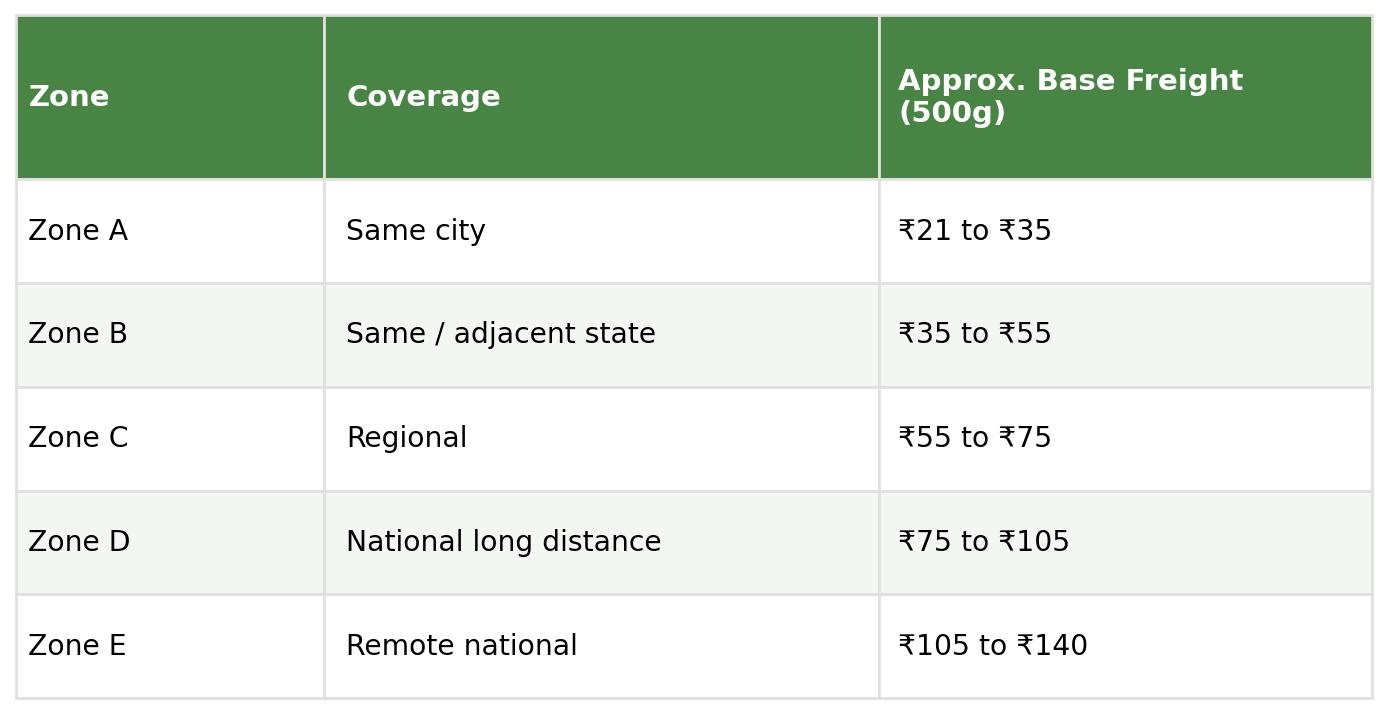
Component 1: Base Freight by Zone
Your base freight varies by delivery zone. Calculate separately for each zone that represents more than 10% of your order volume:
Component 2: Fuel Surcharge
Typically 10 to 20% of base freight, revised monthly. Use 15% as a conservative estimate in your model. On a ₹80 Zone D order, this adds ₹12.
Component 3: COD Handling Fee
For every COD order: ₹15 to ₹25 fixed plus 1 to 2% of order value. On a ₹699 order at 1.5%: ₹20 + ₹10.49 = ₹30.49. This is per order - it adds up fast if your COD ratio is 60%+.
Component 4: Packaging Material Cost
Box or poly mailer, tape, bubble wrap (if applicable), void fill, branded inserts. Calculate your actual cost per pack for each SKU. Most businesses spend ₹12 to ₹35 per order in packaging materials - but rarely track it explicitly.
Component 5: RTO Provision
Every RTO costs you forward freight + return freight. With a 20% RTO rate on COD orders, you are effectively paying for 1.2 deliveries per COD order dispatched. Model it this way:
RTO provision per order = (RTO rate % x round-trip freight cost)
At 20% RTO and ₹80 round-trip freight: 0.20 x ₹80 = ₹16 additional cost per order dispatched.
Reducing your RTO rate is the highest-leverage cost reduction available. Reducing RTO by 5 percentage points on 500 monthly COD orders at ₹80 round-trip freight saves ₹2,000 per month - without changing your pricing at all.
Step 2: Build Your Zone-by-Zone Cost Model
Now combine all components for each zone. Using a ₹699 product, 500g packed weight, 60% COD at 20% RTO as an example:
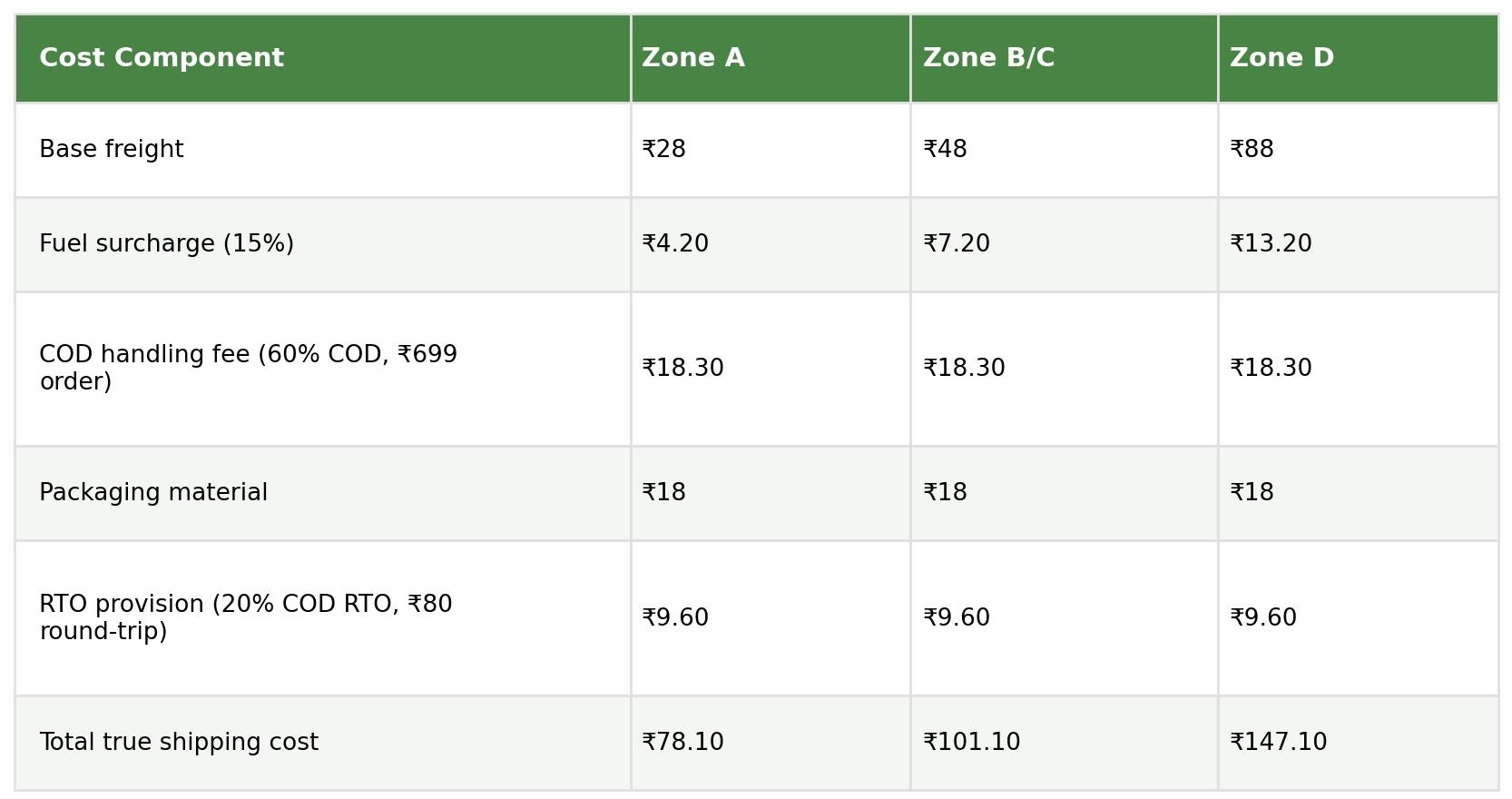
Key insight: On a ₹699 product, the shipping cost difference between Zone A and Zone D is ₹69. If your gross product margin is ₹200, offering free shipping costs you 39% of margin on Zone A orders and 74% on Zone D orders. Zone D free shipping is margin-destructive for most products at this price point.
Step 3: Choose the Right Shipping Pricing Model
There are four models. Each suits a different business type and margin structure.
Model 1: Free Shipping on All Orders
Build the blended average shipping cost into your product price. The customer sees one price, shipping included.
When it works: High-margin products (above 60% gross margin), geographically concentrated customer base (most orders Zone A/B), or products priced high enough that the shipping cost is a small percentage of price
When it breaks: Low to mid-margin products, geographically distributed customers, high COD ratio, or high Zone D/E order volume
How to price: Calculate your weighted average shipping cost across all zones weighted by your order volume distribution. Add this to your base product price.
Model 2: Free Shipping Above a Threshold
The most common model in Indian D2C. Free shipping for orders above ₹499 or ₹799. Paid shipping below.
When it works: Increases average order value. Filters out lowest-value orders that are most margin-destructive. Most buyers understand and accept the threshold.
How to set the threshold: Your threshold should be the point at which your product margin can absorb the blended average shipping cost and still deliver an acceptable net margin. For most mid-margin products, this is ₹599 to ₹799.
Zone problem: Free shipping above ₹699 still costs you ₹147 on a Zone D COD order if the order is ₹699. Consider a Zone-based threshold or Zone surcharge for very remote pincodes.
Model 3: Flat Rate Shipping
One shipping fee for all orders regardless of zone or weight. Simple for customers. You absorb zone variability.
When it works: Geographically concentrated customer base where zone variability is low. Businesses where simplicity of the customer experience is the priority.
How to price: Set the flat rate at your average shipping cost across your actual order zone mix - not the cheapest zone. If 40% of orders are Zone D and your Zone D cost is ₹147, a ₹60 flat rate means you absorb ₹87 per Zone D order.
Model 4: Calculated Shipping (Actual Cost Passed Through)
The customer pays the actual shipping cost for their pincode and order weight, calculated at checkout.
When it works: B2B businesses where buyers expect to pay actual freight. Businesses with very wide product weight range where flat rate creates winners and losers. International shipping.
When it does not work: Consumer D2C where checkout surprise on shipping cost is the leading cause of cart abandonment. Not recommended for most consumer-facing Indian D2C brands.
Step 4: Handle Zone D and ODA Orders Separately
Zone D and Zone E shipping costs are high enough to be margin-destructive on low to mid-price products. Options for handling them: ODA surcharges and zone-based pricing explains how these costs appear and how to factor them in.
- Zone surcharge: Add a visible surcharge for delivery to Zone D/E pincodes at checkout. '₹60 surcharge applies for delivery to remote locations.' Transparent and recovers cost without blanket price increase.
- Minimum order for remote delivery: Set a higher free shipping threshold for Zone E pincodes. Free shipping above ₹499 for metros, free shipping above ₹999 for remote pincodes.
- Prepaid discount to offset zone cost: Offering a ₹50 prepaid discount on Zone D orders eliminates the COD handling fee and reduces RTO exposure - recovering part of the zone cost through improved order economics.
The Pricing Formula: Building It All Together
For a product with ₹150 COGS, target 40% net margin after all logistics costs:
Target selling price calculation: COGS + logistics costs (blended) + target net margin
Blended logistics cost (example): ₹98 average across zone mix including freight, surcharge, packaging, COD fee, and RTO provision
Target 40% net margin on ₹X: 0.40 x X = X - ₹150 COGS - ₹98 logistics = X - ₹248. Solve: X = ₹248 / 0.60 = ₹413. Round to ₹449 or ₹499.
This is the minimum price to achieve your target margin. If the market will not bear this price, the options are: reduce COGS, reduce logistics cost (better courier rates, lower RTO), reduce packaging cost, or accept a lower margin.
How iCarry® Reduces the Logistics Cost Side of the Equation
iCarry® is a courier aggregator that gives Indian businesses pre-negotiated rates across multiple courier partners from the first shipment. Lower freight cost directly expands the margin available in your pricing model.
- Rate comparison before every booking: Ensure you are always on the best available rate for each order's specific zone and weight. Compare rates before booking - a ₹15 saving per order on 500 daily orders is ₹27.4 lakh per year
- Delivery Boost and RTO reduction: Every percentage point of RTO reduction at 500 monthly COD orders and ₹80 round-trip freight saves ₹400 per month. Lower RTO = lower RTO provision in your pricing model = more margin or lower required selling price
- Free Bronze plan: No monthly fee, no minimum - pre-negotiated rates from day one reduce your blended logistics cost without any volume threshold
Register free at iCarry® today.
Final Thoughts
Shipping pricing is not a marketing decision. It is a margin engineering decision that must be made with real numbers - your actual zone mix, your actual COD ratio, your actual RTO rate, your actual packaging cost. A free shipping offer built on assumptions instead of data quietly destroys margin at every order.
Calculate first. Price second. Review every quarter as your zone mix and order volume evolves. The businesses with the healthiest margins are not necessarily the ones with the lowest prices - they are the ones who know exactly what each order costs and have priced for it.
Frequently Asked Questions (FAQs)
Should I offer free shipping for my Indian D2C brand?
Only if your margins support it after modelling the full shipping cost including freight, fuel surcharge, COD handling fee, packaging materials, and RTO provision by zone. Free shipping above a threshold (typically ₹499 to ₹799) is a more sustainable model for most mid-margin Indian D2C brands than blanket free shipping on all orders.
How do I calculate my true shipping cost per order?
True shipping cost = Base freight + Fuel surcharge (15% of base) + COD handling fee (if COD order) + Packaging material cost + RTO provision (RTO rate x round-trip freight). Calculate separately for each zone that represents more than 10% of your order volume - not a single blended average, which hides the Zone D problem.
What is the right free shipping threshold for my business?
Set the threshold at the order value where your product gross margin can absorb the blended average shipping cost and still deliver acceptable net margin. For most mid-margin Indian D2C products, this is ₹599 to ₹999. Model it: at your threshold price, subtract COGS, blended shipping cost, and payment gateway fee. If what remains is above your minimum acceptable margin, the threshold works.
How does RTO rate affect my shipping pricing?
Every RTO costs forward freight plus return freight with zero revenue. At 20% RTO on COD orders and ₹80 round-trip freight, you are paying ₹16 in RTO provision per COD order dispatched - before the order even delivers. Reducing RTO by 5 percentage points removes ₹4 from your effective per-order cost, either improving margin or allowing a lower selling price.
How does iCarry® help with shipping cost management for pricing?
iCarry® provides pre-negotiated bulk rates across multiple courier partners from the first shipment - reducing your base freight cost without volume thresholds. Rate comparison before every booking ensures you never pay above the best available rate. Delivery Boost reduces RTO, lowering the RTO provision that must be built into your pricing model.
Shipping pricing is not a marketing decision - it is a margin engineering decision. The true per-order cost includes freight, fuel surcharge, COD handling fee, packaging, and RTO provision, and it varies sharply by zone. A blended average hides where the Zone D and Zone E orders are quietly destroying margin. Calculate first, choose the pricing model that fits your margin and geography, and review every quarter as your zone mix shifts. The businesses protecting their margins are the ones who know exactly what each order costs before they price it.