A customer orders a custom hoodie from your store. Your page promised 5-day delivery, but printing takes 2 days and the courier takes 6. The parcel arrives on day 8, and the customer is already asking for a refund.
What Is Print-on-Demand in India?
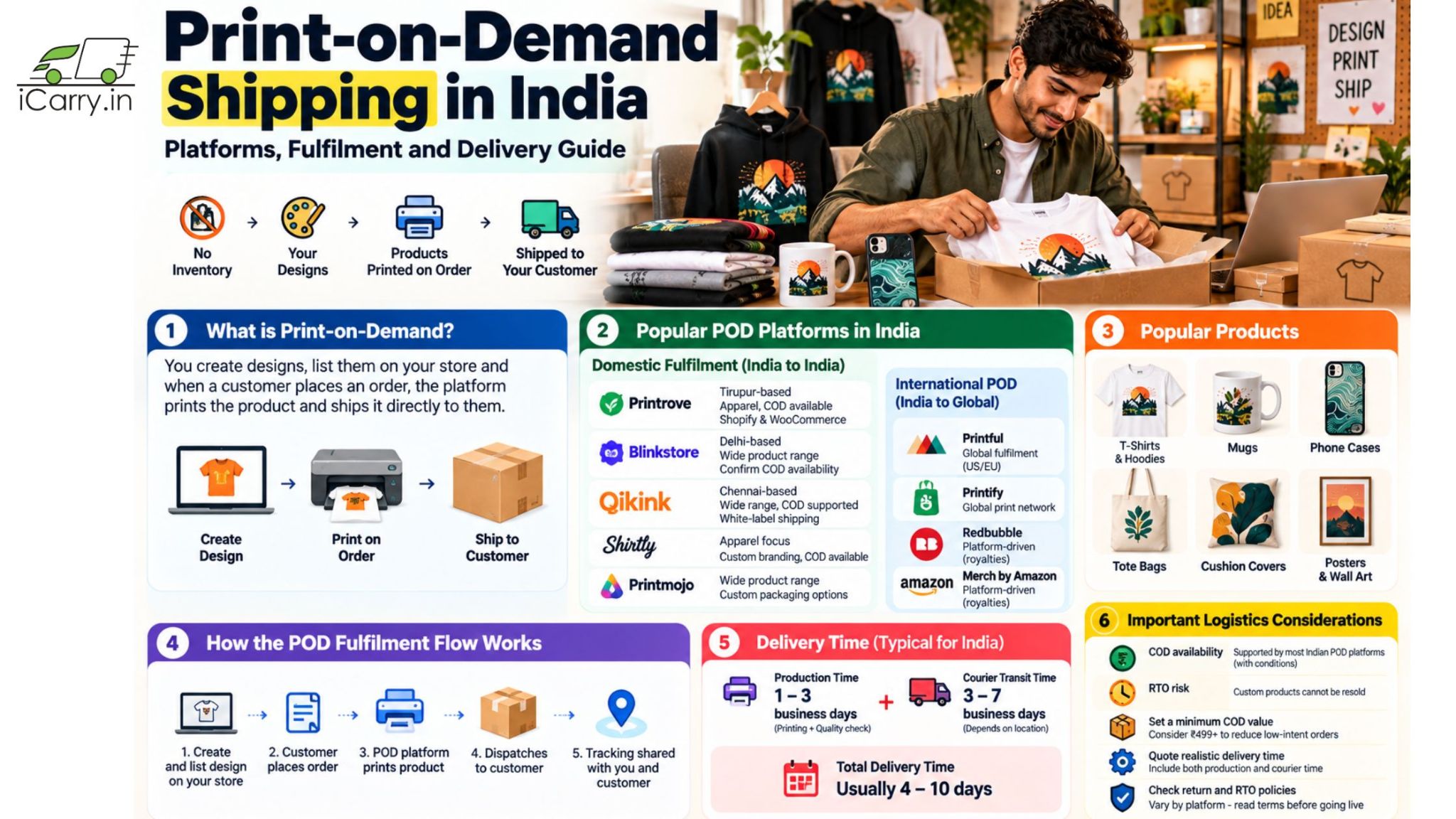
Print-on-demand (POD) is a fulfilment model where products are manufactured only when an order is placed - no inventory, no upfront stock investment. The seller creates designs, lists them on a store, and when a customer orders, the POD platform prints the product and ships it directly to the customer.
The model has grown significantly in India, driven by the growth of online selling, with an estimated 1.5 to 2.5 million MSMEs already online. T-shirts, hoodies, mugs, phone cases, tote bags, cushion covers, and posters are the most common POD categories. For creators, influencers, and niche brand builders, POD eliminates inventory risk entirely.
Print-on-Demand Platforms Operating in India
Domestic Fulfilment (India to India)
- Printrove: Strong on apparel - t-shirts, hoodies, polos. Integrates with Shopify and WooCommerce. COD available on its paid Business plan. Pan-India delivery via courier partners
- Blinkstore: Wide product range including apparel, mugs, phone cases, stationery. Shopify and WooCommerce integration. Prepaid orders. COD was not offered at last check, so confirm before you rely on it
- Qikink: Very wide product range. COD supported. White-label shipping - your brand name on labels. Strong Shopify integration
International POD (India to Global)
- Printful: US-headquartered with global fulfilment. No India-based fulfilment but used by Indian creators selling to international buyers. Products shipped from US or EU facilities to international customers
- Printify: Global print network. Indian sellers can connect to international print partners and sell globally. No domestic India fulfilment
- Redbubble / Amazon Merch on Demand: Platform-driven. Indian designers upload and earn royalties. Fulfilment handled entirely by the platform. No direct shipping management required from the seller
The POD Fulfilment Flow
- Step 1: Seller creates design and lists product on their Shopify, WooCommerce, or marketplace store
- Step 2: Customer places order. Payment collected by the seller's store
- Step 3: Order automatically forwarded to the POD platform via API integration
- Step 4: POD platform prints and dispatches directly to the customer
- Step 5: Tracking information is returned to the seller's platform and forwarded to the customer
The seller never touches the physical product. The entire logistics loop runs through the POD platform's own courier arrangements.
Key Logistics Considerations for Indian POD Sellers
COD Availability
COD is critical for Indian D2C commerce. COD support differs sharply between domestic Indian POD platforms, so check the terms before you commit:
- COD terms differ by platform: some charge a per-order COD fee, and some offer COD only on a paid plan
- COD remittance timelines vary by platform - verify before going live
- COD increases RTO risk on custom-printed products (which cannot be resold if returned). RTO policies differ, with some platforms charging a fee and others not, so check before going live
- Consider restricting COD to orders above ₹499 to reduce low-intent COD volume, because a returned custom print cannot be resold
Dispatch and Transit Time
POD adds a production time to the standard courier transit time:
- Production time: 1 to 3 business days for most POD platforms (printing + quality check)
- Courier transit: 3 to 7 days depending on zone
- Total customer-facing delivery time: 4 to 10 days. This must be clearly communicated in your store's shipping policy
The mistake: Listing standard '3 to 5 day delivery' without accounting for production time. A customer who expects 5 days and receives in 8 is dissatisfied. A customer who was told 7 to 10 days and receives in 8 is happy.
Shipping your own bestsellers? Check courier rates and zones with the iCarry® domestic rate calculator, so your delivery promise matches reality.
Packaging and Branding
Most Indian POD platforms offer white-label shipping - your brand name on the shipping label and outer packaging rather than the POD platform's name. This is the standard expectation for a branded POD business:
- Ask your POD platform whether white-label shipping is included or an add-on
- Some platforms offer custom-branded inner packaging (branded tissue, stickers, thank-you cards) for a per-order fee
- For a premium customer experience, branded packaging significantly outperforms plain courier packaging at the price premium POD products typically command
Returns and Exchanges on POD Products
POD products are produced specifically for the buyer - they cannot be restocked and resold. Your returns policy needs to reflect this:
- Standard policy: returns accepted only for print defects or courier damage - not for size dissatisfaction or change of mind. India's Consumer Protection (E-Commerce) Rules, 2020 also bar sellers from refusing a refund when goods are defective, do not match the listing, or arrive after the promised date, so only promise delivery times you can meet
- Size exchanges: offer only when the POD platform confirms they will reprint at their cost for wrong size shipped. If the customer chose the wrong size, the cost of reprinting is on the seller
- Display your returns policy prominently in your store - POD buyers who understand the made-to-order nature accept limited returns readily
How to Set Up Shipping for Your POD Store
- Pick a platform that fits: Compare COD, white-label and store integration first, since these differ a lot between platforms
- Order a sample: Check print quality and packaging yourself, because you cannot inspect any customer order before it ships
- Add production time to your promise: Quote 4 to 10 days, not courier transit alone, so late-delivery refund claims stay rare
- Set a COD rule: Use a ₹499 minimum or prepaid only, since a returned custom print cannot be resold
- Publish a made-to-order returns policy: Cover print defects and courier damage, so buyers know the terms before they pay
- Plan your switch point: Move a design to own stock at 100+ units a month, when bulk printing becomes cheaper
When to Run Your Own Fulfilment vs POD
- Use POD when: You are testing designs, have no upfront capital for inventory, are selling niche or limited-edition products, or want zero inventory risk
- Switch to own fulfilment when: You have 3 to 5 consistently bestselling designs that justify bulk printing. Per-unit cost drops significantly with bulk printing vs POD per-unit pricing. At 100+ monthly units of the same design, own inventory is almost always cheaper
- Hybrid model: Run bestsellers from your own inventory via iCarry®. Use POD for new designs and long-tail products. This optimises cost on proven SKUs while maintaining zero risk on experimental ones
How iCarry® Complements a POD Operation
If you transition from print-on-demand (POD) to holding inventory for your bestselling designs, iCarry® provides shipping infrastructure to help manage fulfilment as your business grows.
- Multiple courier partners: Compare available courier options and shipping rates through one account.
- eCommerce integrations: Connect your online store through supported integrations, including Shopify, to simplify order processing and shipping workflows.
- WooCommerce support: If you sell through WordPress and WooCommerce, explore available integration options to streamline shipment management.
- COD management: Manage cash-on-delivery collections and settlements across courier partners, with automatic T+7 settlement and Early COD options from T+0.
- Bulk booking: Process multiple shipments using Excel or CSV uploads as your order volume increases.
- Rate comparison: Compare courier rates before booking to help manage shipping costs for your own-inventory orders.
- Free Bronze plan with no minimum shipment volume. Register at iCarry
Whether you sell through Shopify, WooCommerce, or other supported sales channels, iCarry® can help simplify shipping as you expand beyond POD fulfilment.
Frequently Asked Questions (FAQs)
Is COD available on print-on-demand platforms in India?
Qikink offers COD, and Printrove offers it on its paid Business plan. Blinkstore did not offer COD at last check. Conditions vary - some platforms charge a per-order COD fee, and RTO on POD products is costly since custom-printed items cannot be resold. Consider restricting COD to orders above ₹499 to reduce low-intent COD volume.
How long does print-on-demand delivery take in India?
Total delivery time is production time plus courier transit time. Production typically takes 1 to 3 business days. Courier transit is 3 to 7 days depending on the destination zone. Total customer-facing delivery time is 4 to 10 business days. Always communicate this in your shipping policy - do not quote courier transit times alone without adding production time.
Can I put my own brand name on print-on-demand shipments?
Yes, through white-label shipping. Most Indian POD platforms offer white-label options where your brand name appears on the shipping label and packaging rather than the platform's name. Some platforms include this by default; others charge a small per-order premium. Custom branded inner packaging (tissue, stickers, branded cards) is typically an add-on available from most platforms.
When should I switch from POD to my own inventory?
When you have 3 to 5 designs consistently selling 100+ units per month, bulk printing your own inventory becomes cheaper than POD per-unit pricing. Calculate the break-even point: compare your POD per-unit cost against (bulk print cost + shipping cost via iCarry® + packaging cost) at your expected monthly volume. For most Indian POD brands, the switch to own inventory for bestsellers is financially justified at around 100 units per month per design.
Print-on-demand lets you sell without holding stock, but it adds 1 to 3 days of production to courier transit, so quote 4 to 10 days. Check COD terms platform by platform, restrict COD on custom prints, publish a made-to-order returns policy, and move a design to your own inventory once it reaches around 100 units a month.