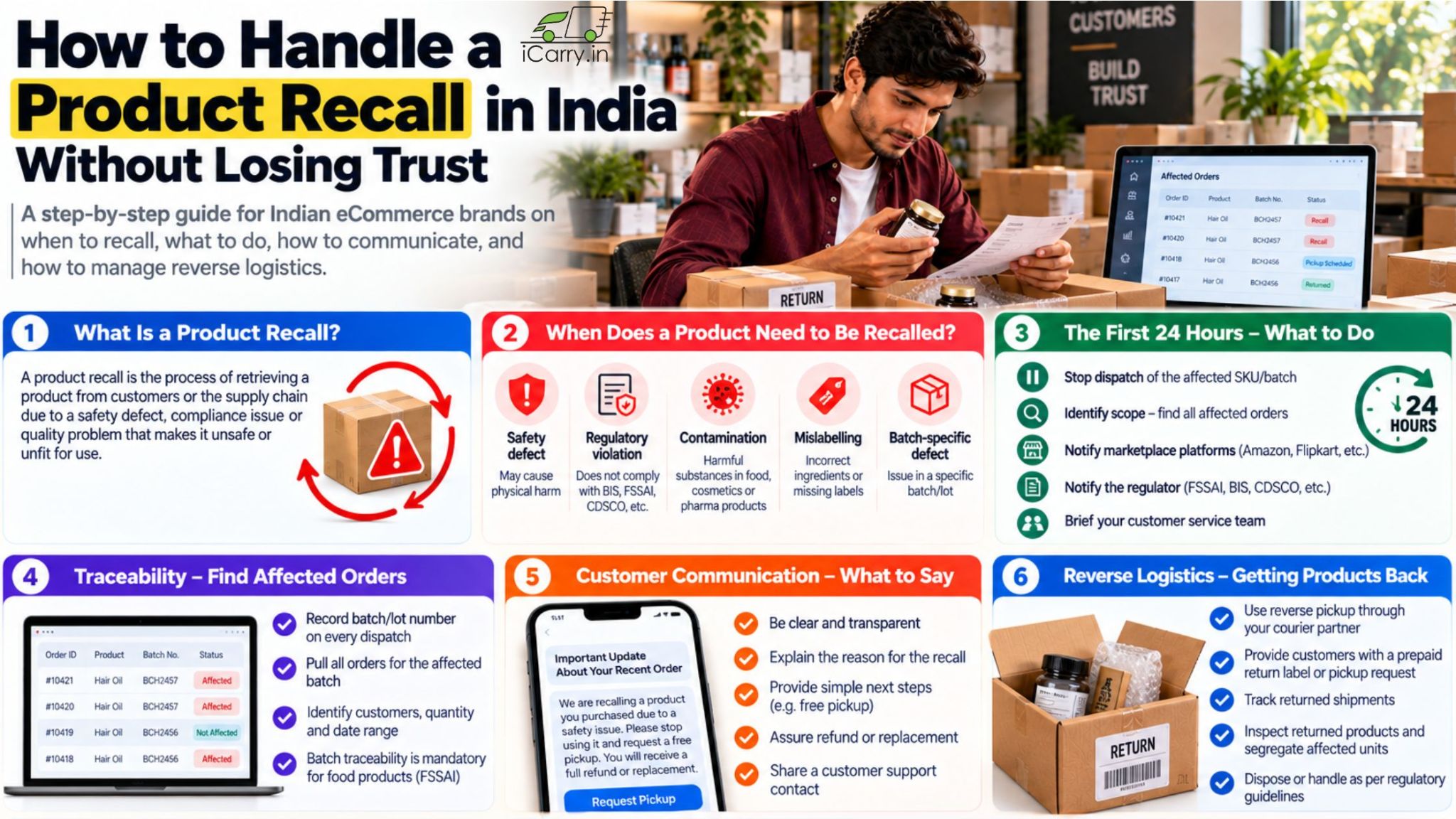
What Is a Product Recall?
A product recall is the process of retrieving a product from customers or the supply chain due to a safety defect, compliance violation, or quality issue that makes it unsafe or unfit for its intended use. Recalls range from voluntary (brand-initiated before regulators intervene) to mandatory (ordered by a regulatory authority).
In Indian eCommerce, recalls are most common in food and FMCG (FSSAI-regulated), toys and baby products (BIS-regulated), electronics (BIS and CDSCO), and cosmetics (CDSCO). Indian consumer protection law under the Consumer Protection Act, 2019 also creates recall obligations when a product defect poses risk to consumers.
When Does a Product Need to Be Recalled?
- Safety defect: Product causes or could cause physical harm. Mandatory recall under consumer protection and product-specific regulations
- Regulatory violation: Product does not comply with BIS, FSSAI, CDSCO, or other applicable standards. Regulator may order recall or business may initiate voluntarily to avoid enforcement action
- Contamination: Food, cosmetics, or pharmaceutical product contaminated with harmful substances. FSSAI can order mandatory recall and market withdrawal
- Mislabelling: Incorrect allergen information, wrong ingredient list, or missing mandatory label fields - particularly serious for food and pharmaceutical products
- Batch-specific defect: Manufacturing error in a specific batch. Recall limited to affected batch numbers - makes traceability critical
How to Respond in the First 24 Hours of a Recall
- Stop dispatch: Immediately halt all dispatch of the affected SKU or batch. Place affected warehouse stock in quarantine (a separate marked zone, not accessible for picking)
- Identify scope: Pull all order records for the affected SKU and batch number. How many units shipped? To how many customers? Over what date range? This data drives every subsequent decision
- Notify marketplace platforms: If the product is listed on Amazon, Flipkart, or other marketplaces, notify them immediately. Marketplaces have their own recall protocols and will delist the product pending investigation
- Notify the regulator: For food recalls, inform FSSAI immediately - the CEO, FSSAI for central licences or your State Commissioner of Food Safety for state licences - as the FSS (Food Recall Procedure) Regulations, 2017 require. For toys and electronics, notify BIS if the recall relates to certified products. Voluntary notification before regulatory discovery reduces penalty risk significantly
- Brief your customer service team: Before the first customer communication goes out, your customer service team must know what happened, what the resolution is, and what customers should do. Uninformed CS teams amplify the crisis
Traceability - Why Batch Numbers Matter
The difference between recalling 200 units and recalling 20,000 units is your batch tracking capability. A business that records batch numbers on every order dispatch can identify exactly which customers received affected products. A business with no batch tracking must recall every unit of every shipment of that SKU.
- Record batch/lot number on every dispatch - either in your order management system or in your courier aggregator booking data
- For food products, batch and lot traceability records are an FSSAI requirement under the Food Recall Procedure Regulations, not optional; pharmaceutical products fall under CDSCO rules instead
- Pre-upload product images per batch to your courier aggregator for evidence and recall documentation purposes
- When a defect is identified, the batch number immediately defines the recall scope - without it, the scope is unlimited
Customer Communication - What to Say and When
The Initial Recall Communication
Speed and clarity are the two requirements. Delay amplifies the problem. Vagueness amplifies distrust.
- Contact every affected customer within 24 to 48 hours of the recall decision
- Channel: WhatsApp first (highest open rate), email second, phone for high-risk or high-value situations
- Message should include: What the product is, what the issue is (be honest - a vague 'quality concern' frustrates customers), what the customer should do (stop using / return), what the business will do (full refund, free pickup, replacement)
- Do not minimize the issue or use legal language that obscures the problem. Plain, direct communication preserves more trust than corporate hedging
Communication Template
Subject: Important Notice - [Product Name] Recall
Hi [Name],
We are writing to inform you that we are recalling [Product Name] from batch [Batch Number], which you purchased on [Date].
We have identified [brief description of issue - e.g. 'a labelling error on the allergen information']. While [risk level - e.g. 'there have been no reported incidents'], we are taking this step out of caution for your safety.
Please stop using the product immediately.
We will arrange a free pickup from your address and process a full refund within [X days] of return.
To initiate the return, reply to this message with your address or call us at [number].
We sincerely apologise for this inconvenience. [Your brand name] takes product safety seriously and we are working to ensure this does not happen again.
Reverse Logistics for a Recall
- Book reverse pickups proactively: Do not wait for customers to initiate. For a safety-related recall, book reverse pickups for all affected customers and communicate the pickup date
- Batch the reverse pickups by zone: Recalls generate concentrated reverse logistics volume. Batch by zone and coordinate pickup volume with your courier aggregator in advance
- Inspect recalled products on return: Confirm defect, document, and quarantine. Do not restock recalled products
- Process refunds within committed timeline: The refund timeline stated in your recall communication must be honoured. Delayed refunds after a recall are the fastest route from a customer who accepted the situation to a customer who files a consumer complaint
How iCarry® Supports Product Recalls
iCarry® is a courier aggregator that supports the reverse logistics leg of product recalls.
- Reverse pickup booking: Book reverse pickups for all affected customers from the iCarry® dashboard. Filter orders by SKU and date range to identify affected shipments
- Batch booking for recall volume: Process all recall reverse pickups as a batch rather than individual bookings
- Order history and traceability: iCarry®'s My Shipments history provides dispatch records by SKU, date, and AWB - the data needed to identify affected orders quickly
- Multiple courier partners: Book recall pickups through whichever courier partner serves each customer's pincode, all from the same account, so customers in hard-to-reach areas are not left waiting on one network
Frequently Asked Questions (FAQs)
Is a product recall mandatory in India?
Mandatory recalls can be ordered by FSSAI for food products, BIS for certified products, CDSCO for cosmetics and medical devices, and under the Consumer Protection Act, 2019 for any product posing consumer safety risk. Voluntary recalls initiated by the business before regulatory action typically result in lower penalties and better brand outcomes than recalls forced by regulatory order.
How do I identify which customers received the recalled batch?
From your order management system or courier aggregator shipment records, filter all orders of the affected SKU within the batch's dispatch date range. If you recorded batch numbers at dispatch (as required for food products under FSSAI), you can identify the exact affected orders. Without batch tracking, you must recall all dispatches of that SKU within the potential affected period.
What should I include in a product recall customer communication?
The product name, the specific batch or lot number affected, the nature of the issue in plain language, the risk level, what the customer should do (stop using, return), and what you will do (free pickup, full refund within a specific timeframe). Speed and clarity are more important than perfect legal language. Contact affected customers within 24 to 48 hours of the recall decision.
How quickly must I process refunds during a product recall?
Whatever timeline you communicate in your recall notice must be honoured. Typically 5 to 7 business days from product return is the standard commitment. For high-risk safety recalls where customers must stop using the product immediately, consider issuing the refund before the physical return is received - the goodwill generated significantly outweighs the small percentage of customers who may not return the product.
Stop dispatch and quarantine affected stock, define the recall scope by batch number, notify marketplaces and the regulator, contact every affected customer within 24 to 48 hours, book reverse pickups proactively, and honour the refund timeline stated in your recall communication.