
Why Stockouts and Overstock Both Hurt
A bestseller goes out of stock on a Friday before a sale weekend. Orders are lost, ad spend is wasted, and customers go to a competitor. A few months later, the same brand has cash locked in slow SKUs and a full warehouse. Both problems come from the same cause: reordering by feel instead of by number.
Safety stock and reorder point are two simple numbers that tell you when to reorder and how much cushion to hold. As D2C order volumes grow, they replace guesswork with a rule your team can follow every week.
What Are Safety Stock and Reorder Point?
Safety stock is the extra inventory you keep to cover surprises such as a demand spike or a late supplier. The reorder point is the stock level at which you place a new order. Together they tell you when to reorder and how much cushion to hold.
Key Terms in Plain Language
- Lead time: Days between placing a purchase order and the stock being ready to sell at your warehouse
- Average daily sales: Units sold per day on a normal day, for a specific SKU
- Safety stock: Extra units kept to cover surprises, such as a demand spike or a late supplier
- Reorder point (ROP): The stock level at which you place a new order
- Stockout: A situation where you have no stock to fulfil orders
- Days of cover: How many days current stock will last at normal sales
The Reorder Point Formula
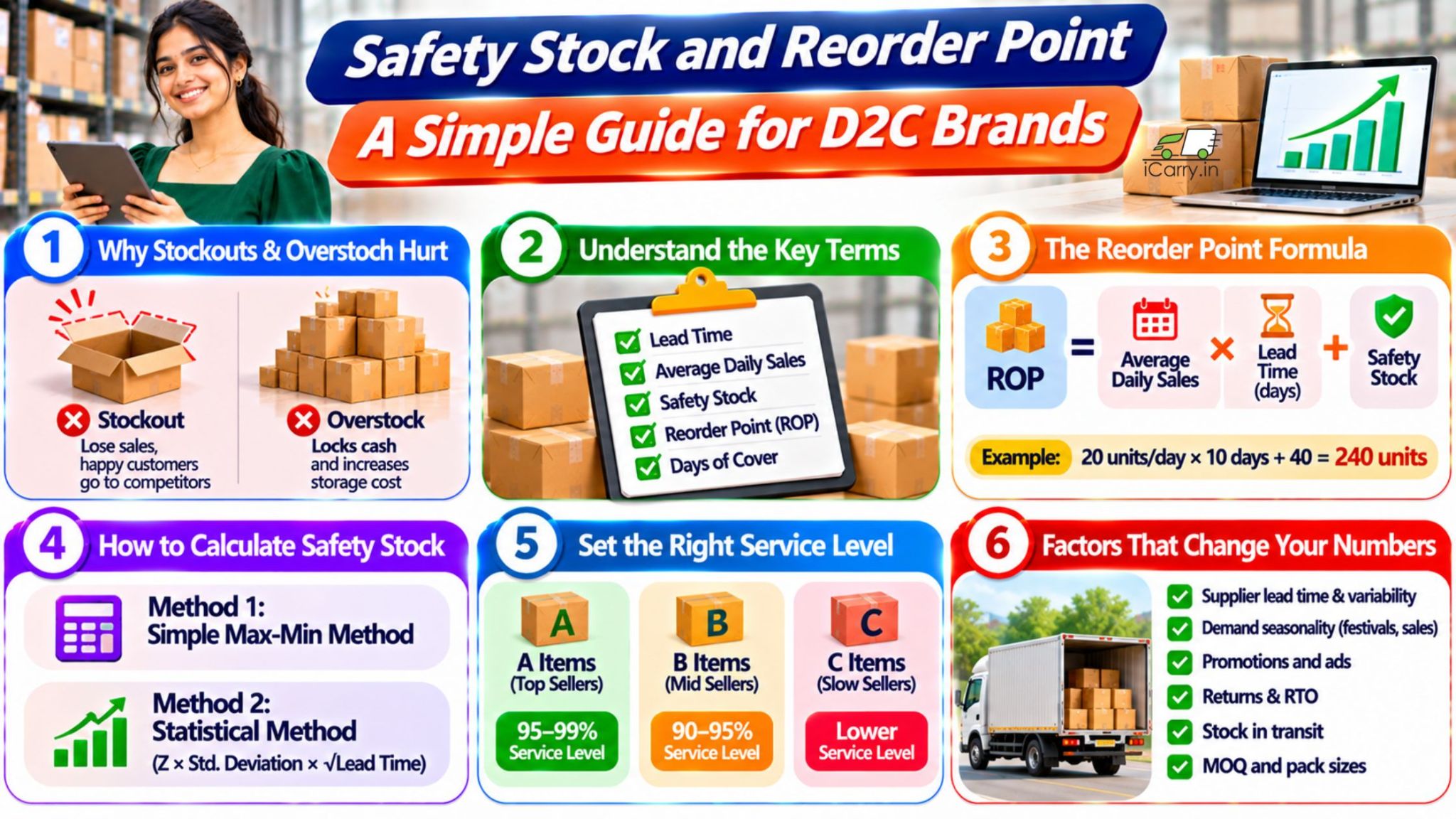
Reorder point = (Average daily sales x Lead time in days) + Safety stock
The first part covers normal demand while you wait for the new stock. The second part is your cushion for things going wrong.
Example: A SKU sells 20 units a day on average. Supplier lead time is 10 days. Demand during lead time is 20 x 10 = 200 units. If safety stock is 40 units, the reorder point is 200 + 40 = 240 units. When stock falls to 240, place the order.
How to Calculate Safety Stock
Method 1: Simple Max-Min Method
Safety stock = (Maximum daily sales x Maximum lead time) - (Average daily sales x Average lead time)
- Look at your highest daily sales in a normal period and your longest supplier lead time
- Example: Maximum daily sales 30, maximum lead time 14 days, average daily sales 20, average lead time 10 days
- Safety stock = (30 x 14) - (20 x 10) = 420 - 200 = 220 units
- This is cautious. It covers the worst case on both demand and lead time at the same time, so it can lead to overstock for slow SKUs
Method 2: Statistical Method
Safety stock = Z x Standard deviation of daily demand x Square root of lead time
- Z value: Depends on the service level you want. Around 1.28 for 90 percent, 1.65 for 95 percent and 2.33 for 99 percent
- Standard deviation: A measure of how much daily sales vary. A spreadsheet can calculate it from your daily sales
- Example: Z of 1.65, standard deviation of 5 units, lead time 10 days. Safety stock = 1.65 x 5 x 3.16 = about 26 units
- Reorder point = 200 + 26 = about 226 units
- This method is more precise when you have clean sales data and fairly stable lead times
Decide the Service Level by SKU Importance
- A items (top sellers): Aim for a high service level, such as 95 to 99 percent. A stockout here costs the most
- B items (mid sellers): A moderate service level, such as 90 to 95 percent
- C items (slow sellers): A lower service level, or order on demand. Do not tie up cash in cushion for slow SKUs
Inputs That Change Your Numbers
- Supplier lead time: Use real delivery times from past orders, not what the supplier promises
- Lead time variability: A supplier that is sometimes 7 days and sometimes 15 needs more safety stock
- Demand seasonality: Festivals, sales and seasons raise daily sales. Recalculate before peak periods
- Promotions and ads: Planned campaigns change demand, so add expected uplift to the plan
- Returns and RTO: Returned stock takes time to come back and may not be resellable. Count only sellable stock
- Stock in transit: Include confirmed inbound stock when checking whether to reorder
- MOQ and pack sizes: Your supplier's minimum order quantity may force a larger order than the formula suggests
How to Set Up Safety Stock and Reorder Points for D2C Brands
- Step 1: List your SKUs and rank them by sales, with A, B and C groups
- Step 2: For each A and B SKU, pull the last 60 to 90 days of daily sales
- Step 3: Calculate average daily sales and, if you can, the highest and the typical variation
- Step 4: Record the average and the longest lead time from past purchase orders
- Step 5: Calculate safety stock and reorder point using one of the methods
- Step 6: Add the reorder point to your inventory sheet or system, with an alert when stock hits it
- Step 7: Review monthly and before each peak season
How Much to Order
- A simple order quantity is the demand you expect between now and the next order cycle, plus what is needed to get back above the reorder point
- Many D2C brands order enough for 30 to 60 days of sales for fast sellers, depending on cash, storage and supplier terms
- Avoid ordering large quantities of untested products. Start small and reorder as data comes in
Common Mistakes
- Using the same safety stock for every SKU
- Ignoring lead time variation from suppliers
- Using old sales data, or a quiet month, for a busy period
- Counting damaged, returned or blocked stock as available
- Never reviewing the numbers after setting them
- Treating safety stock as a way to avoid planning, instead of a buffer for real uncertainty
Connect Stock Planning With Shipping Data
- Delivery and RTO patterns affect how much sellable stock you really have
- High RTO on a SKU means more stock returning, and slower availability of sellable units
- Zone-wise sales data helps you plan where stock should be held if you use multiple warehouses
- Late deliveries can raise customer cancellations and change demand patterns
How iCarry® Supports Inventory Planning
iCarry® is a courier aggregator that provides shipping data you can use alongside your inventory planning. It does not manage stock levels.
- Shipment history: Filter and export shipment data from the Shipment Dashboard by status, courier and date range, to see daily dispatch volumes and returns.
- RTO and NDR visibility: See returning orders so you can estimate sellable stock more accurately
- Multiple pickup locations: Ship from different warehouses using the same account if you hold stock in more than one place
Not sure which courier or service suits your orders? Contact iCarry® customer support and we will help.
Frequently Asked Questions (FAQs)
What is the difference between safety stock and reorder point?
Safety stock is the extra buffer you keep for surprises. Reorder point is the stock level at which you place a new order. The reorder point includes the expected demand during lead time plus the safety stock.
How do I calculate reorder point?
Reorder point equals average daily sales multiplied by lead time in days, plus safety stock. For example, selling 20 units a day with a 10-day lead time and 40 units of safety stock gives a reorder point of 240 units.
How much safety stock should a D2C brand hold?
It depends on how variable your demand and supplier lead times are, and how costly a stockout is. Hold more for bestsellers and unreliable suppliers, and less for slow-moving items. Use the max-min or statistical method, and review it regularly.
When should I recalculate my reorder points?
Review them monthly, and recalculate before peak seasons, big sales or when a supplier's lead time changes. Seasonal demand and campaigns can make last month's numbers wrong.
Reorder point is average daily sales times lead time, plus safety stock. Calculate safety stock with the simple max-min method or the statistical method, set service levels by SKU importance, and use real lead times. Review the numbers monthly and before each peak season.