A garment manufacturer in Surat wants to compete with exporters from Bangladesh and Vietnam on price. A software services firm in Chennai needs to reduce the tax burden on foreign earnings. A pharmaceutical company in Hyderabad is scaling exports and looking for a way to import raw materials duty-free.
All three are looking at the same solution: a Special Economic Zone.
India's Special Economic Zones (SEZs) were designed to give export-oriented businesses a competitive edge - through tax benefits, simplified customs procedures, and world-class infrastructure - within a defined geographic boundary. The SEZ framework has been one of India's primary tools for boosting exports since the SEZ Act was enacted in 2005, and it remains relevant for businesses serious about building or scaling an export operation.
This guide explains what SEZs and Free Trade Zones are, how they differ, what benefits they offer Indian exporters, and what the practical requirements are for setting up or sourcing from within one.
What Is a Special Economic Zone (SEZ)?
A Special Economic Zone (SEZ) is a geographically defined area within India that operates under a separate regulatory and tax framework from the rest of the country. Businesses operating within an SEZ are treated as if they are outside India's domestic territory for customs and certain tax purposes - allowing them to import duty-free and operate with significant tax concessions.
Think of an SEZ as a country within a country. The SEZ boundary separates the Domestic Tariff Area (DTA - the rest of India) from the SEZ. When goods move from the DTA into the SEZ, it is treated as an export. When goods move from the SEZ out to international buyers, the export happens with streamlined customs procedures.
India currently has around 276 operational SEZs across states including Maharashtra, Tamil Nadu, Andhra Pradesh, Karnataka, Telangana, Gujarat, and Rajasthan - spanning sectors from IT/ITES and jewellery to textiles, pharmaceuticals, and engineering goods.
What Is a Free Trade Zone (FTZ)?
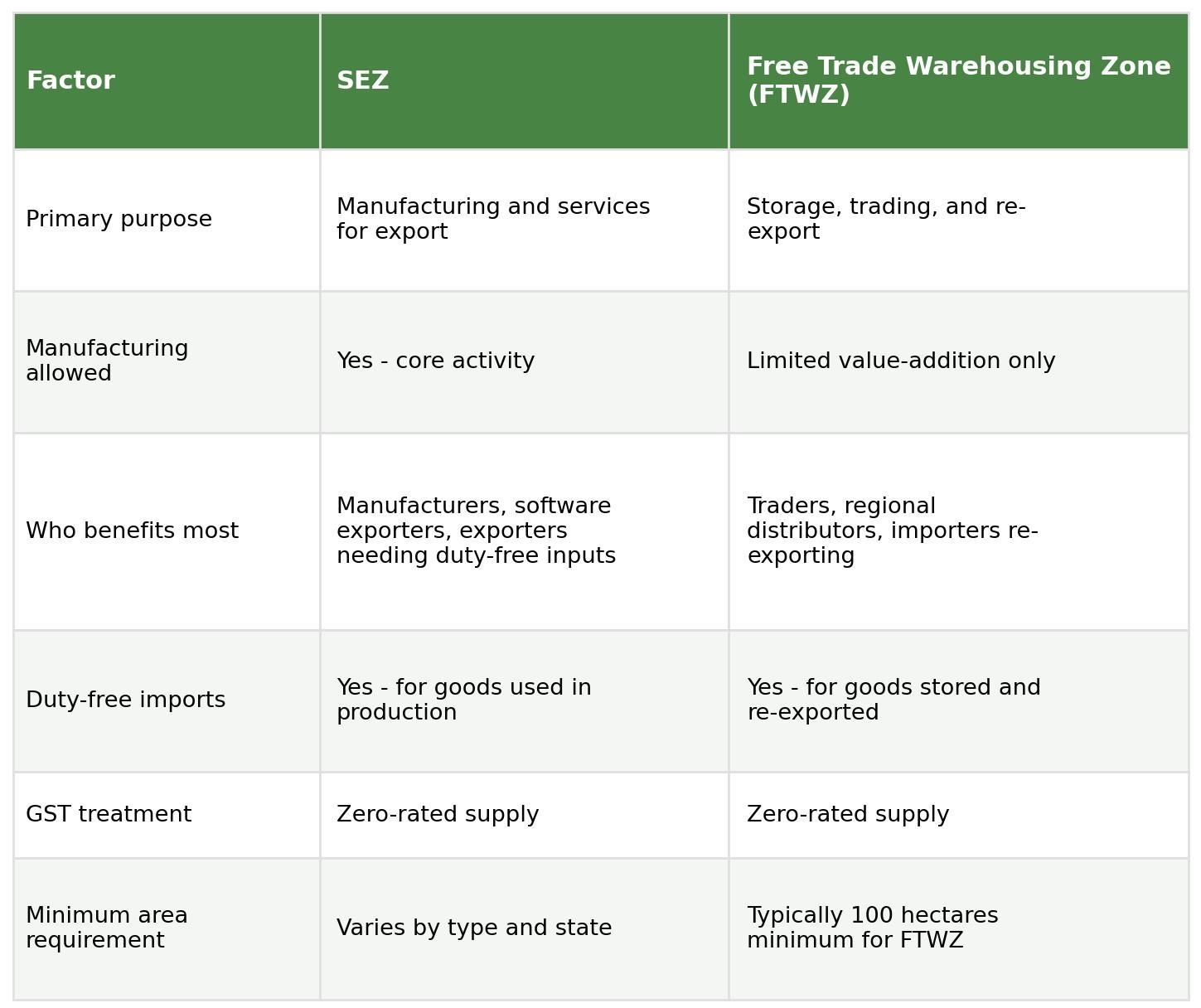
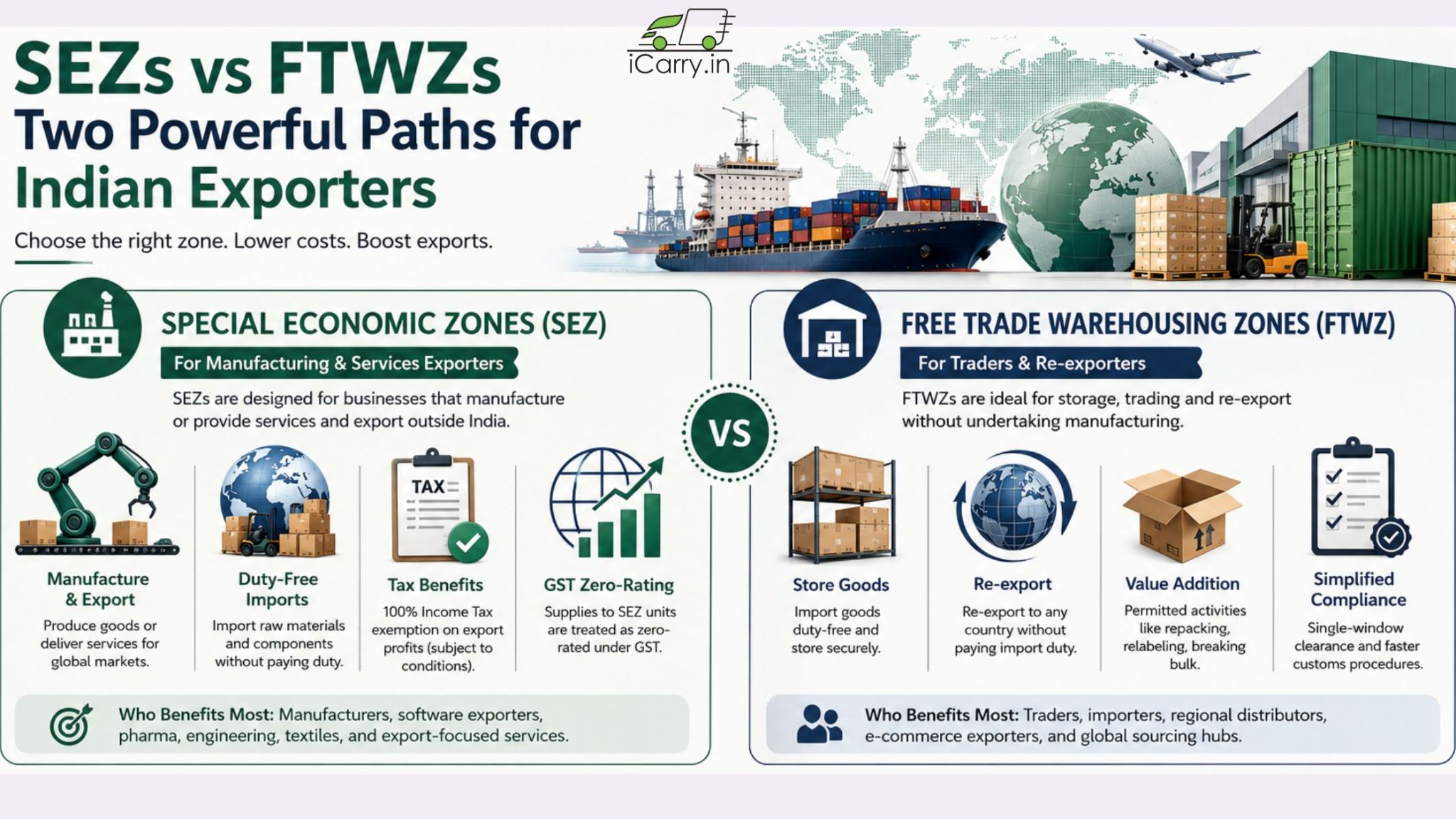
A Free Trade Zone (FTZ) or Free Trade Warehousing Zone (FTWZ) is a related but distinct concept. Where an SEZ is designed for manufacturing and services units that export, an FTWZ is specifically designed for storage, trading, and re-export of goods - without manufacturing being required.
An FTWZ allows businesses to:
- Import goods duty-free and store them
- Re-export to third countries without paying Indian import duty
- Serve as a regional distribution hub for international trade
- Break bulk, repack, or relabel goods for onward export
How to Tell If an SEZ Is Relevant for You: Quick Checklist
- Do you export goods or services and want to reduce your income tax liability on export profits?
- Do you import raw materials or components for manufacturing products that are then exported?
- Is your business primarily export-oriented - at least 50% of output sold outside India?
- Do you want faster customs clearance and single-window compliance for your export operations?
- Are you evaluating locations for a new manufacturing or services facility with long-term export intent?
Key Benefits of Operating in an SEZ
1. Income Tax Exemption on Export Profits
Units operating in SEZs can claim income tax deductions on profits from export activities under Section 10AA of the Income Tax Act. New SEZ units get 100% deduction on export profits for the first 5 years, 50% for the next 5 years, and 50% of reinvested profits for the subsequent 5 years.
Important: The Minimum Alternate Tax (MAT) and Dividend Distribution Tax were made applicable to SEZ units in later amendments. The effective tax benefit must be calculated accounting for MAT liability. Consult a tax advisor for the current applicable benefits.
2. Duty-Free Import of Raw Materials and Capital Goods
SEZ units can import raw materials, components, consumables, and capital goods duty-free for use in their manufacturing or services operations. This is particularly valuable for manufacturers who import inputs - the customs duty saving on raw materials can be substantial in import-heavy manufacturing categories like electronics, pharma, and precision engineering.
3. Exemption from GST
Supplies to SEZ units from the domestic tariff area are zero-rated under GST - treated as exports. The SEZ unit itself does not pay GST on domestic purchases used for export production. This eliminates a significant working capital burden - no GST paid upfront waiting for refunds.
4. Simplified Customs Procedures
SEZ units operate under a self-certification model for many compliance requirements, reducing dependence on customs officers for every transaction. Online customs processing, 24/7 customs support at major SEZs, and dedicated customs staff reduce clearance time and compliance overhead significantly compared to DTA operations.
5. Single-Window Clearance
Approvals that would normally require multiple government departments - environment clearance, industrial licence, building plan approval - are processed through a single Development Commissioner office for SEZ units. This reduces approval timelines and administrative complexity for new and expanding units.
6. Infrastructure
Major SEZs provide built-in infrastructure - power, water, roads, warehousing, and connectivity - that reduces the capital investment required to set up a new export manufacturing facility. For businesses expanding to a new state, the infrastructure advantage of an established SEZ can be significant.
How SEZ Exports Work - The Compliance Flow
- Procurement (DTA to SEZ): When a DTA supplier sells goods to an SEZ unit, the supply is zero-rated. The DTA supplier provides goods with a GST invoice showing zero-rated supply, and the SEZ unit receives goods without paying GST
- Manufacturing: Goods are manufactured within the SEZ using the duty-free inputs
- Export from SEZ: When goods are exported, the SEZ unit files a Shipping Bill through the customs officer posted at the SEZ. The ICEGATE system tracks the export
- Let Export Order (LEO): After customs verification, a Let Export Order is issued, authorising the goods to leave the SEZ for shipment
- Proof of export: The shipping bill and bank realization certificate serve as proof of export for tax benefit claims
What Is Net Foreign Exchange (NFE) and Why It Matters
SEZ units must maintain a positive Net Foreign Exchange (NFE) balance. NFE is calculated as:
NFE = Foreign Exchange Earned (exports) - Foreign Exchange Spent (imports and other payments)
A positive NFE means the unit earns more foreign exchange than it spends. This is a compliance requirement for maintaining SEZ unit status. Units that fail to maintain positive NFE over a 5-year period can lose their SEZ unit authorisation and face demands to pay duty on previously imported goods.
NFE is calculated cumulatively over the 5-year SEZ unit authorisation period - a bad year can be offset by good years before and after.
Practical Requirements for Setting Up an SEZ Unit
- Letter of Approval (LOA): Apply to the Development Commissioner of the relevant SEZ. The LOA specifies the approved goods or services, the area allotted, and the NFE commitment
- Bond-cum-Legal Undertaking (BLUT): Execute a BLUT with the Development Commissioner committing to comply with SEZ rules including NFE maintenance and duty-free goods use
- Minimum investment: Varies by SEZ and sector. IT/ITES SEZs often have lower minimum investment thresholds than manufacturing SEZs
- Positive NFE commitment: Demonstrate a business plan that generates positive NFE over the 5-year period
- Zone co-developer or developer approval: Lease or purchase space within the approved SEZ from the SEZ developer
SEZs vs Standard Export Operations - Is the Complexity Worth It?
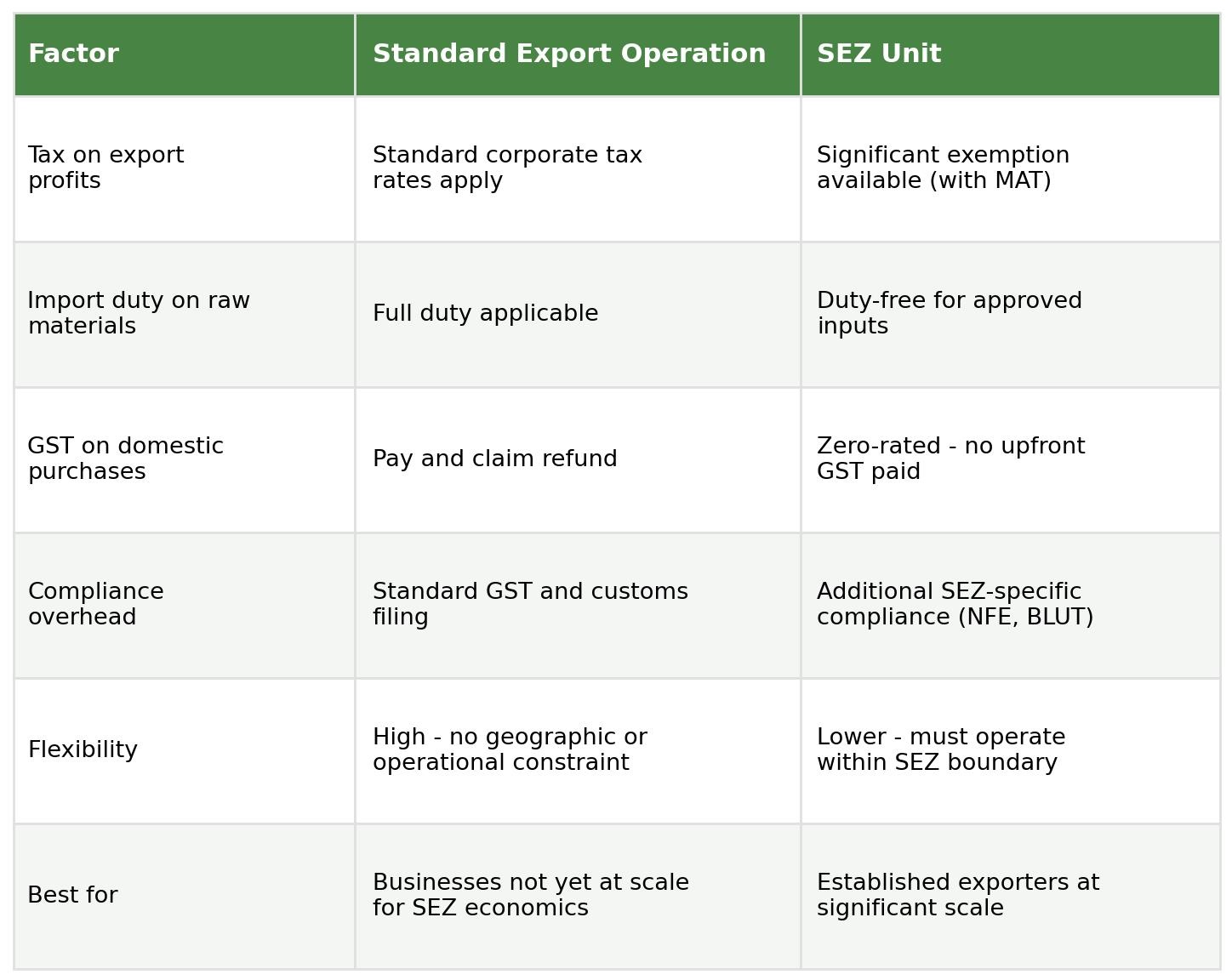
SEZs make sense for established, export-focused businesses where the tax and duty savings justify the compliance and operational overhead. For smaller exporters or businesses where exports are a secondary revenue stream, standard export operations with IEC registration and standard GST refund processes are typically more practical.
How iCarry® Supports Exporter Logistics
iCarry® is a courier aggregator - it does not operate within SEZs or manage SEZ compliance. What iCarry® provides is the courier leg of international exports: FedEx and Aramex access for parcel and express shipments to international buyers, alongside domestic multi-courier shipping from one account.
For exporters operating from SEZs or standard export facilities, iCarry® handles the last-mile logistics from the point goods leave the facility to international delivery:
- International courier access: FedEx and Aramex for parcel-level international exports - D2C orders, product samples, and small B2B consignments
- Rate comparison: Compare international rates before every booking. How to estimate international shipping cost shows the process in iCarry®
- Domestic distribution: Multiple courier partners for any domestic distribution alongside international export operations
- Free Bronze plan: No minimum volume, no monthly fee. Indian exporters at any scale access the same rates from the first shipment
For full details on setting up international shipping from India, the guide on how to ship internationally from India covers IEC registration, customs documentation, and courier selection.
Final Thoughts
SEZs and Free Trade Zones are powerful instruments for Indian exporters at the right scale. The combination of duty-free imports, GST zero-rating, income tax exemption, and simplified compliance can meaningfully improve the economics of export manufacturing and services.
They are not, however, the right solution for every export business. The compliance requirements - NFE maintenance, bond obligations, Development Commissioner oversight - add operational complexity that only pays off at sufficient scale and export orientation.
For businesses evaluating whether to set up an SEZ unit, the starting point is a realistic NFE projection and a tax benefit calculation against current and projected export volumes. For exporters not yet at SEZ scale, the DGFT export registration process and standard IEC-based export operations remain the most practical path to international markets.
Frequently Asked Questions (FAQs)
What is a Special Economic Zone (SEZ) in India?
An SEZ is a geographically defined area that operates under a separate customs and tax framework from the rest of India. Businesses within an SEZ can import duty-free, sell to the domestic market as if exporting (zero-rated GST), and claim income tax exemptions on export profits. India has around 276 operational SEZs across multiple states and sectors.
What is the difference between an SEZ and a Free Trade Zone in India?
An SEZ is designed for manufacturing and services units that export - they import duty-free inputs, manufacture or deliver services, and export the output. An FTWZ (Free Trade Warehousing Zone) is designed for storage, trading, and re-export without manufacturing. FTWZs are suitable for traders and regional distributors; SEZs are for manufacturers and service exporters.
What are the main tax benefits of operating in an Indian SEZ?
SEZ units can claim 100% income tax deduction on export profits for the first 5 years, 50% for the next 5 years, and 50% of reinvested profits for the following 5 years under Section 10AA. They can import raw materials and capital goods duty-free. Supplies to SEZ units from domestic suppliers are zero-rated under GST. Note: Minimum Alternate Tax applies - consult a tax advisor for current effective benefits.
What is Net Foreign Exchange (NFE) in the context of SEZs?
NFE is the difference between foreign exchange earned through exports and foreign exchange spent on imports and other outward payments. SEZ units must maintain a positive cumulative NFE balance over their 5-year authorisation period. Failure to maintain positive NFE can result in loss of SEZ unit status and duty demands on previously imported goods.
Can a small exporter benefit from an SEZ?
For most small exporters, the compliance overhead of SEZ unit status outweighs the benefits at low export volumes. Standard export operations using IEC registration, GST refund claims, and duty drawback are more practical below a certain scale. SEZs make sense for established exporters where duty-free imports, GST zero-rating, and income tax exemptions collectively deliver significant savings relative to compliance cost.
SEZs and FTWZs are not a shortcut - they are a trade-off. Duty-free imports, GST zero-rating, and income tax exemption on export profits can meaningfully improve export economics, but they come with NFE maintenance, bond obligations, and Development Commissioner oversight that only make sense once export volume justifies the overhead. Run the numbers against your actual export scale before committing to either path.