India's logistics landscape has changed dramatically over the last five years. What was once a fragmented market of individual courier contracts, manual booking, and inconsistent delivery performance has evolved into a sophisticated multi-courier ecosystem where the right platform choice directly determines cost efficiency, delivery reliability, and operational scalability.
For Indian businesses of every type - manufacturers in Pune, distributors in Ahmedabad, exporters in Visakhapatnam, retail chains across Delhi NCR, or fast-growing brands in Bengaluru - the question is no longer whether to use a shipping aggregator. It is which one to use, and how to use it well.
India's logistics sector is one of the world's fastest-growing, driven by domestic consumption growth, expanding export markets, and rising expectations for delivery speed and accountability across every business category, as highlighted in IMARC's analysis of the India logistics market. The aggregator model - connecting shippers to multiple courier partners through one platform - is at the centre of how Indian businesses are managing this complexity.
This guide explains what a shipping aggregator is, how it works, what features matter for different Indian business types, and what to evaluate before committing to a platform.
Quick Checklist - Is Your Current Shipping Setup Holding You Back?
- Are you using more than one courier but managing them on separate platforms with separate invoices?
- Do you know your exact cost per delivered shipment - including return freight, COD fees, and weight discrepancy charges?
- Are you comparing courier rates before every booking or defaulting to the same courier regardless of route?
- Do you have visibility of all active shipments across all couriers from one dashboard?
- Is your COD remittance cycle creating working capital pressure across your operation?
- Are you able to dispute weight discrepancy charges within the required 5-day window?
What Is a Shipping Aggregator?
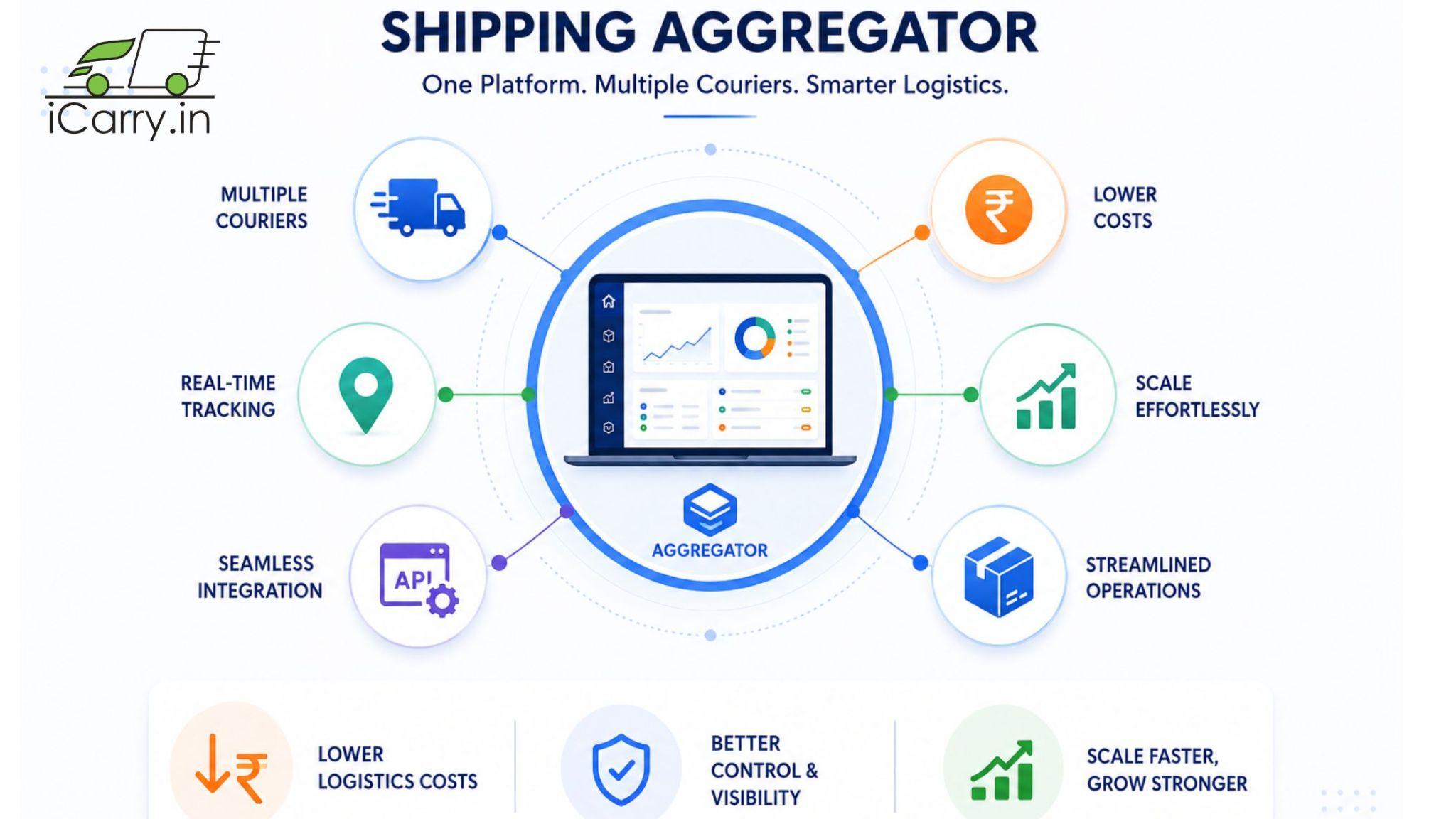
A shipping aggregator is a logistics platform that connects businesses to multiple courier partners through a single interface. Instead of negotiating separate contracts with Delhivery, Blue Dart, Xpressbees, Ekart, FedEx, and others individually - and managing separate accounts, invoices, and tracking systems for each - businesses access all of these through one dashboard.
The aggregator negotiates bulk rates across the combined volume of all businesses on the platform and passes those rates to every shipper - regardless of their individual shipment volume. A business shipping 50 consignments per month accesses the same rate structure that would otherwise require thousands of monthly shipments to negotiate directly.
Beyond rate access, the aggregator model provides a unified operational layer: rate comparison before booking, consolidated tracking across all couriers, single-point NDR management, integrated weight discrepancy disputes, and COD remittance consolidation across multiple courier partners.
Why Indian Businesses Are Moving to the Aggregator Model
1. Rate Access Without Volume Pressure
Direct courier contracts in India typically require consistent monthly volume - often 1,000 shipments or more - before meaningfully discounted rates are offered. For most Indian businesses, building to that volume while paying rack rates creates a margin problem during the growth phase.
Aggregator platforms eliminate this constraint. A new manufacturer or a scaling distributor accesses pre-negotiated rates from the first shipment. The savings compound immediately rather than being deferred until volume milestones are reached. The full cost breakdown - including surcharges, COD fees, and volumetric adjustments that are not visible in headline rates - is covered in the guide on hidden shipping charges in India.
2. Multi-Courier Access From One Account
No single courier serves every route optimally. Delhivery's surface network is India's most extensive. Blue Dart has unmatched express reliability for high-value shipments. Xpressbees performs consistently for COD-heavy orders in Tier 2 cities. Amazon shipping and Ekart have deep coverage across South India's district-level markets. FedEx and Aramex are best at handling international exports.
For Indian businesses shipping across diverse geographies - North India distributors, South India manufacturers, exporters, retail chains - multi-courier access is a routing advantage, not just a cost tool. The right courier for each consignment reduces delivery failure rates, RTO, and the downstream customer service cost of failed deliveries.
3. Operational Consolidation
Managing multiple courier relationships means multiple dashboards, multiple invoices, multiple reconciliation processes, and multiple support escalation channels. As shipment volumes grow, this operational overhead compounds.
A shipping aggregator consolidates all of this. One dashboard shows every active shipment across all couriers. One invoice covers all courier charges. One dispute process handles weight discrepancy claims. One support escalation handles delivery failures regardless of which courier is involved.
4. COD Management at Scale
India remains a predominantly COD-driven market across most consumer categories. For businesses shipping high COD volumes - fashion brands, FMCG distributors, direct-to-consumer businesses, retail suppliers - COD remittance management is a treasury function, not just a logistics detail.
Aggregators that consolidate COD collections across multiple courier partners and provide daily automatic remittance significantly simplify cash flow management. The alternative - tracking COD settlements from each courier separately on different cycles - is operational complexity that grows unsustainably with volume.
5. Delivery Accountability Tools
At scale, the gap between shipments booked and shipments actually delivered is where margin goes. Fake non-delivery reports, incomplete addresses that cause first-attempt failures, and COD doorstep refusals are all categories of delivery failure that require active management rather than passive tracking.
Shipping aggregators that provide delivery management tools - not just booking interfaces - give Indian businesses the operational leverage to convert booked shipments into completed deliveries at a higher rate, in line with the direction outlined in the Economic Times Government piece on aggregator platforms powering the National Logistics Policy.
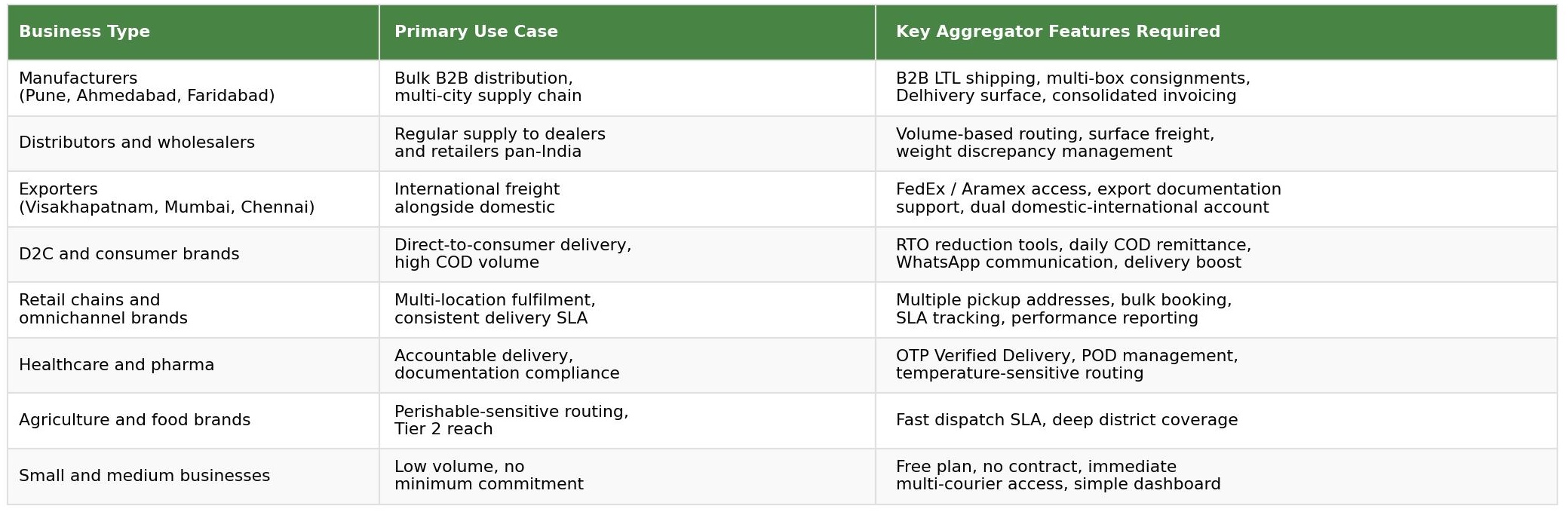
How Different Types of Indian Businesses Use Shipping Aggregators
What Features to Evaluate in a Shipping Aggregator for Indian Businesses
Courier Partner Breadth and Performance Data
The number of courier partners on the platform matters less than the quality of access and the performance data available for each. Evaluate: which specific couriers are accessible, what pincodes they service, and whether the platform provides delivery success rate data by courier and geography to support routing decisions.
Rate Transparency and Comparison
Headline rates are not what businesses pay. The true cost per consignment includes fuel surcharge, COD handling fee, ODA surcharge, and weight discrepancy adjustment. A platform that shows all-in rates before booking - across multiple couriers simultaneously - enables genuine cost comparison. Comparing rates before every booking is a business-level operational practice, not just a consumer convenience.
Video Tutorial: How to Estimate Shipment Cost on iCarry.in
NDR and RTO Management
Non-Delivery Reports are the leading cause of RTO across all shipping categories. Reducing RTO systematically requires specific tools: an NDR dashboard that surfaces every failed attempt immediately, the ability to update delivery instructions and request reattempt, and active follow-up capability for high-value or high-risk consignments. Read the full guide on how to reduce RTO systematically.
Video Tutorial: How to Manage NDR and Disputes on iCarry.in
Weight and Dimension Management
Weight discrepancy charges - where the courier measures a different weight than declared - are one of the most common sources of unexpected billing for Indian businesses shipping at volume. A platform with a dedicated dispute dashboard, a 5-day dispute window management system, and the ability to pre-upload consignment images for automatic dispute triggering recovers real money every month.
API and System Integration
For businesses processing significant shipment volumes through ERP, OMS, WMS, or custom systems, API integration is not optional - it is the difference between a scalable operation and one that bottlenecks at booking. Evaluate: API endpoint coverage (booking, label generation, status updates, COD reconciliation), documentation quality, and support response time for integration issues.
COD Remittance Flexibility
Daily automatic remittance should be the baseline. Beyond that, evaluate: early remittance tiers available (T+0 through T+4), whether the platform advances payment before couriers settle, destination account configuration options (bank account, wallet, split), and the reconciliation reporting available for COD accounting.
Multi-Location and B2B Shipment Support
Indian businesses with multiple dispatch locations - warehouses, manufacturing plants, branch offices - need a platform that supports multiple pickup addresses, each assignable to specific order types or geographies. B2B multi-box consignments require different documentation and handling than standard parcels. Evaluate both capabilities before committing.
Understanding Delivery Management in Large-Scale Indian Shipping Operations
At low shipment volumes, a failed delivery is an inconvenience. At scale, it is a margin problem. A business shipping 2,000 consignments daily with a 15% failure rate has 300 daily failures to manage - each requiring follow-up, reattempt coordination, or RTO processing.
The delivery management tools that matter at this scale:
Delivery Boost
Active delivery coordination where trained agents reach out to consignees before delivery, follow up on failed attempts, audit NDR claims from courier executives, and open tickets for suspected fake non-deliveries. This is particularly important for businesses shipping to Tier 2 and Tier 3 geographies where franchise courier accountability is harder to enforce. Delivery Boost agents communicate in the consignee's regional language - ensuring effective coordination across every geography in India.
Two-Way WhatsApp Communication
At enterprise scale, the volume of 'where is my order?' queries can overwhelm customer service teams. Two-way WhatsApp communication - where consignees receive delivery updates and can reply to reschedule, update an address detail, or communicate a delivery constraint - addresses this at the last-mile level before it becomes a customer service ticket.
For the business, this means full visibility of every conversation between the coordination team and the consignee. Every message, every reply, every instruction relayed to the courier is logged and accessible. No information sits in a black box between the last-mile executive and the customer.
Consignees can update a specific address detail (door number, floor, wing) if entered incorrectly, request the executive to arrive at a specific time, or confirm they will be available. The coordination team manages this on the sender's behalf and ensures maximum delivery success rate from every attempt.
OTP Verified Delivery
For consignments where proof of physical receipt matters - pharmaceutical deliveries, high-value equipment, accountable distribution to dealers - OTP Verified Delivery requires the consignee to enter a one-time password before the delivery can be marked as complete. This eliminates fraudulent delivery confirmation and provides an auditable delivery record for compliance and dispute resolution.
Address Quality Scoring
Pre-dispatch address validation evaluates every consignment address before it is dispatched and flags incomplete or high-risk entries. For Indian businesses shipping to 29,000+ pincodes with enormous variation in address format - from numbered industrial estate units to village-level addresses with mandal references - pre-dispatch address quality assessment prevents a significant proportion of first-attempt failures before they ever occur.
The Economics of a Shipping Aggregator for Indian Businesses
The financial case for the aggregator model across Indian business types:
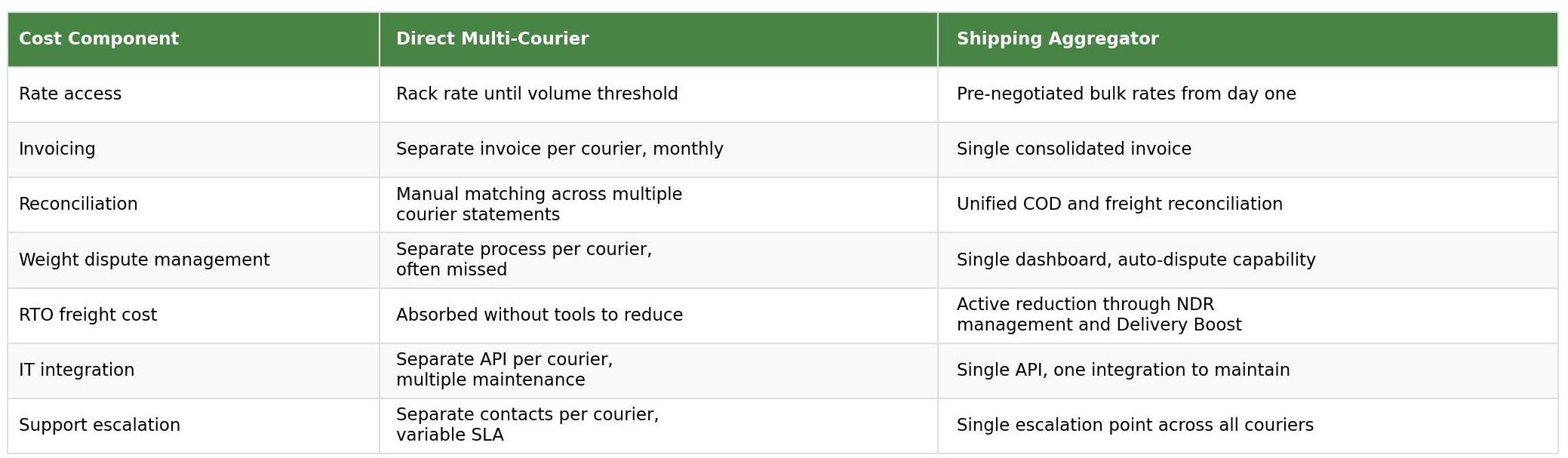
For a business shipping 5,000 consignments per month, the difference between unoptimised direct courier management and a well-configured aggregator setup is typically ₹15 to ₹30 per consignment in recovered cost - ₹75,000 to ₹1.5 lakh per month - before accounting for RTO reduction and dispute recovery.
What the Best Shipping Aggregators in India Offer in 2026
The leading aggregator platforms in 2026 provide:
- Access to multiple courier partners including surface, express, hyperlocal, and international
- Live rate comparison including all surcharges before every booking
- Multi-courier routing rules configurable by geography, weight, order type, and value
- Single-dashboard tracking across all active shipments
- Consolidated COD remittance with daily settlement and early remittance options
- Weight discrepancy dispute dashboard with auto-dispute for pre-registered consignment types
- Delivery Boost for active last-mile follow-through on high-risk or high-value consignments
- Two-way consignee communication for delivery coordination
- OTP Verified Delivery for accountable high-value shipments
- Address Quality Scoring before dispatch
- Full REST API with comprehensive endpoint coverage for ERP and OMS integration
- B2B multi-box consignment booking
- International shipping access without separate freight forwarder contracts
Not all aggregator platforms offer all of these. Evaluate against your specific business requirements before committing. Check live rates and features at iCarry®'s free rate calculator - no login needed.
How iCarry® Serves Indian Businesses Across All Sectors
iCarry® is a courier aggregator headquartered in Bengaluru, trusted by 50,000+ businesses across India. It serves businesses of every type and scale - from manufacturers shipping B2B consignments across supply chains to growing consumer brands managing COD-heavy direct delivery, from healthcare distributors requiring accountable last-mile to exporters needing international freight access.
The platform offers all of the features described in this guide - Delivery Boost, two-way WhatsApp communication, OTP Verified Delivery, Address Quality Scoring, early COD remittance, multi-courier access, B2B LTL shipping, and a full REST API - from a single account with no minimum shipment volume.
Businesses can start on the free Bronze plan with no monthly fee and no commitment, and scale to enterprise API integration without changing platforms. See all active shipments, courier rates, and delivery tools in one view in iCarry®'s My Shipments dashboard.
iCarry® is built for all Indian businesses - not for one sector, one size, or one shipment type. Register and start at iCarry.in.
Final Thoughts
The aggregator model is not a shortcut. It is an architectural choice in how an Indian business manages its logistics infrastructure. The businesses that use it well - configuring multi-courier routing by geography and shipment type, managing NDRs actively, disputing weight discrepancies systematically, and using delivery management tools for high-value consignments - build a compounding logistics advantage over time.
The businesses that use it passively - treating it as just a cheaper booking interface and ignoring the operational tools - capture the rate benefit but leave the larger efficiency gains unrealised.
Evaluate your current shipping setup against the criteria in this guide. The gap between what you are paying now and what a well-configured aggregator relationship delivers is almost always larger than expected. Multi-courier allocation strategy is the starting point for any business ready to move from passive to active logistics management.
Frequently Asked Questions (FAQs)
What is a shipping aggregator in India?
A shipping aggregator is a logistics platform that connects Indian businesses to multiple courier partners through one account. It provides pre-negotiated bulk rates, a unified booking and tracking dashboard, consolidated COD management, and delivery tools that individual courier contracts do not offer. Learn more about the courier aggregator model in detail.
Is a shipping aggregator suitable for B2B and enterprise businesses in India?
Yes. Shipping aggregators serve all business types - manufacturers, distributors, exporters, retail chains, healthcare companies, and large enterprises. Features like B2B multi-box booking, LTL freight access, full REST API integration, OTP Verified Delivery, and enterprise account management are specifically designed for large-scale and B2B operations.
How does a shipping aggregator reduce logistics costs for Indian businesses?
Through three mechanisms: pre-negotiated bulk rates available from the first shipment, live rate comparison across couriers that prevents paying above the best available rate for each route, and delivery management tools that reduce RTO and weight discrepancy losses. The combined impact is typically ₹15 to ₹30 per consignment at mid-to-high volumes.
What is OTP Verified Delivery and which businesses need it?
OTP Verified Delivery requires the consignee to enter a one-time password before the courier can mark a delivery as complete. It is relevant for pharmaceutical distributors, electronics businesses, high-value consumer brands, and any operation where fraudulent delivery confirmation is a risk or where an auditable delivery record is required for compliance.
How does two-way WhatsApp communication work in logistics?
The courier aggregator's coordination team communicates with the consignee via WhatsApp on the sender's behalf. The consignee can reply to reschedule, update an address detail, or provide delivery instructions. All conversations are logged and visible to the sending business. The coordination team manages reattempts and delivery coordination based on the consignee's responses - maximising delivery success without requiring the sender to handle each interaction directly.
Can large Indian enterprises integrate a shipping aggregator with their ERP or OMS?
Yes. The best aggregator platforms provide a full REST API with endpoint coverage for booking, label generation, status updates, COD reconciliation, and webhook callbacks for real-time integration. This allows enterprise ERP and OMS systems to trigger shipment booking and receive status updates automatically without any manual platform interaction.
Shipping aggregators have become central to how Indian businesses of every type - manufacturers, distributors, exporters, D2C brands, retail chains, and healthcare companies - manage logistics in 2026, offering pre-negotiated bulk rates from the first shipment, multi-courier access for optimal routing, consolidated invoicing and COD reconciliation, and enterprise-grade delivery tools like Delivery Boost, OTP Verified Delivery, two-way WhatsApp communication, and Address Quality Scoring - with businesses that actively configure and use these operational tools building a compounding cost and reliability advantage of ₹15-30 per consignment over those treating the aggregator as merely a cheaper booking interface.