An organic grocery brand receives 200 orders on a Monday morning. Eighty orders go to Zone D destinations - 6 to 8 days in transit. Fifteen of those orders contain cold-pressed juices with a 7-day refrigerated shelf life. The brand dispatches all 200 orders via the same surface courier.
Six days later, twelve Zone D customers receive juices that are at or past their best-before date. Four arrive leaking - the PET bottles compressed and cracked in the sorting centre. Three customers post photographs of brown, separated juice on social media.
Grocery and FMCG is one of the most logistically unforgiving categories in Indian eCommerce. India's packaged food and FMCG market is one of the country's largest consumer segments, with online grocery growing rapidly post-pandemic. But logistics constraints - shelf life, temperature, weight, liquid leakage, and FSSAI labelling - mean that the standard eCommerce logistics playbook often does not apply.
This guide covers the specific decisions that determine whether a grocery or FMCG brand's logistics operation works.
What Is Grocery and FMCG Shipping in India?
Grocery and FMCG shipping in India means moving packaged food, perishables, and fast-moving consumer goods through courier or cold-chain networks while staying within FSSAI rules and safe shelf-life limits. Because shelf life, temperature, and liquid leakage all constrain which zones a product can safely reach, it works differently from standard eCommerce logistics.
How to Check If Your Grocery or FMCG Product Is Ready to Ship
- Does your product have sufficient shelf life remaining for the delivery zone transit time?
- Is the primary packaging sealed airtight - heat seal, cap seal, or induction seal?
- Is every product FSSAI compliant with batch number, manufacturing date, and best-before date on label?
- For liquids: is there a secondary containment layer (ziplock or shrink wrap) in case the primary seal fails?
- Have you restricted perishables to Zone A and Zone B only, or enabled cold chain for Zone D?
- For B2B distributor delivery: have you accounted for carton-level labelling and case quantity requirements?
The Shelf Life Rule - The Most Important Logistics Decision in Grocery
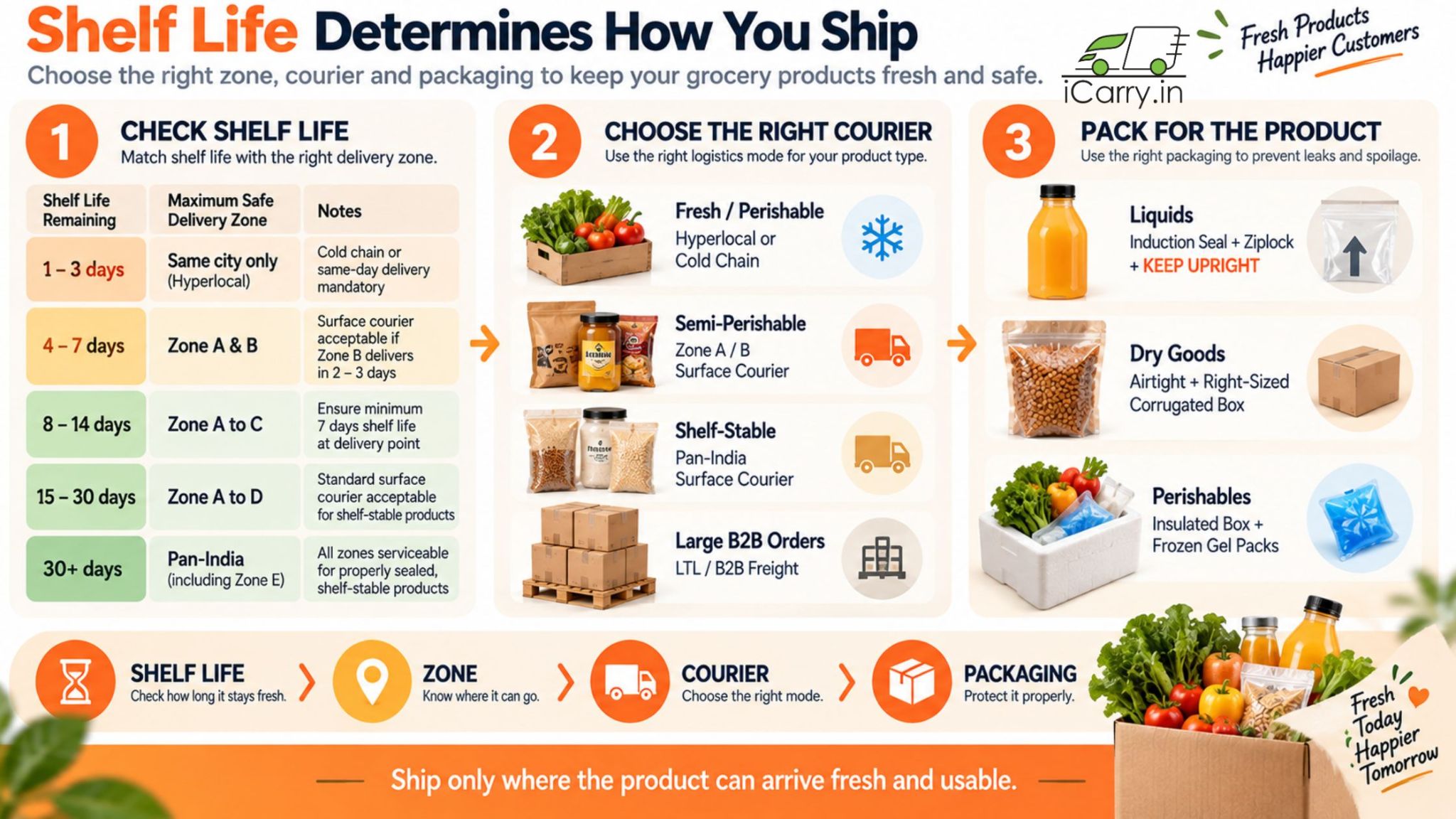
Every grocery product has a maximum deliverable zone range determined by its shelf life. This is the non-negotiable constraint that all other logistics decisions flow from:
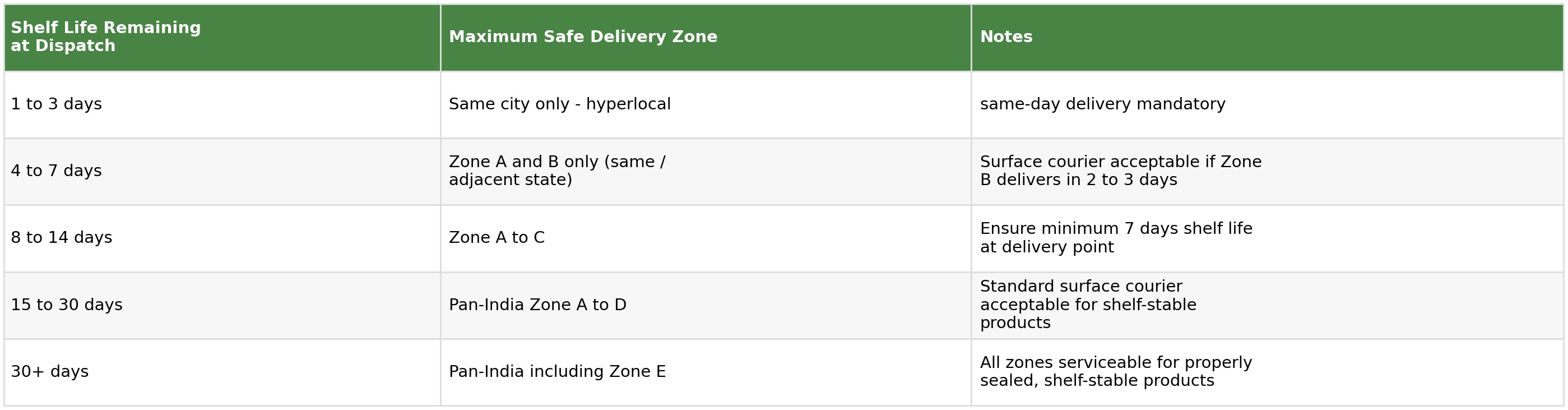
The rule: Never dispatch a grocery product where transit time will consume more than 50% of the remaining shelf life. A customer who receives a product with 2 days of shelf life remaining has not received a usable product. The return, refund, and review that follow cost more than not dispatching the order.
This means zone restriction is a product-level logistics decision, not a customer service one. If your product cannot safely reach Zone D, do not offer Zone D shipping. State it at checkout: 'Due to the fresh nature of this product, we ship to select pincodes only.'
FSSAI Compliance for Grocery and FMCG Shipping
All packaged food products sold commercially in India must comply with FSSAI regulations - and this applies equally to online grocery orders. FSSAI's labelling requirements for packaged food include:
- FSSAI licence/registration number: 14-digit number on every product label. Marketplace listings without this number are delisted
- Batch/lot number: For traceability and potential recall. Mandatory for all packaged food
- Manufacturing date and best-before/expiry date: In dd/mm/yyyy format on every unit
- Ingredient list in descending weight order: Including all additives with INS number or name
- Allergen declaration: All 8 major allergens must be declared such as gluten-containing cereals, crustaceans, eggs, fish, peanuts, soybeans, milk and milk products, and tree nuts, where applicable.
- Net quantity and MRP inclusive of all taxes
- Storage instructions: Particularly important for products requiring refrigeration or specific temperature ranges
FEFO compliance: First Expired First Out. Dispatch the oldest stock (closest to expiry) before newer stock. For businesses managing multiple batches, FEFO is a mandatory warehouse practice. Dispatching newer stock while older stock approaches expiry creates a write-off problem.
Packaging Grocery and FMCG Products for Courier Transit
Liquids (Oils, Sauces, Beverages, Juices)
- Cap must be induction sealed - the outer cap alone is not sufficient containment for courier transit
- Each bottle in a ziplock bag as secondary containment. If the seal fails, the leak is contained
- Mark KEEP UPRIGHT on all four sides and top of the outer carton
- Foam dividers or cardboard separators between bottles - no glass-to-glass or plastic-to-plastic contact
- For glass bottles: individual bubble wrap before dividers
- Never use poly mailers for any liquid product regardless of seal quality
Dry Goods (Grains, Flour, Pulses, Spices, Snacks)
- Primary packaging must be airtight - heat-sealed pouch or sealed container. Loosely tied bags fail in transit
- Silica gel sachet inside the outer carton for moisture-sensitive products (flour, spice blends)
- Right-sized corrugated outer - avoid oversized boxes where products shift and packs can be punctured
- Heavy products (5 kg rice bags, 2 kg dal packs): 5-ply corrugated outer mandatory to prevent base collapse
- Seal carton seams fully - grocery products exposed to moisture through a poorly sealed seam present contamination risk
Perishables and Short-Shelf-Life Products
Short shelf life products require either zone restriction (local only) or cold chain logistics. Standard surface courier is not appropriate:
- Cold chain courier maintains temperature-controlled environment from pickup to delivery - required for dairy, fresh produce, refrigerated beverages
- Insulated packaging (thermocol-lined box with gel ice packs) extends the safe transit window for semi-perishables but does not replace cold chain for fully refrigerated products
- Gel ice packs for insulated boxes should be frozen solid at dispatch. Partially frozen packs fail within 12 to 18 hours
- Insulated packaging is viable for Zone A and B deliveries (1 to 3 days transit) for products that can tolerate a controlled temperature drift
B2B Distribution: Shipping to Retailers and Distributors
FMCG B2B deliveries to retailers, kirana stores, and distributors have different requirements from consumer D2C orders:
- Carton-level labelling: Each outer carton must carry the product name, quantity (number of units), batch number, manufacturing date, best-before date, and the brand's address. This is separate from the individual unit label
- Case quantity consistency: Retailers and distributors order in standard case quantities. Partial cases create inventory management problems at the buyer's end. Confirm case quantity before the first B2B shipment
- Delivery address specifics: Kirana stores and small retailers often have restricted delivery hours, no loading docks, and limited storage capacity. Confirm delivery window before dispatch to avoid failed B2B deliveries
- B2B multi-box booking: For multi-carton B2B consignments, book as linked multi-box shipments so all cartons are delivered together and the retailer can verify count against the invoice at delivery
- Credit and COD management: B2B FMCG often runs on credit terms. For COD B2B orders, the COD amount and receiving authority at the buyer must be confirmed before dispatch
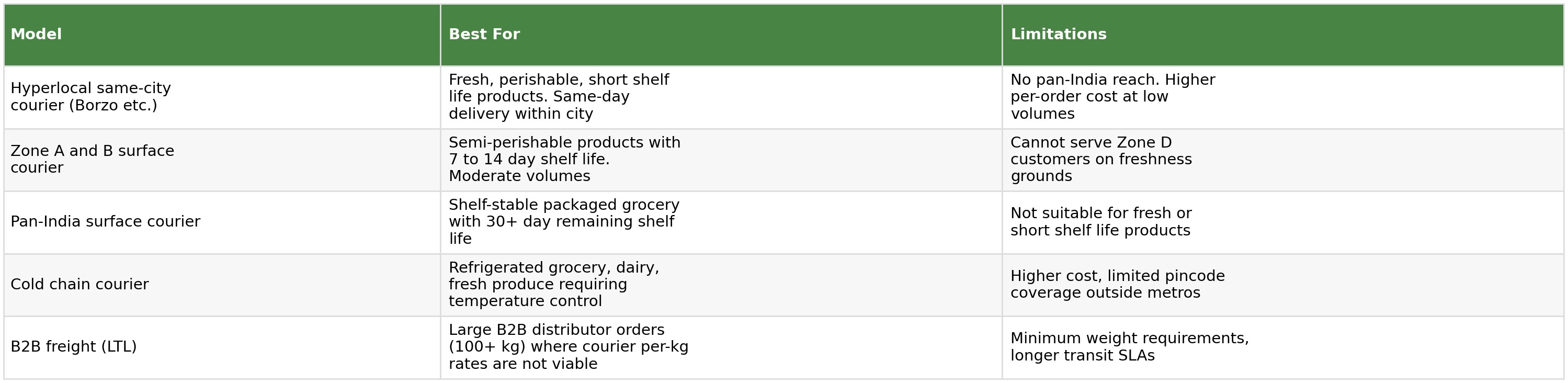
Hyperlocal vs Pan-India: Choosing the Right Distribution Model
How iCarry® Supports Grocery and FMCG Businesses
iCarry® is a courier aggregator that supports packaged grocery and FMCG businesses with the logistics infrastructure for both D2C and B2B distribution:
- Same-city hyperlocal via Borzo: For same-day delivery of fresh and perishable products within city limits. Borzo is available through iCarry® for hyperlocal same-city dispatch - the right mode for short shelf life grocery
- Multi-courier rate comparison: Compare surface courier rates for shelf-stable grocery across all available partners before every booking. Monitor all active grocery shipments in My Shipments
- B2B multi-box booking: For B2B retailer and distributor shipments, book multi-carton consignments as linked B2B shipments with all cartons tracked together
- Address Quality Scoring: Pre-dispatch address validation is particularly important for grocery where a failed delivery means a perishable RTO - stock that cannot be resold once it returns
- Two-way WhatsApp engagement: Pre-delivery coordination ensures the customer is home and available - reducing the failed first attempts that turn grocery RTOs into expired-stock write-offs
- COD remittance: Manage COD collections and settlements across courier partners through one account, with automatic T+7 remittance and Early COD options from T+0 for faster access to COD funds.
- Free Bronze plan, no minimum volume.
Final Thoughts
Grocery and FMCG logistics is built around one constraint that most other eCommerce categories do not face: time. Shelf life determines zone range, which determines courier mode, which determines packaging requirements. Every decision flows from knowing the shelf life of each product at the point of dispatch.
Get shelf life management right and restrict zones accordingly. Package liquids with secondary containment and mark upright. Maintain FEFO in the warehouse. Apply FSSAI compliance on every unit before the first commercial shipment.
These are not complex decisions. They are specific ones - and in grocery logistics, specific and correct consistently beats broad and approximate.
Frequently Asked Questions (FAQs)
Can I ship fresh grocery pan-India via standard courier?
Only if the product has sufficient remaining shelf life for Zone D transit (6 to 8 days) plus meaningful shelf life on arrival for the customer. Fresh produce, dairy, juices, and bakery products with less than 14 days remaining shelf life should be restricted to Zone A and B or dispatched via cold chain courier. Standard surface courier cannot maintain safe temperatures for refrigerated products.
What FSSAI requirements apply to online grocery orders?
Every packaged food product sold online must carry an FSSAI licence/registration number, batch number, manufacturing date, best-before date, ingredient list, allergen declaration, MRP inclusive of all taxes, and storage instructions. These requirements apply equally to D2C orders and marketplace listings. Register at FSSAI's portal if your food business is not yet registered.
How do I package liquid grocery products to prevent leakage?
Induction seal the cap before the outer cap goes on. Place each bottle in a ziplock bag as secondary containment. Use a corrugated outer with foam or cardboard dividers between bottles. Mark KEEP UPRIGHT on all faces of the outer carton. Never use poly mailers for any liquid product. Test the packaging by inverting and shaking before committing to a packaging format for dispatch.
What is FEFO and why does it matter for grocery shipping?
FEFO stands for First Expired First Out - the practice of dispatching the oldest stock (batch with the earliest expiry) before newer batches. Without FEFO compliance, newer stock is dispatched while older stock approaches expiry and requires a write-off. In grocery, where margins are already tight, FEFO-driven write-offs can be significant. FEFO applies to any product with an expiry or best-before date.
How does iCarry® handle same-day grocery delivery?
iCarry® provides access to Borzo for hyperlocal same-city same-day delivery - the appropriate mode for fresh and perishable grocery products that cannot survive even a 2-day surface courier transit. Borzo is available for same-city dispatch from your dispatch location. For shelf-stable grocery going pan-India, iCarry®'s surface courier partners provide rate comparison across multiple couriers for every booking.
Grocery and FMCG logistics is built around one constraint most other eCommerce categories don't face: time. Get shelf life management right and restrict zones accordingly, package liquids with secondary containment and mark upright, maintain FEFO in the warehouse, and apply FSSAI compliance on every unit - specific and correct consistently beats broad and approximate.