Why Handicraft Logistics Is Different
Artisan and handicraft products are irreplaceable by definition. A machine-made ceramic can be replaced from stock. A hand-thrown Khurja pottery piece made by a specific artisan cannot. Damage in transit is not just a financial event - it is the loss of someone's handmade work and a buyer's trust in a category built entirely on authenticity.
India's handicrafts exports (excluding hand-knotted carpets) were about ₹33,123 crore in 2024-25, spanning textiles, woodwork, metalware, pottery, jewellery, and leather goods. The US is the largest buyer, and demand also comes from the EU and the Gulf. Domestically, platforms like Etsy India, Amazon Karigar, and direct D2C sites have given artisan sellers access to buyers across the country. In both cases, logistics quality determines whether the artisan's work reaches the buyer as it left the workshop.
What Is Handicraft Shipping?
Handicraft shipping means sending handmade pottery, woodwork, textiles and metalware to buyers in India or abroad with packing matched to each craft. Each piece is hard to replace, so cushioning, declared value coverage and photographs before sealing matter more than for factory goods. Exports add paperwork such as an IEC, correct HS codes and, for some products, GI documents.
How to Ship Handicrafts Without Damage
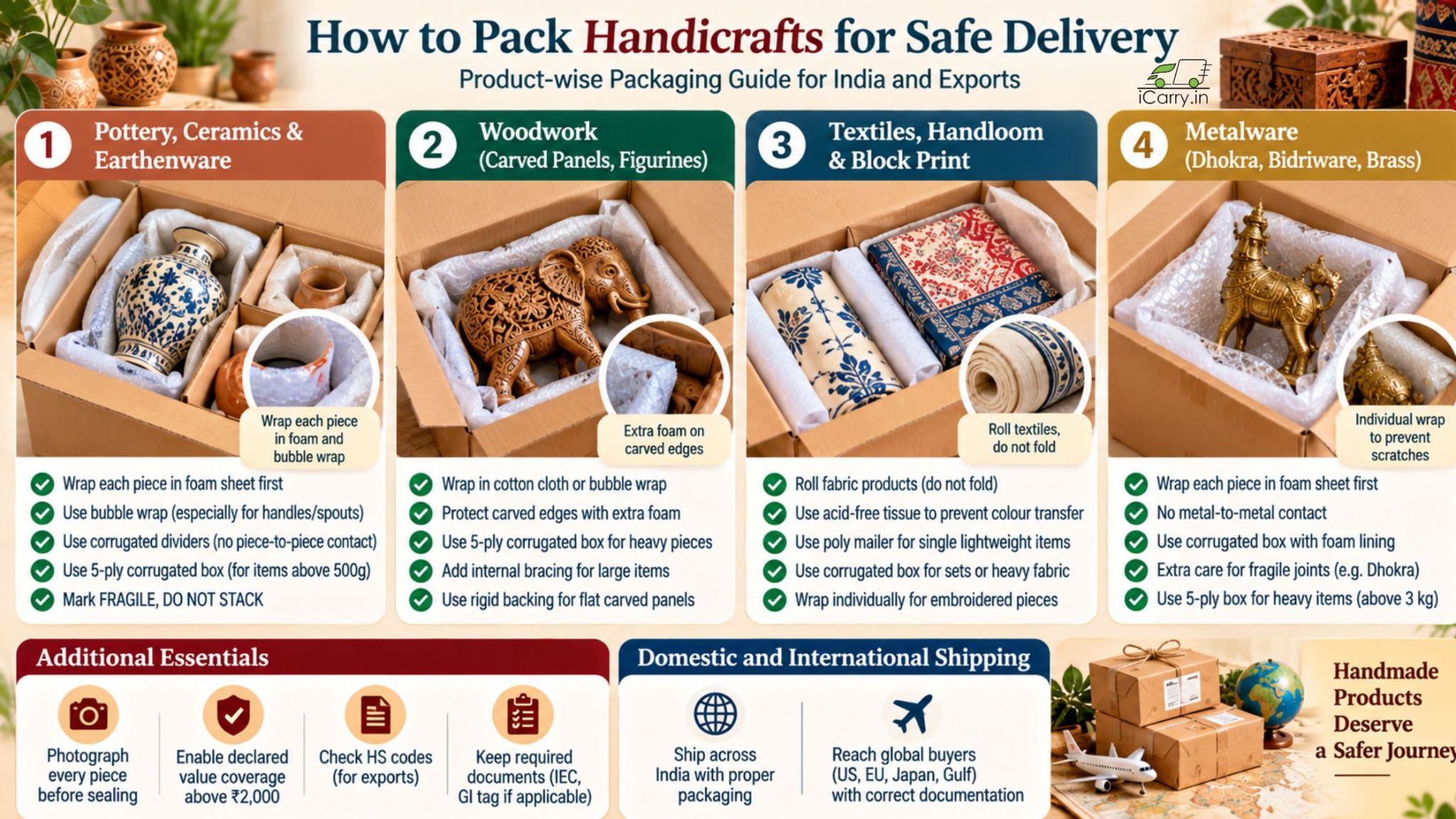
- Wrap every piece in foam first - hard surfaces scratch and chip in transit
- Use 5-ply corrugated for pottery above 500g - 3-ply collapses under sorting-centre stacking weight
- Roll textiles, never fold - fold marks may not recover
- Photograph every piece before sealing - it is your evidence for a damage claim
- Enable declared value coverage above ₹2,000 - a damaged handmade piece cannot be replaced
- Check HS codes and documents before exporting - errors cause customs delays
How to Pack Handicrafts by Craft Category
Pottery, Ceramics and Earthenware
- Foam sheet first on every piece - no surface-to-surface contact at any point
- Bubble wrap over foam. For pieces with handles, spouts, or decorative protrusions: wrap each element separately before wrapping the whole piece
- Corrugated dividers in multi-piece orders. Each piece in its own cell
- 5-ply corrugated outer for all pottery above 500g. 3-ply is inadequate under the stacking weight in courier sorting centres
- Mark FRAGILE, DO NOT STACK, and HANDMADE - HANDLE WITH CARE on all faces
Woodwork (Carved Panels, Figurines, Furniture Accessories)
- Wrap in cotton cloth or bubble wrap to protect painted or lacquered surfaces from scratching
- Carved edges are the most vulnerable point - additional foam on protruding carved elements
- Heavy wooden pieces above 5 kg: 5-ply corrugated with internal bracing struts to prevent the outer box from collapsing under weight
- For flat carved panels: rigid cardboard backing inside the corrugated to prevent the panel from flexing
Block Print, Handloom and Textile Handicrafts
- Roll fabric products - do not fold. Fold marks in handloom fabric may not recover, and in block print fabric they crack the print
- Wrap the roll in acid-free tissue before polythene outer wrap to prevent colour transfer
- Poly mailer acceptable for single-piece lightweight textiles. Corrugated for sets, heavy fabric, or anything above 1 kg
- For embroidered pieces: individual tissue wrap to protect thread work. Do not compress
Metalware (Dhokra, Bidriware, Brass Craft)
- Foam sheet first to protect metal finish and prevent scratching
- Each piece wrapped individually - metal-to-metal contact in transit causes irreversible surface damage
- Heavy metalwork above 3 kg: corrugated with foam lining on all inner walls
- For Dhokra (tribal lost-wax casting): extremely fragile at joints. Wrap each piece as if it is the most delicate item you own
Packed and ready? Compare courier partners and turn on declared value coverage for artisan pieces on iCarry®.
Domestic Shipping for Handicraft Sellers
For domestic D2C sales, the three highest-impact decisions are:
- Declared value coverage: Enable for all artisan products above ₹2,000. A handmade piece damaged in transit without coverage is a full financial loss - the maker's time cannot be recovered
- Pre-dispatch photography: Photograph every piece before sealing. This is your evidence for any damage claim. Without it, a damaged claim is hard to substantiate
- Express courier for high-value pieces: Route pieces above ₹5,000 via Express couriers for fewer handling points. The freight premium is a fraction of the product value
Exporting Handicrafts from India
Documentation for Handicraft Exports
- IEC (Import Export Code): Mandatory for all exports. Register at dgft.gov.in
- EPCH membership: The Export Promotion Council for Handicrafts (EPCH) issues the RCMC (Registration-cum-Membership Certificate) required for most handicraft export schemes and incentives
- Certificate of Origin: Required for buyers claiming FTA duty benefits at destination. Issued by EPCH, FIEO, or Chamber of Commerce
- GI tag documentation: If your product carries a Geographical Indication tag (Channapatna toys, Madhubani art, Blue Pottery, Pashmina), carry GI certification documentation. This protects against imitation claims at the buyer's end and can command price premiums in international markets
HS Code Accuracy for Handicraft Exports
Handicrafts span many HS chapters depending on material and product type. Incorrect HS codes cause customs delays and potential duty issues:
- Textiles and textile handicrafts: Chapters 50 to 63
- Ceramic and pottery: Chapter 69
- Glassware: Chapter 70
- Metalware and brasswork: Chapters 73 to 83
- Wood articles: Chapter 44
- Works of art and antiques: Chapter 97. Antiques more than 100 years old cannot be exported by private sellers under the Antiquities and Art Treasures Act, 1972
Export Incentives for Handicraft Exporters
- RoDTEP: Remission of duties on exported products. Claimed on the shipping bill as a percentage of FOB value
- EPCH trade fair participation: EPCH subsidises participation in international trade fairs for registered handicraft exporters - a direct route to wholesale buyers
- Artisan credit card scheme: Working capital financing for artisan exporters through SIDBI and nationalised banks under government artisan promotion schemes
Exporting handicrafts? Compare FedEx and Aramex rates on iCarry® before you book.
How iCarry® Supports Handicraft Businesses
iCarry® is a courier aggregator that gives handicraft sellers and artisan brands access to multiple courier partners for domestic delivery, along with available FedEx and Aramex options for international parcel shipments.
- Multiple courier partners: Compare available courier options and choose suitable services based on shipment value, weight, destination, serviceability, and cost.
- Rate comparison: Compare courier rates before booking to help manage shipping costs for different types of handicraft products.
- Transit Loss Insurance: For high-value or fragile handmade pieces, enable Transit Loss Insurance during booking. Review the available coverage and applicable fee before confirmation.
- Delivery Boost: For valuable or time-sensitive orders, Delivery Boost supports additional pre-delivery coordination to help reduce avoidable delivery failures.
- Two-way WhatsApp Engagement: Customers can confirm availability, update address details, or coordinate delivery through WhatsApp engagement, helping reduce failed delivery attempts.
- International shipping: Compare available FedEx and Aramex options for international parcel shipments and choose based on destination, shipment requirements, and applicable rates.
- COD remittance: Manage COD collections and settlements through one account, with automatic T+7 settlement and Early COD options from T+0 for faster access to funds.
Free Bronze plan with no minimum shipment volume.
Frequently Asked Questions (FAQs)
Do I need a special licence to export handicrafts from India?
You need an IEC (Import Export Code) from DGFT, which is mandatory for all commercial exports. For handicraft-specific schemes and incentives, register with EPCH (Export Promotion Council for Handicrafts) to obtain an RCMC. GI-tagged products should carry GI certification documentation. Antiques more than 100 years old cannot be exported by private sellers under the Antiquities and Art Treasures Act, 1972.
How should I package handmade pottery for courier transit?
Foam sheet directly on the pottery surface first - never bubble wrap directly on ceramic. Bubble wrap over the foam. Individual wrapping for every piece with no surface contact between pieces. Corrugated dividers in multi-piece orders. 5-ply corrugated outer for anything above 500g. FRAGILE and DO NOT STACK on all faces. Pre-dispatch photograph of every piece before sealing.
What is EPCH and why do handicraft exporters need to register?
EPCH (Export Promotion Council for Handicrafts) is the government-recognised body for Indian handicraft exporters. EPCH membership and RCMC registration are required to access handicraft export incentive schemes, RoDTEP benefits, subsidised trade fair participation, and buyer introduction programmes. Registration is done online through the EPCH portal.
Can I ship GI-tagged handicrafts internationally?
Yes. GI (Geographical Indication) tagged products like Channapatna toys, Blue Pottery, or Pashmina can be exported commercially. Carry your GI certification documentation with the export shipment and include a reference to the GI tag on the commercial invoice and product label. GI certification supports premium pricing with international buyers and protects against imitation product claims in the destination market.
Handicrafts are one-of-a-kind, so the packing standard has to match: foam before bubble wrap, no piece touching another, rolled rather than folded textiles, and a photograph of every piece before you seal the box. For exports, line up the IEC, EPCH registration and the right HS chapter before you ship, and keep GI certification on hand for GI-tagged crafts. Declared value coverage above ₹2,000 is the one step that protects you if, despite all of this, a piece is still damaged in transit.