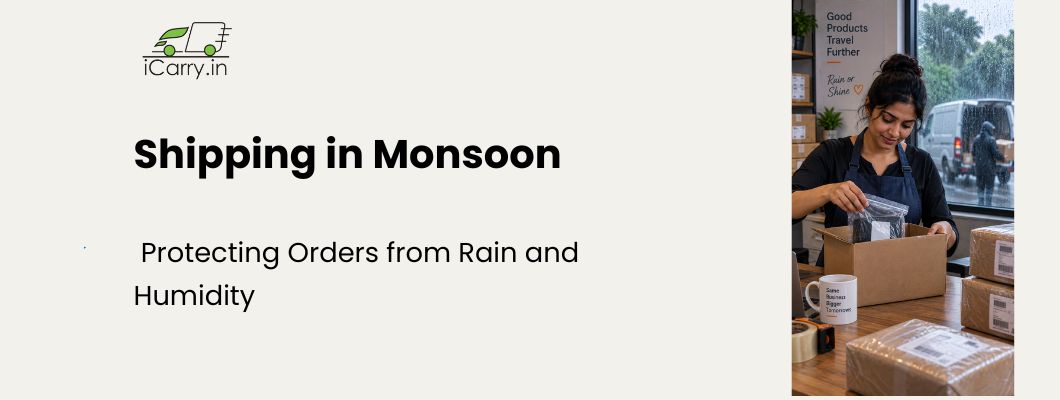
A book seller dispatches 150 orders in the first week of July. Twelve arrive with water-damaged covers. Four have warped pages. Two are so wet the customer cannot read them. The outer corrugated had soaked through during what the courier marked as a 'routine transit stop in heavy rainfall.'
None of these orders were insured for water damage. The corrugated box had no inner moisture barrier. The courier's liability for water damage was minimal. The seller absorbed every return, every refund, and the reviews that followed.
India's monsoon season - June through September - creates a specific and consistent set of logistics challenges. With heavy rainfall across most of the country, courier vehicles are exposed to rain at loading, unloading, and in transit. Sorting centres in flood-prone areas slow down or shut temporarily. Pincodes in coastal and flood-affected geographies become unserviceable for days at a time. And parcels that were perfectly packaged for dry conditions absorb moisture and fail in ways the packaging was never designed to handle.
This guide covers how to monsoon-proof your packaging, manage monsoon-related delivery delays, and protect both products and margins through India's rainy season. Packaging solves the product side; a platform like iCarry® helps with the routing side when a courier suspends service to a flooded city mid-season.
What Does Monsoon-Proofing a Shipment Involve?
Monsoon-proofing a shipment means adding moisture protection at the product, box, and label level - not just choosing a sturdier box. It matters because standard dry-season packaging fails in humidity above 80%, direct rain exposure, and flooded sorting hubs, turning an otherwise normal order into a damaged return.
How to Tell If Your Packaging Is Monsoon-Ready:
- Does your outer corrugated box have a moisture barrier - polythene inner lining or waterproof outer wrap?
- Are all products in moisture-sensitive categories wrapped in polythene or zip-sealed before boxing?
- Is your label applied with waterproof adhesive or covered with clear tape to prevent label peel?
- For food products: is your primary packaging airtight and moisture-proof?
- Have you checked which of your regular delivery pincodes become flood-affected or seasonally unserviceable during monsoon?
- Do you have a communication template ready for monsoon delay situations?
Why Monsoon Damages Shipments
Understanding the failure modes helps prioritise the right protection measures:
- Direct rain exposure: Courier vehicles - particularly two-wheelers used for last-mile delivery - are open to rain during transit. A parcel in a delivery bag on a bike in heavy rain absorbs moisture from the outside within 15 to 20 minutes
- Sorting centre flooding: Ground-level sorting centres and loading docks in flood-prone cities (Mumbai, Kolkata, Chennai, Kochi, Guwahati) accumulate standing water during heavy rain events. Parcels stored at ground level in these facilities absorb moisture through the base of the corrugated box
- Humidity-induced damage: Even without direct rain contact, humidity levels of 80 to 95% during monsoon cause corrugated boxes to soften and lose structural integrity. A box that was adequate for dry-season transit collapses under stacking weight in high-humidity conditions
- Label peel and shipping label failure: Paper labels absorb moisture and peel away from box surfaces. A parcel with a missing shipping label becomes undeliverable - an avoidable problem with waterproof labelling
- Condensation inside packaging: Temperature differences between air-conditioned sorting facilities and outdoor temperatures cause condensation inside sealed packages. Electronics, paper products, and leather goods are particularly vulnerable
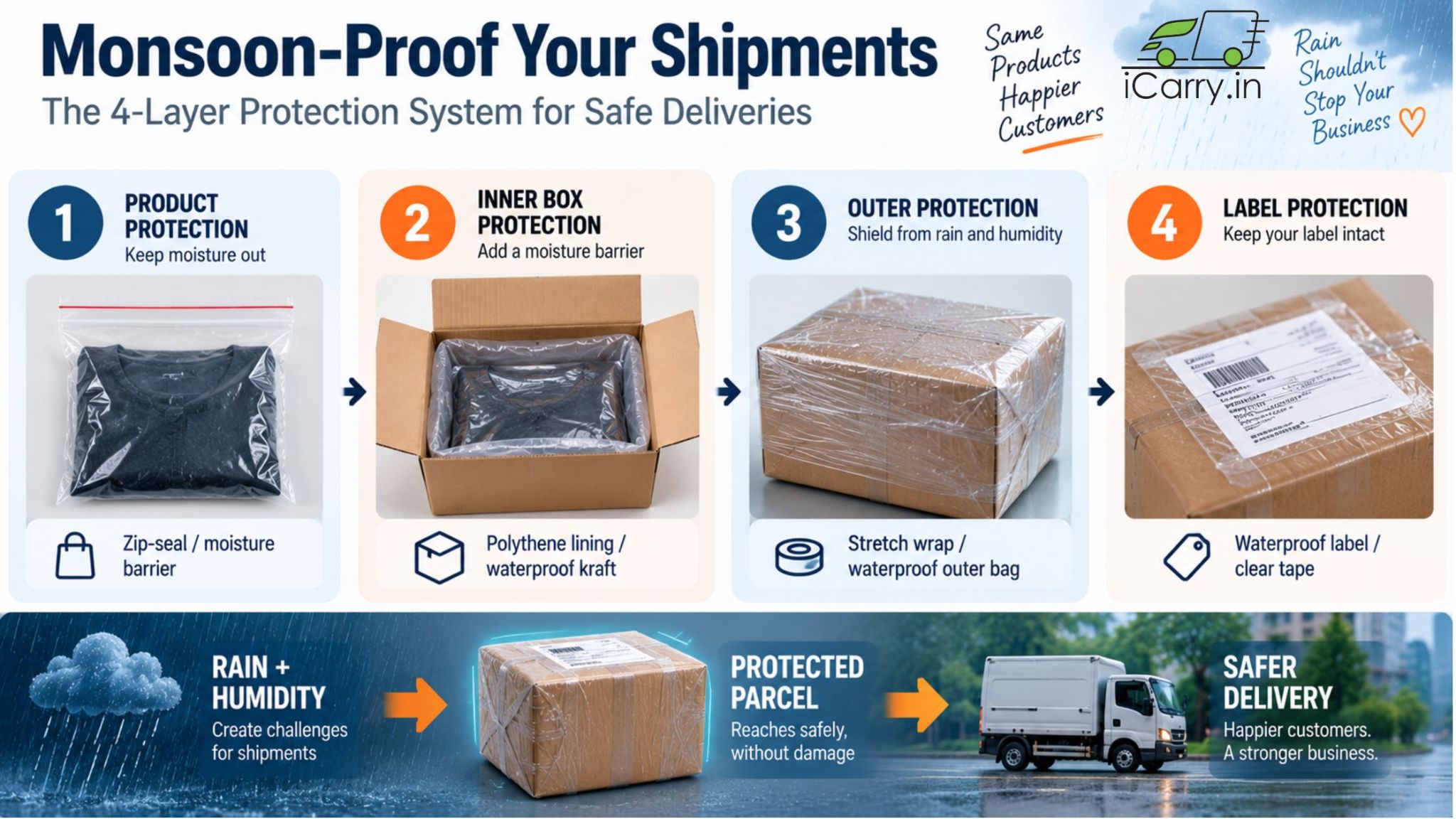
Monsoon Packaging - The Four-Layer Protection System
Layer 1: Product-Level Moisture Protection
The first protection layer is around the product itself, before any box is involved. For moisture-sensitive products, this layer is non-negotiable during monsoon season:
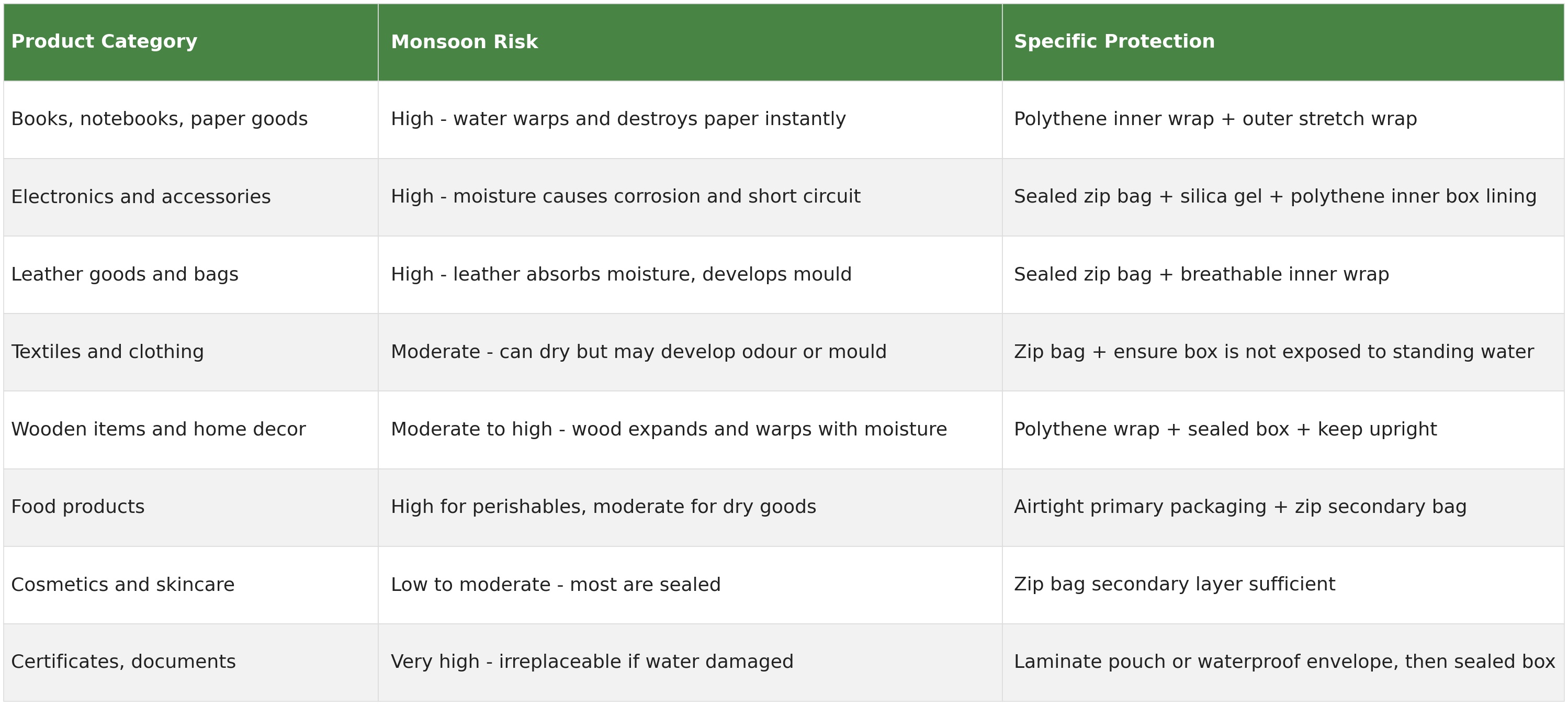
- Electronics and accessories: Sealed polythene bag or zip-seal bag around the product before any bubble wrap. Electronics exposed to moisture even briefly can develop corrosion or short-circuit
- Paper products (books, stationery, documents): Polythene inner wrap or a waterproof kraft envelope around the product before boxing. A single polythene layer adds ₹2 to ₹4 to packaging cost and prevents the warping and water damage that generates returns
- Fabric and leather goods: Zip-seal polythene bag before tissue and any other inner packaging. Leather absorbs moisture and develops mould within 48 hours in high-humidity conditions
- Food products: Already in primary airtight packaging - add a zip-seal secondary bag around the primary package for additional moisture protection
- Cosmetics and skincare: Most product packaging is already sealed. Add a polythene zip bag around the primary container as a secondary moisture barrier
Layer 2: Inner Box Lining
For high-value or highly moisture-sensitive products, line the inside of the outer corrugated box with a polythene bag or waterproof kraft paper before placing the product inside. This creates a continuous moisture barrier between the corrugated walls and the product.
This is particularly important for:
- Products shipping to Mumbai, Kolkata, Chennai, Kochi, or Northeast India during peak monsoon (June to August)
- Any Zone D or E shipment during monsoon - longer transit means more days of humidity exposure
- Products valued above ₹2,000 where the cost of a return and replacement significantly exceeds the ₹5 to ₹8 cost of inner lining
Layer 3: Waterproof Outer Wrap or Sealed Outer Box
For the highest-risk products and the most rainfall-affected routes, the outer corrugated box itself needs protection:
- Stretch wrap: Wrap the sealed corrugated box in 1 to 2 layers of plastic stretch wrap (the same type used for pallet wrapping). Inexpensive, adds minimal weight, keeps the box surface dry even in direct rain exposure
- Waterproof bag over the box: A large polythene bag over the entire outer box provides the most complete protection. Seal with tape around the bag opening. Used by book sellers, paper goods businesses, and electronics brands during monsoon peak
- Water-resistant corrugated: Some corrugated suppliers offer wax-coated or moisture-resistant corrugated boxes at marginal additional cost. These are worth considering for businesses shipping consistently to high-rainfall geographies
Layer 4: Label Protection
A shipment that arrives intact but with its label peeled off cannot be delivered. Monsoon label protection:
- Use waterproof adhesive labels rather than standard paper labels during monsoon season
- If using standard paper labels, cover the entire label with clear packing tape after application - not just the edges
- For thermal-printed labels: thermal ink is water-soluble. A clear tape cover is mandatory during monsoon, not optional
- Write the AWB number and delivery address on the outer box in permanent marker as a backup - if the label fails, the backup information can still get the parcel to its destination
Products That Need Extra Care in Monsoon
Managing Delivery Delays During Monsoon
Monsoon creates delivery delays across India that are outside both the seller's and the courier's control. Floods close roads. Courier sorting centres in affected cities shut for 1 to 3 days. Two-wheeler delivery agents cannot operate during heavy rainfall.
Communicating Delays to Customers
Proactive communication about monsoon delays prevents the 'where is my order?' queries that consume support bandwidth and generate negative reviews. What to communicate:
- Send a pre-dispatch WhatsApp or email during peak monsoon months noting that transit times may be 1 to 2 days longer than usual due to seasonal conditions
- For orders to Mumbai, Kolkata, Chennai, Kochi, and Northeast India during June to August: add 2 to 3 days to your quoted delivery estimate
- When a specific tracking event shows a delay at a known flood-affected hub: proactively message the customer with an updated estimate
- The tone: sympathetic and specific - 'Your order is at our courier's Mumbai hub. Heavy rainfall in the city has caused a 2-day delay across the courier network. Expected delivery is now [date]. We apologise for the inconvenience.'
Pincodes That Become Unserviceable During Monsoon
Certain pincodes - particularly in coastal Maharashtra, Goa, Kerala, West Bengal, Odisha, and Northeast India - become temporarily unserviceable during severe monsoon events. Courier partners suspend service to flooded or inaccessible areas.
- Check courier serviceability to your customer's pincode before dispatch during peak monsoon, not after booking
- For orders to flood-prone pincodes during June to August: contact the customer before dispatch to confirm their area is accessible
- For high-value orders to temporarily unserviceable pincodes: hold the order rather than dispatch to a pincode where delivery is currently suspended. A held order is better than an RTO or a water-damaged delivery
Monsoon and RTO Rate - What to Expect and How to Manage
RTO rates typically rise 3 to 8 percentage points during peak monsoon months for two reasons: more failed first delivery attempts (customers not home during heavy rain, delivery agents not operating) and more unserviceable pincodes leading to forced returns.
- Pre-delivery confirmation becomes more important: Sending a WhatsApp confirmation before dispatch on COD orders during monsoon filters the lowest-intent buyers who would have refused in dry conditions. During monsoon, with multiple reattempts needed, an unconfirmed COD order is even more costly than usual
- Follow up on NDRs within 12 hours (not 24): Monsoon-delayed reattempts can consume the entire reattempt window. Act faster on NDRs during monsoon months
- For perishables: set a monsoon shipping policy: 'Due to monsoon conditions, we temporarily restrict shipping of perishable products to affected regions. Please check back when conditions improve.'
How iCarry® Helps During Monsoon Season
iCarry® is a courier aggregator that gives Indian businesses multi-courier access, delivery management tools, and real-time tracking visibility - particularly valuable during monsoon when courier performance varies significantly by city and day:
- Multi-courier routing: During monsoon, if Courier A has suspended service to a flood-affected city, route those orders to Courier B through the same iCarry® account. No disruption to booking flow
- Real-time tracking visibility: Monitor all active shipments for transit anomalies - packages stuck at flood-affected sorting hubs. My Account > My Shipments shows all shipments in one dashboard across all couriers
- Two-way WhatsApp engagement: When monsoon-related delays occur, iCarry®'s team can coordinate with customers via WhatsApp to update delivery expectations and reschedule - reducing the complaint volume that monsoon delays typically generate
- Address Quality Scoring: Catches problematic delivery addresses before dispatch. Particularly valuable for monsoon as reattempts on bad addresses are more costly during high-rainfall periods
- NDR management: Active monitoring of NDRs with 24-hour response - critical during monsoon when reattempt windows shrink due to weather-related delivery constraints
- Free Bronze plan, no minimum volume.
Final Thoughts
Monsoon is predictable. It comes every year, June through September, with consistent risk patterns across consistent geographies. The businesses that treat monsoon packaging as a one-time investment - polythene inner wraps in stock, stretch wrap rolls at the packing station, waterproof label stock ordered - are ready when the first monsoon rain arrives.
The ones that wait until the first batch of water-damaged returns to update their packaging are absorbing preventable losses and reacting to a problem that a ₹5 polythene bag per order would have prevented.
Audit your current packaging against the four-layer monsoon protection system. Identify the highest-risk product categories in your catalogue. Make the packaging change before June. Communicate delivery estimate adjustments to customers proactively. And manage NDRs faster during monsoon months than you would in dry conditions.
These habits turn monsoon from a logistics crisis into a managed seasonal variable.
Frequently Asked Questions (FAQs)
When is monsoon season in India and which months pose the highest shipping risk?
India's monsoon typically runs June through September, with peak intensity in July and August. Western coastal areas (Mumbai, Goa, Kerala, coastal Karnataka) receive the heaviest rainfall. Northeast India (Guwahati, Shillong, Meghalaya) has some of India's highest annual rainfall. Eastern India (Kolkata, Odisha) faces significant flooding risk. These geographies and these months represent the highest shipping risk.
How do I protect paper and book products from monsoon damage in courier transit?
Wrap each book or paper product in polythene before placing in the corrugated box. Line the inside of the outer box with a polythene bag. Cover the sealed outer box in stretch wrap or a polythene outer bag. Cover the shipping label entirely with clear tape. At ₹8 to ₹12 additional packaging cost, you eliminate the ₹200 to ₹1,500 loss per damaged book that generates a return and a negative review.
Should I stop shipping to certain pincodes during monsoon?
For high-value or perishable products, yes - temporarily restrict shipping to pincodes in flood-prone zones during peak monsoon months. For standard products with adequate moisture protection, continue shipping but add 2 to 3 days to your transit estimate and communicate proactively. For pincodes that your courier has suspended service to due to flooding: always hold the order rather than dispatch to a suspended pincode.
How do I handle delayed monsoon deliveries with customers?
Proactively. Send a WhatsApp or email noting that transit times to specific regions may be extended by 1 to 3 days due to seasonal rainfall. When a specific order is delayed at a known flood-affected hub, message the customer with the reason and updated estimate before they contact you. Customers who are informed tolerate delays significantly better than those who receive no communication.
Does monsoon increase RTO rates?
Yes, typically by 3 to 8 percentage points. Causes: more failed delivery attempts during heavy rainfall, delivery agents not operating in severe rain, and temporarily unserviceable pincodes requiring forced returns. Combat with stronger pre-dispatch COD confirmation, 12-hour NDR follow-up (not 24), and restricting COD on known high-RTO pincodes during monsoon peak.
What is the minimum monsoon packaging for a standard eCommerce product?
Minimum: a polythene zip bag around the product (primary moisture barrier), standard corrugated outer box, and full clear-tape cover over the shipping label. This three-step addition costs ₹3 to ₹7 per order and prevents the majority of moisture damage complaints. For high-value or highly moisture-sensitive products, add the outer stretch wrap as a fourth layer.
Monsoon is predictable - it comes every year, June through September, with consistent risk patterns across consistent geographies. The businesses that treat monsoon packaging as a one-time investment are ready when the first monsoon rain arrives, while the ones that wait until the first batch of water-damaged returns to update their packaging are absorbing preventable losses that a ₹5 polythene bag per order would have prevented. These habits turn monsoon from a logistics crisis into a managed seasonal variable.