
Why Uniform and Workwear Orders Are Different
Term starts on Monday, and your school's 600 uniform sets have arrived, but only 11 of 12 cartons. The missing carton holds every size M.
A uniform order is rarely one parcel. A school orders 600 sets across eight sizes. A hospital group needs scrubs delivered to six branches in four cities. A manufacturer orders safety workwear for 1,200 employees on three shifts. Each order has a fixed deadline, a fixed size breakdown, and very little tolerance for missing or wrong items.
India's uniform and workwear segment is a large, steady B2B market spanning education, healthcare, hospitality, manufacturing and corporate offices. For suppliers and manufacturers, logistics quality directly affects renewals. A school that receives uniforms a week after term begins will not reorder.
What Is B2B Uniform Shipping in India?
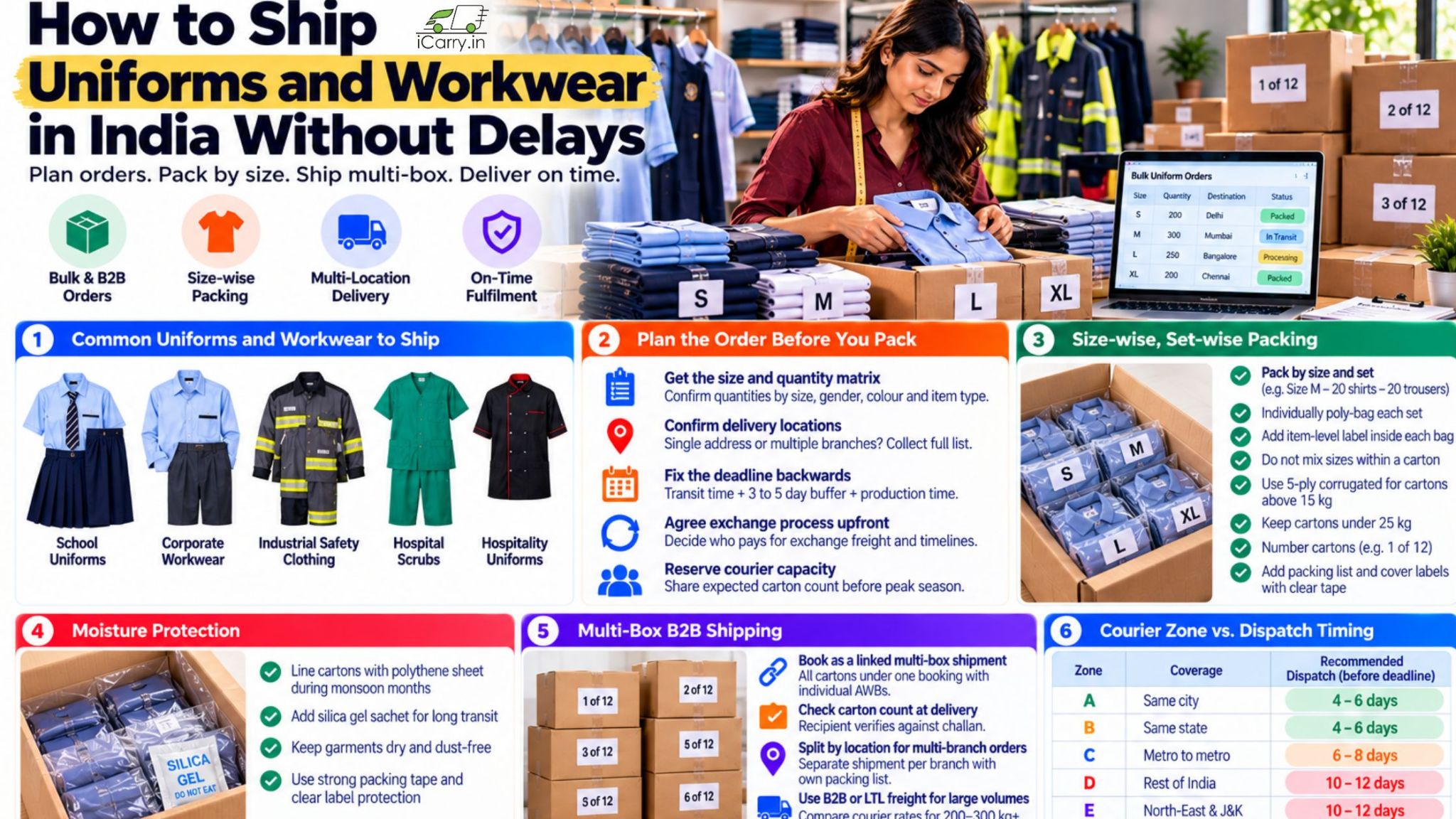
B2B uniform shipping is the bulk delivery of school uniforms, corporate workwear and safety clothing to institutions, usually as many cartons to one or more locations. Each order has a fixed deadline and size breakdown, so cartons are packed by size and set, booked together as one consignment and checked against a challan on delivery.
How to Plan the Order Before You Pack It
- Get the size and quantity matrix: Confirm quantities by size, gender, colour and item type before production. Changes after packing cause repacking and delay
- Confirm delivery locations: Single address or multiple branches? For multi-location orders, get a complete list with contact numbers and receiving hours
- Fix the deadline backwards: Work back from the date uniforms must be worn. Subtract transit time plus a 3 to 5 day buffer, then production and quality check time
- Agree the exchange process upfront: Size mismatches are common in bulk uniform orders. Decide who pays for exchange freight and how quickly replacements ship
- Reserve courier capacity: Tell your courier partner the expected carton count before peak season, so capacity is available when you dispatch
Packing Uniforms for Bulk Dispatch
Size-wise, Set-wise Packing
- Pack by size and set, not by item. A carton labelled 'Size M - 20 shirts - 20 trousers' is easy to verify and distribute
- Individually poly-bag each set or garment to protect from moisture and dust
- Add an item-level label inside each bag with name, size and class or department where applicable
- Do not mix sizes within a carton unless the buyer has asked for pre-assembled individual kits
Carton Standards
- Use 5-ply corrugated for cartons above 15 kg. Bulk garments are dense and heavy
- Keep cartons under 25 kg where possible so they stay within standard courier weight limits and are manageable for receiving staff
- Number every carton ('1 of 12', '2 of 12') and put a packing list inside each carton
- Mark the carton with size, quantity, delivery location and contact on at least two sides
Moisture Protection
- Line cartons with a polythene sheet during monsoon months
- Add a silica gel sachet for long transit routes
- Cover shipping labels with clear tape so they do not peel in humid conditions
Multi-Box B2B Shipping
Large uniform orders ship as multiple cartons to the same address. They need to be booked, tracked and delivered together:
- Book as a linked multi-box shipment: Every carton gets its own AWB, but all cartons are linked under one booking so they are picked up and delivered as one consignment
- Check carton count at delivery: Ask the receiving person to count cartons against the delivery challan before signing. Note any missing or damaged carton on the proof of delivery
- Split by location for multi-branch orders: Create a separate shipment per branch with its own packing list, contact person and delivery window
- Use B2B or LTL freight for very large volumes: If total weight crosses 200 to 300 kg to a single address, compare courier multi-box rates against freight options
Shipping a large order to one school? See how to book a multi-box B2B shipment on iCarry®.
Documents Required for B2B Uniform Orders
- GST tax invoice: Correct GSTIN of buyer and supplier, HSN code for garments, and the right tax split (CGST and SGST within the state, IGST across states). Readymade garments are taxed at 5% up to ₹2,500 per piece and 18% above, since 22 September 2025 (see the PIB factsheet on GST reforms)
- E-way bill: Required when the consignment value crosses ₹50,000. Generate before pickup
- Delivery challan: A signed delivery challan listing carton numbers, sizes and quantities, for receiving confirmation
- Packing list: Per carton, with size-wise quantities that match the invoice
Timelines for Peak Seasons
- School uniforms (March to June): Dispatch must complete at least 7 to 10 days before the school reopening date. Demand peaks sharply and courier networks get congested
- Corporate and hospitality workwear: Align with onboarding dates and new site openings. Ask for the date of the first working day, not the date of the order
- Industrial safety wear: Often tied to audits and compliance dates. Build a buffer and confirm receiving hours at the plant gate
Compare transit times and rates for each branch pincode with the iCarry® domestic rate calculator before you fix your dispatch date.
Handling Exchanges and Reorders
- Plan an exchange buffer: Keep 5 to 8% extra stock in commonly exchanged sizes to ship replacements immediately
- Single reverse pickup per branch: Collect all exchange pieces from a location in one pickup rather than many small ones
- Record order history: For repeat enterprise clients, store the size matrix and carton configuration so the next order can be repeated quickly and accurately
How iCarry® Supports B2B Uniform Shipping
iCarry® is a courier aggregator that helps uniform manufacturers, wholesalers, and suppliers manage B2B shipments through multiple courier partners from one account.
- Multi-box B2B booking: Link multiple cartons under one booking and manage B2B multi-box shipments for coordinated tracking and delivery.
- Rate comparison before booking: Compare courier rates based on actual carton weights, dimensions, destination, and serviceability to help manage shipping costs.
- Transit Loss Insurance: For high-value uniform consignments, enable Transit Loss Insurance during booking and review the available coverage and applicable fee before confirmation.
- Address Quality Scoring: Identify incomplete or potentially problematic delivery addresses before dispatch, particularly for schools, factories, and institutional locations.
- Two-way WhatsApp Engagement: Receiving contacts can confirm availability, update address details, or coordinate delivery through WhatsApp engagement, while businesses can view the conversation history.
- Delivery Boost: For time-sensitive institutional deliveries, Delivery Boost supports additional pre-delivery coordination to help reduce avoidable delivery failures.
Free Bronze plan with no minimum shipment volume.
Frequently Asked Questions (FAQs)
How should I pack a bulk uniform order of 500 or more sets?
Pack by size and set in numbered 5-ply cartons under 25 kg each. Poly-bag each garment or set, label each bag with size and department, and place a packing list in every carton. Mark carton number, size, quantity and delivery location on at least two sides so the receiving team can verify and distribute quickly.
How do I ship uniforms to multiple branches or locations?
Create a separate shipment for each location with its own packing list and receiving contact. If a location receives multiple cartons, book them as a linked multi-box shipment so all cartons travel and arrive together. Share the carton count and delivery window with each branch before dispatch.
Is an e-way bill required for uniform shipments?
Yes, when the invoice value of the goods in a consignment exceeds ₹50,000. Generate the e-way bill before the courier picks up the shipment. Make sure the GST invoice has the correct HSN code and the right tax split for intrastate or interstate supply.
How early should I dispatch school uniforms?
Aim to complete dispatch at least 7 to 10 days before the school reopening date. Courier networks are congested during peak admission and reopening periods, and transit times extend. Build a 3 to 5 day buffer on top of normal transit for Zone D and Zone E deliveries.
A bulk uniform order succeeds or fails on carton discipline: pack by size and set, number every carton, keep each under 25 kg, and book them as one linked multi-box consignment so nothing arrives separately. Work the dispatch date backwards from the day uniforms must be worn, add a 3 to 5 day buffer, and have the GST invoice, e-way bill and delivery challan ready before pickup. Then the receiving team can count cartons against the challan and the order is verified the day it arrives.