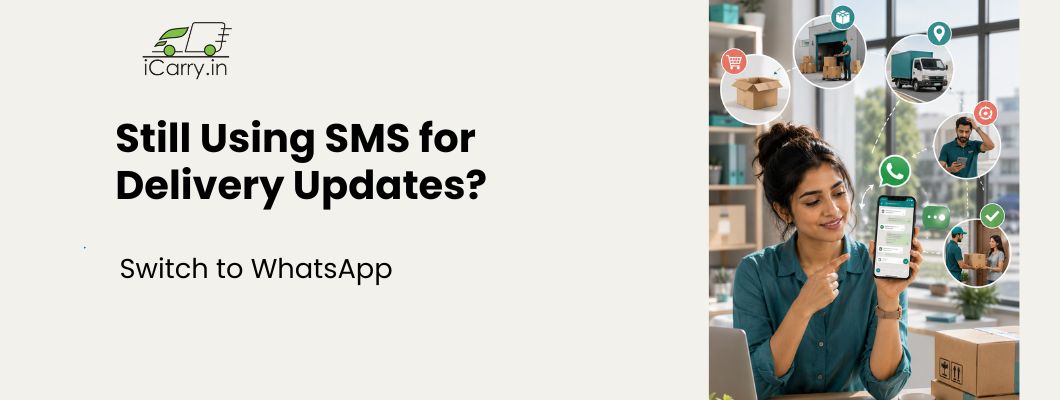
A customer orders a ₹1,499 skincare set. The order ships on Tuesday. By Wednesday evening they message: 'Where is my order?' The seller checks the tracking - it is out for delivery. They reply on WhatsApp. The customer is satisfied and waits. The order delivers Thursday morning.
Now imagine the same scenario without any WhatsApp communication. The customer waits until Thursday afternoon, assumes the order is lost, raises a complaint with the payment gateway, and initiates a chargeback. The seller spends an hour resolving it.
WhatsApp is how India communicates. With over 500 million active users in India - and confirmed as the country's single most-used social or messaging app (Statista), it is the channel customers actually read - not email, not SMS, not in-app notifications. For Indian businesses shipping orders across the country, WhatsApp is not just a customer service tool. It is a delivery management tool that directly determines whether shipments succeed or fail.
This guide explains how to use WhatsApp effectively at every stage of the delivery journey - from dispatch confirmation to NDR resolution to COD collection - and how automated two-way WhatsApp communication transforms the seller's delivery operation.
What Is WhatsApp Delivery Communication?
WhatsApp delivery communication means sending order and shipment updates - order confirmation, dispatch, out-for-delivery, NDR alerts, and delivery confirmation - to customers over WhatsApp instead of SMS or email, since it's the channel Indian buyers actually read. The more effective version is two-way: the customer can reply directly to reschedule a failed delivery, update an address, or confirm COD availability, and that reply is received and acted on rather than sent into a one-way broadcast that nobody responds to.
How to Check If You're Using WhatsApp for Delivery Communication
- Do customers receive a WhatsApp dispatch message with tracking number and courier name?
- Do you send a WhatsApp COD confirmation before dispatching COD orders?
- Do customers get an out-for-delivery WhatsApp alert on delivery day?
- When an NDR occurs, does the customer receive a WhatsApp message to reschedule?
- Can the customer reply to your delivery WhatsApp messages to update their address or timing?
Why WhatsApp Works Better Than Other Delivery Channels in India
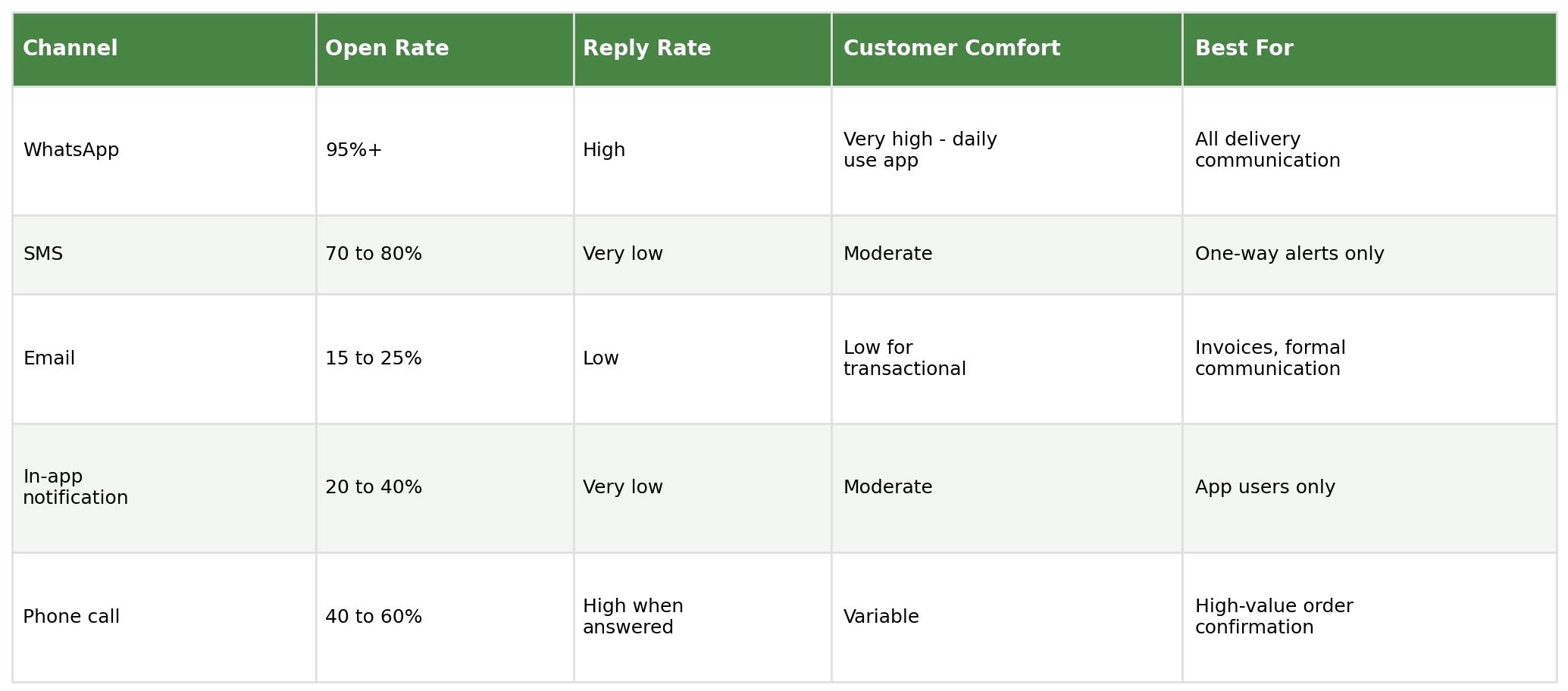
WhatsApp's combination of near-universal adoption, high open rate, and conversational format makes it the most effective channel for delivery communication in India. A customer who misses an SMS will see a WhatsApp message. A customer who ignores an email will reply on WhatsApp.
WhatsApp at Every Stage of the Delivery Journey
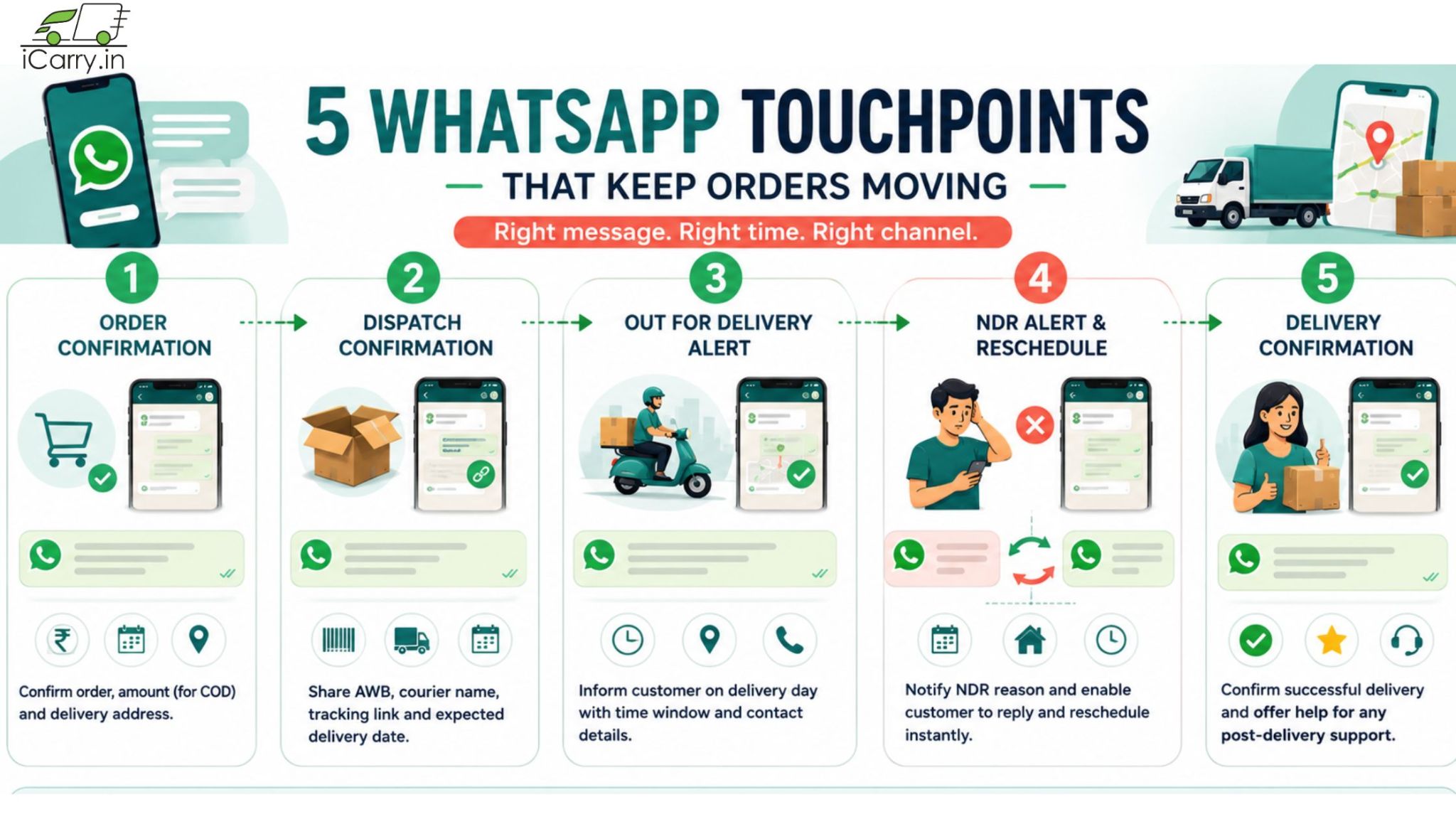
Stage 1: Order Confirmation (Before Dispatch)
Send a WhatsApp message immediately after the order is placed - before the product is even packed.
What to include: Order number, product name, total amount (for COD: the amount to keep ready), expected dispatch date, and a request to confirm the delivery address.
For COD orders specifically: 'Hi [Name], your order for [Product] (₹[Amount]) has been placed. Please reply YES to confirm you would like this order delivered. Keep ₹[Amount] ready for payment on delivery.'
This single message eliminates a large proportion of impulse COD orders that would have become doorstep refusals. A customer who does not reply does not get dispatched to. A customer who replies YES has confirmed intent.
Stage 2: Dispatch Confirmation
Send immediately after the shipment is booked and the label is generated.
What to include: AWB (tracking) number, courier name, tracking link, expected delivery date range, and a contact for queries.
Example: 'Your order has been shipped! Tracking number: [AWB]. Courier: [Name]. Expected delivery: [Date range]. Track here: [link]. Reply to this message if you need any help with your delivery.'
The dispatch message sets the customer's delivery expectation precisely - preventing the 'where is my order?' queries that start from unclear timelines.
Stage 3: Out-for-Delivery Alert
Sent when the courier updates the shipment status to 'Out for Delivery.' This is the most important message in the delivery sequence.
Why it matters: The customer who knows their order is on its way today is home, available, and has cash ready (for COD). The customer who does not know goes to work, locks the door, and generates an NDR.
Example: 'Great news! Your order is out for delivery today. The delivery executive will arrive at your address shortly. For COD orders, please keep ₹[Amount] ready. Reply if you need to update your delivery timing or address.'
Stage 4: NDR Communication and Rescheduling
When a delivery attempt fails, the customer receives an NDR notification via WhatsApp - not just a tracking status update they may never check.
What to include: Notification that delivery was attempted, reason if available, and a clear call to action: 'Reply with your preferred delivery time' or 'Reply with updated address details.'
This is where two-way WhatsApp communication becomes critical. A customer who can reply directly to reschedule converts an NDR into a successful second attempt. A customer who has to call a courier helpline to reschedule - or navigate a web portal - is far more likely to simply let the parcel return to origin.
The RTO prevention impact: Each NDR that converts to a successful reattempt saves forward freight + return freight + the product's margin on an unsaleable returned item. Two-way WhatsApp Engagement on NDRs is the single most effective RTO reduction tool available to Indian sellers.
Stage 5: Delivery Confirmation
Sent when the courier marks the shipment as delivered.
What to include: Confirmation of delivery, a request for feedback or review, and details for returns or exchanges if applicable.
Example: 'Your order has been delivered! We hope you love it. If you have any issues with your order, please reply to this message within 48 hours and we will sort it out. Enjoy!'
This message closes the delivery loop professionally and opens the channel for post-delivery customer service - preventing complaints from escalating to payment gateway disputes.
One-Way vs Two-Way WhatsApp Engagement
Not all WhatsApp delivery communication is equal. There is a fundamental difference between one-way and two-way WhatsApp communication:
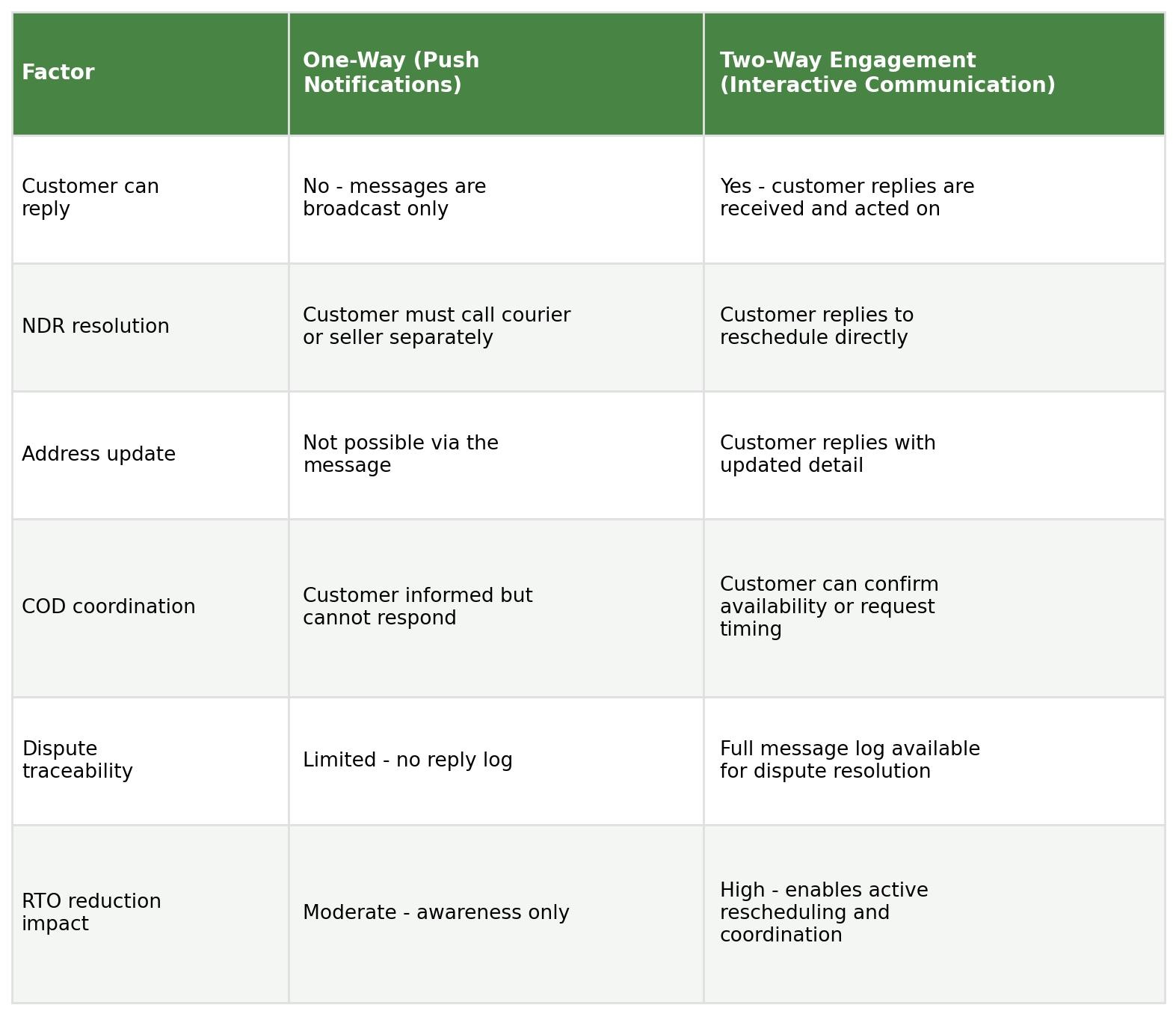
One-way WhatsApp alerts are better than SMS or email. But two-way engagement- where the customer's reply is received, read, and acted on - is what converts NDRs into successful deliveries. This is the difference between informing the customer and coordinating the delivery.
WhatsApp for COD Order Management
COD orders have three specific WhatsApp communication needs that prepaid orders do not:
- Pre-dispatch confirmation: Confirm the customer actually wants the order and will be available to pay. Eliminates low-intent impulse orders before dispatch cost is incurred
- Cash amount reminder: Remind the customer of the exact COD amount on the out-for-delivery day. A customer who does not have the exact amount generates a failed delivery even when home and willing
- Rescheduling flexibility: When a COD order fails delivery, the customer needs a frictionless way to reschedule. WhatsApp reply is that way - lower friction than any alternative
iCarry®'s WhatsApp Engagement handles all three for COD orders automatically. The service is specifically noted as 'especially useful for clients who ship COD orders' because it directly addresses the highest-cost failure mode in COD logistics: doorstep refusal from an unconfirmed or unprepared buyer.
How iCarry® WhatsApp Engagement Works
iCarry® is a courier aggregator that provides WhatsApp Engagement as a managed two-way communication service for Indian businesses of all types - not just for eCommerce sellers.
WhatsApp Engagement is an interactive two-way communication service from iCarry®'s official WhatsApp number to your customers' WhatsApp numbers. It is not a broadcast notification system - it is a managed communication service where iCarry®'s team coordinates delivery on your behalf via WhatsApp.
Here is what it does:
- Customers are notified and can interact with the iCarry® team at every key delivery stage: dispatch, out for delivery, delivery attempt, and delivery confirmation
- If there is an NDR, the customer can reach iCarry® directly and the team handles it on your behalf: rescheduling, address updates, and delivery coordination - without the seller needing to intervene on each case
- Reduces RTO due to fake NDR remarks from couriers: iCarry® agents audit suspicious NDRs and coordinate re-attempts, especially useful for COD orders where fake non-delivery marks are most common
- Your customer support mobile number and email can be added: so customers can contact you directly if the delivery query requires the seller's input
- Full traceability via message logs: every WhatsApp conversation between iCarry®'s team and your customer is logged and visible to you in the seller dashboard - for dispute resolution and quality monitoring
- Saves time and cost on customer support: you do not need to hire a dedicated customer support person to co-ordinate deliveries. iCarry®'s team does this on your behalf
How to enable: Go to Settings > WhatsApp Engagement in your iCarry® panel. The service is available at a nominal per-shipment fee. Log in to view current rates.
Setting Up WhatsApp Communication Yourself vs Using iCarry®
Many businesses attempt to set up their own WhatsApp order communication using WhatsApp Business. This works well for certain functions but has limitations compared to a managed two-way service:
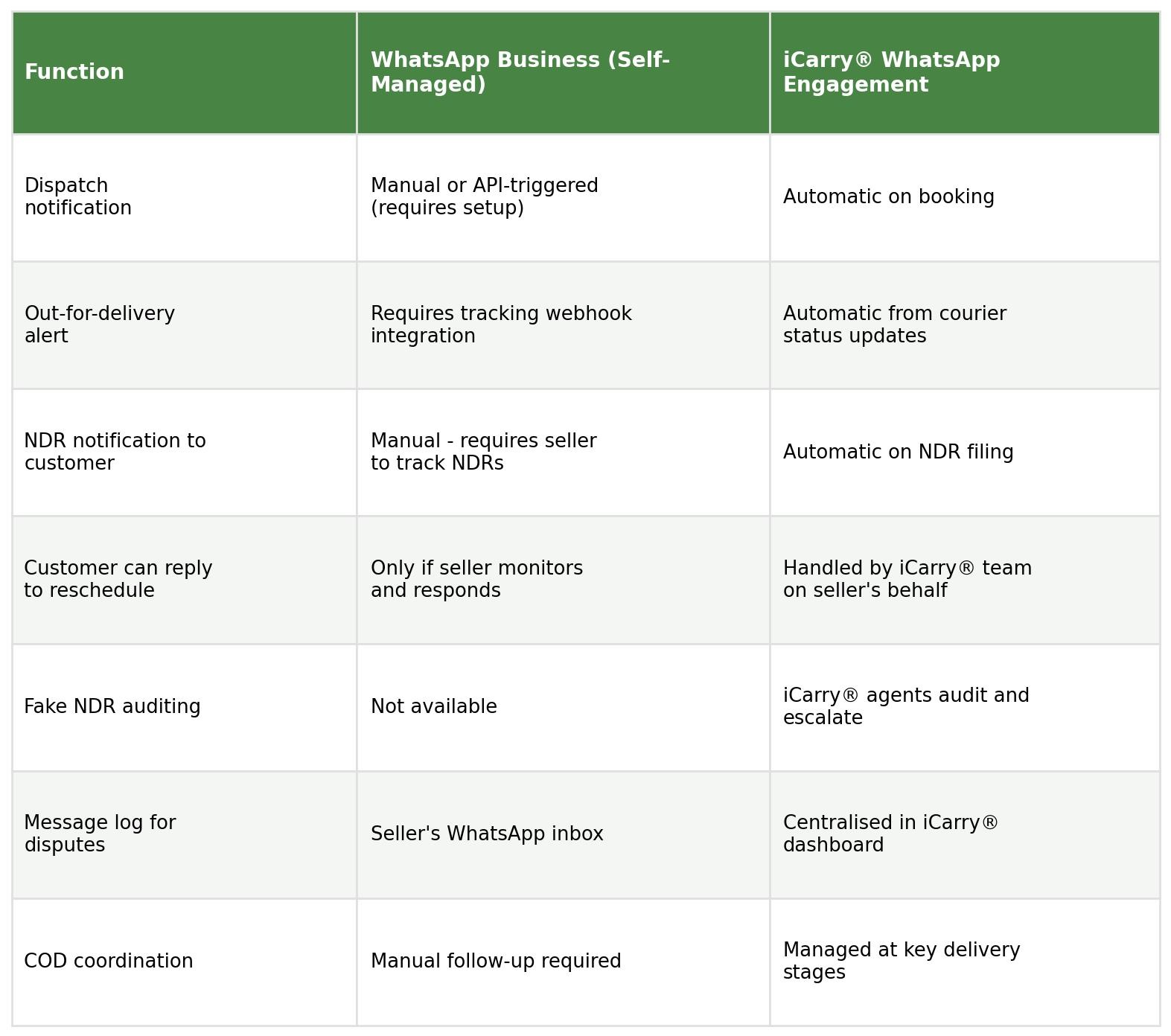
Self-managed WhatsApp works for businesses with small order volumes and dedicated customer service staff who can monitor replies. For businesses dispatching 100+ orders daily, iCarry®'s managed two-way communication removes the operational overhead while delivering better delivery coordination than any self-managed setup.
What Not to Do: Common WhatsApp Delivery Communication Mistakes
- Sending tracking links without the courier name: Customers need to know which courier app or website to use. A bare tracking link without context generates a support query
- Sending all messages from a personal number: A personal WhatsApp number is not searchable, not professional, and creates a support backlog in the seller's personal inbox
- Not acting on customer replies: Sending out-for-delivery messages and then not monitoring replies means a customer who tries to reschedule gets no response - an avoidable NDR
- Sending messages at 11 PM: Delivery update messages should go out during reasonable hours. Messages that arrive at midnight are likely to be ignored or cause irritation
- Over-communicating: Sending 6 messages per shipment creates notification fatigue. The right touchpoints are: order confirmation, dispatch, out-for-delivery, and delivery confirmation. NDR only if required
Final Thoughts
WhatsApp is where your customers are. It is where they expect to hear from brands they have purchased from, and it is the channel where they will actually read and respond to delivery updates. Email and SMS are secondary - WhatsApp is primary.
The difference between one-way WhatsApp notifications and two-way WhatsApp engagement is the difference between informing customers and coordinating deliveries. For Indian businesses where COD orders, NDR management, and delivery failure prevention directly determine profitability, two-way WhatsApp engagement is one of the highest-impact tools available.
iCarry®'s WhatsApp Engagement manages this on your behalf - so your customers get professional, responsive delivery coordination on WhatsApp without requiring your team to manage it manually. Enable from Settings > WhatsApp Engagement in your iCarry® account. Register free at iCarry® now..
Frequently Asked Questions (FAQs)
Why is WhatsApp better than SMS for delivery communication in India?
WhatsApp has a 95%+ open rate versus SMS at 70 to 80%, and crucially, customers can reply to WhatsApp messages. This two-way capability enables delivery rescheduling, address updates, and COD coordination directly in the message thread - none of which are possible with one-way SMS. WhatsApp is also the app most Indian consumers already use daily for personal and business communication.
What is the difference between one-way and two-way WhatsApp delivery communication?
One-way WhatsApp sends notifications to the customer but does not allow replies to be received or acted on. Two-way communication lets the customer reply - to reschedule a delivery, update an address, or confirm COD availability - and those replies are received and acted on by a human or managed system. Two-way communication is what converts NDRs into successful deliveries.
What is iCarry® WhatsApp Engagement?
WhatsApp Engagement is iCarry®'s managed two-way WhatsApp communication service. It sends delivery updates to your customers from iCarry®'s official WhatsApp number and allows customers to reply for rescheduling, address updates, or delivery coordination. iCarry®'s team manages these replies on your behalf. The seller sees all conversations in their iCarry® dashboard. Useful for reducing RTO on COD orders and eliminating the need for a dedicated delivery coordination team.
How do I enable WhatsApp Engagement on iCarry®?
Log in to your iCarry® account and go to Settings > WhatsApp Engagement. The service is enabled per shipment at a nominal fee. Once enabled, WhatsApp messages are sent automatically at key delivery stages without any manual action required from the seller.
Does WhatsApp delivery communication reduce RTO?
Yes, significantly. The out-for-delivery WhatsApp alert ensures customers are home and prepared (with cash for COD). The NDR notification with a reply-to-reschedule mechanism converts failed first attempts into successful second attempts. iCarry®'s two-way WhatsApp Engagement also audits suspicious NDRs and coordinates reattempts - directly reducing fake non-delivery marks that cause unnecessary RTOs.
Can customers contact me directly through iCarry®'s WhatsApp Engagement?
Yes. Your customer support mobile number and email can be added to the WhatsApp Engagement setup so customers can contact you directly if their query requires seller input beyond delivery coordination. All message logs are visible in your iCarry® dashboard for full transparency and dispute traceability.
WhatsApp is where your customers already are, and it is the channel they will actually read and respond to. The gap between one-way notifications and two-way engagement is the gap between informing a customer and coordinating a delivery - and that gap is where NDRs convert into successful reattempts instead of RTOs. Five touchpoints, done consistently, change the outcome of every order: order confirmation, dispatch, out-for-delivery, NDR reschedule, and delivery confirmation.