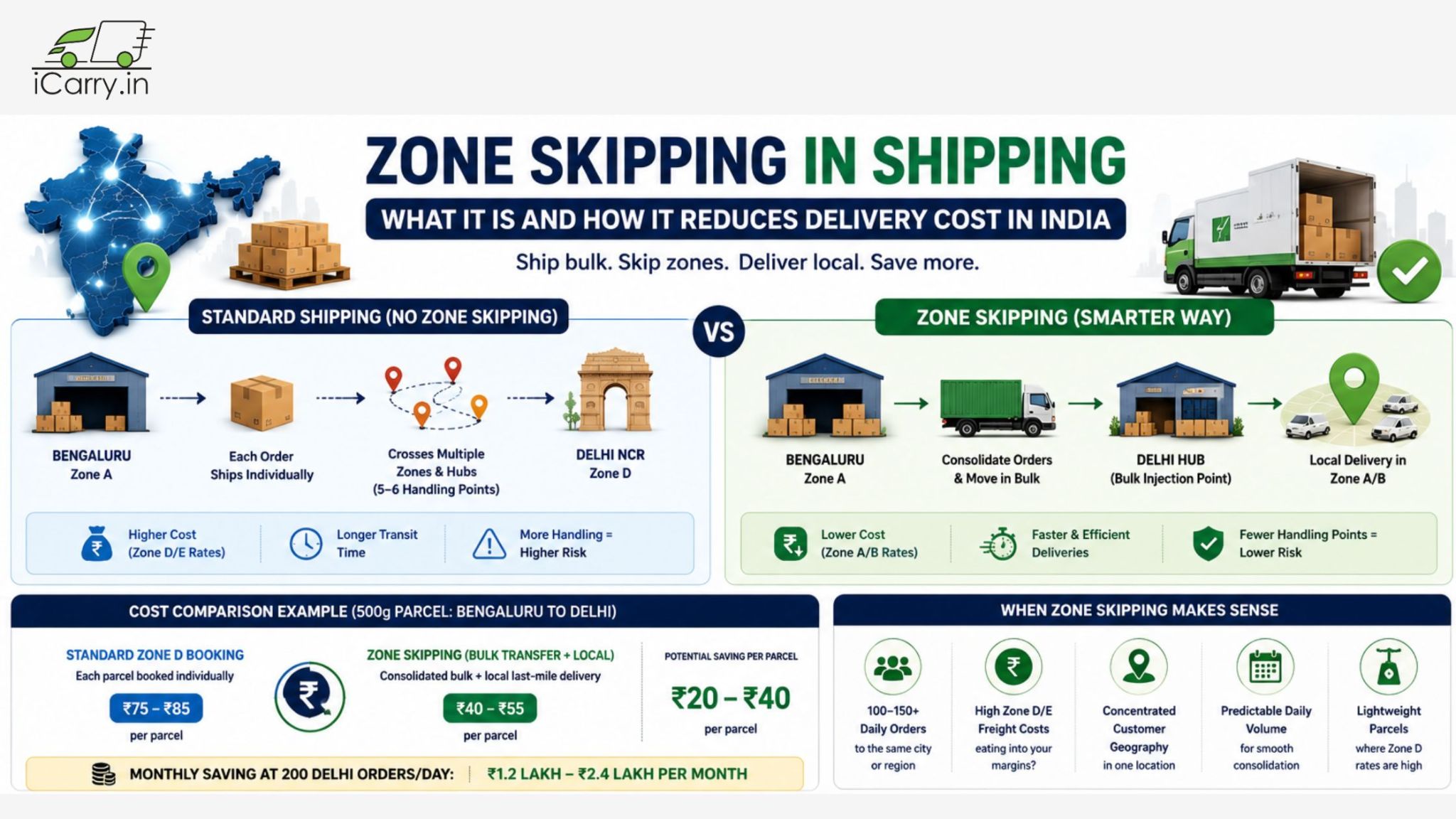
A business in Bengaluru ships 500 daily orders. Roughly 180 of those go to customers in Delhi, Noida, and Gurgaon. Each parcel travels from Zone A in Bengaluru all the way to Zone D in Delhi NCR - paying the full cross-zone rate, covering the full distance, and passing through 5 to 6 courier handling points along the way.
Now imagine those 180 Delhi orders being consolidated into a single truck movement from Bengaluru to Delhi - a bulk surface transfer at freight rates - and then injected into Delhi's local delivery network at Zone A rates. The cost per parcel drops. The transit time may actually improve. And the number of handling points the individual parcels go through is significantly reduced.
That is zone skipping. And for Indian businesses with concentrated customer geographies, it is one of the most underused cost reduction strategies available. India's logistics sector is evolving rapidly - logistics costs have fallen to 7.97% of GDP per a DPIIT report (Business Standard), and businesses that understand how zone-based pricing works - and how to work around it intelligently - build a structural cost advantage that compounds across thousands of monthly orders.
What Is Zone Skipping?
Zone skipping is the practice of consolidating a large number of parcels destined for the same geographic region, moving them together as a bulk consignment to a hub or facility near that region, and then injecting them into the local delivery network - effectively making the individual parcels appear as local (Zone A or B) shipments for last-mile pricing.
The mechanics:
- Consolidation: Instead of booking each Delhi order individually as a Zone D shipment, you consolidate all Delhi-bound orders into a single truck or line haul movement
- Bulk transfer: The consolidated load moves from your origin city (Bengaluru) to a hub or facility near the destination (Delhi) at bulk freight rates - significantly cheaper per kg than individual parcel Zone D rates
- Injection: At the Delhi hub, parcels are deconsolidated and handed over to the courier's local network for last-mile delivery at Zone A or Zone B rates
- Net saving: The combined cost of bulk transfer + local delivery is lower than individual Zone D rate for each parcel
How to Check If Zone Skipping Is Relevant for Your Business
- Do more than 15% of your monthly orders go to one specific city or region outside your dispatch location?
- Are Zone D or Zone E freight charges making up a significant share of your monthly shipping spend?
- Do you have sufficient daily order volume to that region to justify a consolidated bulk transfer?
- Does your courier aggregator or logistics partner support injection at destination hubs?
- Have you modelled the per-parcel cost of zone skipping against your current per-parcel Zone D rate?
How Courier Zone Pricing Works in India
Before understanding zone skipping, you need to understand why zones create the cost problem in the first place.
Indian couriers divide the country into delivery zones based on distance from the dispatch pincode. Zone A is the same city. Zone B is the same or adjacent state. Zone C is regional. Zone D is national long-distance. Zone E and beyond covers remote pincodes.
Each zone has a progressively higher per-shipment rate. The same 500g parcel that costs ₹25 to deliver within Bengaluru (Zone A) costs ₹85 to deliver to Delhi (Zone D) from the same dispatch point. The rate difference exists because the courier is transporting each individual parcel across the full distance - managing the line haul, multiple transit hubs, and cross-country sorting for every single order.
Zone skipping disrupts this individual-parcel pricing model by separating the long-distance movement from the last-mile delivery.
Zone Skipping vs Standard Delivery - Cost Comparison
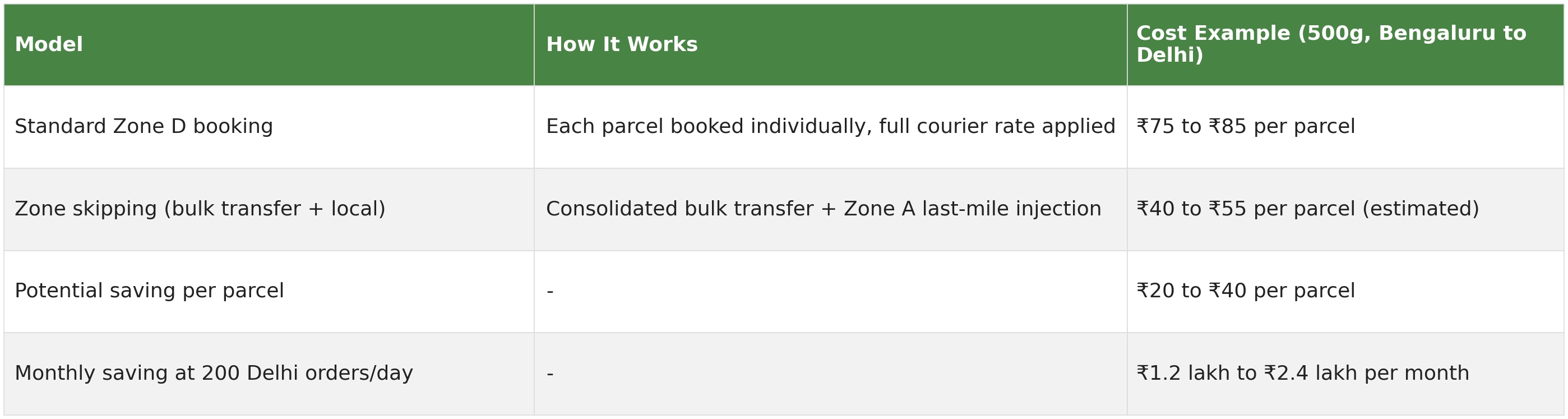
Important: Actual savings depend on your specific volume, route, courier partner, and the bulk transfer rate you negotiate. Zone skipping is not always cheaper at low volumes - there is a minimum order concentration needed to make the maths work.
When Zone Skipping Makes Sense
Zone skipping is not universally applicable. The conditions that make it financially viable:
- High concentration in one geography: At least 100 to 150 daily orders going to the same city or region. Below this threshold, the fixed cost of operating a consolidation point may outweigh the per-parcel saving
- Predictable daily volume: Zone skipping requires a regular, predictable flow to make consolidation efficient. Irregular spikes do not justify the operational setup
- Weight per parcel matters: Zone skipping is most effective for lightweight parcels where the individual Zone D rate is high relative to product value. Heavy shipments already use LTL or surface freight which achieves similar savings through different mechanisms
- Tolerance for slightly longer transit: Consolidation and deconsolidation adds a few hours to the overall transit cycle. For time-critical express orders, zone skipping may not be appropriate
Zone Skipping vs Multi-Warehouse Strategy
Zone skipping and multi-warehouse routing are often confused - they address the same problem (high Zone D costs) through different mechanisms.
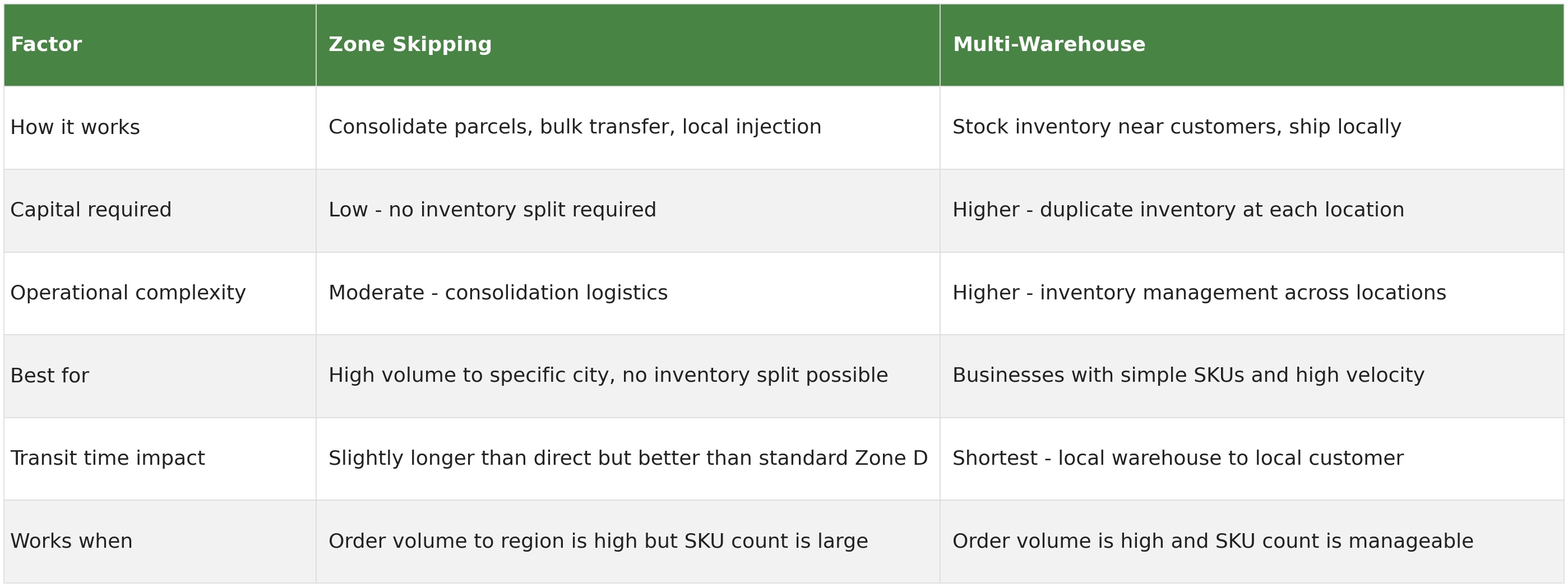
For businesses that cannot split inventory across locations, zone skipping delivers most of the cost benefit of multi-warehouse routing without the inventory complexity. For businesses that can split inventory, multi-warehouse order routing typically delivers better transit time alongside the cost saving.
How to Implement Zone Skipping in India
Step 1 - Analyse Your Order Geography
Export 3 months of shipment data. Group orders by destination city. Identify which cities receive more than 100 daily orders from your dispatch location. These are your zone skipping candidates.
Step 2 - Calculate the Break-Even
Model the cost per parcel under zone skipping: (bulk transfer cost to destination city / number of parcels) + local delivery rate. Compare against your current Zone D rate. If the zone skipping total is lower, the maths works. If not, you need more volume concentration before implementing.
Step 3 - Choose Your Implementation Model
Three approaches are available to Indian businesses:
- Self-managed: You arrange your own truck from Bengaluru to Delhi and negotiate directly with a local courier for last-mile injection. Requires volume and operational capability
- Through your courier aggregator: Some courier aggregators provide zone skipping as a managed service - you book normally and they handle the consolidation and injection behind the scenes
- Through a 3PL with hub network: Third-party logistics providers with hubs in major cities can receive your consolidated transfers and manage last-mile injection through their local partner network
Step 4 - Run a Pilot Before Full Commitment
Run zone skipping on one destination city for one month. Track: total cost per parcel including all components, transit time vs standard Zone D, delivery success rate, and NDR rate. Compare against the previous month's Zone D performance on the same city. Commit fully only if the pilot data confirms the saving.
Risks and Limitations of Zone Skipping
- Consolidation delay: Parcels must wait at the origin until enough volume accumulates for the bulk transfer. Daily cutoffs help manage this but add a few hours to dispatch-to-in-transit time
- Last-mile partner dependency: The injection courier at the destination must perform reliably. If last-mile delivery fails at high rates, the cost saving disappears in RTO freight
- Tracking complexity: Parcels go through a consolidation leg before entering the courier's individual tracking system. Tracking gaps during the bulk transfer phase can generate customer enquiries
- Not suitable for urgent orders: Express and same-day orders must bypass zone skipping and ship via standard Zone D booking
How iCarry® Supports Cost Reduction on Zone D Orders
iCarry® is a courier aggregator that gives Indian businesses access to multiple courier partners with live rate comparison before every booking - the starting point for managing Zone D cost intelligently.
For businesses not yet at the volume required for zone skipping, multi-courier allocation - routing each Zone D order to the courier with the best rate for that specific pincode - delivers meaningful savings without any consolidation infrastructure. Compare rates before every booking to ensure you are never paying above the best available Zone D rate.
For businesses exploring zone skipping, iCarry®'s shipment data across all couriers gives you the order geography analysis needed to identify which destination cities have sufficient daily volume to make zone skipping viable.
Free Bronze plan with no minimum volume. Register at iCarry® today..
Final Thoughts
Zone skipping is not a complex concept. It is simply the recognition that moving 200 parcels to Delhi as one bulk load and distributing them locally is cheaper than moving each parcel individually across the full distance at Zone D rates.
The businesses that benefit most are those with predictable, concentrated customer geographies - a D2C brand with a strong Delhi NCR customer base, a distributor serving Maharashtra from Bengaluru, a manufacturer shipping to Tier 1 cities from a Tier 2 production location.
If your Zone D and Zone E freight is a significant share of your monthly shipping spend, the analysis is worth running. The savings at scale are substantial - and unlike many logistics improvements, zone skipping requires no product changes, no packaging changes, and no customer-facing changes at all.
Frequently Asked Questions (FAQs)
What is zone skipping in logistics?
Zone skipping is a shipping strategy where parcels destined for the same geographic region are consolidated and moved together as a bulk transfer to a hub near that region. They are then injected into the local delivery network - effectively converting long-distance Zone D shipments into local Zone A or B last-mile deliveries at lower cost.
How much can zone skipping save on shipping costs?
Savings depend on route, volume, and the bulk transfer rate negotiated. On a Bengaluru-to-Delhi route, zone skipping can reduce per-parcel cost from ₹75 to ₹85 (Zone D rate) to ₹40 to ₹55 - saving ₹20 to ₹40 per parcel. At 200 daily orders to Delhi, this is ₹1.2 to ₹2.4 lakh in monthly savings.
How is zone skipping different from multi-warehouse shipping?
Zone skipping consolidates parcels from one location and moves them in bulk to near the destination before last-mile injection - no inventory split required. Multi-warehouse shipping stocks inventory at multiple locations and ships each order locally. Zone skipping is better when inventory cannot be split; multi-warehouse is better when it can.
What volume do I need for zone skipping to be cost-effective?
Generally 100 to 150 daily parcels going to the same destination city is the minimum threshold where consolidation economics start to outweigh the fixed costs of operating a bulk transfer. Below this, standard courier aggregator rate comparison delivers better results with less complexity.
Does zone skipping affect delivery time?
Slightly. Consolidation and deconsolidation adds a few hours to the overall journey compared to direct single-parcel Zone D booking. However, because the bulk transfer moves efficiently and the last-mile is local, total transit time is often comparable to or better than standard Zone D delivery which goes through 5 to 6 individual handling points.
Zone skipping is simply the recognition that moving 200 parcels to a city as one bulk load and distributing them locally is cheaper than moving each parcel individually across the full distance at Zone D rates. The businesses that benefit most are those with predictable, concentrated customer geographies - and unlike many logistics improvements, zone skipping requires no product changes, no packaging changes, and no customer-facing changes at all.