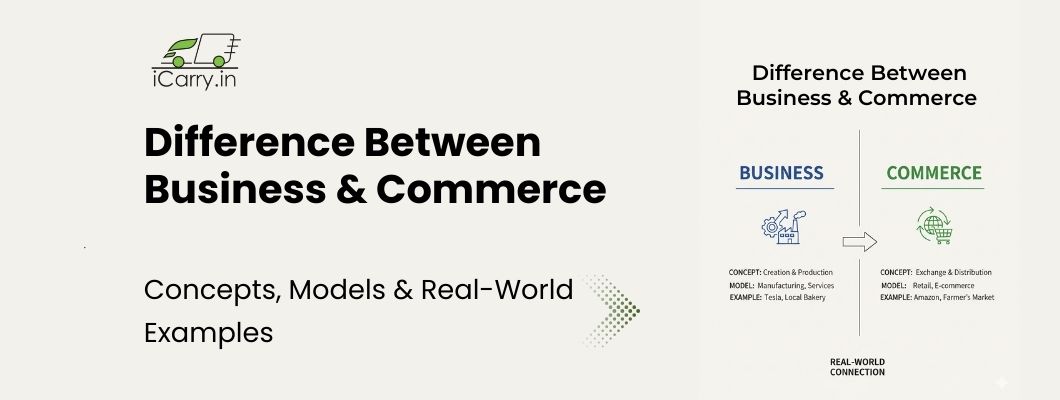
What is the difference between business and commerce? Many people use these terms interchangeably, but they have distinct meanings.
Every product you buy, service you use, or brand you recognize exists because of business and commerce.
But these terms are often used loosely - and confused with each other.
This guide breaks down what business and commerce actually mean, their core concepts, common models, and real-world examples you can relate to.
What Is Business?
Business is the activity of creating, producing, or providing goods and services to satisfy customer needs with the aim of earning profit, a definition widely accepted in economic and management literature.
In simpler terms, business is about creating value that customers are willing to pay for.
For example, a company that manufactures clothing creates value through design and production. A restaurant creates value by preparing meals and offering dining experiences. A software firm delivers value by solving operational problems through technology. Similarly, a logistics company creates value by enabling efficient transportation of goods.
At its core, business is the engine of value creation in an economy.
What Is Commerce?
Commerce is the process of buying, selling, and distributing goods and services. It connects producers with consumers through systems such as trade, transportation, marketing, and payments.
If business creates value, commerce ensures that value reaches the right customer at the right time.
Commerce includes activities like domestic and international trade, distribution networks, warehousing, marketing campaigns, and payment processing systems. In today's digital economy, it also involves eCommerce platforms, digital transactions, and logistics coordination.
Without commerce, even the most innovative product would remain stuck at the production stage.
Commerce connects producers with consumers - and in modern eCommerce, that connection depends heavily on efficient logistics and reliable delivery systems.
Business vs Commerce (Quick Difference)
Business creates value.
Commerce moves value.
Economists often distinguish business as value creation and commerce as value exchange within an economy.
Why Business & Commerce Matter
Business and commerce function together as the backbone of economic systems. Business drives innovation, production, and value creation, while commerce enables that value to circulate efficiently within markets.
Together, they generate employment, stimulate economic growth, improve living standards, and encourage technological advancement.
Without business, there would be nothing to sell. Without commerce, products and services would never reach customers. Sustainable economic progress depends on both working in alignment.
Core Concepts of Business
1. Value Proposition
Every successful business begins with a clear value proposition - a defined answer to the question: What problem are we solving for customers?
This could mean offering affordable fashion, faster delivery, superior product quality, or a more convenient user experience. If customers do not clearly understand the value, long-term sales and loyalty become difficult to sustain.
2. Profit Motive
Profit is not merely a financial goal; it is what allows a business to survive, reinvest, and grow. Sustainable profit enables innovation, expansion, employee compensation, and long-term stability.
Without profitability, even strong ideas cannot survive in competitive markets.
3. Risk and Uncertainty
Every business operates under uncertainty. Demand may fluctuate, costs may increase, and competitors may enter the market. Managing these risks effectively is a key part of strategic decision-making.
4. Customer Focus
Modern markets are customer-driven. Businesses that invest in understanding customer needs, delivering consistent experiences, and building trust are far more likely to survive and scale. Ultimately, customers determine which businesses succeed.
Core Concepts of Commerce
1. Trade
Buying and selling of goods/services.
Types:
- Domestic trade
- International trade
2. Transportation
Moves goods from producers to markets.
Without transport, trade stops - and choosing the right courier aggregator directly affects cost, speed, and customer satisfaction.
3. Warehousing
Stores goods safely until demand arises.
Prevents shortages and delays.
4. Marketing & Promotion
Creates awareness and demand.
No marketing = no commerce.
5. Payment & Finance
Includes:
- Cash
- Digital payments
- Credit systems
Commerce needs smooth money flow.
Common Business Models Explained
1. B2C (Business to Consumer)
Business sells directly to customers.
Examples:
- Online shopping apps
- Restaurants
- Retail stores
2. B2B (Business to Business)
Business sells to another business.
Examples:
- Raw material suppliers
- Software for companies
- Logistics services
3. D2C (Direct to Consumer)
Manufacturers sell directly to customers.
Examples:
- Brand websites
- Instagram stores
Cuts middlemen.
4. Marketplace Model
Marketplace models connect buyers and sellers at scale, which makes courier allocation and delivery performance critical for sustaining growth.
Examples:
- Online marketplaces
- Service platforms
The platform earns commission from each sale.
5. Subscription Model
Customers pay regularly.
Examples:
- OTT platforms
- Software subscriptions
This model provides predictable revenue.
Modern business models like B2C, B2B, D2C, and marketplaces define how value is delivered and monetized.
Commerce in the Real World (Examples)
Example 1: A T-Shirt Brand
Business: Designing and manufacturing T-shirts
Commerce: Selling through stores, websites, delivery partners
Example 2: Online Food Delivery
Business: Preparing food
Commerce: App ordering, payments, delivery
Example 3: Smartphone Company
Business: Product development & manufacturing
Commerce: Retail sales, logistics, marketing
Both must work together.
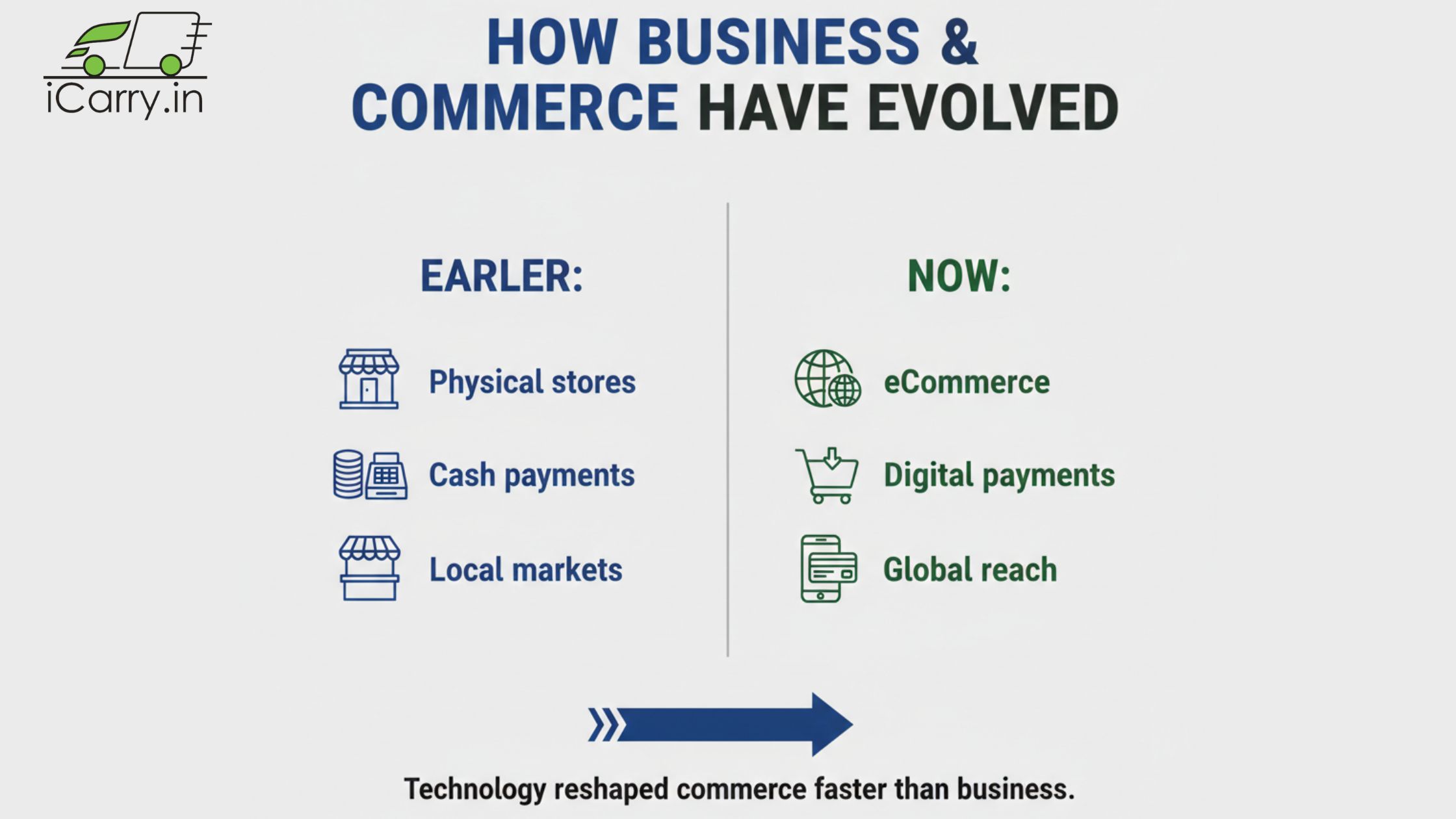
How Business & Commerce Have Evolved
Earlier:
- Physical stores
- Cash payments
- Local markets
Now:
- eCommerce
- Digital payments
- Global reach
Technology reshaped commerce faster than business.
Business, Commerce & the Digital Era
Modern commerce includes:
- Online marketplaces
- Social commerce
- Digital marketing
- Logistics tech
- Cross-border trade
Digital commerce lowers entry barriers for small businesses, but managing returns, pre-orders in eCommerce, and delivery challenges remains one of the biggest operational hurdles.
Digital commerce has transformed how businesses reach customers, reducing barriers for small and new entrepreneurs.
Common Misunderstandings
Clear concepts lead to better decisions.
Why Students & Founders Should Understand This
Understanding basics helps you:
- Choose the right business model
- Understand market dynamics
- Plan operations logically
- Avoid costly mistakes
Strong fundamentals beat shortcuts.
Understanding core business and commerce concepts helps founders make informed strategic and operational decisions.
Why This Is Helpful to Understand
Understanding the difference between business and commerce helps entrepreneurs, students, and professionals make clearer strategic decisions. While business focuses on creating value through products and services, commerce ensures that value moves efficiently through markets and reaches customers.
A strong business idea alone is not enough. Without structured systems of trade, transportation, marketing, and payment, even the most innovative product cannot scale. In the same way, commerce cannot function without businesses generating value to exchange.
In today's digital economy, the relationship between business and commerce has become even more interconnected. Technology, logistics networks, online marketplaces, and digital payment systems have accelerated how value is created and distributed.
When business (value creation) and commerce (value movement) work together, growth becomes sustainable. When they don't, inefficiencies limit progress.
Understanding these fundamentals builds stronger foundations — whether you are launching a startup, studying commerce, or scaling an enterprise.
Because value is not proven when it is created. It is proven when it successfully reaches the customer.
Final Thoughts
Ideas build businesses. Execution builds momentum.
You can create remarkable value - innovative products, meaningful services, strong demand - but until that value moves efficiently through systems, partners, and customers, it remains potential.
Commerce is what converts potential into reality.
It's the discipline of distribution, coordination, and fulfillment. It's the bridge between intention and outcome. And the strength of that bridge determines how far a business can scale.
When creation and movement work together, growth becomes sustainable. When they don't, friction quietly limits progress - no matter how strong the idea is.
Solutions like iCarry support that bridge by simplifying shipping coordination and improving delivery consistency as businesses expand.
Because value isn't proven when it's built.
It's proven when it reaches someone - exactly as promised.
Frequently Asked Questions (FAQ)
1. What is the main difference between business and commerce?
The main difference between business and commerce is that business focuses on creating goods or services, while commerce focuses on buying, selling, and distributing those goods and services. Business generates value, and commerce moves that value through markets.
2. Is commerce a part of business?
Commerce is considered a broader system that supports business activities. While business involves production or service creation, commerce includes trade, transportation, warehousing, marketing, and payment systems that enable businesses to reach customers.
3. Can a business exist without commerce?
A business can technically create products without commerce, but it cannot succeed without commerce. Without systems for exchange and distribution, products would never reach customers, and revenue generation would not occur.
4. What are the main components of commerce?
The main components of commerce include:
- Trade (domestic and international)
- Transportation
- Warehousing
- Marketing and promotion
- Banking and payment systems
- Insurance and risk management
These components ensure smooth exchange and distribution of goods and services.
5. What are the different types of business models?
Common business models include:
- B2C (Business to Consumer)
- B2B (Business to Business)
- D2C (Direct to Consumer)
- Marketplace Model
- Subscription Model
Each model defines how a company creates, delivers, and captures value.
6. Why are business and commerce important in an economy?
Business and commerce together drive economic growth by:
- Creating employment
- Encouraging innovation
- Enabling trade
- Increasing income levels
- Supporting technological development
Without business and commerce, economic systems cannot function effectively.
7. How has digital technology changed commerce?
Digital technology has transformed commerce through:
- eCommerce platforms
- Online payments
- Social commerce
- Cross-border trade
- Logistics and supply chain automation
This has reduced entry barriers for small businesses and expanded global market access.
8. Why is understanding business and commerce important for students?
Understanding business and commerce fundamentals helps students:
- Choose suitable career paths
- Understand market dynamics
- Build entrepreneurial skills
- Make informed economic decisions
- Develop strong strategic thinking
Strong conceptual clarity supports long-term professional success.
Business creates value through products and services, while commerce moves that value through trade, transportation, warehousing, marketing, and payment systems—both must work together for sustainable economic growth and successful market operations.