Your courier invoice lists 3,000 shipments, and you pay it without checking. For example, if 2 in every 100 carry a wrong ₹50 charge, that is ₹3,000 lost a month and ₹36,000 a year.
What Is a Freight Audit?
A freight audit is a systematic check of your courier invoices against your own shipment records and the agreed rates. The goal is simple: confirm that every charge on the invoice is correct, and recover money wherever it is not.
Most Indian businesses pay courier invoices without checking them line by line. As India's logistics sector grows, small billing errors repeat across thousands of shipments and add up to a meaningful leak. A freight audit finds that leak and closes it.
Why Overbilling Happens
Overbilling is rarely fraud. It is usually the result of mismatches between what you declared and what the courier recorded, or errors in how charges are applied:
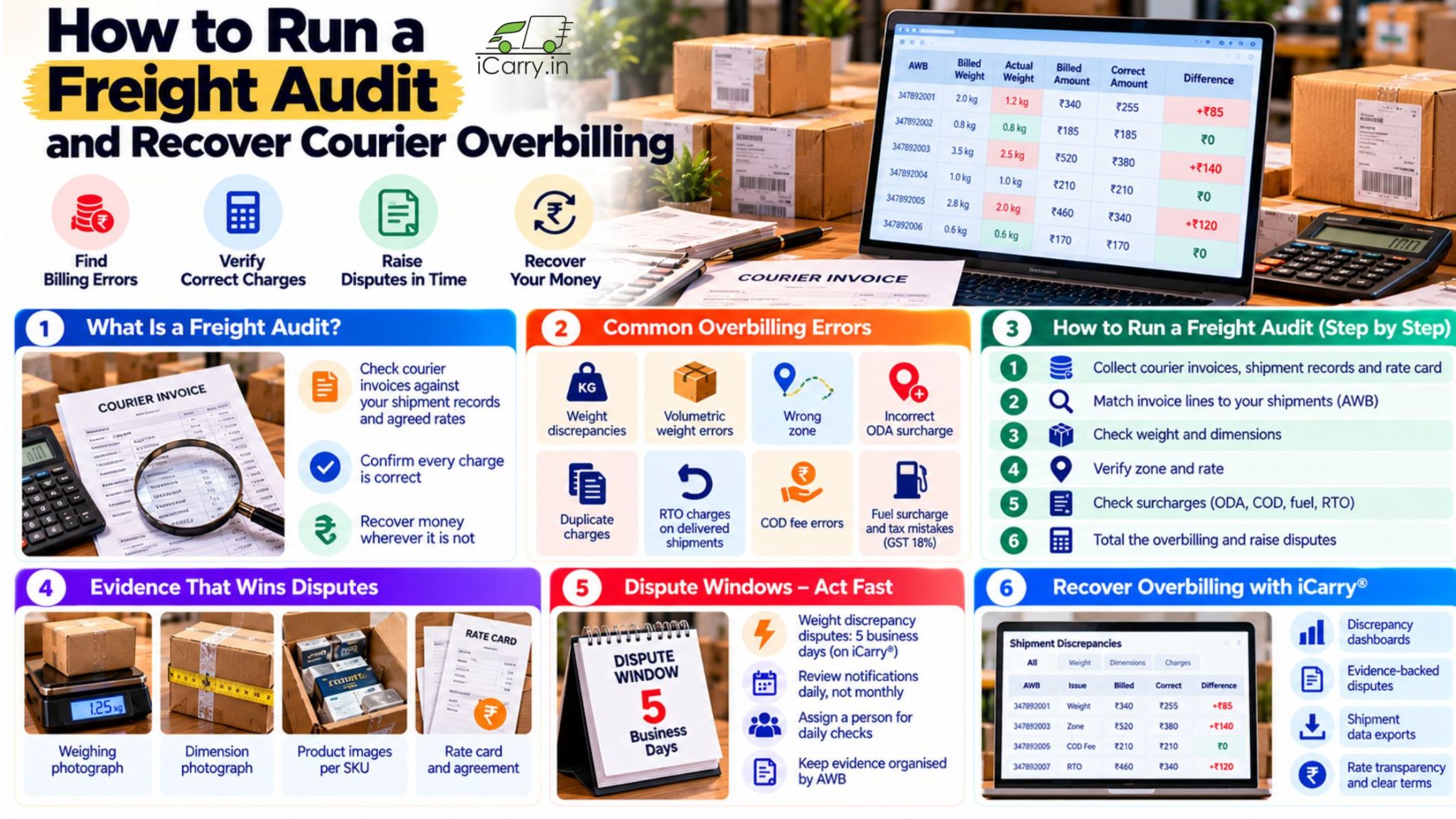
- Weight discrepancies: The courier re-weighs the parcel at the hub and records a higher weight than you declared, then bills the difference
- Volumetric weight errors: Dimensions are recorded larger than the actual box, or volumetric weight is applied when it should not be
- Wrong zone: The shipment is billed in a higher zone than the pickup and delivery pincodes justify
- Incorrect ODA surcharge: An out of delivery area surcharge is applied to a pincode that is not ODA for that courier
- Duplicate charges: The same AWB appears twice, or an RTO is billed twice
- RTO charges on delivered shipments: Return charges billed on a shipment that was actually delivered
- COD fee errors: COD handling fee applied to a prepaid shipment, or calculated on the wrong order value
- Fuel surcharge and tax mistakes: A surcharge percentage that does not match the agreed rate, or GST calculated incorrectly, since courier services are taxed at 18%
How to Run a Freight Audit - Step by Step
Step 1: Collect the Data
- Courier invoices for the period, ideally one month
- Your own shipment records: AWB, weight declared, dimensions, origin and destination pincodes, payment type, order value
- Your agreed rate card and surcharge terms
Step 2: Match Invoice Lines to Shipments
Match every AWB on the invoice against your own record. Flag any AWB that appears on the invoice but not in your records, and any that appears twice.
Step 3: Check Weight and Dimensions
Compare the weight billed against the weight you declared. For every line where billed weight is higher, check whether you have a weighing photograph and packed dimensions. These are your evidence for a dispute.
Step 4: Verify Zone and Rate
Confirm that the zone applied matches the origin and destination pincodes, and that the base rate matches your rate card for that zone and weight slab.
Step 5: Check Surcharges
- ODA: is the destination pincode actually ODA for that courier?
- COD: is the fee applied only on COD shipments and at the agreed rate?
- Fuel surcharge: does the percentage match the agreed rate? Rates move with fuel prices, which are revised daily, so check the date of any change
- RTO: was the shipment actually returned, and is the return charge correct?
Step 6: Total the Overbilling and Raise Disputes
Add up the incorrect charges and raise disputes with supporting evidence before the dispute window closes.
Not sure how to build your evidence? See how to raise a weight discrepancy dispute on iCarry® with images attached.
Dispute Windows - Act Fast
Every courier and platform has a limited time within which a billing dispute must be raised. On iCarry®, the weight discrepancy dispute window is 5 business days. Disputes raised after the window closes are usually rejected, even if the charge is wrong.
- Review weight discrepancy notifications daily, not monthly
- Assign one person to check and dispute charges every working day
- Keep evidence organised by AWB so a dispute takes minutes, not hours
Evidence That Wins Disputes
- Weighing photograph: The sealed parcel on the scale with the weight clearly visible
- Dimension photograph: A measuring tape against the packed box
- Pre-uploaded product images per SKU: Standard images that show product and packaging, supporting your declared weight and dimensions
- Rate card and agreement: To prove the correct rate and surcharge terms
- Tracking history: To prove delivery status when an RTO charge is wrongly applied
How Often to Audit
- Daily: Review weight discrepancy notifications and dispute within the window
- Weekly: Check RTO charges, duplicate AWBs and COD fee errors
- Monthly: Full invoice reconciliation against shipment records and rate card
- Quarterly: Review courier performance and error rates, and use the data to decide which courier partners should get more volume
Want to see where extra charges come from? Read our guide to hidden shipping charges, then set up a free iCarry® account to see rates before you book.
How iCarry® Helps With Freight Audits
iCarry® helps sellers manage shipments across multiple courier partners and review shipment-related charges, making it easier to identify discrepancies and follow up on potential overbilling.
- Weight Discrepancy Management: Review declared and billed weight differences, then raise disputes with supporting evidence within the applicable dispute window. Learn how to resolve weight discrepancies and prevent extra charges.
- Shipment Records and Exports: Download shipment data from the shipments dashboard to help reconcile your records against courier invoices.
- Pre-uploaded Product Images: Save images for standard SKUs to support weight discrepancy disputes with relevant product and packaging evidence.
- Rate Transparency: Check available courier rates before booking and compare them with subsequent shipment charges during your audit.
- Shipment Tracking and Management: Manage shipment details and review tracking information to help investigate billing issues, including discrepancies related to delivery or return status.
For a more accurate freight audit, review weight discrepancy notifications regularly, keep shipment evidence organised by AWB, and raise disputes within the applicable deadline.
Start with the free Bronze plan, with no minimum shipment volume.
Frequently Asked Questions (FAQs)
What is a freight audit in simple terms?
A freight audit is a check of your courier invoices against your own shipment records and agreed rates, to confirm every charge is correct and to recover money where it is not. It typically covers weight, zone, surcharges, COD fees and RTO charges.
What are the most common overbilling errors on Indian courier invoices?
The most common errors are weight discrepancies where the courier records a higher weight than declared, incorrect volumetric weight, wrong zone classification, ODA surcharges applied to pincodes that are not ODA, duplicate AWB charges, RTO charges on delivered shipments, and COD fees applied to prepaid orders.
How long do I have to dispute a weight discrepancy?
It depends on the courier and platform. On iCarry®, the weight discrepancy dispute window is 5 business days. Disputes raised after the window closes are usually rejected even when the charge is incorrect, so review notifications daily and raise disputes quickly.
What evidence do I need to win a billing dispute?
A photograph of the sealed parcel on the scale with weight visible, a photograph of the packed dimensions, standard product images, your rate card, and tracking history. Pre-uploading images for your standard SKUs means evidence is attached automatically when a discrepancy is raised.
How often should a business audit its courier invoices?
Review weight discrepancy notifications daily, check RTO, duplicate and COD fee errors weekly, and do a full invoice reconciliation monthly. A quarterly review of error rates by courier helps you decide where to send more volume.
A freight audit is a six-step habit, not a one-off project: collect your invoices, shipment records and rate card; match every AWB; check weight, dimensions, zone and surcharges; then total the overbilling and dispute it inside the window. On iCarry® that weight discrepancy window is 5 business days, so review notifications daily and keep weighing photographs and SKU images organised by AWB. Small recurring errors, such as 2 wrong ₹50 charges in every 100 shipments, are worth recovering.