A home baker in Pune makes artisan chocolate boxes. She sells 20 boxes a week through Instagram. Orders come from Bengaluru, Delhi, and Mumbai. She packs them in branded boxes, wraps them in bubble wrap, and hands them to a courier agent. Three days later, two customers report melted chocolate. One reports a broken box.
The product was good. The packaging was not designed for a Zone D transit journey through courier sorting centres in summer. And the FSSAI registration number was missing from the label - which her Flipkart listing flagged as non-compliant within the week.
India's home kitchen and artisan food sector is one of the most dynamic segments in the country's food economy. ONDC alone now has over 7.7 lakh registered sellers and service providers, with platforms like Instagram, WhatsApp storefronts, and ONDC giving home-based food entrepreneurs their first channel to customers beyond their immediate network. But shipping food - even lovingly made, high-quality food - requires specific knowledge that most home kitchen founders do not have when they start.
This guide covers FSSAI compliance for home kitchens, food-safe packaging for courier transit, courier selection for perishable and non-perishable food, and how to scale from local delivery to pan-India shipping. Compliance and packaging solve the product side; a platform like iCarry® handles the courier side, from your first 20-order week onward.
What Does Shipping Home Kitchen Food Involve?
Shipping home kitchen food in India means holding a valid FSSAI registration, printing a compliant label on every product, and packaging by category - airtight for dry goods, rigid and insulated for baked goods and chocolate, leak-proof for jars. Skipping any one of the three risks a delisting, a damaged order, or a food-safety complaint.
How to Prepare Your First Food Order for Shipping: Quick Checklist
- Do you have a valid FSSAI registration or licence for your home kitchen?
- Is your FSSAI registration number printed on every product label?
- Is the product label compliant - ingredient list, allergen declaration, best before date, net weight, MRP?
- Is your packaging food-safe - materials that do not leach chemicals into food?
- Have you tested your packaging for the transit conditions of your longest delivery route?
- For perishables: do you have adequate cold or insulated packaging for summer transit?
- Have you checked which courier partners accept food shipments for your product category?
FSSAI Registration for Home Kitchens - What You Need
The Food Safety and Standards Authority of India (FSSAI) regulates all food businesses in India, including home kitchens. Under FSSAI guidelines , any person or business engaged in the manufacture, processing, packaging, or sale of food products for commercial purposes requires a valid FSSAI registration or licence.
Home kitchens selling food online commercially - even 20 boxes per week - qualify as food businesses under FSSAI and must be registered.
Registration vs Licence: Which Do You Need?
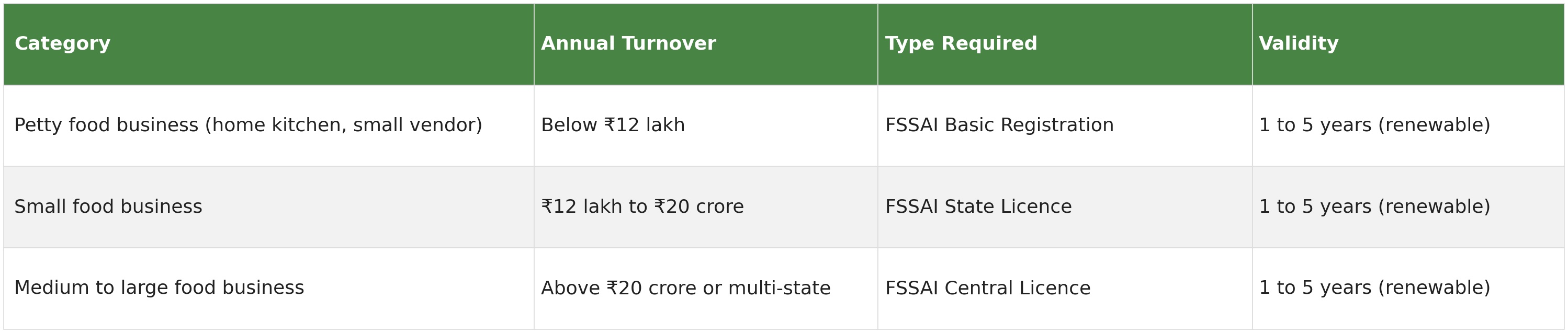
Most home kitchen founders start with FSSAI Basic Registration. As turnover grows past ₹12 lakh annually, upgrade to State Licence. The registration number from either document must appear on every product label.
How to Apply for FSSAI Basic Registration
- Step 1: Go to foscos.fssai.gov.in (FSSAI's online portal)
- Step 2: Select 'Apply for Registration' and choose your food business category
- Step 3: Fill in business details - address of manufacturing (your home kitchen address), products to be manufactured, and proprietor details
- Step 4: Upload required documents - identity proof, address proof, and a passport photo
- Step 5: Pay the registration fee (varies by state and duration, typically ₹100 per year)
- Step 6: Submit. Registration is typically issued within 7 to 30 days by the local food safety officer
Important: FSSAI registration uses your home address as the manufacturing address. If you move, you must update your registration. If you start manufacturing at a commercial kitchen or rented space, a new registration for that address is required.
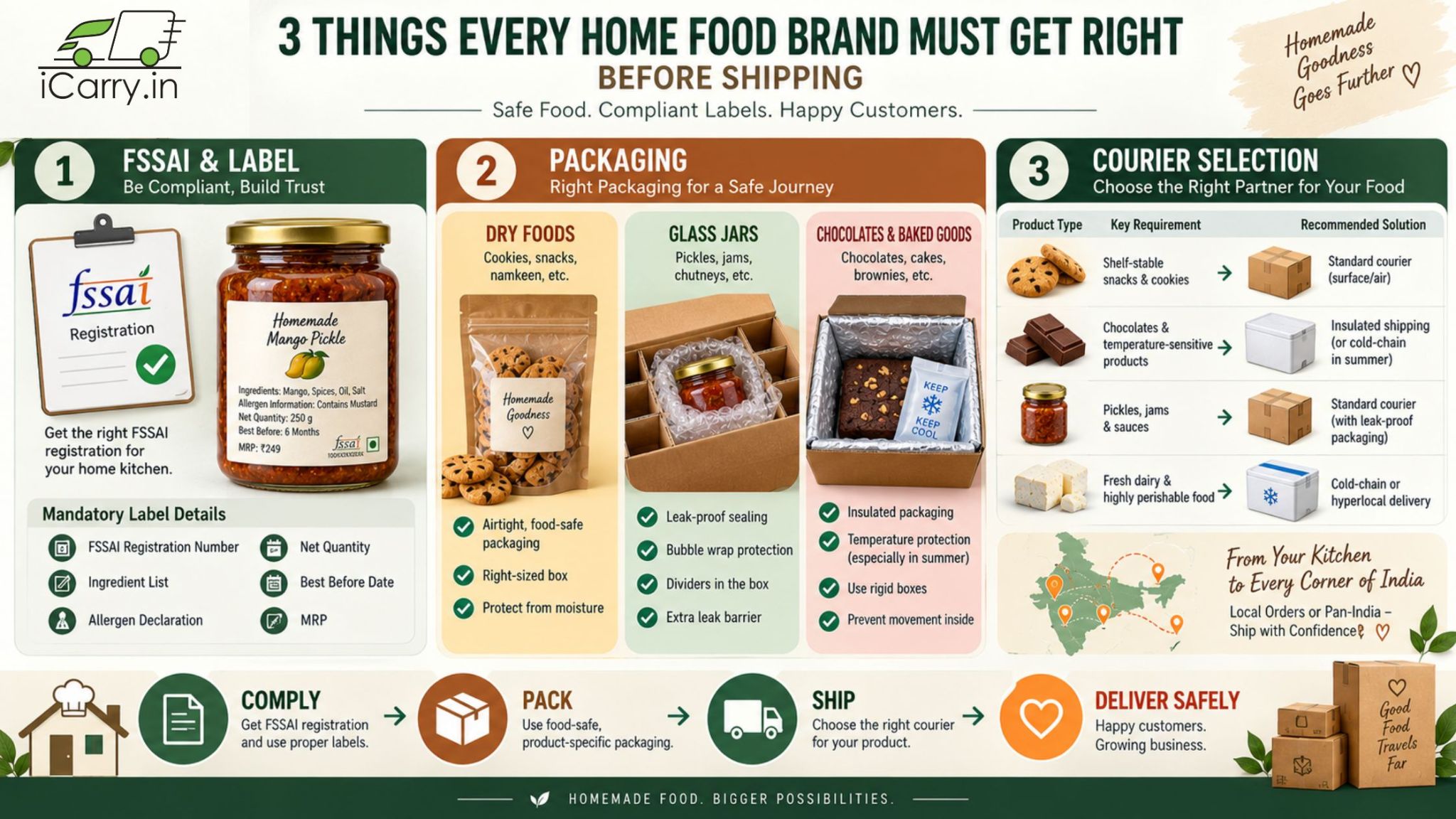
Mandatory Label Requirements for Home Kitchen Food Products
Every packaged food product sold commercially in India must carry specific information on its label. Missing fields are the most common reason for marketplace delisting and regulatory notices. Every label must include:
- FSSAI registration/licence number: 14-digit number, prominently displayed. This is the most commonly missing field on home kitchen labels
- Product name: Common and descriptive name of the food - 'Dark Chocolate Bark with Sea Salt', not just 'Chocolate'
- Ingredients list: All ingredients in descending order of weight. Includes every additive with INS number or name
- Allergen declaration: Must clearly state if the product contains or may contain any of the 8 major allergens: nuts, milk, eggs, wheat/gluten, soya, fish, shellfish, peanuts. Home kitchens that use shared equipment must declare 'May contain traces of [allergen]'
- Net quantity: Weight or volume in grams, ml, or piece count as applicable
- Best before / expiry date: In dd/mm/yyyy format. Never ship food within the last 30% of its shelf life
- Batch or lot number: For traceability. Can be a date-based code: batch 240815 for a product made on 15 August 2024
- Manufacturer name and address: Your name and home kitchen address as registered with FSSAI
- MRP inclusive of all taxes: Required for all pre-packaged products. Must be printed as 'MRP ₹[amount] incl. of all taxes'
- Storage instructions: 'Keep refrigerated', 'Store in a cool dry place', etc. - particularly important for home kitchen products with short shelf lives
Packaging Food for Courier Transit
Food packaging for courier delivery must solve two problems simultaneously: food safety (maintaining product integrity, preventing contamination) and transit protection (surviving 4 to 6 handling points across 3 to 6 days of courier movement).
Non-Perishable Dry Foods (Snacks, Cookies, Dry Mixes, Spices)
- Primary packaging: airtight seal - heat-sealed pouch, resealable zip, or airtight container with secure lid
- Moisture barrier: silica gel sachet inside if the product is moisture-sensitive
- Secondary packaging: corrugated box right-sized to the product. Void fill to prevent movement
- All seams taped. Label applied flat on the top face, not on a seam
- Test: fill a box with your product, seal it, shake vigorously. If anything inside shifts, add more void fill
Baked Goods (Cakes, Brownies, Cookies, Breads)
- Baked goods are fragile and pressure-sensitive. Never place other items on top of them in the box
- Individual pieces individually wrapped or separated by parchment paper
- A rigid cardboard base under layered items prevents crushing from below
- Corrugated box - never poly mailer for baked goods
- For cakes and delicate items: foam inserts or moulded cardboard that holds the product in a fixed position
- Summer consideration: chocolate and cream-filled items cannot survive Zone D transit in summer without insulated packaging
Pickles, Jams, Chutneys, Sauces (Liquids and Semi-Liquids)
- Glass jars: the jar lid must be sealed airtight. Apply additional food-grade shrink wrap or tape around the lid as secondary seal
- Each glass jar individually bubble-wrapped - never jar-to-jar contact
- Corrugated box with no void space - foam dividers or cardboard separators between jars
- Mark FRAGILE and KEEP UPRIGHT on all faces of the outer box
- For plastic containers: verify the plastic is food-safe grade and that lids are secured with food-safe tape
- Secondary containment: place each jar in a ziplock bag as a leak barrier before boxing
Temperature-Sensitive Products (Chocolates, Dairy, Fresh Products)
This is where most home kitchen shipping problems originate. Indian summer temperatures in courier vehicles and sorting centres regularly exceed 40°C. Chocolate melts at 30 to 32°C. Dairy products require refrigeration.
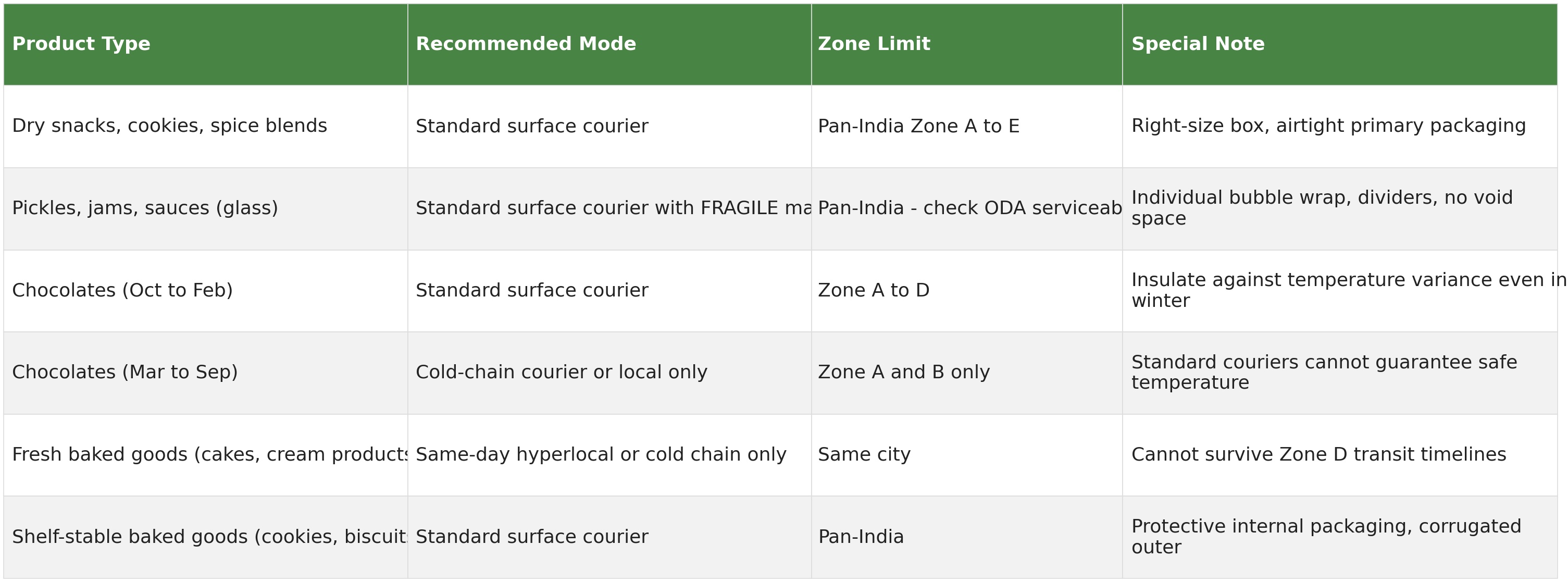
- For chocolates: Insulated packaging (thermocol-lined box or foam-insulated mailer) with gel ice packs for Zone A and Zone B deliveries. For Zone D, consider limiting chocolate shipments to October to February only or using certified cold-chain courier for premium orders
- For fresh dairy products: Cold chain courier or hyperlocal same-day delivery only. Standard courier networks cannot maintain safe dairy temperatures
- For products that can be room-temperature for 2 to 3 days but not 5 to 7: Limit to Zone A and Zone B dispatch only during summer. Set your shipping policy to reflect this honestly
Courier Selection for Home Kitchen Food Products
Scaling From Local to Pan-India: What Changes
Most home kitchen brands start with local delivery - a Swiggy Instamart listing, WhatsApp orders delivered by Rapido, or Instagram orders dispatched via same-city courier. Scaling to pan-India requires specific changes:
- Shelf life requirement increases: A product with 3-day shelf life can only go same-city. Zone D delivery takes 5 to 7 days. You need minimum 10 to 14 days shelf life to ship pan-India and have the product arrive with meaningful remaining shelf life
- Packaging durability requirement increases: Zone A orders survive 2 handling points. Zone D orders go through 5 to 6. Packaging tested for local delivery will fail on Zone D routes
- Temperature management requirement increases: A Zone A delivery completes in hours. Zone D delivery spans multiple days in varying temperature environments. Temperature-sensitive products need active insulation for Zone D
- Labelling requirement becomes non-negotiable: A marketplace listing without a compliant FSSAI label is delisted. A direct pan-India sale from Instagram to a customer in Delhi puts your product under the consumer protection framework for that state. Labelling compliance is no longer optional at pan-India scale
How iCarry® Supports Home Kitchen and Food Brands
iCarry® is a courier aggregator that serves Indian businesses of all sizes - including home-based food brands shipping their first 20 orders a week and growing kitchen brands processing hundreds of daily orders:
- Free Bronze plan: No monthly fee, no minimum volume. A home baker shipping 15 orders a week pays the same per-kg rates as a brand shipping 500
- Multiple courier partners: Route dry goods via the most cost-effective surface courier. Route glass jar products via couriers with better fragile handling track records. Compare rates before every booking
- Address Quality Scoring: Flags incomplete customer addresses before dispatch - particularly important for food products where a failed delivery means a perishable returned
- Two-way WhatsApp engagement: For food products with tight delivery windows, customers can confirm their availability and reschedule if needed - reducing the failed first attempts that result in returned perishables
- Delivery Boost: For premium food gift sets and high-value food orders, Delivery Boost ensures pre-delivery coordination - particularly valuable for time-sensitive food gifting orders
- Declared value coverage: For high-value artisan food products (premium chocolate boxes, specialty hampers), enable declared value coverage to protect against loss or damage in transit
- Free Bronze plan, no minimum volume.
Final Thoughts
Home kitchen and artisan food businesses in India are building some of the most authentic and valued products in the food market. The challenge is not the product - it is the compliance and logistics infrastructure that allows that product to reach customers across India safely and consistently.
FSSAI registration is not optional and not complex. A basic registration for a home kitchen takes one afternoon and costs under ₹500 per year. The labelling requirements are specific but learnable. The packaging changes that make a product safe for Zone D courier transit are finite and implementable.
Get the compliance right first. Then build the packaging for your longest delivery route. Then choose couriers based on your product type and zone range. The brands that do this work build the logistics foundation that allows a 20-order-a-week home kitchen to become a 500-order-a-day food brand.
Frequently Asked Questions (FAQs)
Does a home kitchen selling food online in India need FSSAI registration?
Yes. Any person or business selling food commercially in India requires FSSAI registration or licence, including home kitchens selling through Instagram, WhatsApp, or online marketplaces. Home kitchens with annual turnover below ₹12 lakh qualify for FSSAI Basic Registration, which can be applied for online at foscos.fssai.gov.in . The FSSAI registration number must appear on every product label.
What allergen information must be on home kitchen food labels?
Labels must declare if the product contains any of the 8 major allergens: nuts, milk, eggs, wheat/gluten, soya, fish, shellfish, and peanuts. Home kitchens that prepare multiple products using shared equipment must also declare 'May contain traces of [allergen]' even if the allergen is not an ingredient. Failure to declare allergens is a serious regulatory and consumer safety issue.
Can I ship chocolate pan-India from my home kitchen?
During October to February, yes - with insulated packaging and gel ice packs for Zone D deliveries. During March to September, chocolate shipments should be limited to Zone A and Zone B (same or adjacent state) because standard courier vehicles and sorting centres regularly exceed chocolate's melting point of 30 to 32°C. Cold-chain courier is the only safe option for summer Zone D chocolate delivery.
What packaging should I use for glass pickle jars in courier transit?
Each glass jar is individually bubble-wrapped with no jar-to-jar contact. Corrugated outer box with foam dividers or cardboard separators. Place each jar in a ziplock bag before boxing as a secondary leak barrier. Mark FRAGILE and KEEP UPRIGHT on all four sides and the top of the outer box. No void space inside the box - fill completely to prevent jar movement.
When should a home kitchen switch from local delivery to courier?
When orders start coming from beyond same-city delivery range, or when order volume exceeds what personal delivery can handle consistently. Before switching to courier, verify your product's shelf life is sufficient for Zone D transit (10 to 14 days minimum), your packaging is designed for 5 to 6 handling points, your labels are FSSAI compliant, and your product can survive Zone D temperature conditions.
How do I set up shipping for my home kitchen brand on iCarry®?
Register at iCarry.in for free, with no minimum shipment volume. Add your home kitchen address as the pickup address, complete KYC, and add your bank account details for COD remittance. Book your first shipment by entering the customer's address, parcel weight and dimensions, then compare available courier options and select the most suitable one. Print the shipping label from the dashboard and attach it securely to your parcel. A courier agent will then collect the shipment from your registered pickup address.
Home kitchen and artisan food businesses in India are building some of the most authentic and valued products in the food market - the challenge is not the product, it is the compliance and logistics infrastructure that allows that product to reach customers across India safely and consistently. Get the compliance right first, then build the packaging for your longest delivery route, then choose couriers based on your product type and zone range - the brands that do this work build the logistics foundation that allows a 20-order-a-week home kitchen to become a 500-order-a-day food brand.